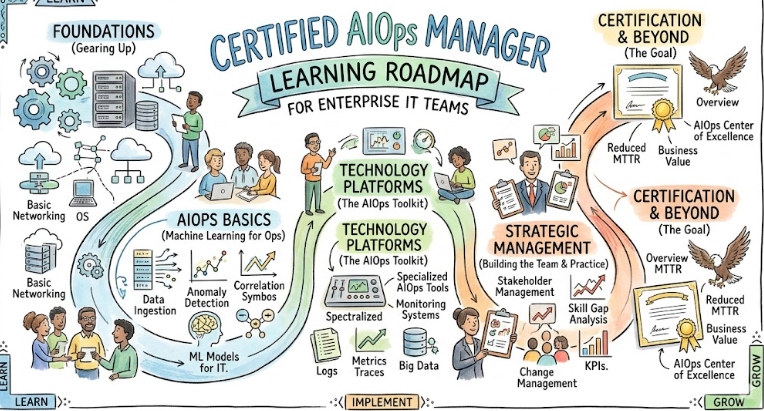
Introduction
The evolution of IT operations is observed to be moving toward a state where human intervention is supplemented by machine intelligence. For many years, system stability was managed through manual oversight and reactive fixes. However, the volume of data generated by modern applications is now seen as being too large for traditional methods. To address this, the concept of Artificial Intelligence for IT Operations (AIOps) has been introduced. A professional path is provided by the Certified AIOps Manager program for those who wish to lead this transformation. This guide is prepared to help engineers and managers understand the importance of this specialized role and the steps required to achieve mastery.
What is Certified AIOps Manager
A Certified AIOps Manager is defined as a professional who oversees the integration of artificial intelligence and machine learning into IT operational workflows. This role is focused on the strategic application of AI to automate problem identification, root cause analysis, and incident response. It is not merely about understanding algorithms; it is about managing the entire ecosystem where data, technology, and people meet. The manager is expected to bridge the gap between technical data science teams and traditional operations staff. By achieving this certification, a leader is validated as being capable of reducing operational noise and improving system uptime through intelligent automation.
Why it matters today?
The complexity of modern distributed systems is found to be increasing at an exponential rate. Traditional monitoring tools are often observed to produce thousands of alerts, many of which are redundant or irrelevant. This “alert fatigue” is known to cause significant delays in identifying real issues. Furthermore, the speed at which business is conducted requires that systems be self-healing and predictive rather than just reactive. A shift is required from manual troubleshooting to automated insights. Without a skilled manager to guide these AI initiatives, organizations are often seen struggling with poorly implemented tools that do not provide clear value.
Why Certified AIOps Manager certifications are important
A formal certification is viewed as a vital credential for anyone looking to advance in high-level operations management. It serves as proof that the candidate has mastered the specific methodologies required to handle large-scale AI implementations. For the individual, it provides a clear competitive advantage in a crowded job market. For the organization, it ensures that best practices are followed and that the risk of failed automation projects is minimized. Confidence is built within the team when a certified leader is at the helm, as the path toward digital transformation is clearly defined and managed.
Why Choose AIOps School?
The decision to study at AIOps School is often made because of the institution’s deep focus on the intersection of AI and IT operations. Unlike general technology schools, this institution provides a curriculum that is specifically tailored to the needs of modern managers. Practical, hands-on labs are provided so that theoretical knowledge is immediately applied to real-world scenarios. The mentors are recognized as being among the best in the industry, offering insights that are gathered from years of practical experience. A supportive community is also maintained, ensuring that learners have access to resources and networking opportunities that last throughout their careers.
Certification Deep-Dive
What is this certification?
This is a management-level credential that focuses on the governance and strategic implementation of AI in IT operations. It is designed to validate the ability to lead AIOps teams and manage complex automated environments.
Who should take this certification?
This program is intended for Engineering Managers, Senior DevOps Engineers, and SRE leads who are responsible for large-scale infrastructure. It is also suitable for IT architects who wish to move into leadership roles focused on intelligent automation.
Certification Overview Table
| Track | Level | Who it’s for | Prerequisites | Skills Covered | Recommended Order |
| AIOps/MLOps | Manager | Engineering Leads | DevOps Foundation | AI Strategy, Data Ops | 1 |
| SRE | Advanced | Platform Leads | Monitoring Basics | Error Budgets, SLIs | 2 |
| DevOps | Professional | Software Engineers | Coding Knowledge | CI/CD, Automation | 3 |
| DevSecOps | Specialist | Security Leads | Security Basics | Threat Detection | 4 |
| DataOps | Specialist | Data Architects | SQL / Data Flow | Pipeline Management | 5 |
| FinOps | Management | Financial Leads | Cloud Costing | Budget Optimization | 6 |
Skills you will gain
- The ability to design a roadmap for AI integration in IT operations is developed.
- Knowledge of data collection and normalization for AI models is acquired.
- Expertise in reducing operational noise through algorithmic filtering is gained.
- The management of cross-functional teams between data science and ops is mastered.
- Strategies for predictive maintenance and proactive incident response are implemented.
- A deep understanding of the ethical and practical challenges of AI automation is achieved.
Real-world projects you should be able to do after this certification
- A noise-reduction strategy for a global monitoring system is implemented.
- An automated root cause analysis workflow using AI tools is designed.
- A predictive scaling model for a high-traffic cloud application is deployed.
- A centralized dashboard for tracking AI-driven operational efficiency is built.
- A governance framework for the ethical use of AI in infrastructure is created.
Preparation Plan
7–14 Days Plan
The core modules of the AIOps framework are reviewed daily. Focus is placed on understanding the different types of AI models used in operations. Practice questions are solved to become familiar with the exam format.
30 Days Plan
One hour of study is combined with one hour of practical lab work each day. Real-world case studies are analyzed to understand how AI is applied in different industries. Collaborative discussions with peers are held to clarify complex topics.
60 Days Plan
A comprehensive deep dive into every section of the curriculum is conducted. Several end-to-end AIOps projects are built from scratch. Mock exams are taken weekly to track progress and ensure total readiness.
Common mistakes to avoid
- Over-reliance on the tools without understanding the underlying data strategy is often seen.
- The cultural aspect of moving a team toward AI adoption is sometimes ignored.
- Attempting to automate everything at once without a phased approach is discouraged.
- The importance of data quality is frequently underestimated by learners.
Best next certification after this
- Same track: Certified MLOps Engineer.
- Cross-track: Site Reliability Engineering (SRE) Foundation.
- Leadership / management: Digital Transformation Leader.
Choose Your Learning Path
DevOps Path
This path is chosen by those who want to master the basics of automation and delivery. It is best for software engineers who wish to understand the full lifecycle of an application from code to production.
DevSecOps Path
This track is recommended for security-minded professionals. It is best for those who want to ensure that security is integrated into every step of the automated deployment process.
Site Reliability Engineering (SRE) Path
This is a path focused on the health and scalability of systems. It is best for engineers who are tasked with maintaining the highest levels of uptime for critical business services.
AIOps / MLOps Path
This is the most specialized path for those working with intelligence. It is best for professionals who want to lead the next generation of automated and predictive IT environments.
DataOps Path
This path is designed for data-focused engineers. It is best for those who manage the flow of information and want to apply operational excellence to data pipelines.
FinOps Path
This track is selected by those interested in the economics of technology. It is best for managers who need to control cloud costs and ensure financial accountability across engineering teams.
Role → Recommended Certifications Mapping
| Role | Primary Recommendation | Secondary Recommendation |
| DevOps Engineer | DevOps Master | AIOps Foundation |
| Site Reliability Engineer | SRE Professional | Cloud Architect |
| Platform Engineer | Certified AIOps Manager | Kubernetes Specialist |
| Cloud Engineer | Cloud Pro (AWS/Azure) | FinOps Certified |
| Security Engineer | DevSecOps Specialist | Security Architect |
| Data Engineer | DataOps Professional | MLOps Specialist |
| FinOps Practitioner | FinOps Certified | Business Analyst |
| Engineering Manager | Certified AIOps Manager | DevOps Leader |
Next Certifications to Take
Same-Track Certification
Advanced training in machine learning operations is recommended for those who have completed the manager level. This allows for a deeper understanding of the technical side of AI model management.
Cross-Track Certification
A certification in Site Reliability Engineering is highly suggested to complement AIOps skills. The combination of reliability principles and AI insights creates a very powerful professional profile.
Leadership-Focused Certification
The DevOps Leader (DOL) certification is recommended for those looking to influence organizational culture. It provides the soft skills needed to manage the human side of technical transitions.
Training & Certification Support Institutions
DevOpsSchool
This institution is recognized for providing high-quality training across a wide range of engineering disciplines. It is often the first choice for professionals looking to build a strong foundation in modern operations.
Cotocus
Specialized consulting and training are provided by this group to help organizations modernize their infrastructure. A focus is maintained on helping teams adopt the latest cloud-native technologies effectively.
ScmGalaxy
A massive repository of tutorials and resources is offered by this platform for the engineering community. It is a valuable place for finding technical answers and staying updated on industry trends.
BestDevOps
Curated learning paths for top-tier certifications are provided here. It is designed to help professionals pass their exams on the first attempt through focused and practical study materials.
devsecopsschool.com
This school is dedicated entirely to the fusion of security and operations. It provides the deep technical knowledge required to protect automated pipelines from modern threats.
sreschool.com
The principles of system reliability and observability are taught at this specialized institution. It is highly recommended for those who are responsible for the uptime of large-scale systems.
aiopsschool.com
This is the premier institution for learning about the application of AI in IT operations. The Certified AIOps Manager program is one of its flagship offerings for aspiring leaders.
dataopsschool.com
The management of data pipelines and the automation of data workflows are focused on here. It is an essential resource for data engineers moving into operational roles.
finopsschool.com
Cloud cost management and financial optimization are the primary subjects taught here. It helps technology leaders align their cloud spending with actual business value.
FAQs Section
1. What is the difficulty level of the Certified AIOps Manager exam?
The level is considered intermediate to advanced, as it requires a strong understanding of both management and technical concepts.
2. How much time is required to prepare for this certification?
A period of four to eight weeks is typically required for a professional to feel fully prepared for the assessment.
3. Are there any specific prerequisites for this program?
A basic understanding of IT operations and some experience in a lead or managerial role is generally expected.
4. In what sequence should these certifications be taken?
It is often advised to complete a foundational DevOps or SRE course before attempting the AIOps Manager level.
5. What is the career value of being a Certified AIOps Manager?
A significant increase in career opportunities and the ability to lead high-budget automation projects is often observed.
6. What job roles can be applied for after achieving this certification?
Roles such as AIOps Lead, Engineering Manager, and Operations Architect become much more accessible to the candidate.
7. Is the certification exam available globally?
Yes, the assessment is delivered through an online platform that can be accessed from India and other global locations.
8. How long does the certification remain valid?
The credential is valid for two years, after which a renewal or continuing education is required to maintain the status.
9. Is the training conducted through live sessions or recorded videos?
A mix of live instructor-led sessions and self-paced recorded content is usually provided to learners.
10. Are there lab environments provided for practice?
Hands-on cloud-based lab environments are provided so that students can practice with real AI and monitoring tools.
11. What is the passing score required for the certification?
A minimum score of 70% is generally required to pass the final assessment and receive the certificate.
12. Is job assistance provided after completion?
Resume building and interview preparation are often included as part of the support services offered by the institution.
Additional 8 FAQs specifically focused on Certified AIOps Manager
1. What makes the Certified AIOps Manager program unique?
The focus is placed specifically on the leadership and strategic aspects of AI in operations rather than just the tools.
2. Can an Engineering Manager without coding skills take this?
Yes, while technical knowledge is helpful, the program is designed to be accessible to managers who focus on strategy and governance.
3. Is there a focus on specific AI tools like TensorFlow?
The principles are taught in a tool-agnostic way, though popular industry tools are used for practical demonstrations in the labs.
4. Are real-world case studies included in the curriculum?
Case studies from major technology companies are analyzed to show how AIOps has improved their operational efficiency.
5. Is the certificate recognized by international employers?
The certification is respected by global organizations that are looking for leaders to drive their digital transformation initiatives.
6. How is the final exam structured?
The exam typically consists of multiple-choice questions that test both theoretical knowledge and situational decision-making.
7. Is there a community for certified managers?
An exclusive alumni group is maintained where certified professionals can share insights and job opportunities.
8. How often is the AIOps curriculum updated?
The course content is reviewed every few months to ensure that the latest advancements in AI and ML are included.
Testimonials
Arjun
A very clear understanding of how to lead an AI transformation was gained through this course. The transition from reactive to proactive operations was managed much more effectively after the training.
Priya
The skill improvement seen in my daily work was immediate. The ability to filter out monitoring noise has allowed my team to focus on the issues that truly matter for the business.
Rahul
Career clarity was the most significant outcome for me. The path to becoming a senior engineering leader became much more defined after completing this management-focused certification.
Sneha
Confidence growth was observed during my interactions with senior stakeholders. The knowledge gained allowed for more strategic conversations regarding the future of our automated infrastructure.
Vikram
Real-world application is the core of this program. The projects completed during the course were very similar to the challenges faced in my current professional role.
Conclusion
The importance of the Certified AIOps Manager credential is seen as being critical for the future of IT leadership. It provides the skills needed to manage the next wave of intelligent automation in a structured and strategic way. Long-term career benefits include the ability to stay relevant in a rapidly changing field and the opportunity to lead high-impact teams. Strategic learning and careful certification planning are encouraged for anyone who wishes to excel. By choosing the right path today, a successful and stable career is built for the years to come.