Introduction
Nutrition Practice Management Tools are specialized software platforms designed to help dietitians, nutritionists, and wellness professionals manage their practices efficiently. These tools combine client management, meal planning, scheduling, billing, and communication into a single system, reducing administrative workload and improving client outcomes.
In today’s health and wellness industry, these platforms are essential due to growing demand for personalized nutrition, remote consultations, and data-driven health insights. Modern tools now integrate AI-powered meal planning, telehealth, client engagement apps, and strong cybersecurity controls, making them far more than simple diet tracking tools.
Common use cases include:
- Creating personalized meal and diet plans
- Managing client records and progress tracking
- Scheduling consultations and follow-ups
- Billing and payment processing
- Remote coaching and telehealth sessions
Key evaluation criteria:
- Meal planning and nutrition analysis capabilities
- Client management and progress tracking
- Scheduling and automation features
- Integration with apps and devices
- Security and compliance (HIPAA/GDPR)
- Ease of use and onboarding
- Scalability for solo to enterprise practices
- Reporting and analytics
Best for: Dietitians, nutritionists, wellness coaches, fitness professionals, and telehealth nutrition services.
Not ideal for: General healthcare practices without nutrition-focused workflows or professionals who only need simple tracking apps.
Key Trends in Nutrition Practice Management Tools
- AI-powered meal planning: Automated diet plans based on client goals and data
- Client engagement apps: Real-time messaging, food logging, and progress tracking
- Telehealth integration: Virtual consultations becoming standard
- Cloud-first platforms: Remote access and reduced infrastructure needs
- Behavioral coaching tools: Habit tracking and client accountability features
- Data-driven nutrition insights: Advanced analytics for better outcomes
- Automation of admin tasks: Scheduling, reminders, and billing
- Wearable integration: Sync with fitness and health devices
- Compliance-first design: GDPR, HIPAA-ready systems
- All-in-one platforms: Combining CRM, EMR, and nutrition tools
How We Evaluated Nutrition Practice Management Tools (Methodology)
- Assessed market adoption and professional usage
- Evaluated meal planning and nutrition analysis depth
- Reviewed client management and workflow features
- Analyzed security and compliance capabilities
- Measured performance and scalability
- Compared AI and automation features
- Evaluated ease of use for practitioners
- Considered integration ecosystem strength
- Reviewed support and onboarding quality
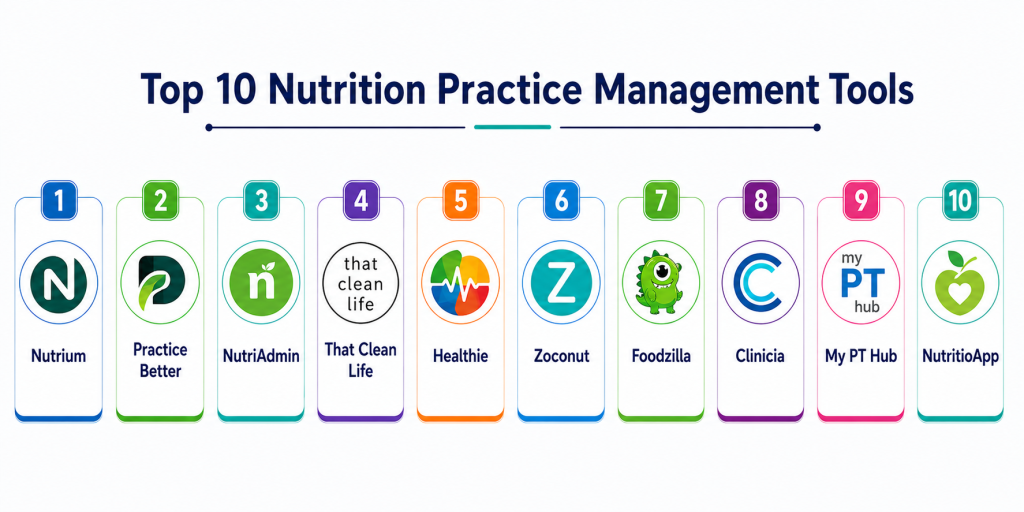
Top 10 Nutrition Practice Management Tools
#1 — Nutrium
Short description: Nutrium is a comprehensive nutrition platform used by professionals worldwide. It combines meal planning, client management, and communication tools into one system. The platform includes a client mobile app for real-time engagement. It supports appointment scheduling and automated reminders. Known for its scalability and global adoption. Suitable for both solo practitioners and large practices.
Key Features
- Nutrition analysis and meal planning
- Client mobile app
- Appointment scheduling
- Secure messaging
- Progress tracking
- Automated reminders
Pros
- All-in-one platform
- Strong client engagement tools
Cons
- Subscription pricing
- Learning curve for advanced features
Platforms / Deployment
Web / iOS / Android
Cloud
Security & Compliance
Encryption, GDPR compliance
Integrations & Ecosystem
Nutrium integrates with health apps and practice tools.
- Mobile apps
- APIs
- Health platforms
Support & Community
Strong global support and active user base.
#2 — Practice Better
Short description: Practice Better is a leading practice management platform for health professionals, including nutritionists. It combines CRM, scheduling, billing, and nutrition tools. The platform supports telehealth and client communication. Known for its flexibility and automation capabilities. Suitable for growing practices.
Key Features
- Client management
- Meal planning tools
- Telehealth sessions
- Scheduling and billing
- Progress tracking
- Automation workflows
Pros
- Flexible and scalable
- Strong automation
Cons
- Pricing tiers can increase
- Requires setup time
Platforms / Deployment
Web / Mobile
Cloud
Security & Compliance
Encryption, HIPAA-ready
Integrations & Ecosystem
Integrates with wellness and business tools.
- Payment systems
- APIs
- Health apps
Support & Community
Strong documentation and onboarding.
#3 — NutriAdmin
Short description: NutriAdmin is an all-in-one nutrition software designed to streamline client management and meal planning. It offers customizable EHR, billing, and scheduling tools. Known for automation and ease of use. Suitable for solo practitioners and small clinics.
Key Features
- Meal planning and recipes
- Client records (EHR)
- Scheduling and payments
- Reporting tools
- Client portal
- Automation
Pros
- Easy to use
- Comprehensive features
Cons
- Limited enterprise features
- UI could improve
Platforms / Deployment
Web
Cloud
Security & Compliance
Encryption
Not publicly stated certifications
Integrations & Ecosystem
Supports integrations with nutrition tools.
- APIs
- Payment systems
Support & Community
Good support and user base.
#4 — That Clean Life
Short description: That Clean Life focuses on meal planning and client engagement. It allows practitioners to create professional meal plans quickly. Known for simplicity and design. Suitable for nutrition-focused practices.
Key Features
- Drag-and-drop meal planning
- Recipe library
- Grocery list automation
- Client-friendly plans
- Branding tools
Pros
- Easy meal planning
- Professional output
Cons
- Limited full practice management
- Requires integration with other tools
Platforms / Deployment
Web
Cloud
Security & Compliance
Varies / N/A
Integrations & Ecosystem
Integrates with practice management tools.
- Practice Better
- APIs
Support & Community
Moderate support.
#5 — Healthie
Short description: Healthie is a healthcare-focused platform offering EHR and practice management tools. It supports nutritionists with scheduling, billing, and client engagement. Known for scalability and compliance.
Key Features
- EHR and client management
- Scheduling and billing
- Telehealth
- Workflow automation
- Reporting
Pros
- Healthcare-grade platform
- Strong compliance features
Cons
- Complex setup
- Higher cost
Platforms / Deployment
Web
Cloud
Security & Compliance
HIPAA-compliant, encryption
Integrations & Ecosystem
Strong healthcare integrations.
- EHR systems
- APIs
Support & Community
Enterprise-level support.
#6 — Zoconut
Short description: Zoconut is a nutrition software designed for dietitians and coaches. It offers meal planning, progress tracking, and client engagement tools. Known for automation and usability.
Key Features
- Meal planning
- Client tracking
- Progress monitoring
- Reporting
- Automation
Pros
- Efficient workflows
- Good client tracking
Cons
- Limited enterprise capabilities
- Smaller ecosystem
Platforms / Deployment
Web / Mobile
Cloud
Security & Compliance
Encryption
Not publicly stated certifications
Integrations & Ecosystem
Supports API-based integrations.
Support & Community
Growing support base.
#7 — Foodzilla
Short description: Foodzilla is a powerful nutrition planning tool that enables fast creation of personalized meal plans. It is widely used by nutrition professionals. Known for efficiency and customization.
Key Features
- Meal plan creation
- Recipe management
- Client tracking
- Reporting
- Automation
Pros
- Fast meal planning
- Highly customizable
Cons
- Limited full CRM features
- Requires integrations
Platforms / Deployment
Web
Cloud
Security & Compliance
Varies / N/A
Integrations & Ecosystem
Supports integrations with coaching tools.
Support & Community
Moderate support.
#8 — Clinicia
Short description: Clinicia is a healthcare practice management platform tailored for nutritionists. It supports diet planning, appointment management, and progress tracking. Known for clinical focus.
Key Features
- Diet planning
- Client records
- Appointment management
- Progress tracking
- Communication tools
Pros
- Healthcare-focused
- Easy workflow management
Cons
- Limited global adoption
- Moderate features
Platforms / Deployment
Web
Cloud
Security & Compliance
Encryption
Supports compliance frameworks
Integrations & Ecosystem
Integrates with healthcare systems.
Support & Community
Moderate support.
#9 — My PT Hub
Short description: My PT Hub is a fitness and nutrition platform used by coaches and nutritionists. It combines workout and nutrition planning with client management. Known for scalability.
Key Features
- Nutrition planning
- Client management
- Habit tracking
- Messaging
- Payments
Pros
- Scalable platform
- Strong engagement tools
Cons
- Fitness-focused
- Less clinical depth
Platforms / Deployment
Web / Mobile
Cloud
Security & Compliance
Encryption
Not publicly stated certifications
Integrations & Ecosystem
Supports integrations with fitness tools.
Support & Community
Large user base.
#10 — NutritioApp
Short description: NutritioApp is a CRM-style nutrition platform designed for coaches and dietitians. It offers automation, client tracking, and communication tools. Known for scalability and automation.
Key Features
- Client CRM
- Automated coaching programs
- Scheduling
- Messaging
- Payment management
Pros
- Strong automation
- Scalable
Cons
- Newer platform
- Limited ecosystem
Platforms / Deployment
Web
Cloud
Security & Compliance
Encryption, HIPAA-ready
Integrations & Ecosystem
Supports API integrations and automation tools.
Support & Community
Growing support ecosystem.
Comparison Table
| Tool Name | Best For | Platform(s) Supported | Deployment | Standout Feature | Public Rating |
|---|---|---|---|---|---|
| Nutrium | Global professionals | Web, Mobile | Cloud | All-in-one nutrition platform | N/A |
| Practice Better | Growing practices | Web, Mobile | Cloud | Automation + CRM | N/A |
| NutriAdmin | Solo practitioners | Web | Cloud | Client management | N/A |
| That Clean Life | Meal planning | Web | Cloud | Recipe planning | N/A |
| Healthie | Healthcare orgs | Web | Cloud | EHR integration | N/A |
| Zoconut | Coaches | Web, Mobile | Cloud | Automation | N/A |
| Foodzilla | Meal planning | Web | Cloud | Fast plan creation | N/A |
| Clinicia | Clinical nutrition | Web | Cloud | Patient tracking | N/A |
| My PT Hub | Fitness + nutrition | Web, Mobile | Cloud | Engagement tools | N/A |
| NutritioApp | Coaching CRM | Web | Cloud | Automation workflows | N/A |
Evaluation & Scoring of Nutrition Practice Management Tools
| Tool Name | Core (25%) | Ease (15%) | Integrations (15%) | Security (10%) | Performance (10%) | Support (10%) | Value (15%) | Weighted Total |
|---|---|---|---|---|---|---|---|---|
| Nutrium | 9 | 8 | 9 | 9 | 9 | 8 | 8 | 8.7 |
| Practice Better | 9 | 8 | 9 | 9 | 8 | 8 | 8 | 8.6 |
| NutriAdmin | 8 | 8 | 8 | 8 | 8 | 7 | 9 | 8.2 |
| That Clean Life | 7 | 9 | 7 | 7 | 8 | 7 | 8 | 7.7 |
| Healthie | 9 | 7 | 9 | 9 | 9 | 8 | 7 | 8.5 |
| Zoconut | 8 | 8 | 7 | 8 | 8 | 7 | 8 | 8.0 |
| Foodzilla | 8 | 8 | 7 | 7 | 8 | 7 | 8 | 7.9 |
| Clinicia | 7 | 8 | 7 | 8 | 7 | 7 | 8 | 7.6 |
| My PT Hub | 8 | 8 | 8 | 7 | 8 | 7 | 8 | 7.9 |
| NutritioApp | 8 | 8 | 8 | 8 | 8 | 7 | 8 | 8.0 |
How to interpret scores:
- Higher scores indicate stronger overall capability
- Enterprise platforms excel in integrations and security
- Meal-planning tools score high on ease of use
- Choose based on workflow fit rather than total score
Which Nutrition Practice Management Tool Is Right for You?
Solo / Freelancer
NutriAdmin or That Clean Life for simplicity and affordability
SMB
Nutrium, Practice Better, or Zoconut for balanced features
Mid-Market
Healthie and Practice Better for scalability and integrations
Enterprise
Healthie and Nutrium for advanced workflows and compliance
Budget vs Premium
Budget: NutriAdmin, Clinicia
Premium: Nutrium, Healthie
Feature Depth vs Ease of Use
Feature-rich: Healthie, Practice Better
User-friendly: Nutrium, That Clean Life
Integrations & Scalability
Best: Nutrium, Practice Better
Moderate: Zoconut, Clinicia
Security & Compliance Needs
High compliance: Healthie, Nutrium
Moderate: SMB tools
Frequently Asked Questions (FAQs)
1. What are nutrition practice management tools?
These are software platforms designed to help nutritionists manage clients, create meal plans, schedule appointments, and track progress. They centralize workflows in one system. They reduce manual tasks. They improve efficiency. They enhance client outcomes.
2. What features should nutrition software include?
Key features include meal planning, client tracking, scheduling, billing, and communication tools. Integration with apps and devices is important. Automation improves efficiency. Analytics provide insights. These features streamline practice operations.
3. Is nutrition software secure?
Most platforms include encryption and access control. Many support GDPR or HIPAA compliance. Security depends on configuration. Cloud systems provide regular updates. Data protection is critical for client trust.
4. How much does nutrition software cost?
Costs vary based on features and users. Most tools use subscription pricing. Entry-level plans are affordable. Advanced features increase cost. Evaluate ROI and scalability.
5. Can these tools support telehealth?
Yes, many platforms include telehealth features. They allow remote consultations and communication. Integration with scheduling and billing improves efficiency. Telehealth is now a standard feature.
6. What are the benefits of using these tools?
They improve efficiency, reduce errors, and enhance client engagement. They automate scheduling and billing. They centralize data. They allow professionals to focus on clients. They improve outcomes.
7. How long does implementation take?
Cloud-based tools can be set up in days. More complex systems may take weeks. Training is required. Data migration may add time. Planning ensures smooth adoption.
8. Is cloud nutrition software better?
Cloud software offers flexibility, scalability, and remote access. It reduces infrastructure costs. However, it depends on internet connectivity. Most modern practices prefer cloud solutions.
9. What should you consider when choosing a tool?
Consider features, integration, security, cost, and usability. Vendor support is important. Scalability matters. Always test before purchase. Choose based on workflow needs.
10. Can these tools scale with business growth?
Yes, many platforms support multi-client and multi-location operations. They provide centralized management. This improves coordination. It enables better reporting. It supports growth.
Conclusion
Nutrition Practice Management Tools have evolved into powerful, all-in-one platforms that go far beyond meal planning. They now combine client management, automation, telehealth, and analytics to help nutrition professionals deliver better outcomes while reducing administrative burden. Tools like Nutrium and Practice Better lead with comprehensive capabilities, while platforms like NutriAdmin and That Clean Life provide focused, easy-to-use solutions for smaller practices. The right tool ultimately depends on your practice size, specialization, and workflow needs. Instead of selecting based purely on features, professionals should shortlist a few tools, run trials, and evaluate usability, integration, and client experience. A well-chosen platform can significantly improve efficiency, enhance client engagement, and support long-term business growth.