Introduction
Writing Assistance Tools help individuals and teams plan, draft, edit, rewrite, summarize, and improve written content across blogs, emails, reports, proposals, social posts, product pages, support replies, and internal documents. These tools combine grammar checking, style improvement, AI writing suggestions, tone adjustment, paraphrasing, readability support, and content generation workflows.
They are useful because modern teams create more written content than ever across multiple channels. Writers need speed, clarity, originality, consistency, and professional tone without spending too much time on manual editing. A strong writing assistant can help reduce writer’s block, improve structure, polish language, and support brand-aligned communication.
Common use cases include:
- Blog and article drafting
- Email and business communication
- Marketing copy creation
- Social media captions
- Product description writing
- Customer support response improvement
- Proposal and report writing
- Rewriting and summarization
Buyers should evaluate:
- Grammar and spelling correction
- AI drafting and rewriting quality
- Tone and style guidance
- Readability improvement
- Brand voice controls
- Plagiarism or originality checks
- Collaboration and team features
- Integrations with writing workflows
- Security and privacy controls
- Pricing and value for individuals or teams
Best for: Writing Assistance Tools are best for bloggers, marketers, students, content writers, founders, sales teams, customer support teams, HR teams, agencies, product teams, and businesses that create written communication regularly. Not ideal for: users who need highly specialized legal, medical, academic, or technical writing without expert review, teams that require fully human editorial judgment, or businesses expecting AI tools to produce publish-ready content without human checking.
Key Trends in Writing Assistance Tools
- AI drafting is becoming a core feature: Writing tools increasingly help users create first drafts, outlines, emails, summaries, blog sections, and social captions faster.
- Editing and rewriting are just as important as generation: Many users value sentence improvement, tone changes, clarity edits, and concise rewrites more than full content generation.
- Brand voice controls are becoming more important: Businesses want tools that help teams write with consistent tone, terminology, style, and messaging rules.
- Human review remains essential: AI-generated writing still needs fact-checking, originality review, context validation, and editorial judgment before publishing.
- Workflow integrations matter more: Users want writing help inside browsers, documents, email tools, project platforms, CMS systems, and team collaboration apps.
- Privacy expectations are increasing: Companies handling customer data, internal documents, legal content, or confidential strategy need clear data controls and admin settings.
- Multimodal and collaborative writing is expanding: Writing assistants are increasingly connected with documents, chat, presentations, spreadsheets, design briefs, and meeting summaries.
- SEO and content marketing support is growing: Many writing tools now include keyword support, outlines, headline suggestions, meta descriptions, and content optimization workflows.
- Prompt quality affects output quality: Users get better results when they provide clear instructions, audience context, tone requirements, and content goals.
- AI detection and originality concerns remain active: Teams must balance speed with responsible content review, originality, and brand credibility.
How We Selected These Tools Methodology
The tools below were selected to represent a balanced mix of grammar-focused assistants, AI content generators, enterprise writing platforms, rewriting tools, productivity assistants, and marketing copy platforms. The goal is to help readers compare tools based on writing goals, workflow, content type, and team size.
Selection criteria included:
- Writing support depth, including drafting, rewriting, grammar correction, clarity, tone, and summarization.
- Use-case coverage for blogs, emails, social media, business writing, marketing copy, and team documentation.
- Ease of use for beginners, professional writers, marketers, students, and teams.
- AI output quality, including structure, tone flexibility, and usefulness for first drafts.
- Editing quality, including grammar, spelling, readability, sentence improvement, and style guidance.
- Integration ecosystem, including browsers, documents, email, CMS tools, and collaboration platforms.
- Team and governance features, including brand voice, style guides, user management, and shared workflows.
- Security and privacy posture, especially for business and enterprise users.
- Support and documentation, including onboarding, templates, help resources, and learning materials.
- Value for money, based on feature depth, usage limits, team needs, and daily productivity impact.
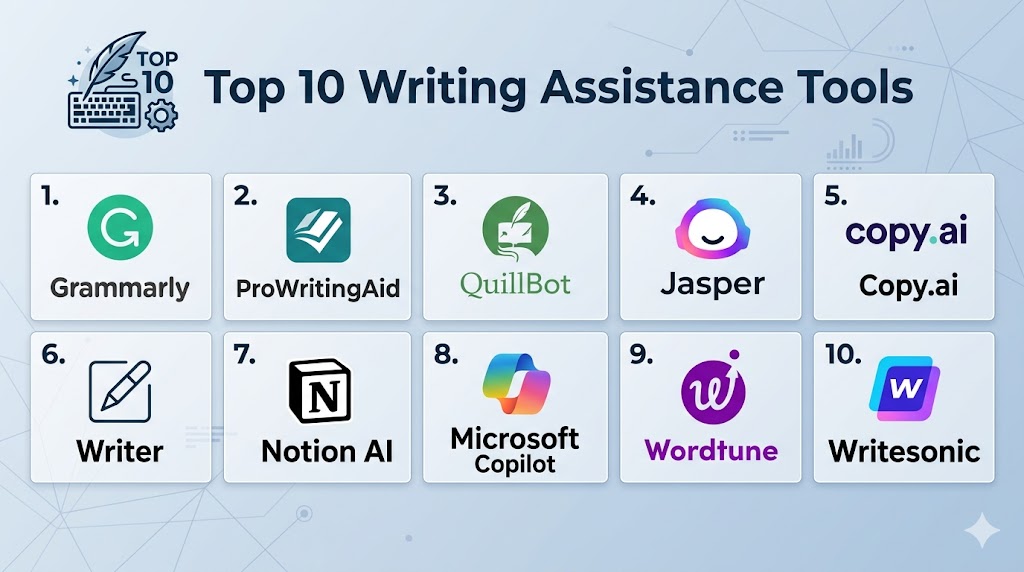
Top 10 Writing Assistance Tools
#1 — Grammarly
Short description: Grammarly is a writing assistant that helps users improve grammar, spelling, punctuation, clarity, tone, and overall writing quality. It works across emails, documents, browsers, and business communication workflows. It is especially useful for individuals and teams that want real-time writing improvement in everyday work.
Key Features
- Grammar, spelling, and punctuation correction.
- Clarity, conciseness, and readability suggestions.
- Tone detection and tone adjustment support.
- AI-assisted rewriting and content suggestions.
- Browser, desktop, document, and mobile support.
- Team style guide and brand writing features.
- Plagiarism detection in selected plans.
Pros
- Strong all-purpose writing assistant for daily use.
- Works across many common writing environments.
- Useful for individuals, students, professionals, and teams.
Cons
- Some advanced features require paid plans.
- Suggestions may not always fit technical, creative, or brand-specific context.
- Users still need to review meaning and accuracy manually.
Platforms / Deployment
Web / Windows / macOS / iOS / Android
Browser extensions / Cloud
Security & Compliance
Enterprise controls, SSO, user management, and security features may be available depending on plan. Buyers should verify certifications, data handling, retention, and admin controls directly.
SOC 2, ISO 27001, HIPAA: Not publicly stated.
Integrations & Ecosystem
Grammarly fits users who want writing help across everyday communication tools. Its broad ecosystem makes it useful for emails, documents, web writing, and team content workflows.
- Browser extensions
- Web editor
- Desktop apps
- Document workflows
- Email writing support
- Mobile writing support
Support & Community
Grammarly provides help resources, onboarding materials, and support options. It has strong recognition among students, professionals, writers, marketers, and business teams.
#2 — ProWritingAid
Short description: ProWritingAid is a writing assistant focused on grammar, style, readability, long-form editing, and detailed writing reports. It is popular with authors, bloggers, editors, students, and content writers who want deeper writing feedback. It is especially useful for improving structure, repetition, pacing, and sentence variety.
Key Features
- Grammar, spelling, and punctuation checks.
- Style and readability suggestions.
- Detailed writing reports and analysis.
- Repetition, pacing, and sentence variety checks.
- Support for long-form writing and manuscripts.
- Integrations with writing and document tools.
- Plagiarism checking options may be available.
Pros
- Strong for long-form writing and editing.
- Detailed feedback helps improve writing habits.
- Useful for authors, bloggers, editors, and serious writers.
Cons
- Reports may feel detailed for users wanting quick corrections.
- Some features require paid access.
- Creative suggestions may need careful judgment.
Platforms / Deployment
Web / Windows / macOS
Browser extensions / Cloud / Desktop options may vary
Security & Compliance
Security and privacy features may vary by plan. Buyers should verify data processing, retention, team controls, and compliance documentation directly.
SOC 2, ISO 27001, HIPAA: Not publicly stated.
Integrations & Ecosystem
ProWritingAid works well for writers who treat editing as a structured process. It supports long-form drafts, articles, manuscripts, and polished content workflows.
- Browser extensions
- Web editor
- Desktop writing workflows
- Document editing tools
- Long-form writing platforms
- Manuscript and article editing workflows
Support & Community
ProWritingAid provides documentation, learning resources, and support materials. It has strong recognition among authors, bloggers, editors, and long-form content creators.
#3 — QuillBot
Short description: QuillBot is a writing assistance platform known for paraphrasing, grammar checking, summarization, citation support, and rewriting workflows. It helps users improve sentence clarity, rewrite content in different tones, and simplify complex text. It is especially useful for students, bloggers, researchers, and content creators.
Key Features
- Paraphrasing and rewriting modes.
- Grammar and spelling checking.
- Summarization support.
- Citation-related writing tools may be available.
- Tone and fluency improvement.
- Web-based editor and browser support.
- Useful for academic and content writing workflows.
Pros
- Strong paraphrasing and rewriting support.
- Easy to use for quick sentence improvement.
- Useful for students, content writers, and researchers.
Cons
- Rewritten output still needs originality and meaning checks.
- Advanced usage may require paid access.
- Enterprise governance features may be limited.
Platforms / Deployment
Web / Browser extensions may be available
Cloud
Security & Compliance
Not publicly stated.
Integrations & Ecosystem
QuillBot works best as a web-based rewriting and writing improvement tool. It is useful when users need to refine drafts, summarize content, or improve sentence flow.
- Web editor
- Browser writing workflows
- Paraphrasing workflows
- Grammar correction
- Summarization workflows
- Academic writing support
Support & Community
QuillBot has strong recognition among students, researchers, and content creators. Support resources and help materials are available, though enterprise support should be verified directly.
#4 — Jasper
Short description: Jasper is an AI writing and marketing content platform designed for teams that create campaigns, blog drafts, social posts, product copy, and brand-aligned marketing content. It focuses on AI-assisted content creation, brand voice, templates, workflows, and team collaboration. It is especially useful for marketing teams and agencies that need scalable content production.
Key Features
- AI-assisted content generation.
- Marketing copy and campaign templates.
- Brand voice and style support.
- Blog, email, ad, and social writing workflows.
- Team collaboration features.
- Content repurposing and rewriting support.
- Workflow support for marketing teams.
Pros
- Strong for marketing and campaign content creation.
- Useful for teams producing high volumes of content.
- Brand voice features help improve consistency.
Cons
- Output requires human editing and fact-checking.
- May be more than casual writers need.
- Pricing and value depend on content volume and team usage.
Platforms / Deployment
Web / Cloud
Browser or workflow integrations may vary
Security & Compliance
Enterprise security features may be available depending on plan. Buyers should verify SSO, data handling, admin controls, and compliance documentation directly.
SOC 2, ISO 27001, HIPAA: Not publicly stated.
Integrations & Ecosystem
Jasper fits marketing teams that need AI writing assistance connected with brand campaigns and content production workflows. It is useful for creating drafts, variations, and repurposed content.
- Marketing content workflows
- Campaign planning support
- Brand voice systems
- Blog and social content creation
- Team collaboration
- Content repurposing workflows
Support & Community
Jasper provides onboarding resources, templates, learning materials, and support options. It has strong recognition among marketers, agencies, and growth teams.
#5 — Copy.ai
Short description: Copy.ai is an AI writing platform focused on generating marketing copy, sales content, emails, social posts, blog ideas, and workflow-based content. It helps teams create drafts, rewrite text, brainstorm messaging, and speed up repetitive writing tasks. It is especially useful for marketers, sales teams, startups, and small businesses.
Key Features
- AI-generated marketing and sales copy.
- Templates for emails, ads, blogs, and social posts.
- Workflow support for repetitive writing tasks.
- Content rewriting and idea generation.
- Team collaboration options.
- Brand messaging support may be available.
- Useful for go-to-market content workflows.
Pros
- Good for fast marketing and sales content drafts.
- Easy to use for brainstorming and copy variations.
- Useful for startups and small teams.
Cons
- Generated content requires editing and fact-checking.
- May not be ideal for highly technical or regulated content.
- Brand governance depth should be validated for enterprise use.
Platforms / Deployment
Web / Cloud
Security & Compliance
Enterprise security features may be available depending on plan. Buyers should verify SSO, data handling, retention, and compliance documentation directly.
SOC 2, ISO 27001, HIPAA: Not publicly stated.
Integrations & Ecosystem
Copy.ai is built for teams that need faster copy creation across marketing and sales workflows. It helps users move from idea to draft quickly.
- Marketing copy workflows
- Sales email drafting
- Blog ideation
- Social content creation
- Campaign messaging
- Team writing workflows
Support & Community
Copy.ai provides support resources, templates, and learning materials. It is recognized among startups, marketers, sales teams, and small businesses using AI for content creation.
#6 — Writer
Short description: Writer is an enterprise-focused writing assistant designed for brand consistency, grammar checking, style guidance, terminology control, AI writing support, and team content governance. It helps organizations align writing with approved voice, messaging, and internal rules. It is especially useful for large teams that need controlled, consistent writing across departments.
Key Features
- Grammar, spelling, and clarity support.
- Brand voice and style guide enforcement.
- Terminology and approved language management.
- AI-assisted writing and rewriting.
- Team governance and admin controls.
- Content consistency workflows.
- Enterprise writing and collaboration features.
Pros
- Strong fit for enterprise brand governance.
- Helps teams maintain consistent tone and terminology.
- Useful for marketing, sales, support, HR, and internal communication.
Cons
- May be more advanced than individual users need.
- Requires setup of brand rules and style guides.
- Pricing and value depend on team size and governance needs.
Platforms / Deployment
Web / Browser extension / Cloud
Business integrations may vary
Security & Compliance
Enterprise security controls, admin features, and access management may be available depending on plan. Buyers should verify SSO, encryption, audit logs, and compliance documentation directly.
SOC 2, ISO 27001, HIPAA: Not publicly stated.
Integrations & Ecosystem
Writer is designed for organizations that need writing assistance inside business workflows while keeping brand, tone, and terminology consistent.
- Browser writing workflows
- Business content platforms
- Marketing and sales workflows
- Support communication workflows
- Style guide and terminology systems
- Enterprise admin workflows
Support & Community
Writer provides business-focused onboarding, documentation, and support options. It is strongest for companies that need team-wide writing quality, brand consistency, and controlled AI writing support.
#7 — Notion AI
Short description: Notion AI is a writing and productivity assistant built into the Notion workspace. It helps users draft, summarize, rewrite, brainstorm, extract action items, improve text, and work with notes or documents. It is especially useful for teams already using Notion for documentation, project planning, knowledge management, and content drafts.
Key Features
- AI-assisted drafting and rewriting.
- Summarization of notes and documents.
- Brainstorming and idea generation.
- Action item extraction.
- Tone and clarity improvement.
- Integrated workspace writing support.
- Useful for documentation and team knowledge workflows.
Pros
- Convenient for teams already using Notion.
- Good for notes, summaries, drafts, and internal content.
- Helps reduce context switching inside workspace documents.
Cons
- Best value depends on Notion adoption.
- Not a dedicated grammar checker or advanced editorial platform.
- Output still requires review for accuracy and tone.
Platforms / Deployment
Web / Windows / macOS / iOS / Android
Cloud
Security & Compliance
Security and admin controls depend on Notion workspace settings and plan. Buyers should verify data handling, permissions, and compliance documentation directly.
SOC 2, ISO 27001, HIPAA: Not publicly stated here.
Integrations & Ecosystem
Notion AI is strongest when writing assistance needs to live inside documents, notes, project pages, and knowledge bases. It is practical for teams already using Notion as a workspace.
- Workspace document writing
- Notes and meeting summaries
- Project planning pages
- Knowledge base content
- Team documentation
- Internal content workflows
Support & Community
Notion AI benefits from Notion’s broader documentation, user community, templates, and workspace support resources. It is most useful for teams already working heavily in Notion.
#8 — Microsoft Copilot
Short description: Microsoft Copilot is an AI productivity assistant that supports writing, summarization, drafting, editing, and content creation across Microsoft productivity tools. It helps users create emails, documents, summaries, presentations, and business communication. It is especially useful for organizations already standardized on Microsoft work environments.
Key Features
- AI-assisted document drafting.
- Email writing and summarization support.
- Meeting and document summary capabilities.
- Rewriting and tone adjustment.
- Integration with Microsoft productivity tools.
- Business workflow and collaboration support.
- Enterprise admin and security controls may be available.
Pros
- Strong fit for Microsoft-based organizations.
- Useful across documents, emails, meetings, and business workflows.
- Reduces context switching for enterprise users.
Cons
- Best value depends on Microsoft ecosystem adoption.
- May be more expensive or complex than standalone writing tools.
- Users still need to validate accuracy and context.
Platforms / Deployment
Web / Windows / macOS / iOS / Android
Cloud / Microsoft productivity ecosystem
Security & Compliance
Security and compliance depend on Microsoft plan, tenant settings, and admin configuration. Buyers should verify data handling, access controls, auditability, and compliance documentation directly through their Microsoft environment.
SOC 2, ISO 27001, HIPAA: Not publicly stated here.
Integrations & Ecosystem
Microsoft Copilot is strongest for organizations that already work inside Microsoft productivity and collaboration tools. It supports writing where business content is already created and shared.
- Document drafting workflows
- Email writing workflows
- Meeting summaries
- Presentation content creation
- Team collaboration
- Enterprise productivity workflows
Support & Community
Microsoft Copilot benefits from Microsoft’s broader enterprise support, documentation, admin resources, and partner ecosystem. It is best suited for organizations already committed to Microsoft productivity tools.
#9 — Wordtune
Short description: Wordtune is a writing assistant focused on rewriting, rephrasing, shortening, expanding, and improving sentence clarity. It helps users quickly adjust tone, improve flow, and make text easier to read. It is especially useful for business professionals, students, writers, and non-native English users who want cleaner wording.
Key Features
- Sentence rewriting and rephrasing.
- Tone adjustment support.
- Shorten and expand writing options.
- Clarity and fluency improvement.
- Browser-based writing support.
- AI-assisted writing suggestions.
- Useful for everyday writing refinement.
Pros
- Strong for quick rewriting and sentence improvement.
- Easy to use for daily communication.
- Helpful for non-native English writers.
Cons
- Less focused on full long-form content generation.
- Advanced usage may require paid access.
- Users must review meaning after rewriting.
Platforms / Deployment
Web / Browser extension / Cloud
Security & Compliance
Not publicly stated.
Integrations & Ecosystem
Wordtune is practical for users who need fast writing improvement in browser-based workflows. It works well for rewriting emails, paragraphs, notes, and short-form content.
- Browser writing workflows
- Email rewriting
- Document editing support
- Short-form content improvement
- Sentence rewriting
- Tone adjustment workflows
Support & Community
Wordtune provides help resources and user support options. It is recognized among students, business professionals, and writers who need fast rewriting assistance.
#10 — Writesonic
Short description: Writesonic is an AI writing platform focused on blog drafts, marketing copy, SEO content, product descriptions, ads, and content generation workflows. It helps users create content ideas, outlines, drafts, and copy variations quickly. It is especially useful for marketers, bloggers, ecommerce teams, and small businesses.
Key Features
- AI-assisted blog and article drafting.
- Marketing copy generation.
- Product description writing.
- Social media and ad copy support.
- Content rewriting and expansion.
- SEO-oriented writing workflows may be available.
- Templates for multiple content formats.
Pros
- Useful for fast content creation and ideation.
- Good fit for marketing and ecommerce workflows.
- Offers a range of templates for different writing needs.
Cons
- Output requires human editing and fact-checking.
- May not be ideal for highly regulated or expert-level content.
- Brand consistency requires careful prompt and review processes.
Platforms / Deployment
Web / Cloud
Security & Compliance
Not publicly stated.
Integrations & Ecosystem
Writesonic fits users who need AI-assisted content generation for marketing, ecommerce, and publishing workflows. It is useful for quickly creating drafts and variations.
- Blog writing workflows
- Marketing copy generation
- Ecommerce product descriptions
- Social media content
- Ad copy workflows
- Content rewriting and expansion
Support & Community
Writesonic provides templates, help resources, and support options. It is recognized among marketers, bloggers, ecommerce teams, and small businesses using AI for content creation.
Comparison Table
| Tool Name | Best For | Platform Supported | Deployment | Standout Feature | Public Rating |
|---|---|---|---|---|---|
| Grammarly | Everyday writing and editing | Web, Windows, macOS, iOS, Android | Cloud | Real-time grammar, clarity, and tone support | N/A |
| ProWritingAid | Long-form writers and editors | Web, Windows, macOS | Cloud / Desktop varies | Detailed reports for deep editing | N/A |
| QuillBot | Paraphrasing and rewriting | Web | Cloud | Strong rewriting and summarization workflows | N/A |
| Jasper | Marketing teams and agencies | Web | Cloud | AI marketing content and brand voice workflows | N/A |
| Copy.ai | Sales and marketing copy | Web | Cloud | Fast copy generation for go-to-market teams | N/A |
| Writer | Enterprise brand governance | Web, browser workflows | Cloud | Style guide and terminology control | N/A |
| Notion AI | Workspace writing and summaries | Web, Windows, macOS, iOS, Android | Cloud | Writing assistance inside Notion workspace | N/A |
| Microsoft Copilot | Microsoft productivity users | Web, Windows, macOS, iOS, Android | Cloud | AI writing inside Microsoft work tools | N/A |
| Wordtune | Sentence rewriting and clarity | Web, browser workflows | Cloud | Fast rephrasing and tone adjustment | N/A |
| Writesonic | AI blogs and marketing content | Web | Cloud | Blog, ad, and product copy generation | N/A |
Evaluation & Scoring of Writing Assistance Tools
The scoring below is comparative and practical. It is not an official rating and should not be treated as a universal ranking. Scores are based on writing depth, ease of use, integrations, security posture, performance, support maturity, and buyer value.
| Tool Name | Core | Ease | Integrations | Security | Performance | Support | Value | Weighted Total |
|---|---|---|---|---|---|---|---|---|
| Grammarly | 9 | 9 | 9 | 8 | 9 | 8 | 8 | 8.65 |
| ProWritingAid | 8 | 8 | 8 | 7 | 8 | 8 | 8 | 7.95 |
| QuillBot | 8 | 9 | 7 | 6 | 8 | 7 | 9 | 7.95 |
| Jasper | 9 | 8 | 8 | 8 | 8 | 8 | 7 | 8.10 |
| Copy.ai | 8 | 9 | 7 | 7 | 8 | 7 | 8 | 7.85 |
| Writer | 9 | 8 | 8 | 8 | 8 | 8 | 7 | 8.10 |
| Notion AI | 8 | 9 | 8 | 8 | 8 | 8 | 8 | 8.15 |
| Microsoft Copilot | 9 | 8 | 9 | 9 | 8 | 8 | 7 | 8.35 |
| Wordtune | 7 | 9 | 7 | 6 | 8 | 7 | 8 | 7.50 |
| Writesonic | 8 | 8 | 7 | 6 | 8 | 7 | 8 | 7.55 |
These scores are designed to help with shortlisting, not to declare a universal winner. Grammarly is strong for daily writing and editing, while ProWritingAid is better for long-form improvement. Jasper, Copy.ai, and Writesonic are stronger for marketing content creation. Writer and Microsoft Copilot are more suitable for organizations that need team governance, enterprise workflows, and business-wide writing support.
Which Writing Assistance Tool Is Right for You?
Solo / Freelancer
Solo writers, freelancers, students, bloggers, and independent professionals should prioritize ease of use, editing quality, rewriting support, and affordable pricing. They usually need fast support for emails, blogs, proposals, articles, and client communication.
Good options include Grammarly, ProWritingAid, QuillBot, Wordtune, and Writesonic. Grammarly is strong for everyday editing, ProWritingAid is better for long-form writing, QuillBot and Wordtune are useful for rewriting, and Writesonic can help with draft generation.
Freelancers should choose based on content type. A blogger may need outlining and drafting, while a consultant may need email polishing and proposal rewriting.
SMB
Small and growing businesses need writing tools that improve content quality without adding heavy process. They may need help with blogs, landing pages, social posts, email campaigns, support replies, and internal communication.
Good options include Grammarly, Copy.ai, Jasper, Notion AI, Writesonic, and Microsoft Copilot depending on the team’s existing workflow. Small teams should prioritize templates, ease of use, collaboration, and predictable pricing.
SMBs should also decide whether they need editing support, content generation, or both. A grammar tool and an AI drafting tool can sometimes work better together than one tool alone.
Mid-Market
Mid-market teams often need writing support across marketing, sales, support, HR, product, and operations. They need more consistency, better workflows, and clearer ownership of brand voice and content quality.
Good options include Grammarly, Writer, Jasper, Microsoft Copilot, Notion AI, and Copy.ai. These tools can support broader teams while improving speed, consistency, and collaboration.
Mid-market buyers should validate team management, style guide support, integrations, security settings, and adoption across departments.
Enterprise
Enterprise organizations need writing assistance with governance, brand control, security, admin management, and workflow integration. They may also need approved terminology, compliance-aware messaging, internal knowledge access, and business-wide writing standards.
Good options include Writer, Microsoft Copilot, Grammarly, Jasper, and Notion AI depending on existing systems and governance needs. Writer is strong for brand and style control, while Microsoft Copilot is useful for organizations already working deeply inside Microsoft productivity tools.
Enterprise buyers should run pilots across multiple departments and review security, privacy, admin controls, and output quality before large-scale rollout.
Budget vs Premium
Budget-focused users can start with QuillBot, Wordtune, Writesonic, ProWritingAid, or basic writing assistance features inside existing productivity tools. These can help with rewriting, grammar, and draft creation without heavy investment.
Premium buyers should evaluate Grammarly, Jasper, Writer, Microsoft Copilot, and Notion AI when they need team collaboration, business integration, brand controls, admin features, and scalable writing workflows.
The best value depends on frequency of use. A casual user may only need grammar checking, while a content team may save significant time with AI drafting, rewriting, and workflow support.
Feature Depth vs Ease of Use
If ease of use is the priority, Grammarly, QuillBot, Wordtune, Notion AI, and Copy.ai are practical choices. They help users get quick improvements without complex setup.
If feature depth is more important, Writer, Jasper, Microsoft Copilot, and ProWritingAid may be stronger. These tools provide deeper editing, brand governance, enterprise integration, or content production workflows.
The best tool should match your writing process, not force your team into a workflow that feels unnatural.
Integrations & Scalability
Integration matters because writing assistance is most useful when it works where users already write. Buyers should check browser support, document integrations, email workflows, CMS compatibility, team workspace access, and collaboration platform support.
Strong integration-focused options include Grammarly, Microsoft Copilot, Notion AI, Writer, and Jasper. These tools are useful for teams that need writing support across many daily work environments.
Scalability also depends on admin controls, user management, shared style rules, permission settings, and workflow visibility.
Security & Compliance Needs
Security-sensitive teams should review data handling, retention, encryption, user permissions, admin controls, training data policies, and access management. Writing tools may process emails, documents, customer replies, strategy drafts, and internal knowledge, so security review is important.
Enterprise buyers should evaluate Writer, Microsoft Copilot, Grammarly, Jasper, and Notion AI depending on their environment. Do not assume compliance certifications unless the vendor confirms them directly.
For legal, healthcare, finance, government, HR, or confidential business content, run a security review before using writing assistants with real data.
Frequently Asked Questions FAQs
1. What is a Writing Assistance Tool?
A Writing Assistance Tool helps users draft, edit, rewrite, summarize, and improve written content.
It may include grammar checking, spell checking, tone suggestions, AI drafting, paraphrasing, and readability support.
These tools are useful for emails, blogs, reports, proposals, social posts, and business communication.
The goal is to make writing faster, clearer, and more professional.
2. Are Writing Assistance Tools the same as grammar checkers?
No, grammar checkers focus mainly on spelling, grammar, punctuation, and clarity issues.
Writing assistance tools usually offer broader support, including drafting, rewriting, summarization, tone changes, and content generation.
Some tools combine both grammar correction and AI writing features.
The right choice depends on whether you need editing, drafting, or both.
3. Which Writing Assistance Tool is best for bloggers?
Bloggers should evaluate Grammarly, ProWritingAid, Jasper, Writesonic, QuillBot, and Notion AI.
Grammarly and ProWritingAid are useful for editing, while Jasper and Writesonic can help with outlines and first drafts.
QuillBot is useful for rewriting, and Notion AI can support planning and drafting inside a workspace.
The best tool depends on whether the blogger needs editing depth or faster content creation.
4. Which Writing Assistance Tool is best for business teams?
Business teams should evaluate Grammarly, Writer, Microsoft Copilot, Jasper, Notion AI, and Copy.ai.
Writer is strong for brand consistency, while Microsoft Copilot is useful for Microsoft-based organizations.
Grammarly supports everyday writing quality, and Jasper or Copy.ai can help marketing teams create campaign content.
Teams should compare integrations, admin controls, style guides, and security features.
5. Can Writing Assistance Tools replace human writers?
Writing assistance tools can speed up drafting and editing, but they do not fully replace skilled human writers.
Human writers understand audience, strategy, brand context, facts, creativity, and emotional nuance.
AI-generated content may contain errors, generic phrasing, or unsupported claims.
The best workflow uses tools for support while keeping human review and judgment in control.
6. Are AI writing tools safe for confidential content?
Safety depends on the vendor, plan, admin settings, data handling practices, and organization policies.
Teams should review encryption, retention, access controls, training data policies, and compliance documentation.
Sensitive content such as legal drafts, customer data, financial information, or internal strategy should be handled carefully.
Businesses should complete a security review before using these tools widely.
7. What features should I look for first?
Start with grammar correction, rewriting quality, drafting support, tone control, readability suggestions, and integrations.
For teams, also check brand voice, style guides, user management, admin controls, and collaboration features.
For marketers, templates, SEO support, campaign workflows, and content repurposing may be important.
The best features depend on your writing volume and use case.
8. Do Writing Assistance Tools help with SEO content?
Yes, some writing tools help with blog outlines, headings, meta descriptions, keyword ideas, and content structure.
However, SEO still requires human strategy, search intent understanding, accuracy, and editorial judgment.
AI writing tools can speed up drafting, but they should not replace topic research or quality review.
For strong SEO content, combine writing tools with planning, editing, and performance analysis.
9. What is the biggest mistake when using Writing Assistance Tools?
The biggest mistake is accepting tool suggestions without reviewing accuracy, tone, and meaning.
AI or grammar suggestions may sound polished but still be incorrect, generic, or off-brand.
Another mistake is using vague prompts and expecting high-quality output.
Clear instructions, examples, and human editing produce much better results.
10. How should I choose the right Writing Assistance Tool?
Start by identifying your main writing needs, such as editing, rewriting, blog drafting, emails, marketing copy, or team governance.
Then compare ease of use, integrations, security, pricing, collaboration, and output quality.
Test each tool with real writing samples before choosing.
The best tool is the one that improves your workflow without weakening accuracy, originality, or brand voice.
Conclusion
Writing Assistance Tools help individuals and teams write faster, clearer, and more professionally across many content types.They support grammar correction, rewriting, summarization, AI drafting, tone improvement, and brand consistency. Grammarly is a strong daily writing assistant, while ProWritingAid is useful for deep editing and long-form improvement. QuillBot and Wordtune are practical for rewriting, while Jasper, Copy.ai, and Writesonic are stronger for marketing content generation. Writer is valuable for enterprise brand governance, while Notion AI and Microsoft Copilot are strong inside broader productivity workflows. There is no single best writing assistant because every user has different writing goals, content volume, workflow, budget, and security needs.
his blog clearly explains writing tools and helps users improve grammar, clarity, and content quality effectively.