Introduction
Pharmacy Management Systems are specialized software platforms designed to streamline pharmacy operations, including prescription processing, inventory management, billing, compliance, and patient data handling. These systems act as a centralized hub that automates daily pharmacy workflows, reducing manual effort and improving accuracy.
In today’s healthcare environment, pharmacy systems are essential due to increasing prescription volumes, regulatory requirements, and the need for real-time patient safety checks. Modern platforms now integrate e-prescriptions, AI-driven analytics, inventory automation, cybersecurity controls, and identity-based access management, ensuring both efficiency and compliance.
Common use cases include:
- Prescription processing and dispensing
- Inventory and stock management
- Billing and insurance claims
- Patient profile and medication tracking
- Compliance and reporting
Key evaluation criteria:
- Prescription workflow efficiency
- Inventory and supply chain management
- Billing and insurance integration
- Compliance and regulatory support
- Integration with EHR and healthcare systems
- Security and data protection
- Ease of use for pharmacists
- Scalability for multi-location pharmacies
Pharmacy systems automate workflows such as prescription handling, billing, and inventory tracking, improving efficiency and patient outcomes.
Best for: Retail pharmacies, hospital pharmacies, long-term care pharmacies, and pharmacy chains.
Not ideal for: Very small setups with minimal prescription volume or manual workflows.
Key Trends in Pharmacy Management Systems
- E-prescription integration: Direct digital prescriptions reduce errors
- AI-driven drug interaction alerts: Improve patient safety
- Cloud-based deployment: Remote access and scalability
- Inventory automation: Real-time stock tracking and expiry alerts
- Patient engagement tools: SMS alerts and mobile apps
- Compliance automation: Built-in regulatory reporting
- Integration ecosystems: Seamless EHR and insurance connectivity
- Barcode and QR scanning: Faster billing and dispensing
- Data analytics dashboards: Sales and patient insights
- Zero trust security models: Strong identity and access control
How We Evaluated Pharmacy Management Systems (Methodology)
- Assessed market adoption and pharmacy usage
- Evaluated core pharmacy workflow capabilities
- Reviewed integration with EHR, billing, and insurance systems
- Analyzed security and compliance readiness
- Measured performance and reliability
- Compared automation and AI capabilities
- Evaluated ease of use for pharmacists
- Considered deployment flexibility (cloud vs hybrid)
- Reviewed vendor support and ecosystem strength
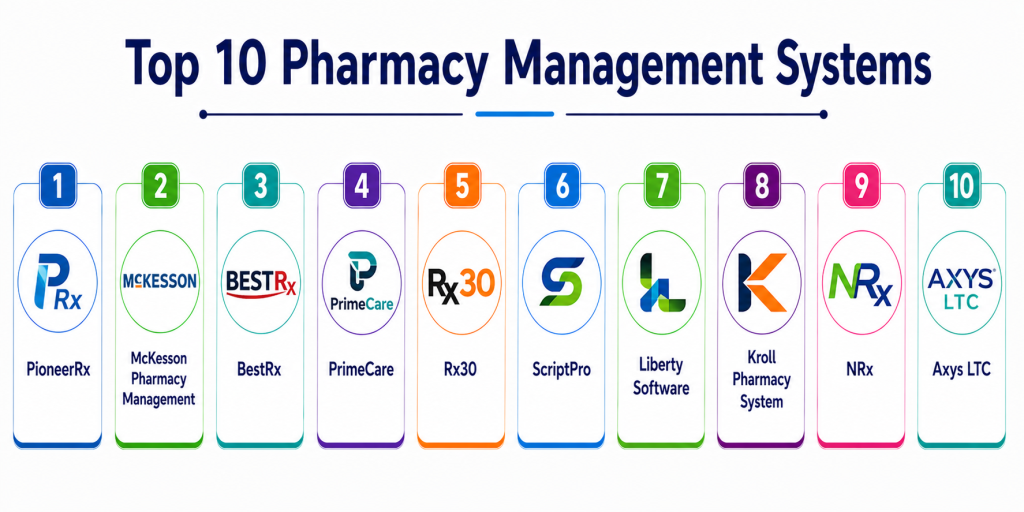
Top 10 Pharmacy Management Systems
#1 — PioneerRx
Short description: PioneerRx is a modern pharmacy management system focused on improving patient outcomes and workflow efficiency. It offers advanced prescription management, inventory tracking, and patient engagement tools. The platform supports integration with multiple healthcare systems. Known for innovation and strong analytics. Suitable for independent and retail pharmacies. It enables personalized patient care workflows.
Key Features
- Prescription processing
- Inventory management
- Patient engagement tools
- Reporting and analytics
- Workflow automation
- Integration with healthcare systems
Pros
- Strong patient care features
- Advanced analytics
Cons
- Learning curve
- Higher cost
Platforms / Deployment
Windows / Web
Cloud / Hybrid
Security & Compliance
Encryption, RBAC, audit logs
Supports compliance frameworks
Integrations & Ecosystem
Strong integration ecosystem with pharmacy and healthcare tools.
- EHR systems
- APIs
- Insurance systems
Support & Community
Strong support and active user community.
#2 — McKesson Pharmacy Management
Short description: McKesson offers enterprise-grade pharmacy management solutions with strong supply chain and inventory capabilities. It is widely used in hospitals and large pharmacy networks. Known for reliability and scalability.
Key Features
- Inventory and supply chain management
- Prescription processing
- Billing and reporting
- Analytics
- Workflow automation
- Compliance tools
Pros
- Enterprise scalability
- Strong supply chain features
Cons
- Complex implementation
- High cost
Platforms / Deployment
Web
Cloud / On-premise
Security & Compliance
Encryption, RBAC
Supports healthcare compliance standards
Integrations & Ecosystem
Extensive healthcare integrations.
- EHR systems
- APIs
- Supply chain systems
Support & Community
Enterprise-level support.
#3 — BestRx
Short description: BestRx is a user-friendly pharmacy management system designed for independent pharmacies. It offers prescription processing, billing, and inventory tools. Known for affordability and ease of use.
Key Features
- Prescription processing
- Inventory tracking
- Billing and POS
- Reporting
- Workflow automation
- Patient management
Pros
- Easy to use
- Affordable
Cons
- Limited enterprise features
- Basic analytics
Platforms / Deployment
Windows / Web
Cloud / On-premise
Security & Compliance
Encryption
Not publicly stated certifications
Integrations & Ecosystem
Supports integration with pharmacy tools.
- APIs
- Billing systems
Support & Community
Good support for SMB users.
#4 — PrimeCare
Short description: PrimeCare is a scalable pharmacy system designed for long-term care and retail pharmacies. It offers workflow automation and integration capabilities. Known for flexibility.
Key Features
- Prescription management
- Inventory control
- Workflow automation
- Reporting
- Integration tools
- Compliance features
Pros
- Flexible platform
- Strong integrations
Cons
- Requires setup effort
- Moderate learning curve
Platforms / Deployment
Web
Cloud
Security & Compliance
Encryption, RBAC
Supports compliance frameworks
Integrations & Ecosystem
Supports integration with pharmacy and delivery systems.
- APIs
- Logistics tools
Support & Community
Moderate support.
#5 — Rx30
Short description: Rx30 is a pharmacy management system designed for workflow automation and compliance. It supports prescription processing and billing. Suitable for mid-sized pharmacies.
Key Features
- Prescription processing
- Billing and insurance
- Inventory management
- Reporting
- Workflow automation
- Compliance tracking
Pros
- Strong compliance features
- Reliable performance
Cons
- Older interface
- Limited customization
Platforms / Deployment
Windows
On-premise / Cloud
Security & Compliance
Encryption, RBAC
Supports compliance frameworks
Integrations & Ecosystem
Supports integration with pharmacy tools.
- APIs
Support & Community
Moderate support.
#6 — ScriptPro
Short description: ScriptPro focuses on automation and robotics integration in pharmacy operations. It improves prescription filling accuracy and efficiency. Suitable for high-volume pharmacies.
Key Features
- Automated dispensing
- Inventory management
- Workflow automation
- Reporting
- Integration tools
- Compliance features
Pros
- Automation capabilities
- Reduces human error
Cons
- High cost
- Requires hardware integration
Platforms / Deployment
Web
Hybrid
Security & Compliance
Encryption
Supports compliance frameworks
Integrations & Ecosystem
Integrates with pharmacy automation systems.
- APIs
- Robotics
Support & Community
Enterprise support.
#7 — Liberty Software
Short description: Liberty Software is a modern pharmacy management system designed for retail pharmacies. It offers strong workflow automation and integration features. Known for ease of use.
Key Features
- Prescription processing
- Inventory tracking
- Billing and POS
- Reporting
- Workflow automation
- Patient management
Pros
- User-friendly
- Efficient workflows
Cons
- Limited enterprise features
- Smaller ecosystem
Platforms / Deployment
Windows / Web
Cloud / Hybrid
Security & Compliance
Encryption
Supports compliance frameworks
Integrations & Ecosystem
Supports integration with pharmacy tools.
- APIs
Support & Community
Good vendor support.
#8 — Kroll Pharmacy System
Short description: Kroll is a comprehensive pharmacy management system used widely in healthcare organizations. It offers prescription management and compliance tools. Suitable for enterprise environments.
Key Features
- Prescription processing
- Patient records
- Billing
- Reporting
- Workflow automation
- Compliance tools
Pros
- Strong clinical features
- Reliable
Cons
- Complex interface
- Requires training
Platforms / Deployment
Web
Cloud
Security & Compliance
Encryption, RBAC
Supports compliance frameworks
Integrations & Ecosystem
Strong integration capabilities.
- EHR
- APIs
Support & Community
Enterprise support.
#9 — NRx
Short description: NRx is a pharmacy system designed for efficiency and compliance. It supports prescription processing and workflow automation. Suitable for small to mid-sized pharmacies.
Key Features
- Prescription processing
- Inventory management
- Billing
- Reporting
- Workflow automation
- Compliance tracking
Pros
- Reliable system
- Easy to use
Cons
- Limited advanced features
- Smaller ecosystem
Platforms / Deployment
Windows
On-premise
Security & Compliance
Encryption
Supports compliance frameworks
Integrations & Ecosystem
Supports integration with pharmacy tools.
- APIs
Support & Community
Moderate support.
#10 — Axys LTC
Short description: Axys LTC is a cloud-based pharmacy management system designed for long-term care pharmacies. It offers modern workflows and scalability. Known for innovation.
Key Features
- Prescription management
- Inventory tracking
- Billing
- Reporting
- Workflow automation
- Compliance tools
Pros
- Cloud-native
- Scalable
Cons
- Newer platform
- Limited ecosystem
Platforms / Deployment
Web
Cloud
Security & Compliance
Encryption, MFA
Supports compliance frameworks
Integrations & Ecosystem
Supports integration with healthcare systems.
- APIs
Support & Community
Growing support ecosystem.
Comparison Table
| Tool Name | Best For | Platform(s) Supported | Deployment | Standout Feature | Public Rating |
|---|---|---|---|---|---|
| PioneerRx | Retail pharmacies | Windows/Web | Hybrid | Patient engagement | N/A |
| McKesson | Enterprise | Web | Hybrid | Supply chain | N/A |
| BestRx | SMB | Windows/Web | Hybrid | Ease of use | N/A |
| PrimeCare | LTC pharmacies | Web | Cloud | Flexibility | N/A |
| Rx30 | Mid-market | Windows | Hybrid | Compliance | N/A |
| ScriptPro | High-volume | Web | Hybrid | Automation | N/A |
| Liberty | Retail | Windows/Web | Hybrid | Workflow efficiency | N/A |
| Kroll | Enterprise | Web | Cloud | Clinical features | N/A |
| NRx | SMB | Windows | On-premise | Simplicity | N/A |
| Axys LTC | LTC | Web | Cloud | Cloud-native | N/A |
Evaluation & Scoring of Pharmacy Management Systems
| Tool Name | Core (25%) | Ease (15%) | Integrations (15%) | Security (10%) | Performance (10%) | Support (10%) | Value (15%) | Weighted Total |
|---|---|---|---|---|---|---|---|---|
| PioneerRx | 9 | 8 | 9 | 9 | 9 | 8 | 8 | 8.6 |
| McKesson | 10 | 7 | 10 | 9 | 9 | 9 | 7 | 8.9 |
| BestRx | 8 | 9 | 7 | 8 | 8 | 7 | 9 | 8.2 |
| PrimeCare | 8 | 7 | 9 | 8 | 8 | 7 | 8 | 8.0 |
| Rx30 | 8 | 7 | 8 | 8 | 8 | 7 | 8 | 7.9 |
| ScriptPro | 9 | 6 | 9 | 9 | 9 | 8 | 7 | 8.3 |
| Liberty | 8 | 8 | 7 | 8 | 8 | 7 | 8 | 8.0 |
| Kroll | 9 | 7 | 9 | 9 | 9 | 8 | 7 | 8.5 |
| NRx | 7 | 8 | 6 | 7 | 7 | 7 | 8 | 7.3 |
| Axys LTC | 8 | 8 | 7 | 8 | 8 | 7 | 8 | 8.0 |
How to interpret scores:
- Enterprise systems score higher in integrations and compliance
- Automation-focused tools excel in performance
- SMB tools offer better affordability and usability
- Choose based on workflow needs rather than total score
Which Pharmacy Management System Is Right for You?
Solo / Independent Pharmacy
BestRx or NRx for affordability and simplicity.
SMB Pharmacy
Liberty or PioneerRx for balanced features and usability.
Mid-Market Pharmacy
Rx30 and PrimeCare for workflow and compliance.
Enterprise / Hospital Pharmacy
McKesson and Kroll for scalability and integrations.
Budget vs Premium
Budget: BestRx, NRx
Premium: McKesson, ScriptPro
Feature Depth vs Ease of Use
Feature-rich: McKesson, PioneerRx
User-friendly: BestRx, Liberty
Integrations & Scalability
Best: McKesson, Kroll
Moderate: PrimeCare, Rx30
Security & Compliance Needs
High compliance: Enterprise tools
Moderate: SMB tools
Frequently Asked Questions (FAQs)
1. What is a pharmacy management system?
A pharmacy management system is software that automates pharmacy workflows such as prescription processing, inventory management, billing, and compliance. It centralizes operations. It improves efficiency. It reduces errors. It enhances patient care.
2. What are the key features of pharmacy software?
Key features include inventory management, prescription processing, billing, and analytics. Advanced systems include AI alerts and integrations. These features improve efficiency and safety.
3. Is pharmacy software secure?
Yes, most systems include encryption and access control. Enterprise tools offer stronger compliance features. Security depends on configuration. Regular audits are important. Data protection is critical.
4. How much does pharmacy software cost?
Costs vary depending on features and scale. Cloud systems use subscription pricing. Enterprise systems cost more. Pricing depends on users and integrations. Evaluate ROI carefully.
5. Can pharmacy systems integrate with EHR?
Yes, most platforms integrate with EHR systems. This ensures unified patient data. Integration improves workflows. APIs enable connectivity. It reduces manual work.
6. What are the benefits of pharmacy management systems?
They improve efficiency, reduce errors, and enhance patient care. They automate workflows. They centralize data. They improve communication. They support compliance.
7. How long does implementation take?
Implementation can take weeks to months. Cloud systems are faster to deploy. Training is required. Data migration adds time. Planning ensures success.
8. Is cloud pharmacy software better?
Cloud software offers flexibility and scalability. It reduces infrastructure costs. It is easier to maintain. However, it depends on internet connectivity.
9. What should you consider when choosing a system?
Consider features, integration, security, cost, and usability. Vendor support is important. Scalability matters. Always test before purchase.
10. Can pharmacy systems support multiple locations?
Yes, many platforms support multi-location management. They centralize operations. This improves coordination. It enables better reporting. It supports growth.
Conclusion
Pharmacy Management Systems have become essential tools for modern pharmacies, enabling them to streamline operations, improve accuracy, and deliver better patient care. With features like automated prescription processing, inventory tracking, compliance management, and integration with healthcare systems, these platforms significantly reduce manual effort and operational errors. Enterprise solutions such as McKesson and Kroll provide deep functionality and scalability, while tools like PioneerRx and BestRx offer flexibility and ease of use for smaller pharmacies. The best system depends on your pharmacy’s size, workflow complexity, and integration needs. Rather than choosing solely based on features, it is recommended to shortlist two or three platforms, conduct pilot testing, and evaluate usability, performance, and compliance in real-world scenarios. A well-selected pharmacy management system can enhance efficiency, ensure regulatory compliance, and ultimately improve patient outcomes.