Introduction
Managing cash flow is one of the most critical responsibilities for any organization. Often, a situation arises where one company has surplus funds while another related company, despite being a separate legal entity, faces cash shortages, such as for paying employee salaries.
For example, consider XYZ company and ZZZ Company, two companies with different PANs, GST numbers, and addresses, but the same director, Ramesh. XYZ company has no sales this month, causing a salary crunch, while ZZZ Company has sufficient funds. In such cases, a formal intercompany loan can be an effective solution to ensure business continuity and employee satisfaction.
This tutorial explains how to legally and safely transfer funds between companies, the steps involved, key compliance points, and practical considerations.
1. Legal and Compliance Basics
- Separate Legal Entities:
- Each company is independent in the eyes of law. Funds cannot be transferred informally or through personal accounts without documentation.
- Director Overlap:
- Having the same director in both companies (Akanksha in our example) does not automatically allow free movement of money. Legal process must be followed.
- Purpose of Loan:
- Intercompany loans should serve specific purposes, such as paying salaries, operational expenses, or funding projects.
- Documentation Requirement:
- Proper agreements and board approvals ensure the transaction is audit-ready and compliant.
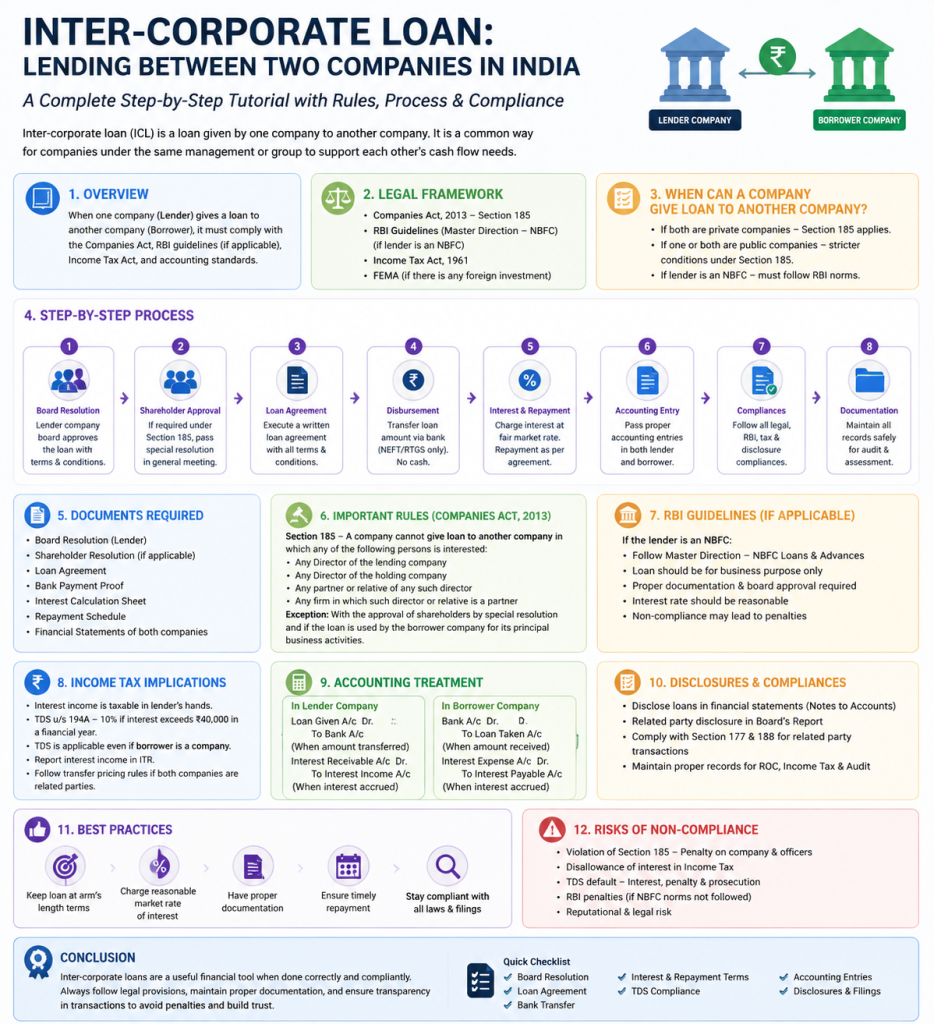
2. Step-by-Step Process for Intercompany Loans
Here’s a practical stepwise guide for transferring funds from one company to another:
Step 1: Board Approval
- Both companies must pass board resolutions approving the loan.
- Include:
- Loan amount
- Purpose (e.g., employee salaries)
- Repayment terms
- Interest rate (if any)
- Default clauses
Tip: Even if the same director is involved, both boards must approve to avoid legal and audit issues.
Step 2: Draft a Formal Loan Agreement
- Prepare a written agreement covering:
- Lender and borrower details
- Loan amount and currency
- Repayment schedule
- Interest rate and method (optional)
- Security or collateral (if applicable)
- Signatures of authorized directors
This agreement protects both companies and ensures clarity in repayment and accountability.
Step 3: Transfer Funds Legally
- Transfer funds directly via bank transfer between company accounts.
- Avoid using personal accounts or cash transfers.
- Maintain bank statements as proof of transaction.
Step 4: Payroll Payment
- Cotocus uses the loan to pay employees’ salaries.
- Ensure salaries are processed normally through bank transfers and payroll systems.
- Keep all salary vouchers and payroll records for compliance.
Step 5: Accounting Entries
Proper accounting ensures both companies’ books reflect the transaction:
For ZZZ Company (Lender):
- Debit: Loan Receivable (Asset)
- Credit: Bank
For XYZ company (Borrower):
- Debit: Bank (received funds)
- Credit: Loan Payable (Liability)
- If interest is charged:
- XYZ company: Debit Interest Expense
- ZZZ Company: Credit Interest Income
Step 6: Tax & Regulatory Compliance
- Loans are not GSTable, but interest (if any) may be taxable.
- Director or shareholder approval must be recorded.
- Maintain loan agreements and board resolutions for audit and statutory compliance.
- Avoid informal transfers, which can be treated as misappropriation.
3. Key Considerations and Best Practices
- Transparency: Clearly define the purpose of the loan in all documents.
- Interest and Repayment: Even if interest-free, document repayment timelines.
- Audit Trail: Keep all documents, resolutions, and bank transfers for audit purposes.
- Separate Funds: Never mix company funds with personal accounts.
- Employee Salaries: Prioritize payroll to maintain employee trust and morale.
4. Practical Examples
Example 1: Payroll Loan
- ZZZ Company lends ₹5,00,000 to Cotocus.
- XYZ Company has 20 employees with a total salary of ₹4,80,000.
- The loan is used to pay salaries, leaving ₹20,000 for other operations.
Accounting Snapshot:
ZZZ Company:
| Account | Debit | Credit |
|---|---|---|
| Loan Receivable | 5,00,000 | |
| Bank | 5,00,000 |
XYZ Company:
| Account | Debit | Credit |
|---|---|---|
| Bank | 5,00,000 | |
| Loan Payable | 5,00,000 |
Example 2: Repayment
- XYZ Company repays ₹1,00,000 monthly for 5 months.
- ZZZ Company records repayment as reduction in Loan Receivable.
- XYZ Company records repayment as reduction in Loan Payable.
5. Risks and Mitigation
| Risk | Mitigation |
|---|---|
| Misuse of funds | Proper board approvals and documentation |
| Audit scrutiny | Maintain all agreements and bank records |
| Tax implications | Track interest payments and report income appropriately |
| Employee dissatisfaction | Ensure salary payments are timely |
6. Conclusion
Intercompany loans are a practical, legal solution for addressing temporary cash shortfalls between related companies. By following formal approvals, proper agreements, correct accounting, and regulatory compliance, companies can:
- Ensure salary continuity
- Maintain financial transparency
- Protect directors and shareholders
- Avoid legal or tax complications
Properly managed, intercompany loans enhance workplace stability, maintain employee trust, and allow smooth business operations even in months with uneven cash flow.
✅ Takeaway:
Always treat intercompany loans as formal, documented financial transactions, not casual transfers. Follow board resolutions, agreements, and accounting rules to ensure legality and audit compliance.