Introduction
Electronic Lab Notebook ELN tools are software platforms that replace traditional paper lab notebooks by allowing researchers to digitally document experiments, protocols, observations, and data in a structured and searchable format.
Unlike paper notebooks, ELNs provide real-time collaboration, version control, audit trails, and secure data storage, making them essential for modern laboratories handling complex research workflows and compliance requirements.
Real-world use cases
- Recording scientific experiments and protocols
- Managing research data and lab documentation
- Collaborating across distributed research teams
- Ensuring compliance and audit readiness
- Integrating with lab instruments and systems
What buyers should evaluate
- Ease of data entry and usability
- Collaboration and sharing features
- Integration with LIMS and lab tools
- Compliance and audit trail support
- Data security and access control
- Scalability for research teams
- Reporting and analytics
- Cloud vs on-premise deployment
Best for: Researchers, scientists, R&D teams, biotech companies, pharma labs, and academic institutions.
Not ideal for: Very small labs or individual researchers with minimal documentation needs.
Key Trends in Electronic Lab Notebook ELN Tools
- AI-assisted experiment documentation and insights
- Integration with LIMS and lab automation systems
- Cloud-first ELN platforms for remote collaboration
- Enhanced compliance and audit tracking capabilities
- Real-time collaboration and team-based workflows
- Multi-format data support including images and files
- API-driven ecosystems for integration
- Digital transformation of laboratory workflows
- Increased adoption in pharma and biotech industries
- Data standardization and reproducibility improvements
How We Selected These Tools
- Evaluated adoption across research and pharma industries
- Assessed core ELN capabilities and usability
- Considered integration with lab systems and tools
- Reviewed scalability for large research teams
- Analyzed compliance and security features
- Evaluated reporting and collaboration capabilities
- Considered cloud and hybrid deployment models
- Assessed overall flexibility and value
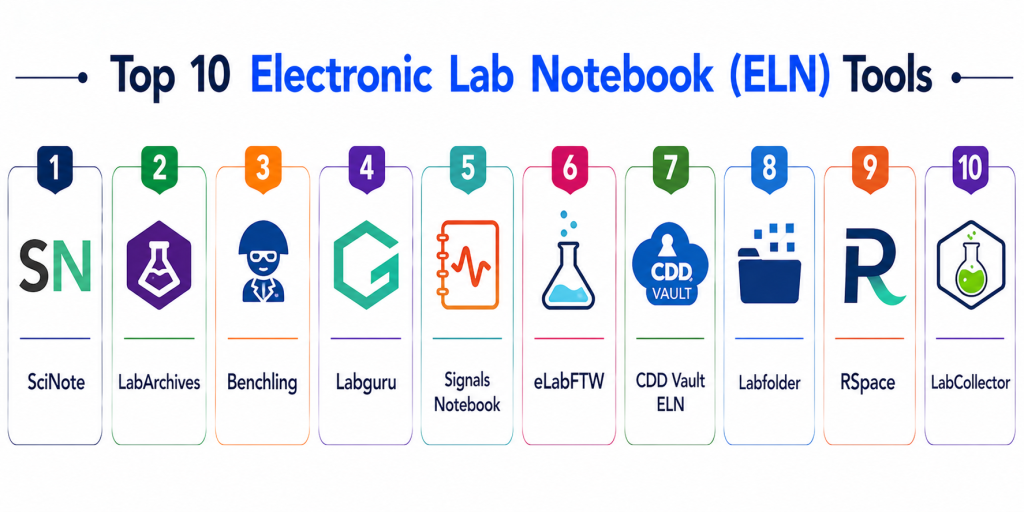
Top 10 Electronic Lab Notebook ELN Tools
#1 — SciNote
Short description: SciNote is a cloud-based ELN platform designed for research teams needing structured experiment tracking and compliance-ready documentation.
Key Features
- Experiment tracking
- Inventory management
- Collaboration tools
- Compliance support
- Reporting
Pros
- Easy to use
- Open-source option available
- Strong compliance features
Cons
- Limited advanced integrations
- Smaller ecosystem
- Setup effort
Platforms / Deployment
- Web
- Cloud
Security & Compliance
- Audit trails and access control
- Not publicly stated
Integrations & Ecosystem
Integrates with lab tools and APIs.
- APIs
- Lab systems
Support & Community
Active community and support
#2 — LabArchives
Short description: LabArchives is a widely adopted ELN that helps researchers organize, search, and share experimental data efficiently.
Key Features
- Data organization
- Collaboration
- Real-time access
- Search functionality
- Reporting
Pros
- User-friendly
- Strong collaboration
- Cloud-based
Cons
- Limited customization
- Pricing
- Basic analytics
Platforms / Deployment
- Web Mobile
- Cloud
Security & Compliance
- Not publicly stated
Integrations & Ecosystem
Supports integration with lab tools.
- APIs
- LMS
Support & Community
Strong academic adoption
#3 — Benchling
Short description: Benchling is a modern R&D platform combining ELN with data management and collaboration for biotech teams.
Key Features
- Experiment documentation
- Data analysis
- Collaboration
- Workflow management
- Integration
Pros
- Modern interface
- Strong collaboration
- Scalable
Cons
- Expensive
- Learning curve
- Complex setup
Platforms / Deployment
- Web
- Cloud
Security & Compliance
- Not publicly stated
Integrations & Ecosystem
Integrates with biotech tools.
- APIs
- Lab systems
Support & Community
Strong enterprise support
#4 — Labguru
Short description: Labguru combines ELN with inventory and sample management for research labs.
Key Features
- Experiment documentation
- Inventory tracking
- Collaboration
- Reporting
- Compliance
Pros
- All-in-one platform
- Strong integration
- Scalable
Cons
- Pricing
- Learning curve
- Setup effort
Platforms / Deployment
- Web
- Cloud
Security & Compliance
- Audit trails
- Not publicly stated
Integrations & Ecosystem
Supports integration with lab tools.
- APIs
- LIMS
Support & Community
Enterprise support
#5 — Signals Notebook
Short description: Signals Notebook is a cloud-native ELN platform designed for pharma and biotech R&D teams.
Key Features
- Data capture
- Collaboration
- Workflow automation
- Reporting
- Integration
Pros
- Enterprise-ready
- Strong data management
- Scalable
Cons
- Expensive
- Complex
- Learning curve
Platforms / Deployment
- Web
- Cloud
Security & Compliance
- Not publicly stated
Integrations & Ecosystem
Integrates with enterprise systems.
- APIs
- Data tools
Support & Community
Enterprise support
#6 — eLabFTW
Short description: eLabFTW is an open-source ELN platform offering experiment tracking and collaboration features.
Key Features
- Experiment documentation
- Tagging and search
- Collaboration
- Timestamping
- Data organization
Pros
- Free and open-source
- Flexible
- Easy to deploy
Cons
- Limited enterprise features
- Smaller ecosystem
- Technical setup
Platforms / Deployment
- Web
- Self-hosted
Security & Compliance
- Not publicly stated
Integrations & Ecosystem
Supports APIs and integrations.
- APIs
- Plugins
Support & Community
Open-source community
#7 — CDD Vault ELN
Short description: CDD Vault ELN focuses on secure data management and collaboration for research organizations.
Key Features
- Secure data storage
- Collaboration
- Reporting
- Audit trails
- Integration
Pros
- Strong security
- Compliance-ready
- Scalable
Cons
- Pricing
- Complex setup
- Learning curve
Platforms / Deployment
- Web
- Cloud
Security & Compliance
- Encryption and audit trails
- Not publicly stated
Integrations & Ecosystem
Integrates with research tools.
- APIs
- Data systems
Support & Community
Enterprise support
#8 — Labfolder
Short description: Labfolder is a cloud-based ELN designed for organizing and sharing research data efficiently.
Key Features
- Data organization
- Collaboration
- Reporting
- Templates
- Integration
Pros
- Easy to use
- Cloud-based
- Good collaboration
Cons
- Limited advanced features
- Smaller ecosystem
- Pricing
Platforms / Deployment
- Web
- Cloud
Security & Compliance
- Not publicly stated
Integrations & Ecosystem
Supports integration via APIs.
- APIs
- Lab tools
Support & Community
Good support
#9 — RSpace
Short description: RSpace is an ELN platform designed for academic and research institutions with strong collaboration features.
Key Features
- Experiment documentation
- Collaboration
- Data organization
- Reporting
- Integration
Pros
- Academic-friendly
- Easy collaboration
- Flexible
Cons
- Limited enterprise features
- Smaller ecosystem
- Pricing
Platforms / Deployment
- Web
- Cloud
Security & Compliance
- Not publicly stated
Integrations & Ecosystem
Supports integration with research tools.
- APIs
- Data tools
Support & Community
Good support
#10 — LabCollector
Short description: LabCollector is an ELN and lab management platform combining experiment tracking and inventory management.
Key Features
- Experiment tracking
- Inventory management
- Reporting
- Collaboration
- Integration
Pros
- All-in-one solution
- Flexible
- Scalable
Cons
- Complex interface
- Learning curve
- Pricing
Platforms / Deployment
- Web
- Cloud Self-hosted
Security & Compliance
- Not publicly stated
Integrations & Ecosystem
Supports integration with lab tools.
- APIs
- Systems
Support & Community
Good support
Comparison Table Top 10
| Tool Name | Best For | Platform Supported | Deployment | Standout Feature | Public Rating |
|---|---|---|---|---|---|
| SciNote | Research teams | Web | Cloud | Compliance tracking | N/A |
| LabArchives | Academia | Web Mobile | Cloud | Data organization | N/A |
| Benchling | Biotech | Web | Cloud | R&D platform | N/A |
| Labguru | Labs | Web | Cloud | ELN + inventory | N/A |
| Signals Notebook | Enterprise | Web | Cloud | Data centralization | N/A |
| eLabFTW | Open-source | Web | Self-hosted | Free flexibility | N/A |
| CDD Vault | Pharma | Web | Cloud | Secure ELN | N/A |
| Labfolder | Research | Web | Cloud | Collaboration | N/A |
| RSpace | Academia | Web | Cloud | Data sharing | N/A |
| LabCollector | Labs | Web | Cloud Self-hosted | ELN + inventory | N/A |
Evaluation & Scoring of Electronic Lab Notebook ELN Tools
| Tool Name | Core | Ease | Integrations | Security | Performance | Support | Value | Weighted Total |
|---|---|---|---|---|---|---|---|---|
| SciNote | 9 | 8 | 8 | 8 | 8 | 7 | 9 | 8.3 |
| LabArchives | 8 | 9 | 7 | 7 | 8 | 8 | 8 | 8.0 |
| Benchling | 9 | 7 | 9 | 8 | 9 | 8 | 7 | 8.3 |
| Labguru | 9 | 7 | 8 | 8 | 8 | 8 | 7 | 8.1 |
| Signals Notebook | 9 | 7 | 9 | 8 | 9 | 8 | 6 | 8.1 |
| eLabFTW | 8 | 7 | 7 | 7 | 8 | 7 | 10 | 8.0 |
| CDD Vault | 9 | 7 | 8 | 9 | 8 | 8 | 7 | 8.2 |
| Labfolder | 8 | 8 | 7 | 7 | 8 | 7 | 8 | 7.9 |
| RSpace | 8 | 8 | 7 | 7 | 8 | 7 | 8 | 7.9 |
| LabCollector | 8 | 7 | 7 | 7 | 8 | 7 | 8 | 7.8 |
Scores are comparative and reflect usability, compliance, and integration capabilities. Choose based on lab size, research complexity, and compliance requirements.
Which Electronic Lab Notebook ELN Tool Is Right for You
Solo / Small Labs
eLabFTW and SciNote are affordable and flexible.
SMB Labs
LabArchives and Labfolder offer strong usability.
Mid-Market
Labguru and RSpace provide balanced features.
Enterprise / Pharma
Benchling, Signals Notebook, and CDD Vault are ideal.
Budget vs Premium
eLabFTW is budget-friendly, Benchling is premium.
Feature Depth vs Ease of Use
Signals Notebook for depth, LabArchives for simplicity.
Integrations & Scalability
Benchling and Labguru are strong choices.
Security & Compliance Needs
CDD Vault and SciNote offer strong compliance support.
Frequently Asked Questions
1. What is an electronic lab notebook
It is software that replaces paper notebooks and allows digital recording of experiments and data.
2. Why are ELNs important
They improve data organization, collaboration, and reproducibility. They also ensure compliance with research standards.
3. How do ELNs work
They store experiments, protocols, and data in structured digital formats. Users can search and collaborate easily.
4. Are ELNs suitable for small labs
Yes, many tools are designed for small teams. Open-source options are also available.
5. How much do ELNs cost
Pricing varies widely. Some tools are free, while enterprise solutions are expensive.
6. Do ELNs integrate with lab systems
Yes, most ELNs integrate with LIMS and other lab tools.
7. How long does implementation take
Implementation can take from hours to weeks depending on complexity.
8. What are common mistakes
Poor data structure and lack of training are common issues. Proper setup is essential.
9. Are ELNs secure
Most ELNs provide encryption and access control.
10. Are there alternatives
Paper notebooks and spreadsheets are alternatives. However, they lack scalability and collaboration.
Conclusion
Electronic Lab Notebook tools are transforming how research is documented, managed, and shared across modern laboratories. By replacing traditional paper notebooks with digital platforms, ELNs improve data accuracy, collaboration, and compliance while enabling faster and more efficient research workflows. From open-source solutions like eLabFTW to enterprise platforms like Benchling and Signals Notebook, each tool offers unique capabilities based on research scale and complexity. The right choice depends on factors such as integration needs, compliance requirements, and usability rather than a one-size-fits-all approach. Organizations should prioritize data security, scalability, and ease of use when selecting an ELN. A practical next step is to shortlist a few tools, run pilot implementations, and evaluate how well they support your research workflows and long-term innovation goals.
Helpful article for research teams wanting better lab data management and digital documentation solutions for scientific workflows.
Very informative comparison. ELN tools are clearly making research documentation more organized, searchable, and collaborative 👍