Introduction
Digital Identity Wallets are secure applications that allow individuals and organizations to store, manage, and share verified identity credentials digitally. These credentials can include government IDs, licenses, certificates, and login credentials, enabling seamless identity verification without repeatedly sharing sensitive information.
They are becoming essential because digital services, remote onboarding, and privacy regulations are rapidly expanding, pushing organizations toward secure, user-controlled identity systems. These wallets support use cases like digital KYC onboarding, age verification, cross-border identity validation, secure login, and document sharing.
Buyers should evaluate security (encryption, biometrics), interoperability standards, credential support, user data control, integration capabilities, compliance readiness, scalability, privacy features, and ecosystem maturity.
Best for: Governments, fintechs, enterprises, and platforms requiring secure identity verification.
Not ideal for: Simple applications where basic authentication methods like OTP or passwords are sufficient.
Key Trends in Digital Identity Wallets
- Self-sovereign identity (SSI) giving users full control of their data
- Verifiable credentials and decentralized identity models
- Government-backed identity wallets for national ecosystems
- Biometric authentication integration
- Privacy-first sharing using selective disclosure
- Cross-border identity interoperability
- Cloud-native identity infrastructure
- Integration with financial services and payments
- Expansion into enterprise identity and access management
- Standardization through global identity frameworks
How We Selected These Tools (Methodology)
- Adoption across governments, enterprises, and fintech platforms
- Support for verifiable credentials and identity standards
- Security features such as encryption and biometrics
- Integration capabilities with digital services and APIs
- Scalability for large user bases
- Privacy and user data control mechanisms
- Vendor ecosystem and innovation in digital identity
- Compliance readiness and regulatory alignment
- Ease of use and user experience
- Fit across individual, enterprise, and government use cases
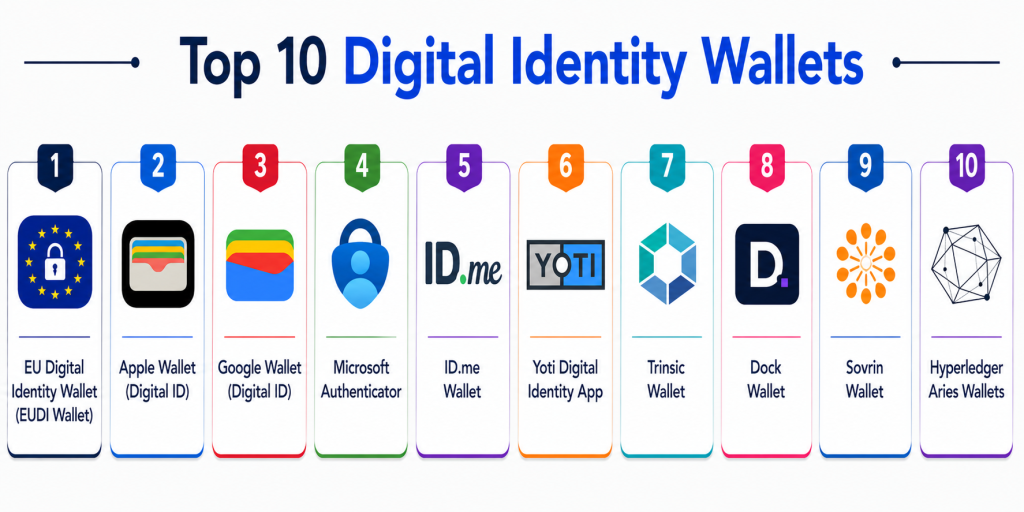
Top 10 Digital Identity Wallets
#1 — EU Digital Identity Wallet
Short description: A government-backed digital identity wallet enabling citizens to store and share verified credentials across services and borders.
Key Features
- Government-issued digital ID storage
- Cross-border identity verification
- Secure credential sharing
- Digital signatures
- Privacy-first design
Pros
- Strong regulatory backing
- High trust level
- Interoperability focus
- Secure and privacy-centric
Cons
- Region-specific
- Implementation still evolving
- Limited outside ecosystem
- Adoption varies
Platforms / Deployment
Mobile (iOS / Android)
Cloud
Security & Compliance
GDPR-aligned, encryption, identity verification standards
Integrations & Ecosystem
Integrates with government services and private sector platforms
- Public services
- Banking systems
- Digital platforms
Support & Community
Government-backed support and ecosystem
#2 — Apple Wallet (Digital ID)
Short description: Apple Wallet allows users to store digital IDs and credentials alongside payment cards in a secure ecosystem.
Key Features
- Digital ID storage
- Secure enclave encryption
- Biometric authentication
- Integration with Apple ecosystem
- Credential sharing
Pros
- Strong security
- User-friendly
- Wide adoption
- Seamless integration
Cons
- Limited regional availability
- Apple ecosystem dependency
- Restricted customization
- Limited enterprise control
Platforms / Deployment
iOS
Device-based / Cloud
Security & Compliance
Biometric authentication, encryption, secure enclave
Integrations & Ecosystem
- Apple ecosystem
- Payment systems
- Apps and services
Support & Community
Extensive user and developer ecosystem
#3 — Google Wallet (Digital ID)
Short description: Google Wallet provides digital identity storage and verification integrated with Android devices.
Key Features
- Digital ID storage
- Secure credential sharing
- Biometric authentication
- Integration with Android ecosystem
- API support
Pros
- Widely accessible
- Easy to use
- Strong integration
- Scalable
Cons
- Limited availability in some regions
- Dependency on Google services
- Privacy concerns for some users
- Limited enterprise customization
Platforms / Deployment
Android
Cloud
Security & Compliance
Encryption, biometric authentication
Integrations & Ecosystem
- Google services
- Apps and platforms
- Payment systems
Support & Community
Large ecosystem support
#4 — Microsoft Authenticator
Short description: Microsoft Authenticator supports identity verification and credential storage for enterprise and consumer use.
Key Features
- Identity authentication
- Credential storage
- Multi-factor authentication
- Secure login
- Integration with Microsoft services
Pros
- Strong enterprise adoption
- Secure authentication
- Easy integration
- Scalable
Cons
- Limited identity wallet features
- Focused on authentication
- Not full SSI wallet
- Microsoft ecosystem dependency
Platforms / Deployment
iOS / Android
Cloud
Security & Compliance
MFA, encryption, secure login
Integrations & Ecosystem
- Microsoft services
- Enterprise systems
- Cloud platforms
Support & Community
Enterprise-grade support
#5 — ID.me Wallet
Short description: ID.me provides identity verification and credential management for secure access to services.
Key Features
- Identity verification
- Credential storage
- Risk scoring
- Secure login
- Compliance tools
Pros
- Trusted identity provider
- Strong verification
- Scalable
- Widely used
Cons
- Region-focused
- Limited customization
- Pricing varies
- Integration required
Platforms / Deployment
Web / Mobile
Cloud
Security & Compliance
Encryption, identity verification controls
Integrations & Ecosystem
- Government services
- Financial platforms
- Healthcare systems
Support & Community
Professional support available
#6 — Yoti Digital Identity App
Short description: Yoti offers a privacy-focused digital identity wallet for individuals and businesses.
Key Features
- Identity verification
- Document storage
- Age verification
- Secure sharing
- Biometric authentication
Pros
- Privacy-focused
- Easy to use
- Scalable
- Strong user control
Cons
- Limited enterprise depth
- Regional availability
- Integration effort
- Pricing varies
Platforms / Deployment
iOS / Android
Cloud
Security & Compliance
Encryption, biometric verification
Integrations & Ecosystem
- Retail platforms
- Online services
- Compliance systems
Support & Community
Support available
#7 — Trinsic Wallet
Short description: Trinsic provides a decentralized identity wallet based on self-sovereign identity principles.
Key Features
- Verifiable credentials
- Decentralized identity
- Secure storage
- API integration
- Credential sharing
Pros
- SSI-focused
- Developer-friendly
- Scalable
- Flexible
Cons
- Requires technical expertise
- Limited mainstream adoption
- Integration required
- Setup complexity
Platforms / Deployment
Web / Mobile
Cloud
Security & Compliance
Cryptographic verification
Integrations & Ecosystem
- Identity frameworks
- APIs
- Blockchain systems
Support & Community
Developer community support
#8 — Dock Wallet
Short description: Dock Wallet enables decentralized identity management using blockchain-based credentials.
Key Features
- Verifiable credentials
- Blockchain integration
- Secure storage
- Identity sharing
- API support
Pros
- Decentralized approach
- Secure
- Scalable
- Flexible
Cons
- Technical complexity
- Limited adoption
- Requires integration
- Setup effort
Platforms / Deployment
Web / Mobile
Cloud
Security & Compliance
Cryptographic security
Integrations & Ecosystem
- Blockchain platforms
- Identity systems
- APIs
Support & Community
Developer-focused support
#9 — Sovrin Wallet
Short description: Sovrin Wallet supports decentralized identity with a focus on trust frameworks and verifiable credentials.
Key Features
- SSI identity management
- Verifiable credentials
- Secure sharing
- Trust framework support
- Identity verification
Pros
- Strong SSI foundation
- Privacy-focused
- Scalable
- Open ecosystem
Cons
- Requires expertise
- Limited enterprise adoption
- Integration effort
- Setup complexity
Platforms / Deployment
Web / Mobile
Cloud
Security & Compliance
Cryptographic identity verification
Integrations & Ecosystem
- SSI frameworks
- Identity platforms
- APIs
Support & Community
Open-source community
#10 — Hyperledger Aries Wallets
Short description: Hyperledger Aries provides frameworks for building digital identity wallets and decentralized identity systems.
Key Features
- SSI frameworks
- Verifiable credentials
- Secure communication
- API integration
- Developer tools
Pros
- Open-source
- Highly flexible
- Scalable
- Strong developer ecosystem
Cons
- Requires development effort
- Not a ready-to-use product
- Technical complexity
- Setup required
Platforms / Deployment
Varies / N/A
Security & Compliance
Cryptographic security
Integrations & Ecosystem
- Blockchain platforms
- Identity frameworks
- APIs
Support & Community
Strong open-source community
Comparison Table
| Tool Name | Best For | Platform(s) Supported | Deployment | Standout Feature | Public Rating |
|---|---|---|---|---|---|
| EU Wallet | Government identity | Mobile | Cloud | Cross-border ID | N/A |
| Apple Wallet | Consumer use | iOS | Device/Cloud | Secure enclave | N/A |
| Google Wallet | Android users | Android | Cloud | Wide adoption | N/A |
| Microsoft Authenticator | Enterprise auth | Mobile | Cloud | MFA integration | N/A |
| ID.me | Identity verification | Web/Mobile | Cloud | Verified identity | N/A |
| Yoti | Privacy-focused identity | Mobile | Cloud | User control | N/A |
| Trinsic | SSI developers | Web/Mobile | Cloud | Decentralized identity | N/A |
| Dock | Blockchain identity | Web/Mobile | Cloud | Blockchain credentials | N/A |
| Sovrin | SSI ecosystem | Web/Mobile | Cloud | Trust framework | N/A |
| Hyperledger Aries | Developers | Varies | Varies | Open framework | N/A |
Evaluation & Scoring of Digital Identity Wallets
| Tool | Core | Ease | Integrations | Security | Performance | Support | Value | Weighted Total |
|---|---|---|---|---|---|---|---|---|
| EU Wallet | 9 | 7 | 8 | 9 | 8 | 8 | 8 | 8.4 |
| Apple Wallet | 8.5 | 9 | 8 | 9 | 9 | 8 | 8 | 8.6 |
| Google Wallet | 8.5 | 9 | 8 | 8 | 9 | 8 | 8 | 8.5 |
| Microsoft | 8 | 8.5 | 8 | 9 | 8.5 | 8 | 8 | 8.3 |
| ID.me | 8.5 | 8 | 8 | 8 | 8.5 | 8 | 8 | 8.3 |
| Yoti | 8 | 9 | 7.5 | 8.5 | 8 | 7.5 | 8.5 | 8.2 |
| Trinsic | 8.5 | 7.5 | 9 | 9 | 8.5 | 7.5 | 8 | 8.4 |
| Dock | 8 | 7 | 8.5 | 9 | 8 | 7.5 | 8 | 8.1 |
| Sovrin | 8 | 7 | 8 | 9 | 8 | 7.5 | 8 | 8.0 |
| Hyperledger | 9 | 6.5 | 9 | 9 | 8.5 | 7.5 | 8 | 8.3 |
How to interpret:
- Consumer wallets score higher on usability
- SSI platforms score higher on security and flexibility
- Enterprise tools balance integration and compliance
- Scores are comparative, not absolute benchmarks
Which Digital Identity Wallet Is Right for You?
Solo / Freelancer
Use Apple Wallet, Google Wallet, or Yoti for personal identity management.
SMB
Choose ID.me or Yoti for simple verification workflows.
Mid-Market
Consider Trinsic or Dock for scalable identity solutions.
Enterprise
Use Microsoft Authenticator or Trinsic-based solutions for identity infrastructure.
Budget vs Premium
Consumer wallets are free; enterprise solutions require investment.
Feature Depth vs Ease of Use
SSI platforms offer depth; consumer wallets focus on simplicity.
Integrations & Scalability
Ensure compatibility with apps, platforms, and APIs.
Security & Compliance Needs
Critical—ensure encryption, biometrics, and regulatory alignment.
Frequently Asked Questions (numbring)
1. What is a digital identity wallet?
It is an app that stores and manages verified digital identity credentials securely.
2. Why is it important?
It enables secure, fast identity verification and reduces data sharing risks.
3. Who uses these wallets?
Individuals, governments, enterprises, and fintech platforms.
4. What credentials can be stored?
IDs, licenses, certificates, and authentication credentials.
5. Are these wallets secure?
Yes, they use encryption, biometrics, and cryptographic verification.
6. Do they support global use?
Some support cross-border identity, while others are region-specific.
7. What is SSI?
Self-sovereign identity allows users to control their own data.
8. How do they integrate with apps?
Through APIs and identity frameworks.
9. Are they required?
Not always, but adoption is increasing globally.
10. What are alternatives?
Traditional identity verification systems and centralized databases.
Conclusion
Digital Identity Wallets are transforming how identity is managed in the digital world.
They provide secure, user-controlled identity verification and reduce reliance on centralized systems.
Consumer wallets like Apple and Google offer convenience and accessibility.
Enterprise and SSI platforms enable deeper identity infrastructure and flexibility.
The right solution depends on use case, scale, and regulatory environment.
Organizations should evaluate security, interoperability, and integration capabilities carefully.
Pilot implementations can help validate usability and compliance readiness.
As adoption grows, digital identity wallets will become a core component of digital ecosystems.
Ultimately, the best wallet aligns with your identity strategy and operational needs.
This blog clearly explains digital identity wallets and how they improve secure identity verification and privacy protection online.