Introduction
Reverse Proxy Tools are infrastructure components that sit between clients and backend servers, managing incoming requests and forwarding them to the appropriate services. In simple terms, a reverse proxy acts as a traffic controller, improving performance, security, and scalability of applications.
With the rise of cloud-native architectures, microservices, and API-driven platforms, reverse proxies have become essential for handling modern traffic patterns. They help organizations manage load distribution, enable SSL termination, provide caching, and protect backend systems from direct exposure.
Common use cases include:
- Routing web traffic to multiple backend servers
- Enabling SSL termination and encryption handling
- Improving performance through caching and compression
- Protecting applications with security filtering
- Supporting microservices and API gateways
What buyers should evaluate:
- Layer 7 routing capabilities
- Performance and latency handling
- Security features like TLS, authentication, and filtering
- Ease of configuration and automation
- Integration with containers and cloud platforms
- Scalability and high availability
- Observability and logging
- Support for modern protocols
Best for: DevOps engineers, cloud architects, backend developers, and enterprises running distributed applications or microservices.
Not ideal for: Small static deployments with minimal traffic or applications that do not require advanced routing or security layers.
Key Trends in Reverse Proxy Tools
- Cloud-native adoption: Increasing use of reverse proxies within Kubernetes and container environments
- API-first architectures: Reverse proxies are evolving into API gateways
- Security integration: Built-in protection features like rate limiting and access control
- Automation and dynamic configuration: Real-time updates without downtime
- Edge computing support: Handling traffic closer to users for reduced latency
- Zero Trust architecture alignment: Identity-aware routing and authentication
- Observability enhancements: Better metrics, logs, and tracing capabilities
- Protocol evolution: Growing support for HTTP/3 and modern standards
- Performance optimization: Advanced caching and compression mechanisms
How We Selected These Tools (Methodology)
- Evaluated industry adoption and real-world usage
- Assessed feature depth across routing, security, and performance
- Considered support for cloud-native and container environments
- Reviewed scalability and reliability capabilities
- Analyzed integration ecosystems
- Included both open-source and enterprise-grade solutions
- Considered ease of deployment and configuration
- Evaluated community and vendor support
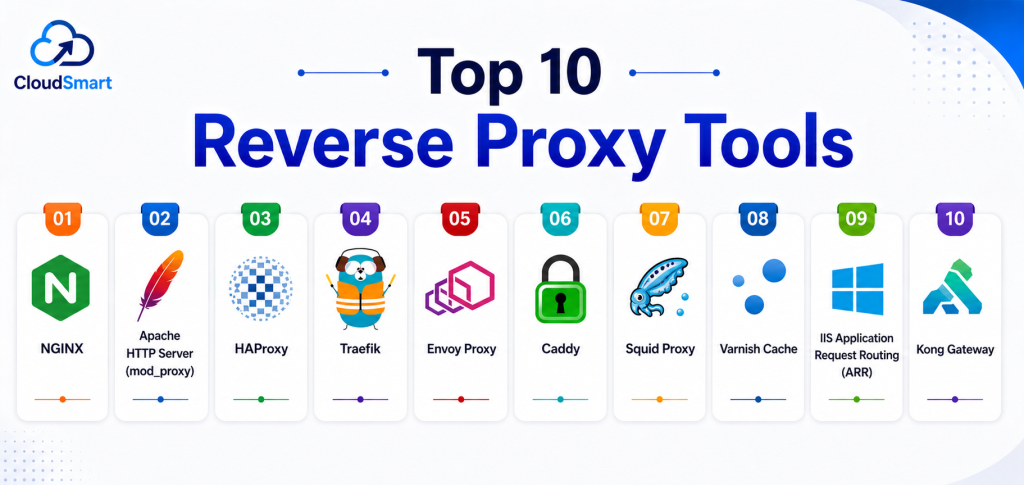
Top 10 Reverse Proxy Tools
#1 — NGINX
Short description: A highly popular reverse proxy and web server known for performance and flexibility, widely used in both startups and enterprises.
Key Features
- Layer 7 reverse proxy
- SSL termination
- Load balancing
- Caching and compression
- High concurrency handling
- Custom configuration
Pros
- Extremely fast and scalable
- Large community and ecosystem
Cons
- Requires configuration expertise
- Advanced features may need paid version
Platforms / Deployment
Linux / Windows
Self-hosted
Security & Compliance
TLS/SSL support, access controls
Not publicly stated certifications
Integrations & Ecosystem
NGINX integrates well with modern DevOps and cloud environments.
- Docker
- Kubernetes
- CI/CD tools
Support & Community
Very large community with extensive documentation.
#2 — Apache HTTP Server (mod_proxy)
Short description: A widely used web server with reverse proxy capabilities through mod_proxy modules.
Key Features
- Reverse proxy support
- SSL/TLS handling
- URL rewriting
- Load balancing
- Modular architecture
Pros
- Highly customizable
- Mature and stable
Cons
- Performance lower than some modern tools
- Complex configuration
Platforms / Deployment
Linux / Windows
Self-hosted
Security & Compliance
SSL/TLS support
Not publicly stated certifications
Integrations & Ecosystem
- PHP
- Web frameworks
- Enterprise stacks
Support & Community
Strong global community and long-term support.
#3 — HAProxy
Short description: A high-performance reverse proxy focused on reliability and advanced traffic routing.
Key Features
- Layer 4 and Layer 7 proxying
- Load balancing
- Health checks
- SSL termination
- Detailed logging
Pros
- Extremely fast and reliable
- Advanced routing capabilities
Cons
- Steep learning curve
- Limited GUI
Platforms / Deployment
Linux / Windows
Self-hosted
Security & Compliance
TLS support
Not publicly stated certifications
Integrations & Ecosystem
- Kubernetes
- Docker
- Monitoring tools
Support & Community
Strong open-source community.
#4 — Traefik
Short description: A modern reverse proxy designed for microservices and containerized environments.
Key Features
- Dynamic configuration
- Automatic service discovery
- Kubernetes integration
- SSL support
- Middleware support
Pros
- Easy integration with containers
- Real-time configuration updates
Cons
- Smaller ecosystem compared to older tools
- Limited legacy support
Platforms / Deployment
Cross-platform
Cloud / Self-hosted
Security & Compliance
TLS support
Not publicly stated certifications
Integrations & Ecosystem
- Docker
- Kubernetes
- Prometheus
Support & Community
Growing developer community.
#5 — Envoy Proxy
Short description: A high-performance proxy designed for cloud-native applications and service mesh architectures.
Key Features
- Layer 7 proxy
- Service mesh integration
- Observability tools
- Dynamic configuration
- High performance
Pros
- Ideal for microservices
- Strong observability
Cons
- Complex setup
- Requires expertise
Platforms / Deployment
Cross-platform
Self-hosted
Security & Compliance
TLS support
Not publicly stated certifications
Integrations & Ecosystem
- Kubernetes
- Istio
- Prometheus
Support & Community
Strong open-source backing.
#6 — Caddy
Short description: A user-friendly reverse proxy with automatic HTTPS support and simple configuration.
Key Features
- Automatic SSL provisioning
- Reverse proxy support
- HTTP/2 and HTTP/3 support
- Simple configuration
- Fast performance
Pros
- Easy to set up
- Built-in HTTPS
Cons
- Smaller ecosystem
- Limited enterprise features
Platforms / Deployment
Cross-platform
Self-hosted
Security & Compliance
TLS encryption
Not publicly stated certifications
Integrations & Ecosystem
- Docker
- Cloud platforms
Support & Community
Active but smaller community.
#7 — Squid Proxy
Short description: A caching proxy often used for web performance optimization and traffic control.
Key Features
- Caching capabilities
- Access control
- Traffic filtering
- Performance optimization
Pros
- Strong caching performance
- Flexible control
Cons
- Not focused purely on reverse proxy
- Complex setup
Platforms / Deployment
Linux / Windows
Self-hosted
Security & Compliance
Access control features
Not publicly stated certifications
Integrations & Ecosystem
- Enterprise networks
- Monitoring tools
Support & Community
Established open-source community.
#8 — Varnish Cache
Short description: A reverse proxy focused on high-performance caching for web applications.
Key Features
- HTTP caching
- Reverse proxy support
- High performance
- Custom caching rules
Pros
- Extremely fast caching
- Reduces server load
Cons
- Limited to HTTP
- Requires configuration expertise
Platforms / Deployment
Linux
Self-hosted
Security & Compliance
Not publicly stated
Integrations & Ecosystem
- Web servers
- CDNs
Support & Community
Strong community support.
#9 — IIS Application Request Routing (ARR)
Short description: A Microsoft-based reverse proxy solution for routing and load balancing in Windows environments.
Key Features
- Reverse proxy routing
- Load balancing
- SSL support
- Integration with IIS
Pros
- Easy integration with Windows stack
- User-friendly interface
Cons
- Limited to Windows
- Less flexible than open-source tools
Platforms / Deployment
Windows
Self-hosted
Security & Compliance
TLS support
Not publicly stated certifications
Integrations & Ecosystem
- Microsoft ecosystem
- IIS applications
Support & Community
Enterprise and Microsoft support available.
#10 — Kong Gateway
Short description: An API gateway built on reverse proxy principles, designed for managing APIs at scale.
Key Features
- API gateway functionality
- Reverse proxy capabilities
- Plugin architecture
- Authentication and rate limiting
- Monitoring tools
Pros
- Ideal for API management
- Highly extensible
Cons
- Requires setup and configuration
- More complex than basic proxies
Platforms / Deployment
Cross-platform
Cloud / Self-hosted
Security & Compliance
Authentication and access control
Not publicly stated certifications
Integrations & Ecosystem
- Kubernetes
- Cloud platforms
- API ecosystems
Support & Community
Strong community and enterprise support options.
Comparison Table
| Tool Name | Best For | Platform(s) Supported | Deployment | Standout Feature | Public Rating |
|---|---|---|---|---|---|
| NGINX | High performance | Linux/Windows | Self-hosted | Speed | N/A |
| Apache | Traditional apps | Linux/Windows | Self-hosted | Flexibility | N/A |
| HAProxy | High traffic | Linux/Windows | Self-hosted | Reliability | N/A |
| Traefik | Containers | Cross-platform | Hybrid | Dynamic config | N/A |
| Envoy | Microservices | Cross-platform | Self-hosted | Observability | N/A |
| Caddy | Simplicity | Cross-platform | Self-hosted | Auto HTTPS | N/A |
| Squid | Caching | Linux/Windows | Self-hosted | Filtering | N/A |
| Varnish | Performance | Linux | Self-hosted | Caching | N/A |
| IIS ARR | Windows | Windows | Self-hosted | Integration | N/A |
| Kong | APIs | Cross-platform | Hybrid | API gateway | N/A |
Evaluation & Scoring of Reverse Proxy Tools
| Tool Name | Core (25%) | Ease (15%) | Integrations (15%) | Security (10%) | Performance (10%) | Support (10%) | Value (15%) | Weighted Total |
|---|---|---|---|---|---|---|---|---|
| NGINX | 9 | 7 | 9 | 8 | 9 | 9 | 9 | 8.7 |
| Apache | 8 | 6 | 8 | 8 | 7 | 9 | 8 | 7.9 |
| HAProxy | 9 | 6 | 8 | 8 | 9 | 9 | 9 | 8.6 |
| Traefik | 8 | 8 | 8 | 7 | 8 | 7 | 9 | 8.0 |
| Envoy | 9 | 6 | 9 | 8 | 9 | 8 | 8 | 8.3 |
| Caddy | 7 | 9 | 7 | 7 | 8 | 7 | 9 | 7.9 |
| Squid | 7 | 6 | 7 | 7 | 8 | 8 | 8 | 7.4 |
| Varnish | 8 | 6 | 7 | 7 | 9 | 8 | 8 | 7.8 |
| IIS ARR | 7 | 8 | 7 | 7 | 7 | 8 | 7 | 7.3 |
| Kong | 9 | 7 | 9 | 8 | 8 | 8 | 7 | 8.2 |
How to interpret the scores:
These scores are comparative and based on typical usage scenarios across different environments. Higher scores indicate stronger overall capabilities, but the best choice depends on your specific requirements. Open-source tools often provide strong value, while enterprise-focused tools offer advanced features. Ease of use varies depending on technical expertise. Always validate tools with real-world testing before final selection.
Which Reverse Proxy Tool Is Right for You?
Solo / Freelancer
Caddy or NGINX are ideal due to simplicity and ease of setup.
SMB
HAProxy or Traefik provide a balance of performance and flexibility.
Mid-Market
NGINX or Kong are suitable for scaling applications and API management.
Enterprise
Envoy and Kong are ideal for complex microservices and API ecosystems.
Budget vs Premium
Open-source tools offer cost-effective solutions, while enterprise tools provide additional capabilities.
Feature Depth vs Ease of Use
Simple tools like Caddy focus on usability, while Envoy and Kong offer advanced features.
Integrations & Scalability
Kubernetes-native tools like Traefik and Envoy provide strong scalability.
Security & Compliance Needs
Enterprise tools and API gateways provide stronger security controls and governance.
Frequently Asked Questions (FAQs)
1. What is a reverse proxy?
A reverse proxy sits between clients and backend servers. It forwards requests and returns responses. It helps improve performance, security, and scalability.
2. How is a reverse proxy different from a forward proxy?
A reverse proxy protects servers, while a forward proxy protects clients. Reverse proxies handle incoming requests to servers. Forward proxies manage outgoing requests from users.
3. Why use a reverse proxy?
It improves performance, security, and reliability. It also enables load balancing and caching. This helps applications scale efficiently.
4. Can reverse proxies improve security?
Yes, they provide SSL termination, filtering, and access control. They also hide backend servers from direct exposure. This reduces attack surfaces.
5. Are reverse proxies necessary for microservices?
Yes, they are essential for routing traffic between services. They help manage complexity and scalability. Many tools are designed specifically for microservices.
6. Do reverse proxies support APIs?
Yes, they are widely used to manage API traffic. They provide routing, security, and monitoring. Some tools also act as API gateways.
7. What is SSL termination?
SSL termination is when the proxy handles encryption and decryption. This reduces load on backend servers. It also improves performance.
8. Can reverse proxies cache content?
Yes, many reverse proxies include caching features. This reduces server load and improves response times. Tools like Varnish specialize in this.
9. Are reverse proxies cloud-friendly?
Yes, many tools integrate with cloud platforms. They support containerized environments and dynamic scaling. Cloud-native proxies are widely used.
10. What are common mistakes when using reverse proxies?
Misconfiguration and lack of monitoring are common issues. Not using caching or security features effectively can reduce benefits. Proper setup is essential.
Conclusion
Reverse Proxy Tools are a foundational component of modern application architectures, enabling efficient traffic management, enhanced security, and improved performance. From widely adopted solutions like NGINX and HAProxy to cloud-native tools such as Traefik and Envoy, organizations have a diverse range of options tailored to different needs. Open-source tools provide flexibility and cost efficiency, while API-focused platforms like Kong add advanced governance and extensibility. The right choice depends on factors such as deployment environment, traffic scale, technical expertise, and integration requirements. Smaller teams may prioritize ease of use and quick setup, whereas enterprises often focus on scalability, security, and observability. No single tool is universally best, and each excels in specific scenarios. A practical approach is to shortlist a few tools, test them in real environments, and evaluate how well they integrate into your workflows. This ensures a scalable, secure, and future-ready reverse proxy strategy.