Introduction
Change Data Capture (CDC) Tools are specialized platforms that enable organizations to track and replicate changes in data as they happen, capturing inserts, updates, and deletes from source databases or applications. Unlike traditional batch ETL processes, CDC ensures real-time data movement, reducing latency and enabling modern analytics, event-driven architectures, and multi-system synchronization.
CDC has become critical as enterprises increasingly rely on real-time insights, data lakes, cloud analytics, and microservices. These tools help maintain data consistency, reduce operational overhead, and enable near-instantaneous propagation of changes across data ecosystems.
Common use cases include:
- Streaming database updates to analytics platforms
- Synchronizing data across multiple databases
- Event-driven microservices architectures
- Real-time ETL pipelines
- Multi-cloud replication for high availability
What buyers should evaluate:
- Real-time vs near real-time replication
- Supported databases and data sources
- Scalability for high-volume transactional data
- Latency and performance metrics
- Integration with data warehouses, data lakes, and analytics tools
- Ease of deployment and monitoring
- Security and compliance capabilities
- Fault tolerance and recovery mechanisms
- Schema evolution support
- Cost and licensing models
Best for: Data engineers, architects, DevOps teams, and enterprises requiring high availability and real-time data replication.
Not ideal for: Low-transaction environments or use cases where batch ETL suffices.
Key Trends in CDC Tools
- Broad adoption of log-based CDC for minimal system impact
- Real-time streaming into data lakes and warehouses
- Cloud-native CDC for multi-cloud and hybrid deployments
- Automation and AI-assisted schema mapping
- Integration with event-driven and microservices architectures
- Zero-downtime replication for mission-critical systems
- Support for heterogeneous and legacy database systems
- Observability and monitoring dashboards
- Incremental replication for low-latency pipelines
- API-driven and low-code CDC pipelines
How We Selected These Tools (Methodology)
- Evaluated support for log-based and trigger-based CDC
- Assessed performance and latency
- Reviewed multi-database and cloud support
- Analyzed automation and schema handling capabilities
- Considered fault tolerance and error handling
- Evaluated integration with data lakes, warehouses, and analytics
- Reviewed scalability for enterprise workloads
- Assessed security, encryption, and compliance readiness
- Evaluated ease of deployment, monitoring, and maintenance
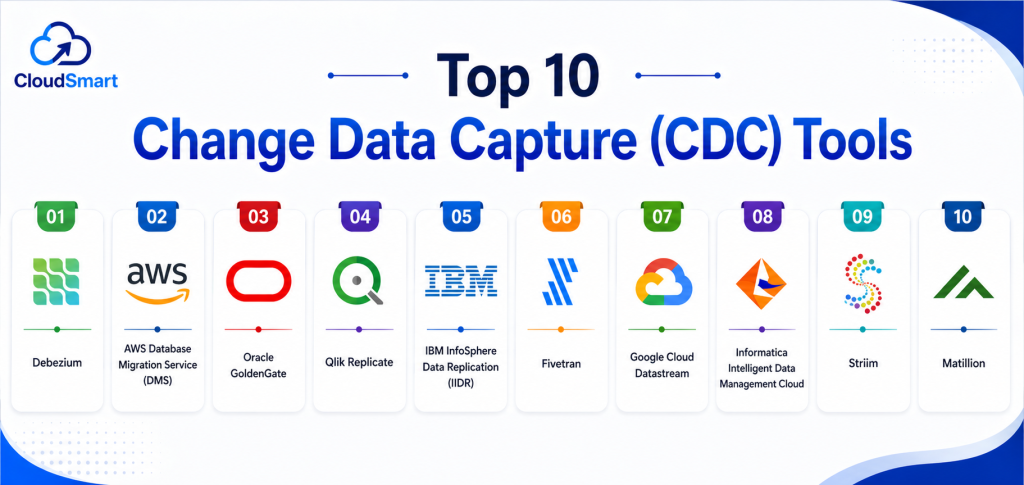
Top 10 Change Data Capture (CDC) Tools
#1 — Debezium
Short description:
Debezium is an open-source CDC platform that streams database changes using Kafka, enabling real-time replication across multiple systems.
Key Features
- Log-based CDC
- Real-time streaming to Kafka
- Schema evolution support
- Multi-database support
Pros
- Open-source and flexible
- Strong community
Cons
- Requires Kafka setup
- Maintenance overhead
Platforms / Deployment
Linux / Web
Cloud / Self-hosted
Security & Compliance
Varies / N/A
Integrations & Ecosystem
- Apache Kafka
- Microservices pipelines
Support & Community
Active open-source community.
#2 — AWS Database Migration Service (DMS)
Short description:
AWS DMS supports CDC for migrating and replicating databases with minimal downtime, integrating with AWS analytics and cloud ecosystems.
Key Features
- Continuous replication
- Multi-database support
- Minimal downtime migration
- Monitoring dashboards
Pros
- Seamless AWS integration
- Scalable
Cons
- AWS-centric
- Requires configuration
Platforms / Deployment
Web
Cloud
Security & Compliance
Encryption, IAM
Integrations & Ecosystem
- AWS services
- Databases
Support & Community
Extensive AWS support.
#3 — Oracle GoldenGate
Short description:
Oracle GoldenGate is an enterprise-grade CDC and replication tool that provides high-performance real-time data streaming across heterogeneous databases.
Key Features
- High-throughput replication
- Log-based CDC
- Cross-database replication
- High availability support
Pros
- Reliable enterprise performance
- Comprehensive feature set
Cons
- Complex deployment
- Premium pricing
Platforms / Deployment
Web / Linux
Cloud / Hybrid
Security & Compliance
Encryption, RBAC
Integrations & Ecosystem
- Oracle ecosystem
- Cloud platforms
Support & Community
Enterprise support.
#4 — Qlik Replicate
Short description:
Qlik Replicate simplifies CDC by providing GUI-based, real-time replication for multiple databases and data warehouses.
Key Features
- Log-based CDC
- GUI-driven setup
- Multi-source support
- Continuous replication
Pros
- Easy configuration
- Enterprise-ready
Cons
- Licensing cost
- Setup complexity
Platforms / Deployment
Web
Cloud / Hybrid
Security & Compliance
Encryption
Integrations & Ecosystem
- Data warehouses
- Cloud systems
Support & Community
Enterprise support.
#5 — IBM InfoSphere Data Replication (IIDR)
Short description:
IBM IIDR delivers real-time replication across heterogeneous databases and platforms, with strong enterprise features for performance and reliability.
Key Features
- Log-based CDC
- Multi-database support
- Low-latency replication
- High availability
Pros
- Reliable
- Enterprise integration
Cons
- Complex setup
- Costly
Platforms / Deployment
Web
Cloud / Hybrid
Security & Compliance
Encryption
Integrations & Ecosystem
- IBM ecosystem
- Enterprise platforms
Support & Community
Enterprise support.
#6 — Fivetran
Short description:
Fivetran offers fully managed CDC pipelines that automatically capture database changes and stream them to data warehouses or analytics platforms.
Key Features
- Managed connectors
- Real-time data sync
- Schema evolution handling
- Minimal setup
Pros
- Fully managed
- Easy deployment
Cons
- Usage-based pricing
- Limited deep customization
Platforms / Deployment
Web
Cloud
Security & Compliance
Encryption
Integrations & Ecosystem
- SaaS apps
- Data warehouses
Support & Community
Strong support.
#7 — Google Cloud Datastream
Short description:
Datastream provides serverless CDC replication for Google Cloud, enabling real-time streaming into analytics and storage systems.
Key Features
- Serverless CDC
- Real-time replication
- Integration with BigQuery
- Monitoring
Pros
- Fully managed
- Scalable
Cons
- Google Cloud dependency
- Limited outside ecosystem
Platforms / Deployment
Web
Cloud
Security & Compliance
Encryption
Integrations & Ecosystem
- Google Cloud
- Analytics platforms
Support & Community
Cloud support.
#8 — Informatica Intelligent Data Management Cloud
Short description:
Informatica provides enterprise-grade CDC with real-time replication, data quality, and governance capabilities.
Key Features
- CDC pipelines
- Data governance
- Real-time replication
- Error handling
Pros
- Enterprise-grade
- Data quality focus
Cons
- Premium pricing
- Complex configuration
Platforms / Deployment
Web
Cloud / Hybrid
Security & Compliance
Encryption, compliance
Integrations & Ecosystem
- Enterprise systems
- Cloud platforms
Support & Community
Enterprise support.
#9 — Striim
Short description:
Striim is a real-time streaming platform offering CDC, event processing, and integration for cloud and on-premises systems.
Key Features
- Real-time CDC
- Event-driven pipelines
- Multi-source support
- Monitoring
Pros
- Streaming and processing
- Flexible architecture
Cons
- Setup complexity
- Premium pricing
Platforms / Deployment
Web
Cloud / Hybrid
Security & Compliance
Encryption
Integrations & Ecosystem
- Cloud and on-prem systems
Support & Community
Enterprise support.
#10 — Matillion
Short description:
Matillion provides cloud-native ETL and CDC pipelines for data warehouses with transformation capabilities and automation.
Key Features
- Cloud-native replication
- ETL/CDC pipelines
- Data transformation
- Monitoring dashboards
Pros
- Cloud-native
- Transformation support
Cons
- Learning curve
- Cost
Platforms / Deployment
Web
Cloud
Security & Compliance
Encryption
Integrations & Ecosystem
- Snowflake
- Redshift
- BigQuery
Support & Community
Professional support.
Comparison Table
| Tool Name | Best For | Platform(s) Supported | Deployment | Standout Feature | Public Rating |
|---|---|---|---|---|---|
| Debezium | Open-source | Linux/Web | Cloud / Self-hosted | Kafka streaming | N/A |
| AWS DMS | AWS users | Web | Cloud | Continuous replication | N/A |
| GoldenGate | Enterprise | Web/Linux | Cloud / Hybrid | High-performance CDC | N/A |
| Qlik Replicate | Enterprise IT | Web | Hybrid | GUI-based CDC | N/A |
| IBM IIDR | Large enterprises | Web | Hybrid | Low-latency replication | N/A |
| Fivetran | SaaS pipelines | Web | Cloud | Managed CDC | N/A |
| Datastream | GCP users | Web | Cloud | Serverless CDC | N/A |
| Informatica | Enterprise | Web | Hybrid | Governance-focused | N/A |
| Striim | Streaming apps | Web | Hybrid | Event-driven CDC | N/A |
| Matillion | Cloud warehouses | Web | Cloud | Cloud-native ETL | N/A |
Evaluation & Scoring of CDC Tools
| Tool Name | Core | Ease | Integrations | Security | Performance | Support | Value | Weighted Total |
|---|---|---|---|---|---|---|---|---|
| Debezium | 8 | 6 | 8 | 7 | 8 | 7 | 9 | 7.8 |
| AWS DMS | 8 | 7 | 9 | 8 | 8 | 8 | 8 | 8.2 |
| GoldenGate | 9 | 6 | 9 | 9 | 9 | 9 | 7 | 8.3 |
| Qlik | 8 | 7 | 8 | 8 | 8 | 8 | 7 | 7.9 |
| IBM IIDR | 9 | 6 | 9 | 9 | 9 | 9 | 7 | 8.2 |
| Fivetran | 8 | 9 | 9 | 8 | 8 | 8 | 8 | 8.3 |
| Datastream | 8 | 8 | 8 | 8 | 8 | 8 | 7 | 8.0 |
| Informatica | 9 | 7 | 9 | 9 | 9 | 9 | 7 | 8.4 |
| Striim | 8 | 7 | 8 | 8 | 8 | 8 | 7 | 7.9 |
| Matillion | 8 | 7 | 8 | 8 | 8 | 8 | 7 | 7.9 |
Which CDC Tool Is Right for You?
Solo / Small Teams
Debezium or Matillion provide open-source and affordable options.
SMB
Fivetran and Striim balance ease of use and real-time replication.
Mid-Market
Qlik Replicate and Datastream offer enterprise features with moderate complexity.
Enterprise
GoldenGate, IBM IIDR, and Informatica deliver scalability, performance, and governance.
Budget vs Premium
Open-source tools are cost-effective; enterprise tools are premium.
Feature Depth vs Ease of Use
GoldenGate provides depth; Fivetran provides simplicity.
Integrations & Scalability
Enterprise tools integrate with multiple databases and cloud systems.
Security & Compliance Needs
Enterprise platforms offer strong encryption and regulatory compliance support.
Frequently Asked Questions
1. What is Change Data Capture (CDC)?
CDC is the process of capturing changes in data (inserts, updates, deletes) in real-time and replicating them to other systems.
2. Why is CDC important?
It enables real-time analytics, multi-system consistency, and low-latency data movement.
3. How does CDC differ from ETL?
ETL often runs in batches, whereas CDC captures changes continuously in near real-time.
4. What databases support CDC?
Most enterprise databases like Oracle, SQL Server, MySQL, PostgreSQL, and cloud databases support CDC.
5. Can CDC reduce downtime?
Yes, it allows near-zero downtime replication by syncing only changes instead of full datasets.
6. Are CDC tools secure?
Most enterprise CDC tools provide encryption and access control to secure replicated data.
7. Can CDC be used for analytics?
Yes, it feeds real-time data into warehouses, lakes, and analytics platforms.
8. Do these tools work in multi-cloud environments?
Many modern CDC tools support replication across multiple cloud platforms.
9. What is log-based CDC?
Log-based CDC reads database transaction logs to capture changes with minimal system load.
10. Who benefits most from CDC tools?
Enterprises with high-volume transactional databases, real-time analytics needs, and multi-system data synchronization.
Conclusion
Change Data Capture (CDC) Tools are essential for modern organizations that need real-time data replication, analytics, and synchronization across multiple databases and cloud platforms. From open-source platforms like Debezium to enterprise-grade solutions like Oracle GoldenGate and IBM IIDR, organizations can achieve high availability, low latency, and consistency for critical business data. Selecting the right CDC tool depends on your scale, technical expertise, and ecosystem requirements. Start with a clear replication strategy, evaluate pilot deployments, and ensure monitoring and security before full-scale adoption.