Introduction
Cloud Migration Tools are software platforms that help organizations move applications, data, and workloads from on-premises environments or legacy systems to cloud infrastructure such as AWS, Azure, or Google Cloud. These tools simplify migration by automating discovery, assessment, replication, testing, and cutover processes while minimizing downtime and risk.
As organizations modernize IT infrastructure, cloud migration has become a strategic priority. Businesses seek scalability, cost optimization, and improved performance, but migration can be complex without the right tooling. Cloud migration platforms enable structured transitions, reduce manual effort, and ensure that workloads are securely and efficiently transferred.
Common use cases include:
- Migrating legacy applications to cloud platforms
- Data center modernization and consolidation
- Hybrid cloud and multi-cloud adoption
- Disaster recovery and replication
- Cloud-native transformation initiatives
What buyers should evaluate:
- Migration automation capabilities
- Supported cloud providers and environments
- Downtime minimization and cutover strategy
- Data replication and synchronization
- Security and compliance features
- Integration with existing IT systems
- Cost optimization and monitoring tools
- Scalability for large workloads
- Ease of use and deployment
- Support and documentation
Best for: IT leaders, cloud architects, DevOps teams, and enterprises undergoing digital transformation.
Not ideal for: Small projects with minimal infrastructure or teams without cloud adoption plans.
Key Trends in Cloud Migration Tools
- Automated lift-and-shift migration workflows
- AI-driven workload assessment and optimization
- Multi-cloud and hybrid cloud migration support
- Real-time replication and minimal downtime migration
- Integration with DevOps and CI/CD pipelines
- Cloud cost optimization during migration
- Containerization and Kubernetes migration support
- Security-first migration with encryption and compliance
- Continuous migration and modernization strategies
- Observability and monitoring integration
How We Selected These Tools (Methodology)
- Evaluated migration automation and orchestration capabilities
- Assessed support for multiple cloud providers
- Reviewed replication and synchronization performance
- Analyzed security and compliance readiness
- Considered scalability for enterprise workloads
- Evaluated ease of use and onboarding
- Reviewed integration with DevOps and IT systems
- Assessed cost optimization features
- Considered vendor adoption and reliability
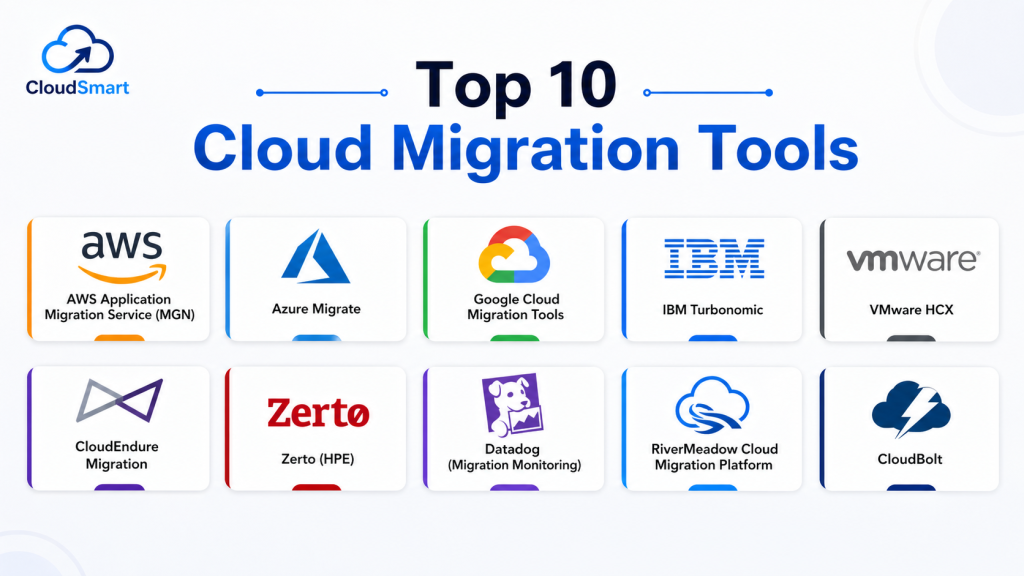
Top 10 Cloud Migration Tools
#1 — AWS Application Migration Service (MGN)
Short description:
AWS Application Migration Service enables automated lift-and-shift migration to AWS with minimal downtime. It continuously replicates source servers and simplifies migration at scale.
Key Features
- Automated server replication
- Lift-and-shift migration
- Minimal downtime cutover
- Migration testing
- Integration with AWS services
Pros
- Native AWS integration
- Highly scalable
Cons
- AWS-only focus
- Requires AWS expertise
Platforms / Deployment
Web
Cloud
Security & Compliance
Encryption, IAM integration
Integrations & Ecosystem
- AWS ecosystem
- DevOps tools
Support & Community
Extensive AWS documentation and support.
#2 — Azure Migrate
Short description:
Azure Migrate provides a centralized hub for discovering, assessing, and migrating workloads to Microsoft Azure. It supports servers, databases, and applications.
Key Features
- Discovery and assessment
- Migration orchestration
- Dependency mapping
- Cost estimation
- Integration with Azure tools
Pros
- End-to-end migration solution
- Strong Microsoft ecosystem
Cons
- Azure-specific
- Learning curve
Platforms / Deployment
Web
Cloud
Security & Compliance
Encryption, Azure security controls
Integrations & Ecosystem
- Azure services
- Microsoft tools
Support & Community
Enterprise support.
#3 — Google Cloud Migration Tools
Short description:
Google Cloud provides migration tools for transferring workloads, databases, and applications into Google Cloud with minimal disruption.
Key Features
- Data migration services
- Application migration
- Database migration
- Real-time replication
- Migration analytics
Pros
- Strong data migration capabilities
- Scalable
Cons
- Google Cloud dependency
- Setup complexity
Platforms / Deployment
Web
Cloud
Security & Compliance
Encryption
Integrations & Ecosystem
- Google Cloud services
Support & Community
Google Cloud support.
#4 — IBM Turbonomic
Short description:
IBM Turbonomic focuses on workload optimization and migration planning, ensuring applications are moved efficiently and perform well in cloud environments.
Key Features
- Workload optimization
- Migration planning
- Performance monitoring
- Cost optimization
Pros
- Strong analytics
- Optimization focus
Cons
- Not a pure migration tool
- Enterprise pricing
Platforms / Deployment
Web
Cloud
Security & Compliance
Encryption
Integrations & Ecosystem
- IBM cloud tools
- Hybrid environments
Support & Community
Enterprise support.
#5 — VMware HCX
Short description:
VMware HCX enables hybrid cloud migration by connecting on-premises VMware environments with cloud platforms for seamless workload transfer.
Key Features
- Hybrid cloud migration
- Workload mobility
- Network extension
- Disaster recovery
Pros
- Strong VMware integration
- Hybrid cloud support
Cons
- Requires VMware ecosystem
- Complexity
Platforms / Deployment
Web
Cloud / Hybrid
Security & Compliance
Encryption
Integrations & Ecosystem
- VMware tools
Support & Community
Enterprise support.
#6 — CloudEndure Migration
Short description:
CloudEndure provides continuous replication and automated migration to cloud environments, minimizing downtime and data loss.
Key Features
- Continuous replication
- Automated cutover
- Disaster recovery
- Minimal downtime
Pros
- Fast migration
- Reliable replication
Cons
- Limited UI
- AWS-focused
Platforms / Deployment
Web
Cloud
Security & Compliance
Encryption
Integrations & Ecosystem
- AWS
Support & Community
AWS support ecosystem.
#7 — Zerto (HPE)
Short description:
Zerto provides migration and disaster recovery solutions with real-time replication and failover capabilities for critical workloads.
Key Features
- Real-time replication
- Disaster recovery
- Migration orchestration
- Failover testing
Pros
- Strong DR capabilities
- High reliability
Cons
- Pricing
- Complexity
Platforms / Deployment
Web
Cloud / Hybrid
Security & Compliance
Encryption
Integrations & Ecosystem
- Enterprise systems
Support & Community
Enterprise support.
#8 — Datadog
Short description:
Datadog is primarily an observability platform but supports cloud migration by monitoring performance, dependencies, and system health during migration.
Key Features
- Monitoring and observability
- Dependency tracking
- Performance analytics
- Alerting
Pros
- Strong monitoring
- Useful during migration
Cons
- Not a migration tool
- Additional cost
Platforms / Deployment
Web
Cloud
Security & Compliance
Encryption
Integrations & Ecosystem
- DevOps tools
- Cloud platforms
Support & Community
Strong developer community.
#9 — RiverMeadow Cloud Migration Platform
Short description:
RiverMeadow provides automated migration for servers and applications across cloud environments, supporting multi-cloud strategies.
Key Features
- Automated migration
- Multi-cloud support
- Orchestration tools
- Monitoring
Pros
- Multi-cloud flexibility
- Automation
Cons
- Smaller ecosystem
- Pricing
Platforms / Deployment
Web
Cloud
Security & Compliance
Encryption
Integrations & Ecosystem
- Cloud platforms
Support & Community
Support available.
#10 — CloudBolt
Short description:
CloudBolt offers cloud management and migration tools with automation and governance features for hybrid and multi-cloud environments.
Key Features
- Cloud orchestration
- Migration automation
- Governance controls
- Cost management
Pros
- Strong automation
- Multi-cloud support
Cons
- Learning curve
- Pricing
Platforms / Deployment
Web
Cloud / Hybrid
Security & Compliance
Encryption
Integrations & Ecosystem
- Cloud providers
- IT systems
Support & Community
Enterprise support.
Comparison Table
| Tool Name | Best For | Platform(s) Supported | Deployment | Standout Feature | Public Rating |
|---|---|---|---|---|---|
| AWS MGN | AWS users | Web | Cloud | Lift-and-shift | N/A |
| Azure Migrate | Microsoft users | Web | Cloud | Centralized hub | N/A |
| Google Cloud Tools | GCP users | Web | Cloud | Data migration | N/A |
| IBM Turbonomic | Optimization | Web | Cloud | Performance analytics | N/A |
| VMware HCX | Hybrid cloud | Web | Hybrid | Workload mobility | N/A |
| CloudEndure | Fast migration | Web | Cloud | Continuous replication | N/A |
| Zerto | DR + migration | Web | Hybrid | Real-time replication | N/A |
| Datadog | Monitoring | Web | Cloud | Observability | N/A |
| RiverMeadow | Multi-cloud | Web | Cloud | Automation | N/A |
| CloudBolt | Governance | Web | Hybrid | Orchestration | N/A |
Evaluation & Scoring of Cloud Migration Tools
| Tool Name | Core | Ease | Integrations | Security | Performance | Support | Value | Weighted Total |
|---|---|---|---|---|---|---|---|---|
| AWS MGN | 9 | 7 | 9 | 9 | 9 | 9 | 7 | 8.4 |
| Azure Migrate | 9 | 7 | 9 | 9 | 9 | 9 | 7 | 8.4 |
| Google Tools | 8 | 7 | 8 | 9 | 9 | 8 | 7 | 8.0 |
| Turbonomic | 8 | 7 | 8 | 8 | 9 | 8 | 7 | 7.9 |
| VMware HCX | 9 | 6 | 9 | 9 | 9 | 9 | 7 | 8.3 |
| CloudEndure | 8 | 7 | 8 | 8 | 9 | 8 | 8 | 8.0 |
| Zerto | 9 | 6 | 8 | 9 | 9 | 9 | 7 | 8.2 |
| Datadog | 7 | 8 | 9 | 8 | 8 | 8 | 7 | 7.8 |
| RiverMeadow | 8 | 7 | 7 | 8 | 8 | 8 | 7 | 7.8 |
| CloudBolt | 8 | 7 | 8 | 8 | 8 | 8 | 7 | 7.9 |
How to interpret scores:
Scores reflect each tool’s migration capabilities, ease of use, integrations, and performance. Higher scores indicate better enterprise readiness, while others may be ideal for specific use cases like monitoring or hybrid environments. Choose based on your cloud strategy and infrastructure complexity.
Which Cloud Migration Tool Is Right for You?
Solo / Small Projects
CloudEndure and RiverMeadow offer simple migration workflows.
SMB
Azure Migrate and Google Cloud Tools provide accessible solutions.
Mid-Market
VMware HCX and CloudBolt support hybrid and multi-cloud environments.
Enterprise
AWS MGN, Zerto, and IBM Turbonomic deliver scalability and advanced analytics.
Budget vs Premium
CloudEndure is cost-effective; enterprise tools are premium.
Feature Depth vs Ease of Use
AWS MGN offers depth; Azure Migrate offers usability.
Integrations & Scalability
Enterprise tools provide extensive integrations.
Security & Compliance Needs
Cloud-native tools ensure encryption and compliance readiness.
Frequently Asked Questions
1. What is cloud migration?
Cloud migration is the process of moving data, applications, and workloads from on-premises systems to cloud platforms.
2. Why use migration tools?
They automate processes, reduce errors, and minimize downtime during migration.
3. What types of migration exist?
Lift-and-shift, re-platforming, and refactoring are common strategies.
4. How long does migration take?
Depends on workload size, complexity, and strategy.
5. Can migration tools reduce downtime?
Yes, many tools use replication to ensure minimal downtime.
6. Are these tools secure?
Yes, they use encryption and secure transfer protocols.
7. Do they support multi-cloud?
Some tools support multi-cloud environments.
8. What industries benefit most?
IT, finance, healthcare, and enterprise sectors benefit significantly.
9. Can I migrate databases?
Yes, most tools support database migration.
10. What is the biggest challenge?
Data integrity and downtime management are key challenges.
Conclusion
Cloud Migration Tools are essential for organizations transitioning to modern cloud environments. They simplify complex migration processes, reduce risk, and ensure efficient workload transfer. From cloud-native tools like AWS MGN and Azure Migrate to hybrid solutions like VMware HCX and Zerto, organizations have a wide range of options based on their needs. The right tool depends on your infrastructure, cloud provider preference, and migration strategy. Start by evaluating your workloads, testing migration scenarios, and validating integrations to ensure a smooth and successful transition to the cloud.