Introduction
Dependency Vulnerability Scanners help organizations detect security risks in open-source libraries, third-party packages, transitive dependencies, containers, software bills of materials, and application build artifacts. These tools are often called Software Composition Analysis tools because they identify which components are used inside an application and match them against known vulnerability databases, package advisories, license data, and supply chain risk signals.
They matter because modern applications depend heavily on open-source ecosystems such as npm, Maven, PyPI, Go, RubyGems, NuGet, Docker images, and Kubernetes packages. A vulnerable dependency can expose applications to remote code execution, data leakage, privilege escalation, compliance failures, and supply chain compromise. Strong dependency scanners now support pull request checks, CI/CD scanning, SBOM generation, license governance, container analysis, reachability insights, and automated remediation. Research comparing SCA tools has also found that tools can report very different results for the same application, so buyers should validate accuracy and not rely blindly on a single scanner.
Real-world use cases include:
- Detecting vulnerable open-source dependencies
- Scanning transitive dependencies in application builds
- Generating and validating SBOMs
- Enforcing license and security policies
- Blocking risky packages in CI/CD pipelines
Evaluation Criteria for Buyers
Organizations evaluating Dependency Vulnerability Scanners should consider:
- Package ecosystem coverage
- Vulnerability database quality
- Transitive dependency analysis
- False-positive control
- CI/CD and pull request integration
- SBOM generation and export
- Container and artifact scanning
- License compliance workflows
- Remediation guidance
- Enterprise reporting and governance
Best for: DevSecOps teams, application security teams, software developers, platform engineers, cloud security teams, SaaS companies, fintech organizations, healthcare companies, enterprises, and any team using third-party libraries in production applications.
Not ideal for: Teams with very small internal-only scripts and no third-party packages. Even then, lightweight scanning is still useful if the code uses package managers, containers, or infrastructure automation.
Key Trends in Dependency Vulnerability Scanners
- SBOM-first security is becoming standard as organizations need better dependency visibility across applications, containers, and software supply chains.
- Transitive dependency visibility is a major priority because many critical risks come from indirect packages rather than direct dependencies.
- Reachability analysis is becoming more important because teams want to know whether vulnerable code is actually used by the application.
- Container and artifact scanning are converging with dependency scanning as teams need one view across source code, images, packages, and deployment artifacts.
- License governance remains important because open-source risk is not only about CVEs but also legal and operational exposure.
- AI-assisted remediation is growing through automated upgrade recommendations, pull requests, and fix prioritization.
- False-positive reduction is still a buyer concern because noisy tools can slow developers and weaken trust in security findings.
- Policy enforcement is shifting left into pull requests, package registries, CI/CD pipelines, and developer IDEs.
- Software supply chain security is expanding beyond dependencies into provenance, package integrity, malicious packages, and build pipeline risks.
- Graph-based dependency analysis is gaining attention because dependency risk often spreads through complex multi-level relationships in modern software.
How We Selected These Tools
The following Dependency Vulnerability Scanners were selected based on practical DevSecOps relevance, ecosystem adoption, package coverage, reporting capabilities, and fit across enterprise, SMB, and developer-first environments.
- Strong support for common package ecosystems
- Ability to detect direct and transitive dependency vulnerabilities
- CI/CD and source control integration quality
- Vulnerability intelligence and remediation guidance
- SBOM generation or consumption support
- Container and artifact scanning support
- License and policy governance
- Developer usability and pull request workflows
- Enterprise reporting and audit visibility
- Balance between open-source and commercial options
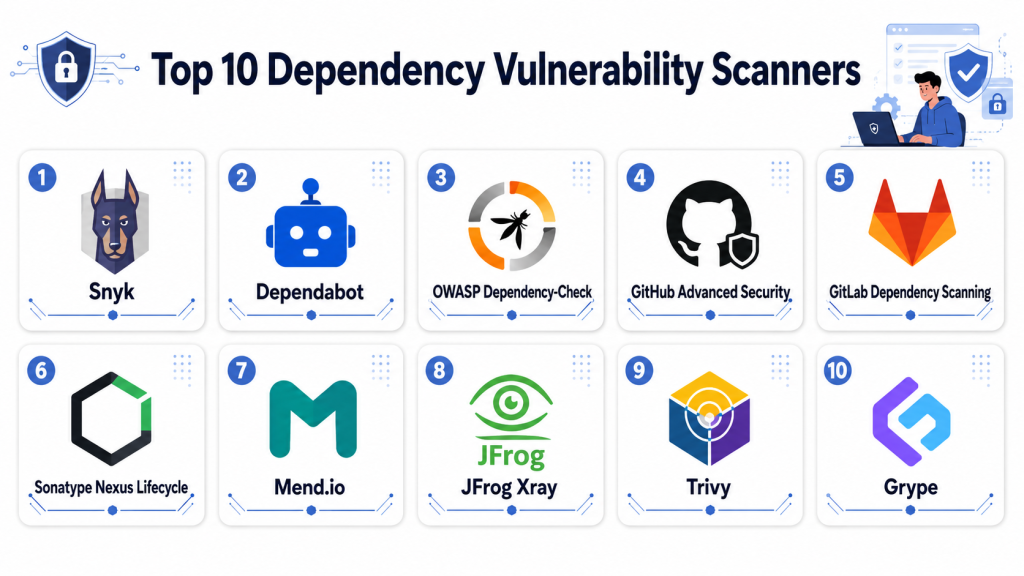
Top 10 Dependency Vulnerability Scanners
1- Snyk Open Source
Short description: Snyk Open Source is a developer-first dependency vulnerability scanner that helps teams find, prioritize, and fix vulnerable open-source packages across code repositories, CI/CD workflows, containers, and developer environments. It is widely used by application security and engineering teams that want fast feedback inside developer workflows.
Key Features
- Open-source dependency scanning
- Pull request vulnerability checks
- Transitive dependency analysis
- License risk detection
- Fix recommendations
- CI/CD and IDE integrations
- Container and IaC ecosystem support through related modules
Pros
- Strong developer experience
- Good remediation guidance
- Broad source control and CI/CD integrations
Cons
- Advanced enterprise governance requires paid plans
- Alert volume can grow in large repositories
- Best results require strong dependency ownership workflows
Platforms / Deployment
- Cloud / CLI / CI/CD / IDE
Security & Compliance
Supports access controls, policy workflows, audit visibility, vulnerability reporting, and remediation tracking. Specific certifications vary by product plan and deployment context.
Integrations & Ecosystem
Snyk integrates deeply with developer and DevSecOps workflows.
- GitHub
- GitLab
- Bitbucket
- Azure DevOps
- Jenkins
- IDE extensions
Support & Community
Large developer security ecosystem with strong documentation, support tiers, and active community usage.
2- GitHub Dependabot
Short description: GitHub Dependabot helps GitHub users detect vulnerable dependencies and automate dependency update pull requests. It is a strong native option for teams that already manage code inside GitHub and want dependency alerts directly within repository workflows.
Key Features
- Native GitHub dependency alerts
- Automated dependency update pull requests
- Security advisory matching
- Package ecosystem support
- Pull request-based remediation
- Repository-level visibility
- Integration with GitHub security workflows
Pros
- Native GitHub experience
- Easy to adopt for GitHub repositories
- Automated update workflows reduce manual work
Cons
- Best suited for GitHub-hosted code
- Governance may require GitHub Advanced Security or broader tooling
- Complex monorepos may need tuning
Platforms / Deployment
- Cloud
Security & Compliance
Supports GitHub-native security alerts, repository permissions, audit visibility, and dependency update workflows.
Integrations & Ecosystem
Dependabot fits naturally into GitHub development workflows.
- GitHub repositories
- GitHub Actions
- Pull requests
- GitHub Security Advisories
- Code scanning workflows
- Developer notifications
Support & Community
Strong GitHub ecosystem support with broad developer adoption and native documentation.
3- Mend SCA
Short description: Mend SCA, formerly known as WhiteSource, provides software composition analysis for open-source security, license compliance, dependency inventory, and remediation workflows. It is suited for enterprises that need strong policy governance and broad open-source management.
Key Features
- Open-source vulnerability detection
- License compliance management
- Dependency inventory
- Automated remediation guidance
- Policy enforcement
- Source control and CI/CD integrations
- Enterprise reporting dashboards
Pros
- Strong enterprise governance capabilities
- Good license compliance workflows
- Broad software supply chain visibility
Cons
- Enterprise setup can require planning
- Developer adoption depends on workflow integration
- Large environments may require policy tuning
Platforms / Deployment
- Cloud / Hybrid
Security & Compliance
Supports policy governance, audit reporting, access controls, and open-source risk management workflows.
Integrations & Ecosystem
Mend integrates with common DevSecOps and enterprise systems.
- GitHub
- GitLab
- Bitbucket
- Azure DevOps
- CI/CD platforms
- Issue tracking systems
Support & Community
Strong enterprise support ecosystem with documentation, onboarding, and customer success resources.
4- Black Duck SCA
Short description: Black Duck SCA is an enterprise software composition analysis platform focused on open-source security, license compliance, SBOM generation, and software supply chain visibility. It can identify dependencies in source code, binaries, containers, and artifacts, and its product material highlights SBOM import and export support using SPDX and CycloneDX formats.
Key Features
- Open-source dependency detection
- Vulnerability and license analysis
- Binary and snippet analysis
- SBOM import and export
- Container and artifact scanning
- Policy enforcement
- Enterprise risk reporting
Pros
- Strong enterprise SCA depth
- Good license and compliance workflows
- Useful for complex software supply chains
Cons
- Enterprise deployment can be complex
- Premium product positioning
- Requires operational ownership for best results
Platforms / Deployment
- Cloud / Hybrid / On-premises
Security & Compliance
Supports governance workflows, audit reporting, policy enforcement, open-source risk management, and SBOM workflows.
Integrations & Ecosystem
Black Duck integrates with enterprise development and security workflows.
- CI/CD platforms
- Source control systems
- Artifact repositories
- Container workflows
- SBOM systems
- Security dashboards
Support & Community
Strong enterprise support model with documentation, onboarding, and software supply chain security expertise.
5- GitLab Dependency Scanning
Short description: GitLab Dependency Scanning is GitLab’s native dependency vulnerability scanning capability within the GitLab DevSecOps platform. It helps teams detect vulnerable packages in projects and view findings inside merge requests and security dashboards.
Key Features
- GitLab-native dependency scanning
- Merge request security visibility
- CI/CD integration
- Vulnerability dashboards
- Dependency list visibility
- Security policy workflows
- Remediation tracking
Pros
- Strong GitLab workflow integration
- Good fit for GitLab CI/CD users
- Centralized DevSecOps visibility
Cons
- Best suited for GitLab environments
- Advanced capabilities depend on GitLab plan
- Custom workflows may require pipeline tuning
Platforms / Deployment
- Cloud / Self-managed / Dedicated
Security & Compliance
Supports GitLab-native vulnerability management, access controls, audit visibility, and CI/CD security workflows.
Integrations & Ecosystem
GitLab Dependency Scanning integrates across the GitLab software delivery lifecycle.
- GitLab CI/CD
- Merge requests
- GitLab security dashboards
- GitLab runners
- Vulnerability management workflows
- GitLab package workflows
Support & Community
Strong DevSecOps ecosystem with enterprise support, self-managed options, and detailed documentation.
6- OWASP Dependency-Check
Short description: OWASP Dependency-Check is an open-source software composition analysis tool that detects publicly disclosed vulnerabilities in application dependencies. Its repository describes it as an SCA utility that identifies dependencies and links them to associated CVE entries when a matching CPE identifier is found.
Key Features
- Open-source dependency scanning
- CVE matching
- Maven and Gradle support
- CI/CD integration
- HTML, XML, JSON, and other reports
- Suppression file support
- Local and pipeline scanning
Pros
- Free and widely used
- Good baseline scanner for CI pipelines
- Strong OWASP recognition
Cons
- False positives can require tuning
- CPE matching may be noisy for some ecosystems
- Enterprise remediation workflows are limited
Platforms / Deployment
- Linux / macOS / Windows / Self-hosted
Security & Compliance
Supports local scanning, CI/CD validation, and vulnerability reporting. Governance and compliance workflows depend on how teams integrate it into pipelines.
Integrations & Ecosystem
OWASP Dependency-Check works well in common build and pipeline environments.
- Maven
- Gradle
- Jenkins
- GitHub Actions
- GitLab CI
- Command-line workflows
Support & Community
Strong open-source and OWASP community support, with broad security-team familiarity.
7- OSV-Scanner
Short description: OSV-Scanner is an open-source vulnerability scanner built around the Open Source Vulnerabilities database. It is useful for developers and security teams that want ecosystem-aware vulnerability detection across dependency manifests, lockfiles, SBOMs, and source repositories.
Key Features
- Open-source vulnerability scanning
- Lockfile and manifest analysis
- SBOM scanning support
- Package ecosystem vulnerability matching
- CLI workflow support
- CI/CD integration
- Developer-friendly output
Pros
- Strong open-source model
- Useful for SBOM and lockfile workflows
- Good fit for lightweight CI integration
Cons
- Enterprise governance requires external tooling
- Remediation workflows are lighter than commercial platforms
- Best results depend on ecosystem support and data coverage
Platforms / Deployment
- Linux / macOS / Windows / Self-hosted
Security & Compliance
Supports local and pipeline-based vulnerability scanning. Compliance workflows depend on reporting integration and organizational process.
Integrations & Ecosystem
OSV-Scanner fits modern developer workflows.
- Git repositories
- CI/CD systems
- SBOM workflows
- Package manifests
- Lockfiles
- Developer scripts
Support & Community
Strong open-source ecosystem with developer-focused usage and vulnerability database alignment.
8- Anchore Enterprise
Short description: Anchore Enterprise provides container security, software composition analysis, SBOM management, and policy enforcement for cloud-native environments. It is a strong fit for teams that need dependency vulnerability scanning inside container and Kubernetes workflows.
Key Features
- Container image scanning
- Dependency vulnerability detection
- SBOM generation and analysis
- Policy enforcement
- Registry integration
- CI/CD scanning
- Kubernetes security workflows
Pros
- Strong container and SBOM focus
- Good policy-driven governance
- Useful for cloud-native security teams
Cons
- Best fit for container-heavy environments
- Enterprise setup requires planning
- Source-code SCA may need complementary tools
Platforms / Deployment
- Cloud / Self-hosted / Kubernetes
Security & Compliance
Supports RBAC, policy controls, audit reporting, vulnerability management, and SBOM governance workflows.
Integrations & Ecosystem
Anchore integrates with cloud-native and container security workflows.
- Kubernetes
- Docker
- Container registries
- CI/CD platforms
- SBOM tools
- Security dashboards
Support & Community
Strong container security ecosystem with enterprise support and open-source community roots.
9- Trivy
Short description: Trivy is an open-source security scanner that detects vulnerabilities in containers, file systems, Git repositories, dependency manifests, Kubernetes configurations, and Infrastructure as Code. It is widely used by DevOps and cloud-native teams looking for fast scanning in CI/CD workflows.
Key Features
- Container vulnerability scanning
- Dependency scanning
- Filesystem and repository scanning
- IaC misconfiguration detection
- Kubernetes scanning
- SBOM generation support
- CI/CD integration
Pros
- Lightweight and fast
- Strong cloud-native adoption
- Broad scanning coverage beyond dependencies
Cons
- Enterprise governance requires additional tooling
- Remediation workflows are limited compared to commercial platforms
- Large-scale reporting needs integration work
Platforms / Deployment
- Linux / macOS / Windows / Self-hosted / CI/CD
Security & Compliance
Supports local and pipeline-based scanning, vulnerability reporting, and cloud-native security checks.
Integrations & Ecosystem
Trivy integrates well into DevOps and container workflows.
- Docker
- Kubernetes
- GitHub Actions
- GitLab CI
- Jenkins
- Container registries
Support & Community
Large open-source community with strong cloud-native adoption and active usage.
10- Grype
Short description: Grype is an open-source vulnerability scanner for container images, filesystems, SBOMs, and application dependencies. It is often used with Syft for SBOM generation and vulnerability analysis in CI/CD and container security workflows.
Key Features
- Container vulnerability scanning
- Filesystem scanning
- SBOM vulnerability analysis
- Package matching
- CI/CD integration
- Command-line workflows
- Multiple output formats
Pros
- Strong SBOM-focused workflows
- Lightweight open-source scanner
- Good fit for container and artifact scanning
Cons
- Enterprise reporting requires external tooling
- Less complete governance than commercial SCA platforms
- Remediation tracking must be managed separately
Platforms / Deployment
- Linux / macOS / Windows / Self-hosted / CI/CD
Security & Compliance
Supports local and pipeline scanning, SBOM vulnerability analysis, and vulnerability reporting.
Integrations & Ecosystem
Grype integrates well with software supply chain and container workflows.
- Syft
- Docker
- Kubernetes
- CI/CD platforms
- SBOM pipelines
- Artifact repositories
Support & Community
Strong open-source ecosystem with practical adoption among cloud-native and DevSecOps teams.
Comparison Table
| Tool Name | Best For | Platform Supported | Deployment | Standout Feature | Public Rating |
|---|---|---|---|---|---|
| Snyk Open Source | Developer-first SCA | Cloud / CLI / CI/CD | Cloud | Remediation-focused developer workflows | N/A |
| GitHub Dependabot | GitHub-native dependency updates | GitHub Cloud | Cloud | Automated security pull requests | N/A |
| Mend SCA | Enterprise open-source governance | Cloud / Hybrid | Cloud / Hybrid | Policy and license governance | N/A |
| Black Duck SCA | Enterprise SBOM and license compliance | Cloud / Hybrid / On-premises | Hybrid | Deep SCA and SBOM workflows | N/A |
| GitLab Dependency Scanning | GitLab DevSecOps workflows | GitLab Cloud / Self-managed | Cloud / Self-managed | Native pipeline security scanning | N/A |
| OWASP Dependency-Check | Open-source baseline scanning | Linux / macOS / Windows | Self-hosted | CVE-based dependency reports | N/A |
| OSV-Scanner | Open-source vulnerability matching | Linux / macOS / Windows | Self-hosted | OSV ecosystem vulnerability data | N/A |
| Anchore Enterprise | Container and SBOM governance | Cloud / Kubernetes | Cloud / Self-hosted | Container-first SBOM scanning | N/A |
| Trivy | Cloud-native scanning | Linux / macOS / Windows | Self-hosted / CI/CD | Broad container and dependency scanning | N/A |
| Grype | SBOM and container vulnerability scanning | Linux / macOS / Windows | Self-hosted / CI/CD | SBOM-driven vulnerability analysis | N/A |
Evaluation & Scoring of Dependency Vulnerability Scanners
| Tool Name | Core 25% | Ease 15% | Integrations 15% | Security 10% | Performance 10% | Support 10% | Value 15% | Weighted Total |
|---|---|---|---|---|---|---|---|---|
| Snyk Open Source | 9 | 9 | 9 | 9 | 8 | 8 | 8 | 8.7 |
| GitHub Dependabot | 8 | 10 | 10 | 8 | 9 | 9 | 9 | 9.0 |
| Mend SCA | 9 | 7 | 9 | 9 | 8 | 8 | 7 | 8.2 |
| Black Duck SCA | 10 | 6 | 9 | 9 | 8 | 9 | 7 | 8.3 |
| GitLab Dependency Scanning | 8 | 8 | 9 | 8 | 8 | 8 | 8 | 8.2 |
| OWASP Dependency-Check | 7 | 7 | 7 | 7 | 7 | 7 | 10 | 7.5 |
| OSV-Scanner | 8 | 8 | 7 | 8 | 8 | 7 | 10 | 8.1 |
| Anchore Enterprise | 9 | 7 | 8 | 9 | 8 | 8 | 7 | 8.0 |
| Trivy | 8 | 9 | 8 | 8 | 9 | 8 | 10 | 8.6 |
| Grype | 8 | 8 | 8 | 8 | 8 | 7 | 10 | 8.3 |
These scores are comparative and should not be treated as a universal ranking. A GitHub-native team may get the fastest value from Dependabot, while an enterprise with strict license and SBOM requirements may prefer Black Duck, Mend, or Anchore. Open-source tools such as Trivy, Grype, OSV-Scanner, and OWASP Dependency-Check are excellent for lightweight CI/CD enforcement, but organizations usually need additional governance workflows for enterprise reporting, ownership, and remediation tracking. Because SCA tools can differ significantly in vulnerability reporting, buyers should test tools against representative applications before standardizing.
Which Dependency Vulnerability Scanner Is Right for You?
Solo / Freelancer
Solo developers should consider GitHub Dependabot, Trivy, OSV-Scanner, or OWASP Dependency-Check. These tools are easy to start with, work well in local or repository-based workflows, and can provide quick visibility into vulnerable packages without heavy setup.
SMB
Small and medium-sized businesses should evaluate Snyk, GitHub Dependabot, GitLab Dependency Scanning, Trivy, or Mend depending on their development platform. The priority should be easy CI/CD integration, actionable remediation guidance, and alerts that developers will actually fix.
Mid-Market
Mid-market organizations should prioritize Snyk, Mend, Anchore, Trivy, GitLab Dependency Scanning, or Black Duck depending on container usage, SBOM requirements, and compliance needs. These teams usually need more structured reporting, policy enforcement, and ownership mapping than small teams.
Enterprise
Large enterprises should evaluate Black Duck, Mend, Snyk, Anchore Enterprise, GitHub Dependabot, and GitLab Dependency Scanning. Enterprise buyers should focus on SBOM governance, license compliance, audit trails, policy enforcement, container coverage, and reporting across multiple business units.
Budget vs Premium
Open-source tools such as Trivy, Grype, OSV-Scanner, and OWASP Dependency-Check provide strong scanning value with low cost. Premium tools usually add centralized reporting, vulnerability intelligence, license workflows, remediation automation, role-based access, and enterprise support.
Feature Depth vs Ease of Use
Native tools like GitHub Dependabot and GitLab Dependency Scanning are easiest for teams already using those platforms. Enterprise SCA platforms provide deeper governance, while open-source scanners offer flexibility but require more internal process design.
Integrations & Scalability
Organizations should choose scanners that integrate with source control, CI/CD, package registries, container registries, SBOM pipelines, ticketing systems, and security dashboards. Large teams should also validate API support, ownership mapping, and policy automation.
Security & Compliance Needs
Regulated organizations should prioritize SBOM generation, audit reporting, license policy enforcement, vulnerability SLAs, exception workflows, and evidence collection. Teams should also assess whether the tool can detect shaded, bundled, copied, or hidden dependencies because some SCA tools may miss these cases.
Frequently Asked Questions FAQs
1- What are Dependency Vulnerability Scanners?
Dependency Vulnerability Scanners detect known security vulnerabilities in third-party libraries, open-source packages, containers, SBOMs, and application dependencies. They help teams identify risky components before those risks reach production.
2- Why are dependency scanners important?
Modern applications rely heavily on open-source packages, and vulnerable dependencies can create serious application security risks. Scanners help teams detect and fix these issues earlier in the development lifecycle.
3- What is Software Composition Analysis?
Software Composition Analysis is the process of identifying third-party and open-source components in software, then checking them for vulnerabilities, license risks, and supply chain issues.
4- Can dependency scanners detect transitive dependencies?
Yes. Many modern scanners detect both direct and transitive dependencies. This is important because many vulnerable packages enter applications indirectly through other libraries.
5- What is an SBOM?
An SBOM is a software bill of materials. It lists the components used in an application, helping teams understand dependency risk, license obligations, and supply chain exposure.
6- Do dependency scanners produce false positives?
Yes. False positives can happen because vulnerability matching depends on package metadata, version accuracy, ecosystem mapping, and vulnerability database quality. Teams should tune policies and validate high-risk findings.
7- Can dependency scanners integrate with CI/CD pipelines?
Yes. Most tools integrate with CI/CD systems, pull requests, source control platforms, container registries, and developer workflows so vulnerabilities can be detected before release.
8- Are open-source dependency scanners available?
Yes. OWASP Dependency-Check, OSV-Scanner, Trivy, and Grype are widely used open-source options for dependency and container vulnerability scanning.
9- What should organizations do after finding a vulnerable dependency?
They should assess severity, exploitability, reachability, business impact, and upgrade availability. Then they should patch, replace, mitigate, or document exceptions based on risk.
10- Which dependency vulnerability scanner is best for enterprise use?
Black Duck, Mend, Snyk, Anchore Enterprise, GitHub Dependabot, and GitLab Dependency Scanning are commonly evaluated for enterprise use. The best choice depends on development platform, compliance needs, SBOM requirements, and governance maturity.
Conclusion
Dependency Vulnerability Scanners are essential for modern DevSecOps because open-source packages, transitive dependencies, containers, and third-party components are now deeply embedded in almost every software product. The best scanner depends on the organization’s development ecosystem, compliance requirements, package languages, container usage, and remediation workflows. GitHub Dependabot and GitLab Dependency Scanning are strong native choices for teams using those platforms, while Snyk, Mend, and Black Duck provide broader commercial SCA workflows for vulnerability management, license governance, and enterprise reporting. Trivy, Grype, OSV-Scanner, and OWASP Dependency-Check are strong open-source options for lightweight scanning and CI/CD enforcement, especially when paired with clear triage and remediation ownership. Buyers should avoid selecting tools based only on feature lists or vulnerability counts because SCA results can vary across tools and ecosystems. A practical next step is to shortlist two or three scanners, run them against representative repositories and container images, compare false positives and missed findings, validate SBOM support, and confirm that developers can fix issues without slowing delivery.
I feel it would be useful to explain how these scanners fit into CI/CD pipelines without slowing down builds. That’s a real challenge.