Introduction
Research Data Management Platforms are software systems designed to store, organize, document, share, and preserve research data throughout its lifecycle, from data collection to long-term archiving. These platforms ensure that datasets remain accessible, reproducible, and compliant with research standards and policies.
In modern research environments, data is growing rapidly in volume and complexity. Institutions and researchers need structured systems to manage datasets efficiently while ensuring compliance with FAIR principles and funding requirements. These platforms provide centralized storage, metadata management, collaboration tools, and secure sharing, enabling better research outcomes and transparency.
Real-world use cases
- Managing research datasets and experiments
- Sharing data for collaboration and publication
- Ensuring compliance with funding and regulatory requirements
- Preserving data for long-term reuse
- Supporting reproducible research
What buyers should evaluate
- Data storage and scalability
- Metadata and documentation support
- Data sharing and collaboration features
- Compliance with research standards
- Integration with research tools and workflows
- Security and access control
- Ease of use and onboarding
- Cost and licensing
Best for: Researchers, universities, research labs, data scientists, and scientific institutions.
Not ideal for: Small projects without structured data workflows or long-term data needs.
Key Trends in Research Data Management Platforms
- AI-assisted metadata tagging and data classification
- Integration with analytics, AI, and data science tools
- Adoption of FAIR data principles
- Cloud-based data storage and sharing
- Automated data lifecycle management
- Increased focus on compliance and governance
- Collaboration across global research teams
- Support for large-scale datasets and big data
- Open science and data sharing initiatives
- API-first platforms for extensibility
How We Selected These Tools
- Evaluated adoption in academic and enterprise research
- Assessed data storage, sharing, and metadata capabilities
- Considered compliance and governance features
- Reviewed integration with research workflows
- Analyzed scalability for large datasets
- Evaluated usability for researchers and teams
- Considered open-source vs enterprise options
- Assessed overall value and flexibility
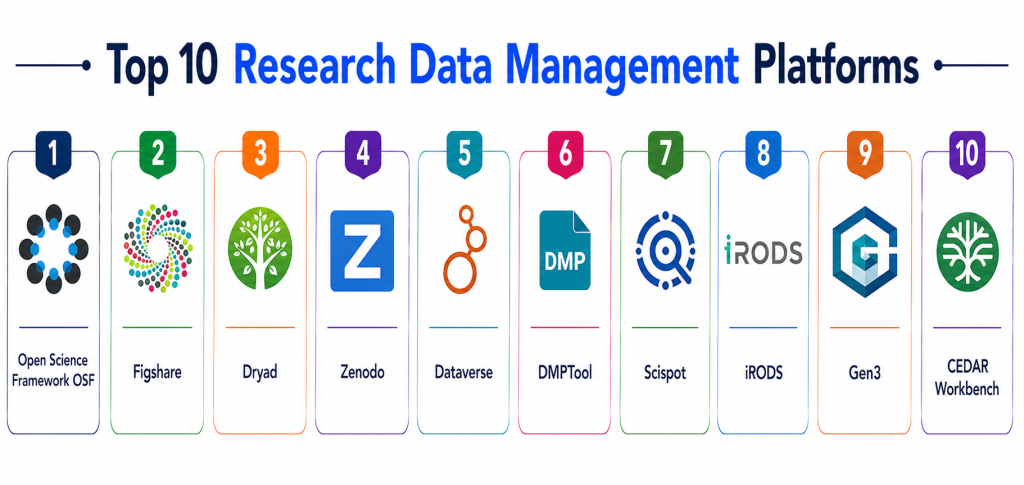
Top 10 Research Data Management Platforms
#1 — Open Science Framework OSF
Short description: OSF is an open platform that supports project management, collaboration, and data sharing for researchers across disciplines.
Key Features
- Project management
- Data sharing
- Version control
- Collaboration tools
- Integration with research tools
Pros
- Open and free
- Strong collaboration
- Flexible
Cons
- Limited enterprise features
- Basic UI
- Learning curve
Platforms / Deployment
- Web
- Cloud
Security & Compliance
- Not publicly stated
Integrations & Ecosystem
Supports integrations with research tools and storage systems.
- APIs
- Cloud storage
Support & Community
Strong academic community
#2 — Figshare
Short description: Figshare is a data repository platform that allows researchers to publish and share datasets with persistent identifiers.
Key Features
- Data publishing
- DOI assignment
- Metadata management
- Data sharing
- Analytics
Pros
- Easy publishing
- Strong visibility
- User-friendly
Cons
- Storage limits
- Pricing
- Limited customization
Platforms / Deployment
- Web
- Cloud
Security & Compliance
- Not publicly stated
Integrations & Ecosystem
Integrates with academic and publishing tools.
- APIs
- Research systems
Support & Community
Strong support
#3 — Dryad
Short description: Dryad is a curated data repository focused on publishing and preserving research data.
Key Features
- Data publishing
- Metadata curation
- Repository storage
- DOI support
- Compliance
Pros
- Trusted repository
- Easy to use
- Strong academic focus
Cons
- Paid submission
- Limited integrations
- Smaller ecosystem
Platforms / Deployment
- Web
- Cloud
Security & Compliance
- Not publicly stated
Integrations & Ecosystem
Supports integration with journals and research systems.
- APIs
- Publishing tools
Support & Community
Good academic support
#4 — Zenodo
Short description: Zenodo is an open-access repository developed to share research outputs across disciplines.
Key Features
- Data storage
- DOI assignment
- Version control
- Metadata support
- Open access
Pros
- Free to use
- Open access
- Easy sharing
Cons
- Limited enterprise features
- Storage limits
- Basic analytics
Platforms / Deployment
- Web
- Cloud
Security & Compliance
- Not publicly stated
Integrations & Ecosystem
Supports integration with research tools.
- APIs
- GitHub
Support & Community
Strong community
#5 — Dataverse
Short description: Dataverse is an open-source platform for sharing, preserving, and analyzing research data with citation support.
Key Features
- Data sharing
- Metadata management
- Data citation
- Repository hosting
- Analytics
Pros
- Open-source
- Strong citation system
- Scalable
Cons
- Technical setup
- Learning curve
- Requires management
Platforms / Deployment
- Web
- Cloud Self-hosted
Security & Compliance
- Not publicly stated
Integrations & Ecosystem
Supports integration with research tools.
- APIs
- Academic systems
Support & Community
Active community
#6 — DMPTool
Short description: DMPTool helps researchers create data management plans that comply with funding requirements.
Key Features
- Data management planning
- Templates
- Compliance support
- Collaboration
- Reporting
Pros
- Free
- Easy to use
- Compliance-focused
Cons
- Limited storage features
- Not a full RDM platform
- Basic functionality
Platforms / Deployment
- Web
- Cloud
Security & Compliance
- Supports compliance frameworks
Integrations & Ecosystem
Supports integration with research workflows.
- APIs
- Funding systems
Support & Community
Strong academic adoption
#7 — Scispot
Short description: Scispot is a modern platform designed for managing research data and laboratory workflows.
Key Features
- Data management
- Workflow automation
- Collaboration
- Analytics
- Integration
Pros
- Modern interface
- Scalable
- Flexible
Cons
- Pricing
- Smaller ecosystem
- Learning curve
Platforms / Deployment
- Web
- Cloud
Security & Compliance
- Not publicly stated
Integrations & Ecosystem
Supports integration with lab tools.
- APIs
- Data systems
Support & Community
Growing support
#8 — iRODS
Short description: iRODS is an open-source data management system with rule-based automation and virtualization features.
Key Features
- Data virtualization
- Rule engine
- Policy enforcement
- Metadata management
- Automation
Pros
- Highly flexible
- Scalable
- Open-source
Cons
- Complex setup
- Requires expertise
- Learning curve
Platforms / Deployment
- Web
- Self-hosted
Security & Compliance
- Policy enforcement features
Integrations & Ecosystem
Supports integration with distributed storage systems.
- APIs
- Data systems
Support & Community
Strong open-source support
#9 — Gen3
Short description: Gen3 is a data platform designed for managing and analyzing large-scale biomedical research data.
Key Features
- Data management
- Metadata handling
- Data sharing
- Analytics
- Security
Pros
- Scalable
- Research-focused
- Strong analytics
Cons
- Complex
- Technical setup
- Smaller ecosystem
Platforms / Deployment
- Web
- Cloud
Security & Compliance
- Not publicly stated
Integrations & Ecosystem
Supports integration with research systems.
- APIs
- Data platforms
Support & Community
Active research community
#10 — CEDAR Workbench
Short description: CEDAR Workbench focuses on metadata creation and standardization for research datasets.
Key Features
- Metadata management
- Data templates
- Standardization
- Integration
- Collaboration
Pros
- Strong metadata support
- Flexible
- Research-focused
Cons
- Limited storage features
- Smaller ecosystem
- Learning curve
Platforms / Deployment
- Web
- Cloud
Security & Compliance
- Not publicly stated
Integrations & Ecosystem
Supports integration with research tools.
- APIs
- Metadata tools
Support & Community
Academic support
Comparison Table Top 10
| Tool Name | Best For | Platform Supported | Deployment | Standout Feature | Public Rating |
|---|---|---|---|---|---|
| OSF | Collaboration | Web | Cloud | Project sharing | N/A |
| Figshare | Publishing | Web | Cloud | DOI support | N/A |
| Dryad | Academic | Web | Cloud | Curated datasets | N/A |
| Zenodo | Open access | Web | Cloud | Free repository | N/A |
| Dataverse | Data sharing | Web | Cloud Self-hosted | Citation system | N/A |
| DMPTool | Planning | Web | Cloud | Compliance templates | N/A |
| Scispot | Labs | Web | Cloud | Workflow mgmt | N/A |
| iRODS | Advanced users | Web | Self-hosted | Rule engine | N/A |
| Gen3 | Biomedical | Web | Cloud | Large-scale data | N/A |
| CEDAR | Metadata | Web | Cloud | Metadata standards | N/A |
Evaluation & Scoring of Research Data Management Platforms
| Tool Name | Core | Ease | Integrations | Security | Performance | Support | Value | Weighted Total |
|---|---|---|---|---|---|---|---|---|
| OSF | 9 | 8 | 8 | 7 | 8 | 8 | 9 | 8.4 |
| Figshare | 8 | 9 | 8 | 7 | 8 | 8 | 8 | 8.1 |
| Dryad | 8 | 9 | 7 | 7 | 8 | 8 | 7 | 7.9 |
| Zenodo | 8 | 9 | 7 | 7 | 8 | 8 | 9 | 8.2 |
| Dataverse | 9 | 7 | 8 | 7 | 8 | 8 | 9 | 8.3 |
| DMPTool | 7 | 9 | 7 | 7 | 7 | 8 | 10 | 8.0 |
| Scispot | 8 | 8 | 8 | 7 | 8 | 7 | 8 | 7.9 |
| iRODS | 9 | 6 | 9 | 8 | 9 | 7 | 9 | 8.3 |
| Gen3 | 9 | 6 | 8 | 8 | 9 | 7 | 8 | 8.1 |
| CEDAR | 8 | 7 | 7 | 7 | 8 | 7 | 8 | 7.7 |
Scores are comparative and reflect performance across usability, scalability, and research capabilities. Choose based on your research needs and data complexity.
Which Research Data Management Platform Is Right for You
Solo / Individual Researchers
Zenodo and Figshare are easy and free options.
SMB Research Teams
OSF and Scispot provide collaboration and flexibility.
Mid-Market Institutions
Dataverse and Dryad offer strong balance.
Enterprise / Large Research Organizations
iRODS and Gen3 are ideal for large datasets.
Budget vs Premium
Zenodo is budget-friendly, enterprise tools are premium.
Feature Depth vs Ease of Use
iRODS for depth, Figshare for simplicity.
Integrations & Scalability
Gen3 and Dataverse are strong options.
Security & Compliance Needs
Enterprise platforms provide stronger governance.
Frequently Asked Questions
1. What are research data management platforms
These platforms help store, organize, and share research data. They ensure data is accessible and reusable. This improves research quality.
2. Why are they important
They support reproducibility and compliance. They also improve collaboration. This ensures better research outcomes.
3. How do they work
They collect, store, and manage datasets. They also provide metadata and sharing tools. This improves accessibility.
4. Are they suitable for small teams
Yes, many tools are free and easy to use. They are suitable for small projects. They can scale with growth.
5. How much do they cost
Some tools are free, while others are paid. Pricing depends on storage and features. Enterprise tools are more expensive.
6. Do they support collaboration
Yes, most platforms include collaboration tools. Teams can share and manage data together. This improves efficiency.
7. How long does implementation take
It can take from hours to weeks. It depends on complexity and data size. Larger systems require more setup.
8. What are common mistakes
Poor metadata management is a common mistake. Lack of planning can also cause issues. Proper structure is important.
9. Are these platforms secure
Most tools provide access control and encryption. Security varies by provider. Compliance should be evaluated.
10. Are there alternatives
Alternatives include local storage or spreadsheets. However, they lack scalability and collaboration features.
Conclusion
Research Data Management Platforms have become essential for handling the growing complexity and scale of modern research data. These tools enable researchers and institutions to organize datasets, ensure compliance with funding requirements, and support collaboration and reproducibility across projects. From open-access platforms like Zenodo and OSF to advanced systems like iRODS and Gen3, each solution serves different needs depending on scale, technical requirements, and governance demands. The best choice depends on your research workflow, data size, and collaboration needs rather than a one-size-fits-all approach. Organizations should prioritize scalability, metadata management, and integration capabilities when selecting a platform. A practical next step is to shortlist a few tools, test them with real datasets, and evaluate how well they support long-term research goals and data governance strategies.
This blog clearly explains research data management platforms and how they improve data organization and collaboration workflows effectively.
Very informative comparison. Research data management platforms are becoming essential for secure and organized scientific research 👍