Introduction
Treasury Management Systems TMS are specialized financial platforms that help organizations manage cash flow, liquidity, payments, financial risk, and banking relationships. In simple terms, they act as the central hub for managing a company’s money—where it is, how it moves, and how it is optimized.
Modern businesses deal with multiple bank accounts, currencies, entities, and financial risks. Without a TMS, treasury teams rely on spreadsheets and disconnected systems, which increases risk and inefficiency. A TMS solves this by providing real-time cash visibility, automation, and risk management capabilities.
Common use cases include:
- Cash and liquidity management
- Payment processing and bank connectivity
- Cash flow forecasting
- FX and interest rate risk management
- Financial compliance and reporting
Key evaluation criteria:
- Cash visibility and forecasting accuracy
- Bank connectivity and payment automation
- Risk management capabilities
- Integration with ERP and financial systems
- Security and compliance controls
- Scalability for global operations
- Automation and AI features
- Ease of use and implementation
Best for: Enterprises, CFOs, treasury teams, multinational companies, and organizations managing complex financial operations.
Not ideal for: Small businesses with simple accounting needs or companies that do not manage multiple bank accounts or currencies.
Key Trends in Treasury Management Systems
- AI-powered cash forecasting and anomaly detection improving accuracy
- Real-time bank connectivity and APIs enabling instant visibility
- Cloud-based treasury platforms replacing legacy systems
- Automation of payments and reconciliation workflows
- Increased focus on fraud prevention and compliance
- Multi-entity and multi-currency management becoming standard
- Integration with ERP, CRM, and banking systems
- Advanced risk management including FX and hedging tools
- Centralized treasury operations across global organizations
- Predictive analytics for liquidity planning
How We Selected These Tools
- Market adoption and enterprise usage
- Coverage of core treasury functions
- Cash management and forecasting capabilities
- Integration with banks and ERP systems
- Risk and compliance features
- Automation and AI capabilities
- Scalability for global operations
- Customer support and reliability
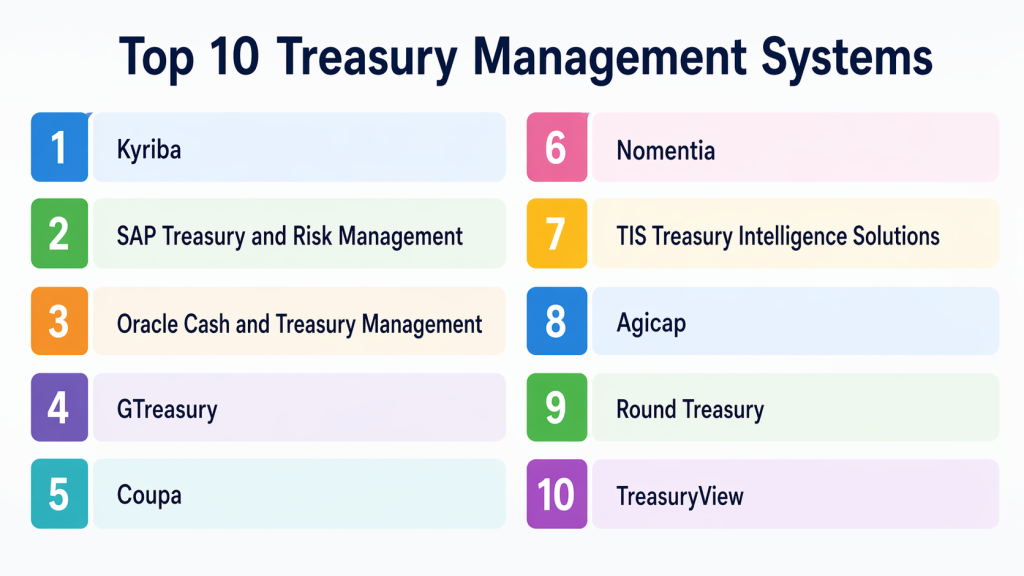
Top 10 Treasury Management Systems
1 — Kyriba
Short description:
Kyriba is one of the most comprehensive cloud-based treasury platforms used by large enterprises globally. It provides real-time cash visibility, liquidity management, and risk analytics. The platform is known for strong automation and forecasting. It is ideal for multinational organizations.
Key Features
- Cash and liquidity management
- Real-time forecasting
- Payments automation
- Risk management
- Fraud detection
Pros
- Comprehensive platform
- Strong analytics
Cons
- Expensive
- Complex implementation
Platforms / Deployment
Web
Cloud
Security & Compliance
Encryption, MFA, audit logs
Integrations & Ecosystem
- ERP systems
- Bank APIs
- Financial platforms
Support & Community
Enterprise-grade support.
2 — SAP Treasury and Risk Management
Short description:
SAP Treasury is an enterprise-grade solution integrated with SAP ERP. It provides advanced liquidity, risk, and payment management. It is best suited for organizations already using SAP systems. It offers deep financial integration.
Key Features
- Cash and liquidity management
- Risk and hedging tools
- Payment processing
- Financial reporting
- ERP integration
Pros
- Deep SAP integration
- Strong compliance
Cons
- Complex setup
- High cost
Platforms / Deployment
Web
Cloud / Hybrid
Security & Compliance
Encryption, audit logs
Integrations & Ecosystem
- SAP ecosystem
- Banking systems
Support & Community
Strong enterprise support.
3 — Oracle Treasury Management
Short description:
Oracle Treasury is part of Oracle’s financial suite, offering comprehensive treasury and risk management. It supports cash positioning, forecasting, and payments. It is designed for large enterprises. It integrates seamlessly with Oracle ERP.
Key Features
- Cash management
- Liquidity forecasting
- Risk management
- Payments automation
- Reporting
Pros
- Strong ERP integration
- Scalable
Cons
- Expensive
- Requires expertise
Platforms / Deployment
Web
Cloud
Security & Compliance
Encryption, compliance tools
Integrations & Ecosystem
- Oracle ERP
- Financial systems
Support & Community
Enterprise support.
4 — GTreasury
Short description:
GTreasury is an all-in-one treasury platform designed for mid-sized and large enterprises. It offers strong cash visibility, forecasting, and risk management. It balances usability and functionality. It is widely adopted.
Key Features
- Cash positioning
- Forecasting
- Risk management
- Payments automation
- Reporting
Pros
- Balanced features
- User-friendly
Cons
- Implementation effort
- Customization required
Platforms / Deployment
Web
Cloud
Security & Compliance
Encryption, access control
Integrations & Ecosystem
- ERP systems
- Banks
Support & Community
Strong support.
5 — FIS Treasury and Risk Manager
Short description:
FIS Treasury is a comprehensive platform for cash, liquidity, and risk management. It offers advanced analytics and automation. It is designed for large enterprises. It supports global treasury operations.
Key Features
- Cash management
- Risk management
- Debt and investment tracking
- Payments
- Reporting
Pros
- Enterprise-grade
- Strong analytics
Cons
- Complex
- Expensive
Platforms / Deployment
Web
Cloud
Security & Compliance
Encryption, compliance
Integrations & Ecosystem
- Banking systems
- ERP
Support & Community
Enterprise support.
6 — ION Treasury
Short description:
ION Treasury offers advanced treasury and risk management solutions. It is used by financial institutions and large enterprises. It focuses on automation and analytics. It is ideal for complex treasury environments.
Key Features
- Cash management
- Risk analytics
- Trading support
- Forecasting
- Automation
Pros
- Advanced analytics
- Highly scalable
Cons
- Complex
- High cost
Platforms / Deployment
Web
Cloud
Security & Compliance
Encryption, audit logs
Integrations & Ecosystem
- Financial systems
- APIs
Support & Community
Enterprise support.
7 — Coupa Treasury
Short description:
Coupa Treasury focuses on liquidity and risk management within the Coupa platform. It integrates procurement and treasury workflows. It is suitable for enterprises. It provides strong visibility and automation.
Key Features
- Cash visibility
- Risk management
- Payments
- Forecasting
- Analytics
Pros
- Strong integration
- Good visibility
Cons
- Limited standalone use
- Pricing varies
Platforms / Deployment
Web
Cloud
Security & Compliance
Encryption, access control
Integrations & Ecosystem
- Coupa platform
- ERP systems
Support & Community
Good support.
8 — Nomentia
Short description:
Nomentia is a modular treasury system designed for mid-sized and large enterprises. It focuses on cash visibility and payment automation. It offers flexibility and fast deployment. It is ideal for companies needing modular solutions.
Key Features
- Cash visibility
- Payment automation
- Forecasting
- Bank connectivity
- Fraud prevention
Pros
- Modular design
- Quick implementation
Cons
- Limited advanced risk features
- Requires multiple modules
Platforms / Deployment
Web
Cloud
Security & Compliance
Encryption, compliance
Integrations & Ecosystem
- ERP systems
- Banking APIs
Support & Community
Good support.
9 — TIS Treasury Intelligence Solutions
Short description:
TIS is a payment-focused treasury solution that enhances bank connectivity and payment workflows. It is ideal for companies with high transaction volumes. It focuses on security and compliance. It complements ERP systems.
Key Features
- Payment processing
- Bank connectivity
- Fraud detection
- Cash visibility
- Compliance
Pros
- Strong payments focus
- High security
Cons
- Limited full TMS features
- Focused scope
Platforms / Deployment
Web
Cloud
Security & Compliance
Encryption, fraud detection
Integrations & Ecosystem
- ERP systems
- Banks
Support & Community
Reliable support.
10 — Serrala
Short description:
Serrala is a finance automation platform with treasury capabilities. It focuses on payments, cash management, and risk control. It integrates well with SAP systems. It is suitable for mid-market and enterprise businesses.
Key Features
- Cash management
- Payment automation
- Risk management
- Bank connectivity
- Reporting
Pros
- Strong automation
- SAP integration
Cons
- Limited risk depth
- Integration complexity
Platforms / Deployment
Web
Cloud
Security & Compliance
Encryption, compliance
Integrations & Ecosystem
- SAP
- ERP systems
Support & Community
Good enterprise support.
Comparison Table
| Tool Name | Best For | Platforms Supported | Deployment | Standout Feature | Public Rating |
|---|---|---|---|---|---|
| Kyriba | Enterprise | Web | Cloud | Real-time cash visibility | N/A |
| SAP Treasury | Enterprise | Web | Hybrid | SAP integration | N/A |
| Oracle Treasury | Enterprise | Web | Cloud | ERP integration | N/A |
| GTreasury | Mid-market | Web | Cloud | Balanced features | N/A |
| FIS Treasury | Enterprise | Web | Cloud | Risk management | N/A |
| ION Treasury | Enterprise | Web | Cloud | Advanced analytics | N/A |
| Coupa Treasury | Enterprise | Web | Cloud | Procurement integration | N/A |
| Nomentia | Mid-market | Web | Cloud | Modular approach | N/A |
| TIS | Enterprise | Web | Cloud | Payment focus | N/A |
| Serrala | Enterprise | Web | Cloud | Automation | N/A |
Evaluation and Scoring of Treasury Management Systems
| Tool Name | Core 25% | Ease 15% | Integrations 15% | Security 10% | Performance 10% | Support 10% | Value 15% | Weighted Total |
|---|---|---|---|---|---|---|---|---|
| Kyriba | 9 | 7 | 9 | 9 | 9 | 8 | 6 | 8.3 |
| SAP | 9 | 6 | 9 | 9 | 9 | 8 | 6 | 8.2 |
| Oracle | 9 | 6 | 9 | 9 | 9 | 8 | 6 | 8.2 |
| GTreasury | 8 | 8 | 8 | 8 | 8 | 8 | 7 | 8.0 |
| FIS | 9 | 6 | 8 | 9 | 9 | 8 | 6 | 8.1 |
| ION | 9 | 6 | 8 | 9 | 9 | 8 | 6 | 8.1 |
| Coupa | 8 | 7 | 8 | 8 | 8 | 8 | 7 | 7.9 |
| Nomentia | 8 | 8 | 8 | 8 | 8 | 8 | 7 | 8.0 |
| TIS | 7 | 8 | 8 | 9 | 8 | 8 | 7 | 7.9 |
| Serrala | 8 | 7 | 8 | 8 | 8 | 8 | 7 | 7.9 |
These scores are comparative and help evaluate tools across features, usability, and value.
Which Treasury Management System Is Right for You
Solo / Startup
Not required; use accounting or FP&A tools instead.
SMB
Nomentia or GTreasury are good entry-level options.
Mid-Market
GTreasury and Serrala provide balance and scalability.
Enterprise
Kyriba, SAP, Oracle, and FIS are best.
Budget vs Premium
Nomentia is budget-friendly, Kyriba is premium.
Feature Depth vs Ease of Use
GTreasury offers balance, SAP offers depth.
Integrations and Scalability
SAP and Oracle excel.
Security and Compliance Needs
Kyriba and FIS are strong.
Frequently Asked Questions
1. What is a Treasury Management System?
A Treasury Management System helps businesses manage cash, liquidity, payments, and financial risk. It centralizes financial data and automates processes. It improves decision-making and efficiency.
2. Why do companies need a TMS?
Companies use TMS to gain real-time cash visibility, reduce risk, and automate treasury operations. It helps manage global financial complexity. It improves control over finances.
3. What features should a TMS have?
Key features include cash management, forecasting, payments, risk management, and reporting. Integration with banks and ERP systems is essential. Automation is also important.
4. Is TMS software expensive?
Most TMS tools are enterprise-level and can be costly. Pricing depends on features and scale. Some modular tools are more affordable.
5. Can TMS integrate with banks?
Yes, TMS platforms connect directly with banks and financial systems. This enables real-time data flow. It improves accuracy.
6. Does TMS support risk management?
Yes, TMS tools help manage FX, interest rate, and liquidity risks. They provide analytics and reporting. This helps reduce financial exposure.
7. Is training required?
Yes, most TMS tools require training due to complexity. Vendors provide support and documentation. Implementation may take time.
8. Can small businesses use TMS?
Small businesses usually do not need TMS. Simpler accounting tools are sufficient. TMS is better for larger organizations.
9. What are common challenges?
Challenges include integration complexity and high cost. Data accuracy and implementation time are also issues. Proper planning is essential.
10. Which TMS is best?
There is no single best tool. The choice depends on business size and needs. Testing tools is recommended.
Conclusion
Treasury Management Systems have become essential for organizations managing complex financial operations across multiple banks, currencies, and regions. These platforms provide real-time visibility into cash, automate payments, and help manage financial risks effectively. Enterprise solutions like Kyriba, SAP Treasury, Oracle, and FIS stand out for their scalability and advanced capabilities. Mid-market tools such as GTreasury and Nomentia offer a strong balance of usability and functionality. Specialized solutions like TIS and Serrala focus on payments and automation, addressing specific treasury needs. The right choice depends on your organization’s size, complexity, and integration requirements. It is important to evaluate forecasting accuracy, bank connectivity, and risk management features before selecting a tool.Running a pilot with real financial data can help validate performance and usability. A well-implemented TMS improves financial control, reduces risk, and enhances decision-making. Choosing the right system can transform treasury from a reactive function into a strategic advantage.
The article covers AI forecasting trends well, but an important missing angle is data quality governance. Most treasury forecasting failures are not caused by weak models — they come from inconsistent ERP mappings, duplicate entities, delayed transactional feeds, and poor master-data hygiene across subsidiaries. Without strong data contracts and validation pipelines, even premium TMS platforms end up becoming expensive reporting layers over unreliable financial data