Introduction
Search Relevance Tuning Tools are platforms and frameworks designed to improve how accurately search systems return results that match user intent. Instead of relying purely on keyword matching, these tools help optimize ranking using signals like semantics, user behavior, personalization, and contextual understanding.
In modern applications—especially AI-driven search, e-commerce, SaaS platforms, and enterprise knowledge systems—poor search relevance directly impacts user experience, engagement, and revenue. Organizations now treat search tuning as a continuous optimization process, not a one-time setup.
Common use cases include:
- Improving product search in e-commerce
- Enhancing enterprise knowledge search
- Optimizing AI-powered search assistants
- Personalizing content recommendations
- Supporting semantic and multilingual search
Key evaluation criteria:
- Control over ranking algorithms and boosting
- Support for semantic and vector search
- Ease of tuning without heavy engineering
- Integration with search engines and AI stacks
- Performance and scalability
- Experimentation and A/B testing capabilities
- Observability and relevance metrics
- Security and compliance
Best for: Search engineers, product teams, AI/ML teams, e-commerce platforms, SaaS companies, and enterprises with large content or data systems.
Not ideal for: Small websites with simple keyword-based search or projects without significant search traffic.
Key Trends in Search Relevance Tuning Tools for 2026 and Beyond
- Hybrid search combining lexical (BM25) and vector search
- AI-driven ranking optimization and auto-tuning
- Real-time feedback loops and continuous relevance improvement
- Query intent detection and personalization
- Integration with LLMs and RAG pipelines
- Experimentation platforms for A/B testing relevance
- Observability dashboards for search quality metrics
- Zero-result query detection and optimization
- Search analytics powered by behavioral data
- API-first and headless search architectures
How We Selected These Tools (Methodology)
- Evaluated adoption across search and AI ecosystems
- Assessed ranking control and tuning flexibility
- Compared support for semantic and vector search
- Reviewed observability and experimentation features
- Analyzed integrations with search engines and pipelines
- Considered usability for both engineers and analysts
- Included both open-source and enterprise tools
- Focused on scalability and real-world usage
- Balanced innovation with maturity
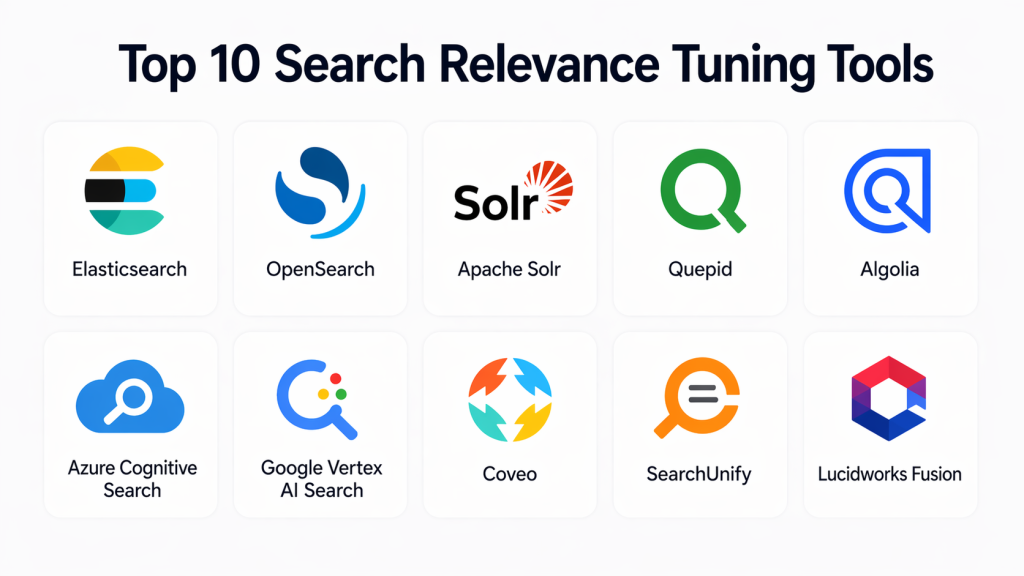
Top 10 Search Relevance Tuning Tools
#1 — Elasticsearch (Elastic Search Platform)
Short description:
Elasticsearch is a widely used search engine that provides powerful relevance tuning capabilities through analyzers, scoring models, and ranking controls.
Key Features
- BM25-based ranking
- Custom analyzers and tokenizers
- Boosting and scoring functions
- Query DSL
- Vector search support
Pros
- Highly flexible
- Large ecosystem
Cons
- Requires expertise
- Complex tuning
Platforms / Deployment
Cloud / Self-hosted
Security & Compliance
RBAC, encryption
Integrations & Ecosystem
Integrates with modern data pipelines and analytics tools for full search customization.
- Kibana
- Logstash
- APIs
Support & Community
Massive global community and enterprise support.
#2 — OpenSearch
Short description:
OpenSearch is an open-source search platform with built-in tools like Search Relevance Workbench for tuning and experimentation.
Key Features
- Search Relevance Workbench
- Ranking optimization
- Query analysis
- Observability tools
- Vector search
Pros
- Open-source flexibility
- Built-in tuning tools
Cons
- Requires setup
- Smaller ecosystem than Elastic
Platforms / Deployment
Cloud / Self-hosted
Security & Compliance
RBAC, encryption
Integrations & Ecosystem
Works with modern search and analytics stacks for scalable deployments.
- APIs
- Data pipelines
Support & Community
Active open-source community.
#3 — Apache Solr
Short description:
Apache Solr is a mature search platform known for its strong relevance tuning capabilities and enterprise-grade performance.
Key Features
- Advanced query parsing
- Faceted search
- Ranking algorithms
- Synonym management
- Distributed search
Pros
- Proven reliability
- Strong customization
Cons
- Complex configuration
- Steeper learning curve
Platforms / Deployment
Self-hosted
Security & Compliance
RBAC
Integrations & Ecosystem
Integrates with enterprise systems and big data platforms.
- Hadoop
- APIs
Support & Community
Strong open-source community.
#4 — Quepid
Short description:
Quepid is a dedicated search relevance tuning tool that helps teams measure, analyze, and improve search quality through test cases and metrics.
Key Features
- Query test case management
- Relevance scoring (NDCG, etc.)
- Experiment tracking
- Collaboration tools
- Metrics visualization
Pros
- Purpose-built for relevance tuning
- Easy experimentation
Cons
- Limited beyond tuning workflows
- Requires integration with search engines
Platforms / Deployment
Web / Self-hosted
Security & Compliance
Varies / N/A
Integrations & Ecosystem
Works with major search engines for relevance evaluation and optimization.
- Elasticsearch
- Solr
Support & Community
Open-source with active contributors.
#5 — Algolia
Short description:
Algolia is a hosted search platform that provides powerful ranking and relevance tuning with minimal setup.
Key Features
- Ranking formula customization
- Personalization
- A/B testing
- Analytics dashboards
- Typo tolerance
Pros
- Easy to use
- Fast performance
Cons
- Cost at scale
- Limited deep customization
Platforms / Deployment
Cloud
Security & Compliance
SSO, encryption
Integrations & Ecosystem
Integrates with front-end frameworks and APIs for rapid deployment.
- APIs
- SDKs
Support & Community
Strong commercial support.
#6 — Azure Cognitive Search
Short description:
Azure Cognitive Search provides enterprise-grade search with built-in AI enrichment and relevance tuning capabilities.
Key Features
- AI enrichment pipelines
- Ranking profiles
- Semantic search
- Index tuning
- Scalable architecture
Pros
- Enterprise-ready
- Strong AI integration
Cons
- Azure dependency
- Pricing complexity
Platforms / Deployment
Cloud
Security & Compliance
RBAC, encryption, compliance support
Integrations & Ecosystem
Deep integration with Microsoft ecosystem and enterprise data systems.
- Azure
- Power BI
Support & Community
Enterprise support.
#7 — Google Vertex AI Search
Short description:
Vertex AI Search enables semantic and AI-driven search experiences with strong relevance tuning and personalization features.
Key Features
- Semantic search
- AI ranking
- Personalization
- Query understanding
- Scalable infrastructure
Pros
- Strong AI capabilities
- Cloud-native
Cons
- Google Cloud dependency
- Limited control vs open-source
Platforms / Deployment
Cloud
Security & Compliance
Encryption, IAM
Integrations & Ecosystem
Integrates with Google Cloud and AI services for advanced search applications.
- GCP
- APIs
Support & Community
Enterprise support from Google.
#8 — Coveo
Short description:
Coveo is an AI-powered search and recommendation platform focused on personalization and relevance optimization.
Key Features
- AI-driven ranking
- Personalization
- Search analytics
- A/B testing
- Recommendation engine
Pros
- Strong personalization
- Enterprise-ready
Cons
- Costly
- Complex setup
Platforms / Deployment
Cloud
Security & Compliance
SSO, RBAC
Integrations & Ecosystem
Integrates with CRM, CMS, and enterprise systems.
- Salesforce
- Adobe
Support & Community
Enterprise support.
#9 — SearchUnify
Short description:
SearchUnify is an AI-powered enterprise search platform with advanced relevance tuning and intent-based optimization.
Key Features
- Intent-based tuning
- Auto-tuning
- Personalization
- Analytics dashboards
- NLP-based search
Pros
- AI-driven tuning
- Easy configuration
Cons
- Enterprise-focused
- Limited open-source flexibility
Platforms / Deployment
Cloud
Security & Compliance
RBAC, encryption
Integrations & Ecosystem
Supports integration with enterprise systems and knowledge bases.
- CRM
- Knowledge bases
Support & Community
Enterprise-level support.
#10 — Lucidworks Fusion
Short description:
Lucidworks Fusion is a search platform built on Solr that provides advanced relevance tuning and AI-powered search capabilities.
Key Features
- AI ranking models
- Query pipelines
- Data ingestion tools
- Personalization
- Analytics
Pros
- Advanced tuning capabilities
- Enterprise scalability
Cons
- Complex setup
- Cost considerations
Platforms / Deployment
Cloud / Hybrid
Security & Compliance
RBAC, encryption
Integrations & Ecosystem
Integrates with enterprise data platforms and search ecosystems.
- APIs
- Data pipelines
Support & Community
Enterprise support with strong documentation.
Comparison Table (Top 10)
| Tool Name | Best For | Platform(s) Supported | Deployment | Standout Feature | Public Rating |
|---|---|---|---|---|---|
| Elasticsearch | Custom search | Web/API | Cloud/Self | Full control | N/A |
| OpenSearch | Open-source tuning | Web/API | Cloud/Self | Workbench | N/A |
| Apache Solr | Enterprise search | Web/API | Self-hosted | Reliability | N/A |
| Quepid | Relevance testing | Web | Self-hosted | Metrics tracking | N/A |
| Algolia | Fast search | Web/API | Cloud | Easy tuning | N/A |
| Azure Search | Enterprise AI | Web | Cloud | AI enrichment | N/A |
| Vertex AI Search | Semantic AI | Web | Cloud | AI ranking | N/A |
| Coveo | Personalization | Web | Cloud | AI-driven ranking | N/A |
| SearchUnify | Enterprise tuning | Web | Cloud | Auto-tuning | N/A |
| Lucidworks Fusion | Advanced tuning | Web/API | Cloud/Hybrid | Query pipelines | N/A |
Evaluation & Scoring of Search Relevance Tuning Tools
| Tool Name | Core (25%) | Ease (15%) | Integrations (15%) | Security (10%) | Performance (10%) | Support (10%) | Value (15%) | Weighted Total (0–10) |
|---|---|---|---|---|---|---|---|---|
| Elasticsearch | 9 | 7 | 9 | 8 | 9 | 9 | 8 | 8.5 |
| OpenSearch | 8 | 7 | 8 | 8 | 8 | 8 | 9 | 8.2 |
| Solr | 8 | 6 | 8 | 7 | 8 | 7 | 8 | 7.7 |
| Quepid | 7 | 8 | 7 | 6 | 7 | 7 | 9 | 7.5 |
| Algolia | 8 | 9 | 8 | 8 | 9 | 8 | 7 | 8.2 |
| Azure Search | 9 | 8 | 9 | 9 | 9 | 9 | 7 | 8.6 |
| Vertex AI | 9 | 8 | 9 | 9 | 9 | 9 | 7 | 8.6 |
| Coveo | 8 | 8 | 8 | 8 | 8 | 8 | 7 | 8.0 |
| SearchUnify | 8 | 8 | 8 | 8 | 8 | 8 | 7 | 8.0 |
| Lucidworks | 9 | 7 | 9 | 8 | 9 | 9 | 7 | 8.4 |
How to interpret scores:
These scores reflect a comparative evaluation across core capabilities, usability, and ecosystem strength. Higher scores indicate well-rounded, production-ready tools, while others may be better suited for specific use cases like experimentation or lightweight deployments.
Which Search Relevance Tuning Tool Is Right for You?
Solo / Freelancer
Use open-source tools like OpenSearch or Quepid for experimentation and learning.
SMB
Algolia offers ease of use and quick deployment for smaller teams.
Mid-Market
Elasticsearch or SearchUnify provide a balance of flexibility and scalability.
Enterprise
Azure Cognitive Search, Vertex AI Search, and Coveo are ideal for large-scale deployments.
Budget vs Premium
- Budget: OpenSearch, Solr
- Premium: Coveo, Azure Search
Feature Depth vs Ease of Use
- Deep features: Elasticsearch, Lucidworks
- Easy to use: Algolia, SearchUnify
Integrations & Scalability
Choose tools with strong API ecosystems and support for AI pipelines.
Security & Compliance Needs
Enterprises should prioritize tools with robust access controls and compliance support.
Frequently Asked Questions (FAQs)
What is search relevance tuning?
Search relevance tuning is the process of improving how search engines rank results to better match user intent.
Why is relevance tuning important?
It improves user experience, engagement, and conversion rates by delivering accurate results.
What techniques are used?
Techniques include boosting, synonyms, personalization, and semantic search.
Do I need AI for relevance tuning?
Not always, but AI improves semantic understanding and personalization.
Can small businesses use these tools?
Yes, especially with cloud-based solutions like Algolia.
What is hybrid search?
Hybrid search combines keyword-based and vector-based search for better results.
How long does tuning take?
It is an ongoing process rather than a one-time setup.
What industries benefit most?
E-commerce, SaaS, healthcare, and enterprise platforms.
Are these tools scalable?
Yes, most tools support large-scale deployments.
Can I switch tools later?
Yes, but migration may require reconfiguration of ranking logic.
Conclusion
Search Relevance Tuning Tools have become essential for delivering high-quality search experiences in modern applications. As user expectations continue to rise, simply retrieving results is no longer enough—systems must understand intent, context, and behavior to deliver precise outcomes. These tools enable organizations to continuously optimize search performance through experimentation, analytics, and AI-driven improvements. From open-source platforms like OpenSearch and Solr to enterprise-grade solutions like Azure Cognitive Search and Coveo, the ecosystem offers a wide range of options tailored to different needs. The right tool depends on your technical expertise, scale, and integration requirements. Teams should focus on building a continuous tuning process rather than a one-time optimization strategy. Testing, measuring, and iterating are key to maintaining high relevance over time. As AI and semantic search evolve, relevance tuning will become even more critical in powering intelligent applications. Investing in the right tooling early can significantly improve user satisfaction and business outcomes. Start by identifying your search challenges, shortlist a few tools, and validate them through real-world testing before scaling.