Introduction
Text Analytics Platforms are tools designed to extract meaningful insights from unstructured text data such as emails, social media posts, customer reviews, documents, and chat logs. These platforms use natural language processing (NLP), machine learning, and AI techniques to analyze text for sentiment, entities, topics, intent, and patterns.
With the exponential growth of unstructured data, organizations need scalable solutions to turn text into actionable insights. Text analytics platforms enable businesses to understand customer feedback, automate document processing, enhance decision-making, and uncover hidden trends across large datasets.
Real-world use cases include:
- Sentiment analysis of customer feedback and social media
- Automated document classification and processing
- Chat and email analysis for customer support
- Fraud detection and risk analysis using text data
- Market research and brand monitoring
Key evaluation criteria for buyers:
- NLP accuracy and language support
- Sentiment analysis and entity recognition capabilities
- Real-time vs batch text processing
- Integration with APIs and data pipelines
- Custom model training and tuning
- Scalability and performance
- Security, compliance, and privacy
- Visualization and reporting features
- Ease of use and developer experience
- Deployment flexibility (cloud/on-prem/hybrid)
Best for:
Text analytics platforms are ideal for data analysts, marketers, customer support teams, and AI engineers working with large volumes of text data.
Not ideal for:
Organizations that primarily work with structured data and have minimal text-based inputs may not require these tools.
Key Trends in Text Analytics Platforms
- AI-driven NLP models for higher accuracy
- Real-time text processing for live analytics
- Multilingual text analysis capabilities
- Integration with conversational AI and chatbots
- Pre-trained models with customization options
- Cloud-native text analytics platforms
- Explainable AI for text insights
- Integration with BI and analytics tools
- Automation of document processing workflows
- Advanced sentiment and intent detection
How We Selected These Tools (Methodology)
- Evaluated NLP capabilities and accuracy
- Assessed sentiment analysis and entity extraction features
- Reviewed integration with APIs and data pipelines
- Checked scalability for large datasets
- Considered real-time processing capabilities
- Examined security and compliance features
- Evaluated ease of use and developer experience
- Reviewed community support and enterprise backing
- Considered open-source vs managed platforms
- Ensured applicability across SMB to enterprise environments
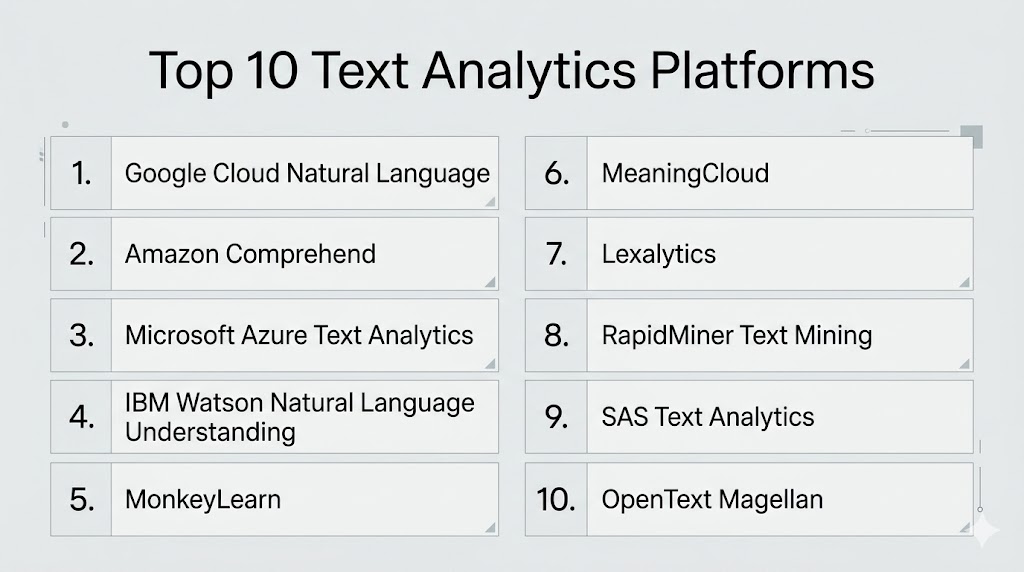
Top 10 Text Analytics Platforms
#1 — Google Cloud Natural Language
Short description (3-4 lines): Google Cloud Natural Language provides powerful NLP APIs for sentiment analysis, entity recognition, and content classification with high accuracy and scalability.
Key Features
- Sentiment analysis
- Entity recognition
- Content classification
- Syntax analysis
- Multi-language support
- Real-time processing
Pros
- High accuracy
- Scalable infrastructure
Cons
- Cloud-only
- Cost scaling
Platforms / Deployment
- Cloud
Security & Compliance
- Encryption, IAM
Integrations & Ecosystem
- Google Cloud services, APIs
Support & Community
- Google support
#2 — Amazon Comprehend
Short description: Amazon Comprehend is an NLP service that extracts insights such as sentiment, entities, and key phrases from text data.
Key Features
- Sentiment analysis
- Entity recognition
- Topic modeling
- Custom classification
- Multi-language support
Pros
- Fully managed
- Easy integration
Cons
- AWS-only
- Pricing complexity
Platforms / Deployment
- Cloud
Security & Compliance
- IAM, encryption
Integrations & Ecosystem
- AWS services
Support & Community
- AWS support
#3 — Azure Text Analytics
Short description: Azure Text Analytics provides NLP capabilities for sentiment analysis, key phrase extraction, and language understanding.
Key Features
- Sentiment analysis
- Key phrase extraction
- Language detection
- Entity recognition
- Custom models
Pros
- Enterprise-ready
- Scalable
Cons
- Azure dependency
- Learning curve
Platforms / Deployment
- Cloud
Security & Compliance
- RBAC, encryption
Integrations & Ecosystem
- Azure ecosystem
Support & Community
- Microsoft support
#4 — IBM Watson Natural Language Understanding
Short description: IBM Watson NLU offers deep text analysis capabilities with customization for enterprise applications.
Key Features
- Sentiment and emotion analysis
- Entity and keyword extraction
- Categorization
- Custom models
- Multi-language support
Pros
- Strong customization
- Enterprise features
Cons
- Cost
- Complexity
Platforms / Deployment
- Cloud / Hybrid
Security & Compliance
- Encryption, RBAC
Integrations & Ecosystem
- IBM Cloud
Support & Community
- Enterprise support
#5 — MonkeyLearn
Short description: MonkeyLearn is a user-friendly text analytics platform focused on business users and no-code workflows.
Key Features
- Sentiment analysis
- Text classification
- Keyword extraction
- No-code model training
- Visualization dashboards
Pros
- Easy to use
- No-code platform
Cons
- Limited advanced features
- Paid plans
Platforms / Deployment
- Cloud
Security & Compliance
- Standard security controls
Integrations & Ecosystem
- APIs, BI tools
Support & Community
- Community support
#6 — MeaningCloud
Short description: MeaningCloud provides text analytics APIs for sentiment analysis, classification, and content extraction.
Key Features
- Sentiment analysis
- Text classification
- Entity extraction
- Language detection
- Topic extraction
Pros
- Multi-language support
- Flexible APIs
Cons
- UI limitations
- Smaller ecosystem
Platforms / Deployment
- Cloud / On-prem
Security & Compliance
- Encryption
Integrations & Ecosystem
- APIs
Support & Community
- Support available
#7 — Lexalytics
Short description: Lexalytics provides enterprise text analytics with strong sentiment and intent analysis capabilities.
Key Features
- Sentiment and intent analysis
- Entity extraction
- Text categorization
- Custom dictionaries
- Multi-language support
Pros
- Strong NLP capabilities
- Customizable
Cons
- Enterprise-focused
- Cost
Platforms / Deployment
- Cloud / On-prem
Security & Compliance
- RBAC, encryption
Integrations & Ecosystem
- APIs
Support & Community
- Enterprise support
#8 — RapidMiner Text Mining
Short description: RapidMiner offers text analytics as part of its data science platform for advanced analytics workflows.
Key Features
- Text preprocessing
- Sentiment analysis
- Topic modeling
- Integration with ML workflows
- Visual workflows
Pros
- Strong analytics integration
- Visual interface
Cons
- Learning curve
- Resource-intensive
Platforms / Deployment
- Cloud / On-prem
Security & Compliance
- Encryption
Integrations & Ecosystem
- ML pipelines
Support & Community
- Community + enterprise support
#9 — SAS Text Analytics
Short description: SAS Text Analytics provides advanced NLP capabilities for enterprise analytics and large-scale data processing.
Key Features
- Text mining and analysis
- Sentiment detection
- Entity extraction
- Topic modeling
- Visualization tools
Pros
- Enterprise-grade analytics
- High performance
Cons
- Expensive
- Complex setup
Platforms / Deployment
- Cloud / On-prem
Security & Compliance
- Enterprise security features
Integrations & Ecosystem
- SAS ecosystem
Support & Community
- Enterprise support
#10 — OpenText Magellan
Short description: OpenText Magellan is an AI-powered analytics platform that includes text analytics capabilities for enterprise data.
Key Features
- NLP and text mining
- Data visualization
- Machine learning integration
- Big data support
- Enterprise analytics
Pros
- Strong enterprise features
- Scalable
Cons
- Complex
- Cost
Platforms / Deployment
- Cloud / On-prem
Security & Compliance
- Enterprise compliance
Integrations & Ecosystem
- Data platforms
Support & Community
- Enterprise support
Comparison Table
| Tool | Best For | Platform | Deployment | Standout Feature | Rating |
|---|---|---|---|---|---|
| Google NLP | Accuracy | Cloud | Cloud | High precision | N/A |
| Comprehend | AWS users | Cloud | Cloud | Easy integration | N/A |
| Azure TA | Enterprise | Cloud | Cloud | Custom models | N/A |
| IBM Watson | Enterprise AI | Cloud | Hybrid | Deep analysis | N/A |
| MonkeyLearn | No-code users | Cloud | Cloud | Simplicity | N/A |
| MeaningCloud | API users | Multi | Hybrid | Flexibility | N/A |
| Lexalytics | NLP power | Multi | Hybrid | Customization | N/A |
| RapidMiner | Data science | Multi | Hybrid | Visual workflows | N/A |
| SAS | Enterprise | Multi | Hybrid | Advanced analytics | N/A |
| OpenText | Enterprise | Multi | Hybrid | Big data support | N/A |
Evaluation & Scoring
| Tool | Core | Ease | Integration | Security | Performance | Support | Value | Total |
|---|---|---|---|---|---|---|---|---|
| Google NLP | 9 | 8 | 8 | 8 | 9 | 8 | 7 | 8.2 |
| Comprehend | 8 | 8 | 8 | 8 | 8 | 7 | 7 | 7.8 |
| Azure TA | 8 | 8 | 8 | 8 | 8 | 7 | 7 | 7.8 |
| IBM Watson | 8 | 7 | 7 | 8 | 8 | 7 | 7 | 7.6 |
| MonkeyLearn | 7 | 9 | 7 | 7 | 7 | 7 | 7 | 7.3 |
| MeaningCloud | 7 | 7 | 7 | 7 | 7 | 6 | 7 | 7.0 |
| Lexalytics | 8 | 7 | 7 | 7 | 8 | 7 | 7 | 7.4 |
| RapidMiner | 8 | 7 | 8 | 7 | 8 | 7 | 7 | 7.6 |
| SAS | 9 | 6 | 8 | 9 | 9 | 8 | 6 | 8.0 |
| OpenText | 8 | 6 | 7 | 8 | 8 | 7 | 6 | 7.3 |
Which Text Analytics Platform Is Right for You?
Solo / Freelancer
MonkeyLearn or MeaningCloud is best for ease of use.
SMB
Amazon Comprehend or Azure Text Analytics offers scalability.
Mid-Market
RapidMiner or Lexalytics provides deeper analytics.
Enterprise
Google NLP, SAS, or IBM Watson delivers advanced capabilities.
Frequently Asked Questions (FAQs)
What is a text analytics platform?
A text analytics platform processes unstructured text data to extract insights such as sentiment, entities, and topics. It uses NLP and AI models to analyze language patterns and convert text into structured information. These platforms help businesses understand large volumes of textual data efficiently.
How does text analytics work?
Text analytics uses techniques like tokenization, entity recognition, sentiment analysis, and machine learning models. It processes raw text, identifies patterns, and generates insights such as sentiment scores or topic classifications. Advanced platforms also use deep learning for higher accuracy.
What industries use text analytics?
Industries such as retail, healthcare, finance, marketing, and customer service rely on text analytics. It helps analyze customer feedback, automate document processing, detect fraud, and improve decision-making through data-driven insights.
Can text analytics handle multiple languages?
Yes, most modern platforms support multiple languages and even detect language automatically. Some tools also provide translation capabilities, enabling global businesses to analyze multilingual datasets effectively.
Is text analytics secure?
Enterprise platforms provide strong security features such as encryption, role-based access control, and compliance with data regulations. Security also depends on deployment and how sensitive data is handled within the system.
Can I build custom NLP models?
Yes, many platforms allow custom model training to handle domain-specific use cases. This is useful for industries like healthcare or legal where specialized vocabulary and context are required.
Are these platforms scalable?
Cloud-based text analytics platforms are highly scalable and can process large volumes of data. They use distributed computing to handle high workloads efficiently.
Do text analytics platforms integrate with BI tools?
Yes, most platforms integrate with BI tools and analytics systems. This allows users to visualize insights and combine text data with structured data for better analysis.
Can text analytics be used in real time?
Yes, many platforms support real-time text processing for applications like chat analysis and live sentiment tracking. This enables immediate insights and faster decision-making.
How to choose the right platform?
Choosing the right platform depends on your use case, data volume, budget, and required features. It is recommended to test multiple tools and evaluate their accuracy, scalability, and integration capabilities.
Conclusion
Text analytics platforms are essential for extracting value from unstructured data, enabling organizations to gain insights, automate workflows, and improve decision-making. Open-source and lightweight tools like MeaningCloud and MonkeyLearn provide simplicity for smaller teams, while platforms like Amazon Comprehend and Azure Text Analytics offer scalable cloud-based solutions for growing organizations. Mid-market users benefit from tools like RapidMiner and Lexalytics, which combine analytics with NLP capabilities. Enterprises requiring advanced features and high performance can rely on Google Cloud Natural Language, SAS Text Analytics, and IBM Watson for comprehensive solutions. Selecting the right platform depends on factors such as accuracy, scalability, integration, and cost. A practical approach is to pilot a few tools, evaluate real-world performance, and choose the one that aligns best with your business needs and technical requirements.