Introduction
Model registry tools are essential components of modern machine learning operations (MLOps). They provide a centralized system to store, version, manage, and govern machine learning models throughout their lifecycle—from experimentation to production deployment and beyond.
As machine learning adoption grows, managing multiple models, versions, and environments becomes complex. Model registries solve this by enabling teams to track model lineage, maintain version control, enforce approval workflows, and streamline deployment across staging and production environments.
Real-world use cases include:
- Versioning models during iterative experimentation
- Managing approvals for production deployment
- Tracking model lineage and metadata
- Enabling CI/CD pipelines for ML deployment
- Ensuring compliance and auditability in regulated industries
Key evaluation criteria for buyers:
- Model versioning and lifecycle management
- Approval workflows and governance features
- Integration with ML pipelines and CI/CD tools
- Deployment support across environments
- Metadata tracking and lineage
- Scalability for large model repositories
- Security, compliance, and access control
- Collaboration and team workflows
- Ease of use and developer experience
- Deployment flexibility (cloud/on-prem/hybrid)
Best for:
Model registry tools are ideal for ML engineers, data scientists, DevOps teams, and enterprises managing production-grade ML systems.
Not ideal for:
Teams working only on small-scale experiments or without deployment pipelines may not require a full model registry.
Key Trends in Model Registry Tools
- Integration with MLOps platforms for end-to-end lifecycle management
- Automated approval workflows and governance controls
- Cloud-native registries with scalable storage
- Support for multi-model environments
- Integration with CI/CD pipelines
- Model lineage and auditability features
- Security and compliance enhancements
- Real-time deployment tracking and rollback capabilities
- Support for multiple ML frameworks
- Centralized model management across teams
How We Selected These Tools (Methodology)
- Evaluated model versioning and lifecycle management features
- Assessed integration with ML pipelines and deployment tools
- Reviewed governance, approval workflows, and compliance capabilities
- Checked scalability and performance for enterprise use cases
- Considered ease of use and developer experience
- Examined security and access control features
- Reviewed community support and vendor backing
- Evaluated open-source vs managed offerings
- Considered integration with cloud ecosystems
- Ensured applicability across SMB, mid-market, and enterprise environments
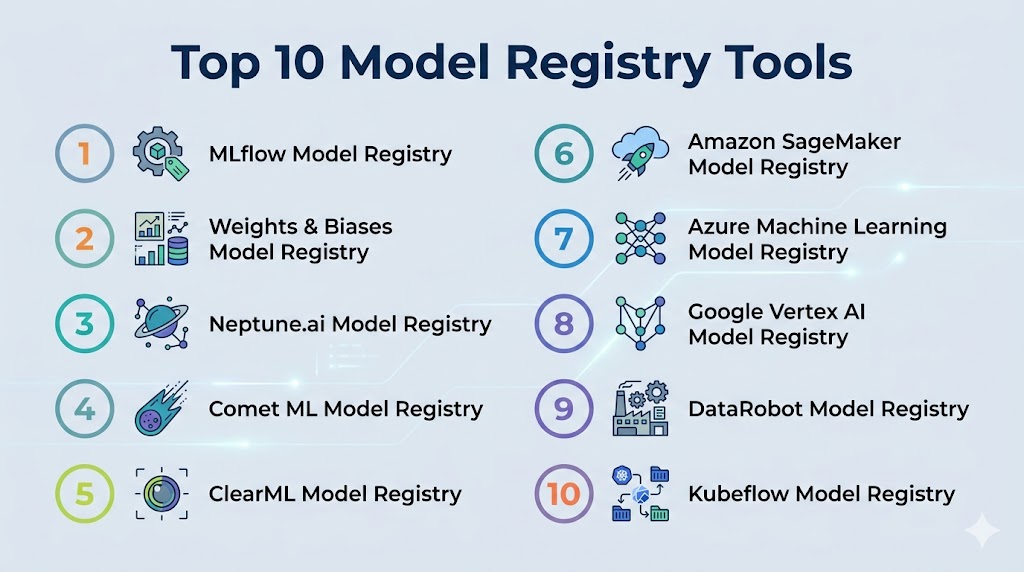
Top 10 Model Registry Tools
#1 — MLflow Model Registry
Short description (3-4 lines): MLflow Model Registry is an open-source tool that provides centralized model versioning, lifecycle management, and deployment tracking across multiple ML frameworks.
Key Features
- Model versioning and staging
- Lifecycle management (staging, production, archived)
- Metadata tracking and lineage
- Integration with MLflow tracking
- REST APIs for deployment
- Multi-framework support
Pros
- Open-source and flexible
- Strong integration with ML pipelines
Cons
- Requires infrastructure setup
- Limited advanced governance features
Platforms / Deployment
- Linux / Windows / macOS
- Cloud / On-prem / Hybrid
Security & Compliance
- Depends on deployment
- Supports access control via integrations
Integrations & Ecosystem
- TensorFlow, PyTorch, Scikit-learn, cloud platforms
Support & Community
- Large open-source community
#2 — Weights & Biases Model Registry
Short description: Weights & Biases provides a model registry integrated with experiment tracking and collaboration tools.
Key Features
- Model versioning and artifacts
- Integration with experiment tracking
- Collaboration dashboards
- Deployment tracking
- Metadata logging
Pros
- Strong visualization
- Easy collaboration
Cons
- Paid for advanced features
- Cloud-first approach
Platforms / Deployment
- Cloud
Security & Compliance
- Encryption, RBAC
Integrations & Ecosystem
- TensorFlow, PyTorch, Hugging Face
Support & Community
- Active community
#3 — Neptune.ai Model Registry
Short description: Neptune.ai offers a flexible model registry integrated with experiment tracking and monitoring.
Key Features
- Model metadata tracking
- Version control
- Integration with pipelines
- Visualization dashboards
- API-based access
Pros
- Flexible logging
- Strong integrations
Cons
- Requires setup
- UI complexity
Platforms / Deployment
- Cloud / On-prem
Security & Compliance
- RBAC, encryption
Integrations & Ecosystem
- ML frameworks, MLflow
Support & Community
- Active community
#4 — Comet ML Model Registry
Short description: Comet ML provides a cloud-based model registry with experiment tracking and deployment features.
Key Features
- Model versioning
- Experiment integration
- Deployment tracking
- Collaboration tools
- Visualization dashboards
Pros
- Strong visualization
- Easy integration
Cons
- Paid platform
- Cloud dependency
Platforms / Deployment
- Cloud / Hybrid
Security & Compliance
- Encryption, RBAC
Integrations & Ecosystem
- ML frameworks, cloud services
Support & Community
- Enterprise support
#5 — ClearML Model Registry
Short description: ClearML offers an open-source model registry integrated with pipeline orchestration and experiment tracking.
Key Features
- Model versioning
- Pipeline integration
- Artifact management
- Dataset tracking
- Remote execution
Pros
- Open-source
- End-to-end ML workflow
Cons
- Setup complexity
- UI learning curve
Platforms / Deployment
- Cloud / On-prem / Hybrid
Security & Compliance
- RBAC, encryption
Integrations & Ecosystem
- ML frameworks, pipelines
Support & Community
- Open-source community
#6 — Amazon SageMaker Model Registry
Short description: SageMaker Model Registry is a managed service for versioning and deploying ML models in AWS.
Key Features
- Model versioning
- Approval workflows
- Deployment integration
- Monitoring integration
- Metadata tracking
Pros
- Fully managed
- Scalable
Cons
- AWS-only
- Cost considerations
Platforms / Deployment
- Cloud
Security & Compliance
- IAM, encryption
Integrations & Ecosystem
- AWS services
Support & Community
- AWS support
#7 — Azure Machine Learning Model Registry
Short description: Azure ML provides a centralized registry for managing and deploying ML models.
Key Features
- Model versioning
- Integration with pipelines
- Deployment tracking
- Governance and monitoring
- Metadata management
Pros
- Strong enterprise integration
- Scalable
Cons
- Azure-only
- Learning curve
Platforms / Deployment
- Cloud
Security & Compliance
- RBAC, encryption
Integrations & Ecosystem
- Azure ecosystem
Support & Community
- Microsoft support
#8 — Google Vertex AI Model Registry
Short description: Vertex AI Model Registry provides centralized model management within the Google Cloud ecosystem.
Key Features
- Model versioning
- Deployment tracking
- Metadata management
- Integration with Vertex pipelines
- Monitoring tools
Pros
- Fully managed
- Scalable
Cons
- Cloud-only
- Vendor lock-in
Platforms / Deployment
- Cloud
Security & Compliance
- IAM, encryption
Integrations & Ecosystem
- GCP ecosystem
Support & Community
- Google Cloud support
#9 — DataRobot Model Registry
Short description: DataRobot provides enterprise-grade model registry with governance and lifecycle management features.
Key Features
- Model lifecycle management
- Governance and audit trails
- Deployment integration
- Monitoring support
- Collaboration tools
Pros
- Enterprise-ready
- Strong governance
Cons
- High cost
- Vendor dependency
Platforms / Deployment
- Cloud / On-prem / Hybrid
Security & Compliance
- SOC 2, GDPR, encryption
Integrations & Ecosystem
- ML pipelines, cloud platforms
Support & Community
- Enterprise support
#10 — Kubeflow Model Registry
Short description: Kubeflow provides a Kubernetes-based model registry integrated with ML pipelines and orchestration tools.
Key Features
- Model versioning
- Pipeline integration
- Kubernetes-native deployment
- Metadata tracking
- Scalable infrastructure
Pros
- Highly scalable
- Cloud-native
Cons
- Requires Kubernetes expertise
- Complex setup
Platforms / Deployment
- Cloud / On-prem / Hybrid
Security & Compliance
- RBAC, encryption
Integrations & Ecosystem
- Kubernetes, ML frameworks
Support & Community
- Open-source community
Comparison Table
| Tool | Best For | Platform | Deployment | Standout Feature | Rating |
|---|---|---|---|---|---|
| MLflow | Open-source ML | Multi | Hybrid | Lifecycle mgmt | N/A |
| W&B | Collaboration | Cloud | Cloud | Visualization | N/A |
| Neptune | Flexible tracking | Multi | Hybrid | Metadata logging | N/A |
| Comet | Team workflows | Cloud | Cloud | Dashboards | N/A |
| ClearML | End-to-end ML | Multi | Hybrid | Pipeline integration | N/A |
| SageMaker | AWS ML | Cloud | Cloud | Managed registry | N/A |
| Azure ML | Enterprise ML | Cloud | Cloud | Governance | N/A |
| Vertex AI | GCP ML | Cloud | Cloud | Scalability | N/A |
| DataRobot | Enterprise AI | Multi | Hybrid | Governance | N/A |
| Kubeflow | Kubernetes ML | Multi | Hybrid | Cloud-native | N/A |
Evaluation & Scoring
| Tool | Core | Ease | Integration | Security | Performance | Support | Value | Total |
|---|---|---|---|---|---|---|---|---|
| MLflow | 9 | 7 | 8 | 7 | 8 | 8 | 8 | 8.0 |
| W&B | 8 | 9 | 8 | 8 | 8 | 8 | 7 | 8.2 |
| Neptune | 8 | 8 | 8 | 7 | 8 | 7 | 7 | 7.7 |
| Comet | 8 | 8 | 8 | 7 | 8 | 7 | 7 | 7.7 |
| ClearML | 8 | 7 | 8 | 7 | 8 | 7 | 8 | 7.9 |
| SageMaker | 8 | 8 | 8 | 8 | 8 | 7 | 7 | 7.8 |
| Azure ML | 8 | 8 | 8 | 8 | 8 | 7 | 7 | 7.8 |
| Vertex AI | 8 | 8 | 8 | 8 | 8 | 7 | 7 | 7.8 |
| DataRobot | 9 | 8 | 8 | 9 | 9 | 8 | 7 | 8.5 |
| Kubeflow | 8 | 6 | 8 | 8 | 8 | 7 | 7 | 7.6 |
Which Model Registry Tool Is Right for You?
Solo / Freelancer
MLflow or ClearML is best for flexibility and cost efficiency.
SMB
Weights & Biases or Neptune provides easy collaboration.
Mid-Market
Comet ML or SageMaker offers scalable workflows.
Enterprise
DataRobot, Azure ML, or Vertex AI provides governance and scalability.
Frequently Asked Questions (FAQs)
What is a model registry?
A system to store, version, and manage ML models.
Why is it important?
It ensures reproducibility and governance.
Are these tools cloud-only?
Some are cloud-native; others support hybrid deployment.
Do they integrate with pipelines?
Yes, most support CI/CD and ML workflows.
Can models be versioned?
Yes, versioning is a core feature.
Are they scalable?
Yes, enterprise tools scale for large workloads.
Do they support collaboration?
Yes, many tools enable team workflows.
Are they secure?
Enterprise tools offer RBAC and encryption.
Can they track metadata?
Yes, metadata tracking is essential.
How to choose one?
Based on scale, cloud preference, and governance needs.
Conclusion
Model registry tools are a foundational pillar of modern MLOps, enabling organizations to manage, version, and deploy machine learning models efficiently and reliably. Open-source solutions like MLflow and ClearML offer flexibility and cost efficiency, making them suitable for teams with strong engineering capabilities. Platforms such as Weights & Biases, Neptune.ai, and Comet ML enhance collaboration and visualization, helping teams streamline experimentation and deployment workflows. For enterprise-scale requirements, tools like DataRobot, Azure ML, and Vertex AI provide robust governance, compliance, and scalability features. Kubernetes-native platforms like Kubeflow are ideal for organizations operating in cloud-native environments. Selecting the right model registry depends on your infrastructure, team size, governance needs, and integration requirements. A practical approach is to pilot a few tools, evaluate their compatibility with your ML pipelines, and choose the one that best aligns with your operational goals.