Introduction
Deep learning frameworks are specialized platforms and libraries designed for building, training, and deploying neural networks and AI models. They provide tools for tensor computation, GPU acceleration, model design, and workflow management, enabling researchers and engineers to implement cutting-edge AI solutions efficiently.
These frameworks are critical for tasks like image recognition, natural language processing, speech recognition, and autonomous systems. By leveraging deep learning frameworks, organizations can accelerate model development, optimize performance, and deploy AI models into production at scale.
Real-world use cases include:
- Computer vision for autonomous vehicles and medical imaging
- Natural language understanding for chatbots and voice assistants
- Speech recognition and synthesis
- Recommendation systems for personalized content
- Fraud detection and predictive analytics
Key evaluation criteria for buyers:
- Support for neural network architectures (CNNs, RNNs, Transformers)
- GPU and TPU acceleration
- Scalability and distributed training
- Ease of model prototyping and experimentation
- Deployment capabilities and integration with production pipelines
- Pre-trained models and community resources
- Language support (Python, C++, R, Java)
- Visualization and debugging tools
- Cloud and on-premises deployment options
- Security, governance, and compliance
Best for:
Deep learning frameworks are ideal for data scientists, AI researchers, ML engineers, and developers building neural network-based AI applications.
Not ideal for:
Organizations with simple predictive analytics needs or small datasets may not require deep learning frameworks; traditional ML libraries or AutoML platforms may suffice.
Key Trends in Deep Learning Frameworks
- Transformer-based models dominating NLP and vision tasks
- GPU and TPU acceleration for high-performance training
- Distributed and multi-node training for large datasets
- Integration with AutoML and MLOps pipelines
- Pre-trained model libraries for rapid experimentation
- Hybrid frameworks supporting research and production
- Low-code frameworks for democratized AI development
- Explainable AI features for model interpretability
- Support for multiple languages and APIs
- Cloud and edge deployment for scalable AI applications
How We Selected These Tools (Methodology)
- Evaluated neural network support and flexibility
- Assessed GPU/TPU acceleration and distributed training
- Reviewed ease of prototyping, experimentation, and debugging
- Checked integration with production pipelines and cloud platforms
- Considered pre-trained model availability and community resources
- Examined scalability, performance, and reliability
- Evaluated documentation, tutorials, and developer support
- Assessed security, governance, and compliance
- Considered cross-language and API support
- Ensured suitability for researchers, SMBs, and enterprises
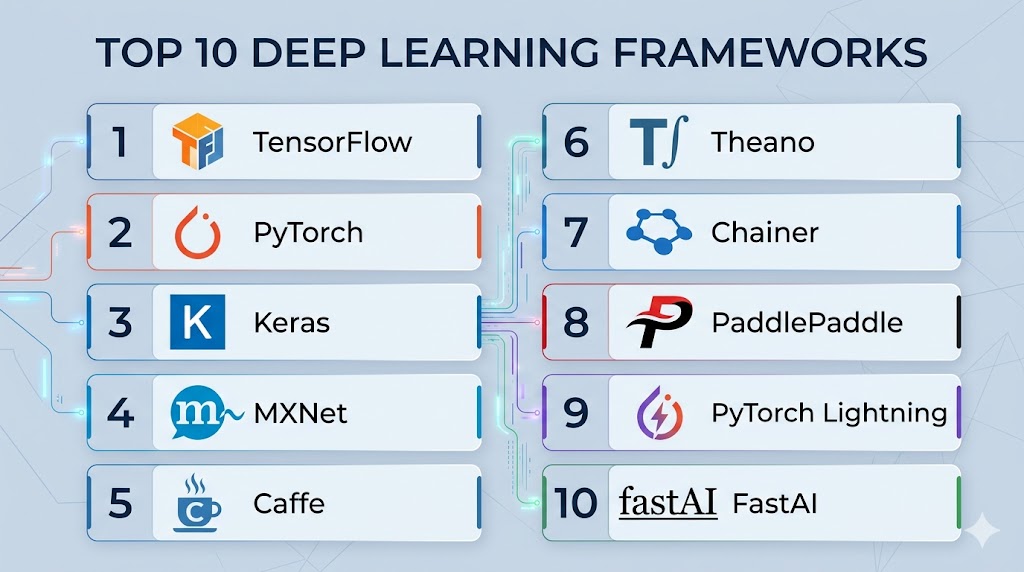
Top 10 Deep Learning Frameworks
#1 — TensorFlow
Short description: TensorFlow is a popular open-source deep learning framework for building and deploying neural networks across platforms.
Key Features
- Supports CNNs, RNNs, Transformers
- GPU/TPU acceleration
- TensorBoard for visualization
- Deployment to mobile, web, and cloud
- Keras API for rapid prototyping
- Distributed training across clusters
Pros
- Highly scalable and flexible
- Large community and pre-trained models
Cons
- Steeper learning curve for beginners
- Verbose syntax compared to some frameworks
Platforms / Deployment
- Linux / Windows / macOS / Cloud
- Cloud / On-prem / Hybrid
Security & Compliance
- Encryption and RBAC depend on deployment
- SOC 2 / GDPR via cloud providers
Integrations & Ecosystem
- Python, Java, C++ APIs
- TensorFlow Hub, TensorFlow Extended (TFX), Keras
Support & Community
- Extensive documentation
- Active global community
#2 — PyTorch
Short description: PyTorch is an open-source framework widely used for research and production, supporting dynamic computation graphs and deep learning models.
Key Features
- Dynamic computation graphs
- GPU acceleration
- TorchScript for production deployment
- Pre-trained model hub (Torch Hub)
- Pythonic API for ease of use
- Distributed training support
Pros
- Intuitive and flexible for research
- Strong adoption in academic and industrial AI
Cons
- Historically less optimized for mobile deployment
- Smaller ecosystem than TensorFlow for production tools
Platforms / Deployment
- Linux / Windows / macOS / Cloud
- Cloud / On-prem / Hybrid
Security & Compliance
- Encryption and access control via deployment
- Compliance depends on cloud or on-prem setup
Integrations & Ecosystem
- Python API, Torch Hub, integration with CUDA, ONNX
Support & Community
- Large developer community
- Extensive tutorials and examples
#3 — Keras
Short description: Keras is a high-level deep learning API for fast prototyping, running on top of TensorFlow, Theano, or CNTK backends.
Key Features
- Simplified model creation with intuitive APIs
- Supports CNNs, RNNs, and hybrid architectures
- GPU acceleration via backend engines
- Integration with TensorBoard for visualization
- Supports multiple backend engines
Pros
- User-friendly and beginner-friendly
- Rapid prototyping of neural networks
Cons
- Limited low-level control
- Depends on backend frameworks
Platforms / Deployment
- Linux / Windows / macOS / Cloud
- Cloud / On-prem / Hybrid
Security & Compliance
- Depends on backend deployment
Integrations & Ecosystem
- TensorFlow, Theano, CNTK, cloud services
Support & Community
- Large community
- Extensive examples and tutorials
#4 — MXNet
Short description: Apache MXNet is a flexible deep learning framework known for distributed training and multi-language support.
Key Features
- GPU/CPU acceleration
- Supports Python, Scala, R, Julia, C++
- Distributed training
- Gluon API for simplicity
- Model deployment on mobile and cloud
Pros
- Highly scalable
- Multi-language support
Cons
- Smaller community than TensorFlow or PyTorch
- Limited high-level API adoption
Platforms / Deployment
- Linux / Windows / macOS / Cloud
- Cloud / On-prem / Hybrid
Security & Compliance
- Depends on deployment
- Encryption via cloud/on-prem options
Integrations & Ecosystem
- Gluon API, cloud services, ML libraries
Support & Community
- Apache community support
- Documentation available
#5 — Caffe
Short description: Caffe is a deep learning framework focused on speed and modularity, commonly used for computer vision tasks.
Key Features
- Optimized for CNNs
- GPU acceleration via CUDA
- Model zoo with pre-trained models
- Python and C++ APIs
- Efficient for image classification
Pros
- Fast execution for vision tasks
- Lightweight framework
Cons
- Limited support for RNNs and modern architectures
- Smaller community
Platforms / Deployment
- Linux / Windows / macOS
- Cloud / On-prem / Hybrid
Security & Compliance
- Deployment-dependent
Integrations & Ecosystem
- Python, C++ APIs, pre-trained vision models
Support & Community
- Active community forums
- Tutorials and examples
#6 — Theano
Short description: Theano is a Python library for fast numerical computation, often used as a backend for high-level deep learning frameworks.
Key Features
- Symbolic differentiation
- GPU acceleration
- Integrates with NumPy
- Supports CNNs and RNNs
- Efficient computational graph optimizations
Pros
- High-performance numerical computation
- Strong integration with Python ecosystem
Cons
- No longer actively developed
- Less user-friendly for beginners
Platforms / Deployment
- Linux / Windows / macOS
- Cloud / On-prem / Hybrid
Security & Compliance
- Depends on deployment
Integrations & Ecosystem
- Python, NumPy, Keras (as backend)
Support & Community
- Community support
- Extensive older tutorials
#7 — Chainer
Short description: Chainer is a Python-based deep learning framework that supports dynamic computation graphs for flexible model design.
Key Features
- Dynamic computation graphs
- GPU acceleration
- Easy model prototyping
- Python-native syntax
- Distributed training support
Pros
- Intuitive and flexible for research
- Suitable for experimental models
Cons
- Smaller community
- Superseded by PyTorch in popularity
Platforms / Deployment
- Linux / Windows / macOS
- Cloud / On-prem / Hybrid
Security & Compliance
- Depends on deployment
Integrations & Ecosystem
- NumPy, CUDA, cloud frameworks
Support & Community
- Community support
- Tutorials available
#8 — PaddlePaddle
Short description: PaddlePaddle is a deep learning platform developed for industrial applications with scalable training and deployment.
Key Features
- GPU/CPU acceleration
- Supports CNNs, RNNs, Transformers
- Pre-trained models and inference tools
- Distributed training
- Python API for model development
Pros
- Industrial-grade framework
- Good pre-trained model support
Cons
- Smaller global adoption
- Limited community resources outside China
Platforms / Deployment
- Linux / Windows / macOS / Cloud
- Cloud / On-prem / Hybrid
Security & Compliance
- Depends on deployment
Integrations & Ecosystem
- Python, cloud services, ML libraries
Support & Community
- Enterprise support
- Documentation and tutorials
#9 — PyTorch Lightning
Short description: PyTorch Lightning is a lightweight wrapper on PyTorch that simplifies training and production deployment.
Key Features
- Standardizes PyTorch training loops
- GPU/TPU acceleration
- Supports distributed training
- Integration with logging and checkpointing tools
- Simplifies MLOps pipelines
Pros
- Reduces boilerplate code
- Ideal for reproducible ML research
Cons
- Requires PyTorch knowledge
- Less suitable for beginners
Platforms / Deployment
- Linux / Windows / macOS / Cloud
- Cloud / On-prem / Hybrid
Security & Compliance
- Depends on deployment
Integrations & Ecosystem
- PyTorch ecosystem, ML libraries, logging tools
Support & Community
- Open-source community
- Tutorials and examples
#10 — FastAI
Short description: FastAI is a high-level Python library built on PyTorch for rapid deep learning prototyping and research.
Key Features
- Pre-built modules for common architectures
- GPU acceleration
- Simplified APIs for CNNs, RNNs, and NLP
- Transfer learning support
- Integration with PyTorch
Pros
- Quick prototyping and experimentation
- Beginner-friendly while powerful
Cons
- Limited low-level control
- Dependent on PyTorch backend
Platforms / Deployment
- Linux / Windows / macOS / Cloud
- Cloud / On-prem / Hybrid
Security & Compliance
- Deployment-dependent
Integrations & Ecosystem
- PyTorch, Python ML ecosystem
Support & Community
- Active open-source community
- Tutorials and courses
Comparison Table (Top 10)
| Tool Name | Best For | Platform(s) Supported | Deployment | Standout Feature | Public Rating |
|---|---|---|---|---|---|
| TensorFlow | Scalable ML | Linux / Windows / macOS / Cloud | Cloud / On-prem / Hybrid | TensorBoard visualization | N/A |
| PyTorch | Research & prototyping | Linux / Windows / macOS / Cloud | Cloud / On-prem / Hybrid | Dynamic graphs | N/A |
| Keras | Rapid prototyping | Linux / Windows / macOS / Cloud | Cloud / On-prem / Hybrid | High-level API | N/A |
| MXNet | Distributed ML | Linux / Windows / macOS / Cloud | Cloud / On-prem / Hybrid | Multi-language support | N/A |
| Caffe | Vision tasks | Linux / Windows / macOS | Cloud / On-prem / Hybrid | Optimized CNNs | N/A |
| Theano | Computation backend | Linux / Windows / macOS | Cloud / On-prem / Hybrid | Symbolic differentiation | N/A |
| Chainer | Experimental ML | Linux / Windows / macOS | Cloud / On-prem / Hybrid | Dynamic graphs | N/A |
| PaddlePaddle | Industrial AI | Linux / Windows / macOS / Cloud | Cloud / On-prem / Hybrid | Pre-trained models | N/A |
| PyTorch Lightning | PyTorch training | Linux / Windows / macOS / Cloud | Cloud / On-prem / Hybrid | Simplified loops | N/A |
| FastAI | Rapid prototyping | Linux / Windows / macOS / Cloud | Cloud / On-prem / Hybrid | High-level modules | N/A |
Evaluation & Scoring of Deep Learning Frameworks
| Tool Name | Core (25%) | Ease (15%) | Integrations (15%) | Security (10%) | Performance (10%) | Support (10%) | Value (15%) | Weighted Total (0–10) |
|---|---|---|---|---|---|---|---|---|
| TensorFlow | 9 | 7 | 8 | 8 | 9 | 8 | 7 | 8.0 |
| PyTorch | 9 | 8 | 8 | 8 | 8 | 8 | 7 | 8.0 |
| Keras | 8 | 9 | 7 | 7 | 7 | 7 | 7 | 7.5 |
| MXNet | 8 | 7 | 7 | 7 | 8 | 7 | 7 | 7.4 |
| Caffe | 7 | 7 | 6 | 7 | 7 | 6 | 6 | 6.7 |
| Theano | 7 | 6 | 6 | 7 | 7 | 6 | 6 | 6.5 |
| Chainer | 7 | 7 | 6 | 6 | 7 | 6 | 6 | 6.6 |
| PaddlePaddle | 8 | 7 | 7 | 7 | 8 | 7 | 7 | 7.4 |
| PyTorch Lightning | 8 | 8 | 7 | 7 | 8 | 7 | 7 | 7.6 |
| FastAI | 8 | 9 | 7 | 7 | 7 | 7 | 7 | 7.5 |
Which Deep Learning Framework Is Right for You?
Solo / Freelancer
FastAI, Keras, or PyTorch are ideal for rapid prototyping and learning.
SMB
TensorFlow or PyTorch Lightning provide scalable training and deployment options.
Mid-Market
MXNet or PaddlePaddle can handle larger datasets and distributed training efficiently.
Enterprise
TensorFlow, PyTorch, or Caffe offer enterprise-level performance, deployment options, and production-ready tools.
Budget vs Premium
Open-source frameworks reduce licensing cost but require engineering expertise; cloud-managed services simplify deployment at higher cost.
Feature Depth vs Ease of Use
High-level APIs like Keras and FastAI simplify experimentation, while TensorFlow and PyTorch provide full flexibility for advanced models.
Integrations & Scalability
Frameworks should support GPUs/TPUs, distributed training, and integration with cloud or on-prem compute clusters.
Security & Compliance Needs
Choose frameworks with deployment options that allow encryption, access control, and compliance adherence.
Frequently Asked Questions (FAQs)
What is a deep learning framework?
A software platform designed to build, train, and deploy neural networks and AI models efficiently.
Can beginners use these frameworks?
Yes, frameworks like Keras and FastAI are beginner-friendly.
Are GPUs required?
Not always, but GPU/TPU acceleration significantly reduces training time for large models.
Can these frameworks handle distributed training?
Yes, TensorFlow, PyTorch, MXNet, and PaddlePaddle support multi-node distributed training.
Do they support pre-trained models?
Yes, many provide pre-trained models for vision, NLP, and speech tasks.
Are cloud deployments available?
Most frameworks support cloud deployment, while some can run on local or hybrid environments.
Can models be deployed in production?
Yes, production deployment is supported through APIs, TorchScript, TensorFlow Serving, or ONNX.
Are these frameworks secure?
Security depends on deployment; enterprise cloud options provide encryption, RBAC, and access control.
Do they support multiple languages?
Yes, frameworks like TensorFlow, MXNet, and PaddlePaddle support Python, C++, R, and more.
How to choose the right framework?
Consider model complexity, deployment needs, GPU/TPU support, team skillset, and scalability requirements.
Conclusion
Deep learning frameworks provide the foundation for AI applications in vision, NLP, speech, and predictive analytics. Beginners and freelancers can leverage FastAI, Keras, or PyTorch for rapid experimentation. SMBs can adopt TensorFlow or PyTorch Lightning for scalable and collaborative development. Mid-market teams benefit from MXNet or PaddlePaddle for distributed training. Enterprises requiring robust performance, deployment options, and production-ready tools rely on TensorFlow, PyTorch, or Caffe. Choosing the right framework involves evaluating ease of use, flexibility, scalability, integrations, GPU/TPU support, and security. Testing with real datasets ensures the framework meets technical and business needs, enabling efficient AI and deep learning workflows across organizations.