Introduction
IVR Design Tools are platforms that help businesses create, design, and manage Interactive Voice Response (IVR) systems—the automated phone menus that guide callers through voice or keypad inputs. In simple terms, these tools allow organizations to build voice call flows like “Press 1 for Sales, Press 2 for Support” or AI-powered conversational menus without writing complex telecom code.
Modern IVR systems are no longer just static phone trees. They now include AI voice bots, speech recognition, drag-and-drop flow builders, and analytics dashboards to improve customer experience and reduce call center load. IVR systems are widely used in customer service, banking, healthcare, and enterprise support operations.
Common use cases include:
- Designing call routing flows for contact centers
- Automating customer support via phone systems
- Building self-service IVR menus
- Creating multilingual voice response systems
- Integrating CRM-based call routing
- Reducing agent workload through automation
What buyers should evaluate:
- Visual IVR flow builder capability
- Speech recognition and NLP support
- Integration with telephony systems
- CRM and helpdesk integrations
- Scalability for high call volume
- Analytics and call tracking
- Ease of design (no-code vs developer tools)
- Security and compliance readiness
Best for: Call centers, SaaS companies, enterprises, banking, healthcare, and customer support teams.
Not ideal for: Small businesses with minimal call volume or teams that do not use phone-based support systems.
Key Trends in IVR Design Tools
- AI-powered conversational IVR: Replacing rigid menus with natural speech
- Drag-and-drop flow builders: No-code IVR design environments
- Speech recognition & NLP: Understanding customer intent instead of keypad inputs
- Omnichannel integration: Voice + chat + SMS workflows
- Cloud-based IVR systems: Scalable, distributed call handling
- Real-time analytics: Monitoring call flow performance
- Visual IVR interfaces: Web-based menu navigation alternatives
- API-first architectures: Easy integration with CRM and backend systems
- Automation of call routing: Smart routing using AI decision-making
- Self-service voice automation: Reducing dependency on live agents
Modern IVR systems now focus on customer intent detection rather than rigid menu navigation, improving satisfaction and reducing drop-offs.
How We Selected These Tools (Methodology)
- Evaluated market adoption in contact center and telecom industry
- Assessed IVR flow design capabilities (visual + AI-based)
- Reviewed speech recognition and NLP capabilities
- Considered integration with CRM and telephony systems
- Analyzed scalability for enterprise call volumes
- Included both developer-focused and no-code platforms
- Balanced cloud-native and hybrid deployment options
- Evaluated analytics, reporting, and monitoring features
- Considered ease of use for non-technical users
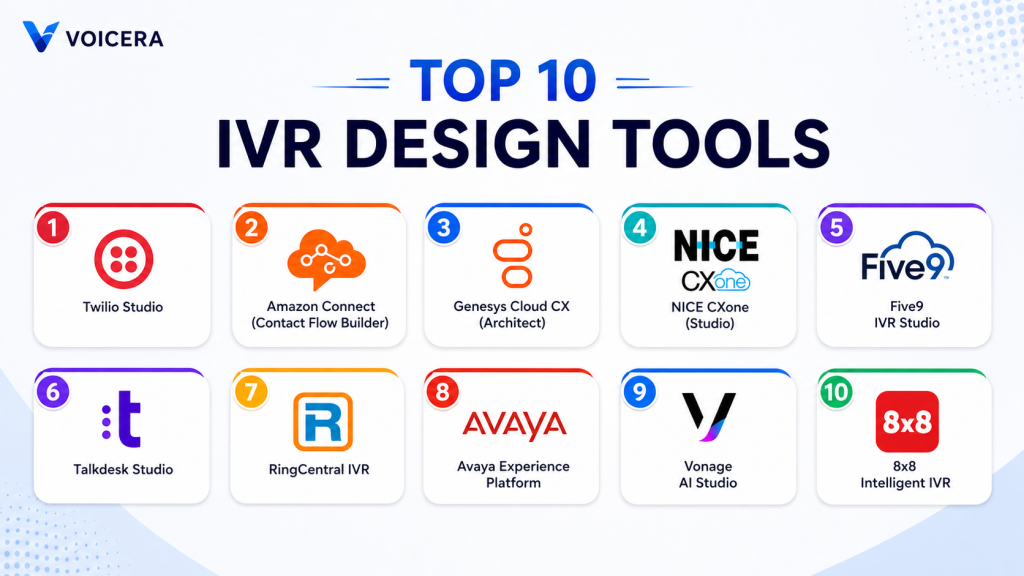
Top 10 IVR Design Tools
#1 — Twilio Studio
Short description: A low-code visual builder for designing IVR call flows and voice automation systems.
Key Features
- Drag-and-drop IVR flow builder
- Voice, SMS, and omnichannel workflows
- API and webhook integrations
- Speech recognition support
- Call routing logic
- Real-time testing and debugging
Pros
- Highly flexible and customizable
- Strong developer ecosystem
Cons
- Requires technical knowledge
- Costs can increase with usage
Platforms / Deployment
Web / Cloud
Security & Compliance
Encryption, SSO, GDPR support
SOC 2 (varies by setup)
Integrations & Ecosystem
- CRM systems
- Databases
- APIs and webhooks
- Telephony providers
Support & Community
Strong developer community and documentation.
#2 — Amazon Connect
Short description: AWS cloud contact center platform with built-in IVR design capabilities.
Key Features
- Visual IVR flow builder
- AI-powered routing
- Speech recognition integration
- Omnichannel support
- Real-time analytics
- Auto-scaling infrastructure
Pros
- Highly scalable
- Deep AWS integration
Cons
- AWS learning curve
- Complex for beginners
Platforms / Deployment
Web / Cloud
Security & Compliance
AWS IAM, encryption
SOC 2, ISO 27001 (AWS-level compliance)
Integrations & Ecosystem
- AWS Lambda
- CRM tools
- Contact center systems
Support & Community
Enterprise AWS support.
#3 — Genesys Cloud CX
Short description: Enterprise-grade IVR and contact center platform with AI-driven routing.
Key Features
- Drag-and-drop IVR builder
- AI speech recognition
- Omnichannel routing
- Customer journey analytics
- Workflow automation
Pros
- Strong enterprise capabilities
- Advanced analytics
Cons
- High cost
- Complex setup
Platforms / Deployment
Web / Cloud
Security & Compliance
Enterprise-grade security
Not publicly stated certifications
Integrations & Ecosystem
- CRM systems
- Cloud telephony
- Analytics tools
Support & Community
Strong enterprise adoption.
#4 — NICE CXone
Short description: Cloud contact center platform with powerful IVR design and automation.
Key Features
- Visual IVR builder
- AI self-service tools
- Call routing automation
- Speech analytics
- Workforce management
Pros
- Strong compliance features
- Reliable enterprise performance
Cons
- Expensive
- Complex onboarding
Platforms / Deployment
Web / Cloud
Security & Compliance
Enterprise compliance frameworks
Not publicly stated
Integrations & Ecosystem
- CRM platforms
- Enterprise systems
Support & Community
Enterprise-grade support.
#5 — Five9
Short description: Cloud contact center solution with drag-and-drop IVR design tools.
Key Features
- Visual IVR builder
- AI call routing
- CRM integration
- Real-time dashboards
- Omnichannel support
Pros
- Easy IVR creation
- Strong reporting tools
Cons
- Pricing complexity
- UI can feel dated
Platforms / Deployment
Web / Cloud
Security & Compliance
Encryption, RBAC
Not publicly stated
Integrations & Ecosystem
- Salesforce
- CRM systems
- Helpdesk tools
Support & Community
Strong enterprise adoption.
#6 — Talkdesk
Short description: Cloud-native IVR and contact center platform with AI capabilities.
Key Features
- No-code IVR builder
- AI voice bots
- CRM integration
- Workflow automation
- Analytics dashboard
Pros
- Easy UI
- Fast deployment
Cons
- Premium pricing
- Limited deep customization
Platforms / Deployment
Web / Cloud
Security & Compliance
Not publicly stated
Integrations & Ecosystem
- CRM systems
- Contact center tools
Support & Community
Strong SaaS ecosystem.
#7 — Avaya Experience Platform
Short description: Enterprise communication platform with advanced IVR design capabilities.
Key Features
- Visual IVR builder
- Call routing logic
- Legacy system integration
- AI-powered voice tools
- Global telephony support
Pros
- Highly reliable
- Enterprise-ready
Cons
- Complex setup
- Slower innovation cycle
Platforms / Deployment
Hybrid / Cloud
Security & Compliance
Enterprise compliance
Not publicly stated
Integrations & Ecosystem
- Enterprise CRM
- Telephony systems
Support & Community
Long-standing enterprise vendor.
#8 — Twilio Flex + IVR Builder
Short description: Programmable contact center platform for custom IVR design.
Key Features
- Programmable IVR flows
- API-based customization
- Speech recognition support
- Omnichannel routing
- Real-time call control
Pros
- Maximum flexibility
- Developer-first approach
Cons
- Requires coding
- Setup complexity
Platforms / Deployment
Web / Cloud
Security & Compliance
Encryption, GDPR support
Not publicly stated
Integrations & Ecosystem
- APIs
- CRM systems
- Messaging platforms
Support & Community
Large developer ecosystem.
#9 — RingCentral IVR
Short description: Cloud phone system with built-in IVR design capabilities.
Key Features
- Auto-attendant IVR
- Call routing
- Multi-level menus
- Basic analytics
- CRM integration
Pros
- Easy setup
- Good for SMBs
Cons
- Limited advanced AI
- Basic customization
Platforms / Deployment
Web / Cloud
Security & Compliance
Not publicly stated
Integrations & Ecosystem
- CRM tools
- Business apps
Support & Community
Strong SMB adoption.
#10 — Nuance Mix (Conversational IVR)
Short description: AI-powered IVR platform focused on conversational voice experiences.
Key Features
- Advanced speech recognition
- Conversational IVR design
- NLP-based routing
- Voice biometrics
- Enterprise automation
Pros
- Highly accurate voice AI
- Strong enterprise focus
Cons
- Expensive
- Complex setup
Platforms / Deployment
Cloud / On-prem
Security & Compliance
Enterprise-grade security
Not publicly stated
Integrations & Ecosystem
- Contact centers
- CRM systems
Support & Community
Enterprise support ecosystem.
Comparison Table
| Tool Name | Best For | Platform(s) Supported | Deployment | Standout Feature | Public Rating |
|---|---|---|---|---|---|
| Twilio Studio | Developers | Web | Cloud | Visual IVR builder | N/A |
| Amazon Connect | Enterprise IVR | Web | Cloud | AWS integration | N/A |
| Genesys Cloud CX | Contact centers | Web | Cloud | AI routing | N/A |
| NICE CXone | Compliance-heavy industries | Web | Cloud | Self-service IVR | N/A |
| Five9 | Omnichannel call centers | Web | Cloud | Visual IVR builder | N/A |
| Talkdesk | SMB + enterprise | Web | Cloud | No-code IVR | N/A |
| Avaya | Legacy enterprises | Hybrid | Hybrid | Telephony integration | N/A |
| Twilio Flex | Custom IVR | Web | Cloud | API-first design | N/A |
| RingCentral | SMB telephony | Web | Cloud | Auto-attendant IVR | N/A |
| Nuance Mix | AI voice IVR | Web | Cloud / On-prem | Conversational IVR | N/A |
Evaluation & Scoring of IVR Design Tools
| Tool Name | Core (25%) | Ease (15%) | Integrations (15%) | Security (10%) | Performance (10%) | Support (10%) | Value (15%) | Weighted Total |
|---|---|---|---|---|---|---|---|---|
| Twilio Studio | 10 | 8 | 10 | 8 | 9 | 9 | 8 | 8.8 |
| Amazon Connect | 10 | 7 | 10 | 9 | 10 | 9 | 8 | 9.0 |
| Genesys | 10 | 7 | 9 | 9 | 9 | 9 | 7 | 8.6 |
| NICE CXone | 10 | 7 | 9 | 9 | 9 | 9 | 7 | 8.6 |
| Five9 | 9 | 8 | 9 | 8 | 9 | 8 | 8 | 8.5 |
| Talkdesk | 9 | 9 | 8 | 8 | 8 | 8 | 8 | 8.4 |
| Avaya | 10 | 6 | 8 | 9 | 9 | 8 | 7 | 8.1 |
| Twilio Flex | 10 | 7 | 10 | 8 | 9 | 9 | 8 | 8.6 |
| RingCentral | 7 | 9 | 8 | 8 | 8 | 8 | 9 | 8.1 |
| Nuance Mix | 10 | 6 | 9 | 9 | 9 | 9 | 7 | 8.3 |
Which IVR Design Tool Is Right for You?
Solo / Freelancer
RingCentral or Twilio Studio for simple IVR flows.
SMB
Talkdesk or RingCentral for easy IVR setup.
Mid-Market
Five9 or Amazon Connect for scalable IVR automation.
Enterprise
Genesys, NICE CXone, or Avaya for complex contact centers.
Budget vs Premium
RingCentral is cost-effective; enterprise tools are premium but powerful.
Feature Depth vs Ease of Use
Amazon Connect is powerful but complex; Talkdesk is easier to use.
Integrations & Scalability
Twilio and Amazon Connect offer strong API ecosystems.
Security & Compliance Needs
NICE CXone and Amazon Connect lead in compliance-heavy environments.
Frequently Asked Questions (FAQs)
1. What is an IVR design tool?
A platform used to create automated phone call flows and voice menus.
2. Why are IVR systems used?
To automate call routing and improve customer service efficiency.
3. What is visual IVR?
A drag-and-drop interface to design call flows visually.
4. Do IVR tools use AI?
Yes, modern IVR systems use AI and NLP for voice understanding.
5. Can IVR integrate with CRM?
Yes, most enterprise tools support CRM integration.
6. Are IVR systems cloud-based?
Most modern IVR tools are cloud-based.
7. Do IVR tools require coding?
Some do (Twilio, Avaya), others are no-code (Talkdesk).
8. Can IVR reduce support costs?
Yes, by automating repetitive customer queries.
9. What industries use IVR tools?
Banking, healthcare, telecom, retail, and SaaS.
10. Which IVR tool is best?
It depends on scale, budget, and technical requirements.
Conclusion
IVR Design Tools are essential for modern customer communication systems, enabling businesses to automate call handling, improve customer experience, and reduce agent workload. Platforms like Amazon Connect and Twilio Studio offer powerful and flexible IVR design capabilities, while Genesys and NICE CXone provide enterprise-grade contact center solutions. Tools like Talkdesk and RingCentral are ideal for SMBs seeking simple and fast deployment, whereas Avaya and Nuance Mix cater to complex enterprise environments with advanced telephony needs. The right choice depends on your business size, technical expertise, and customer service requirements. By adopting the right IVR platform, organizations can significantly improve call efficiency, customer satisfaction, and operational scalability.