Introduction
Usability Testing Platforms are tools that help teams evaluate how real users interact with a product and identify usability issues before they impact customer experience. In simple terms, these platforms allow you to watch users complete tasks, gather feedback, and understand where they struggle.
In today’s competitive digital landscape, usability directly impacts conversion rates, retention, and user satisfaction. Even small friction points in user journeys can lead to drop-offs. Usability testing platforms help teams detect and fix these issues early, ensuring products are intuitive and user-friendly.
These tools are essential for validating design decisions and building products that truly meet user needs.
Common use cases include:
- Testing website or app usability before launch
- Identifying UX issues in user journeys
- Conducting remote moderated and unmoderated tests
- Validating prototypes and design concepts
- Collecting user feedback and insights
- Improving onboarding and conversion flows
What buyers should evaluate:
- Moderated vs unmoderated testing support
- Participant recruitment capabilities
- Video recording and session playback
- Task-based testing features
- Analytics and reporting tools
- Integration with design and product tools
- Ease of use and onboarding
- Scalability for large research programs
Best for: UX designers, product managers, researchers, startups, and enterprises focused on improving user experience.
Not ideal for: Teams that rely only on analytics without direct user feedback or have minimal UX research needs.
Key Trends in Usability Testing Platforms
- Shift to remote testing: Distributed teams and users driving adoption
- Unmoderated testing growth: Faster and scalable research methods
- AI-powered insights: Automated tagging and pattern detection
- Integration with design tools: Seamless testing from prototypes
- Continuous discovery workflows: Ongoing user feedback loops
- Video-based research: Increased use of session recordings
- Global participant panels: Access to diverse user groups
- Low-code research tools: Enabling non-researchers to run tests
- Real-time collaboration: Teams analyzing insights together
How We Selected These Tools (Methodology)
- Evaluated market adoption and popularity
- Assessed testing capabilities and flexibility
- Reviewed participant recruitment features
- Considered ease of use and onboarding experience
- Analyzed reporting and insight generation quality
- Included both enterprise and startup-friendly tools
- Balanced moderated and unmoderated testing solutions
- Evaluated integration with design and analytics tools
- Considered scalability and pricing models
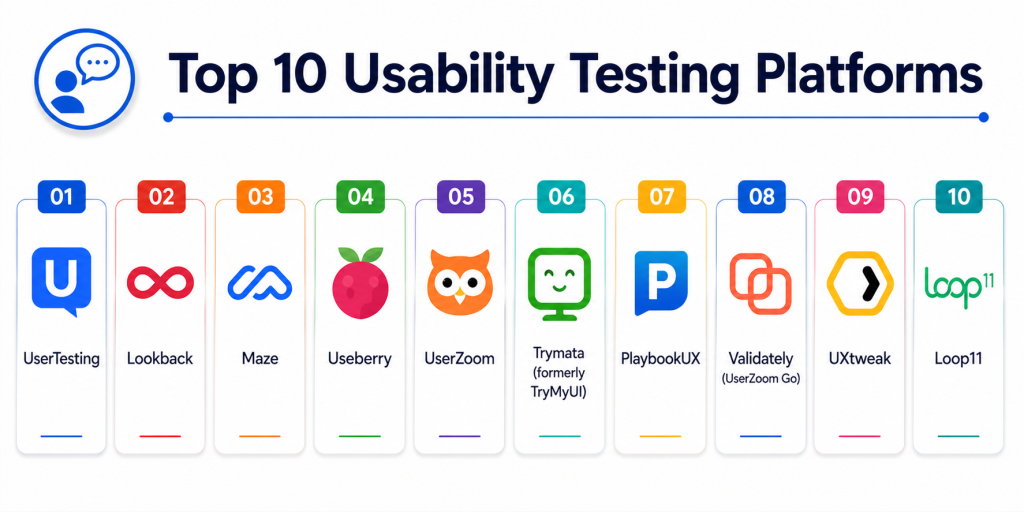
Top 10 Usability Testing Platforms
#1 — UserTesting
Short description: A leading usability testing platform offering video-based feedback from real users across various demographics.
Key Features
- Remote usability testing
- Participant recruitment
- Video session recordings
- Task-based testing
- Real-time insights
- Advanced analytics
Pros
- High-quality insights
- Large user panel
Cons
- Expensive
- Requires structured testing plans
Platforms / Deployment
Web
Cloud
Security & Compliance
Not publicly stated
Integrations & Ecosystem
- Product tools
- Analytics platforms
- Collaboration tools
Support & Community
Strong enterprise support.
#2 — Lookback
Short description: A usability testing tool focused on live moderated sessions and user interviews.
Key Features
- Live moderated testing
- Session recording
- Real-time collaboration
- Highlight reels
- Observer tools
Pros
- Excellent for interviews
- Easy collaboration
Cons
- Limited analytics
- Smaller ecosystem
Platforms / Deployment
Web
Cloud
Security & Compliance
Not publicly stated
Integrations & Ecosystem
- UX workflows
- Collaboration tools
Support & Community
Strong UX community.
#3 — Maze
Short description: A rapid testing platform for collecting usability insights from prototypes and live products.
Key Features
- Prototype testing
- Heatmaps
- Surveys
- User journey tracking
- Metrics dashboards
Pros
- Fast feedback
- Easy integration with design tools
Cons
- Limited qualitative depth
- Not ideal for complex research
Platforms / Deployment
Web
Cloud
Security & Compliance
Not publicly stated
Integrations & Ecosystem
- Figma
- Design tools
Support & Community
Strong product design ecosystem.
#4 — Useberry
Short description: A usability testing platform designed for testing prototypes and validating user flows.
Key Features
- Prototype testing
- Heatmaps
- User flows
- Surveys
- Analytics dashboards
Pros
- Simple interface
- Good for early-stage testing
Cons
- Limited enterprise features
- Smaller ecosystem
Platforms / Deployment
Web
Cloud
Security & Compliance
Not publicly stated
Integrations & Ecosystem
- Figma
- Design tools
Support & Community
Growing community.
#5 — UserZoom
Short description: An enterprise UX research platform offering advanced usability testing and analytics.
Key Features
- Moderated and unmoderated testing
- Survey tools
- Participant recruitment
- Advanced analytics
- Reporting dashboards
Pros
- Enterprise-grade features
- Comprehensive research tools
Cons
- Expensive
- Complex setup
Platforms / Deployment
Web
Cloud
Security & Compliance
Enterprise compliance support
Not publicly stated certifications
Integrations & Ecosystem
- Research tools
- Analytics platforms
Support & Community
Strong enterprise support.
#6 — Trymata (TryMyUI)
Short description: A usability testing platform providing recorded user sessions and feedback.
Key Features
- Task-based testing
- Video recordings
- Surveys
- User feedback
- Analytics
Pros
- Easy to use
- Affordable
Cons
- Limited advanced features
- Smaller participant pool
Platforms / Deployment
Web
Cloud
Security & Compliance
Not publicly stated
Integrations & Ecosystem
- UX workflows
Support & Community
Moderate support.
#7 — PlaybookUX
Short description: A research platform offering interviews, surveys, and usability testing.
Key Features
- Moderated interviews
- Unmoderated testing
- Surveys
- Video recordings
- Insights dashboards
Pros
- Flexible research methods
- Easy to use
Cons
- Limited enterprise features
- Smaller ecosystem
Platforms / Deployment
Web
Cloud
Security & Compliance
Not publicly stated
Integrations & Ecosystem
- Product tools
Support & Community
Growing support.
#8 — Validately (UserZoom Go)
Short description: A usability testing platform focused on rapid user feedback and testing.
Key Features
- Remote testing
- Video recordings
- Task-based testing
- Feedback collection
- Analytics
Pros
- Fast testing setup
- Reliable insights
Cons
- Limited advanced features
- Pricing
Platforms / Deployment
Web
Cloud
Security & Compliance
Not publicly stated
Integrations & Ecosystem
- UX tools
Support & Community
Good support.
#9 — UXtweak
Short description: A comprehensive UX research platform offering usability testing and analytics.
Key Features
- Usability testing
- Card sorting
- Tree testing
- Session recordings
- Analytics
Pros
- All-in-one UX toolkit
- Affordable
Cons
- Smaller ecosystem
- Limited enterprise features
Platforms / Deployment
Web
Cloud
Security & Compliance
Not publicly stated
Integrations & Ecosystem
- UX workflows
Support & Community
Moderate support.
#10 — Loop11
Short description: A usability testing platform focused on task-based testing and analytics.
Key Features
- Task-based testing
- Heatmaps
- User journey tracking
- Analytics dashboards
- Reporting tools
Pros
- Easy to use
- Strong analytics
Cons
- Limited qualitative insights
- Smaller ecosystem
Platforms / Deployment
Web
Cloud
Security & Compliance
Not publicly stated
Integrations & Ecosystem
- UX tools
Support & Community
Stable support.
Comparison Table
| Tool Name | Best For | Platform(s) Supported | Deployment | Standout Feature | Public Rating |
|---|---|---|---|---|---|
| UserTesting | Enterprise UX | Web | Cloud | Video insights | N/A |
| Lookback | Interviews | Web | Cloud | Live sessions | N/A |
| Maze | Prototype testing | Web | Cloud | Fast feedback | N/A |
| Useberry | Early testing | Web | Cloud | UX validation | N/A |
| UserZoom | Enterprise research | Web | Cloud | Advanced analytics | N/A |
| Trymata | SMB testing | Web | Cloud | Recorded sessions | N/A |
| PlaybookUX | Flexible research | Web | Cloud | Interviews + testing | N/A |
| Validately | Rapid testing | Web | Cloud | Fast insights | N/A |
| UXtweak | All-in-one UX | Web | Cloud | Multiple methods | N/A |
| Loop11 | Task testing | Web | Cloud | Analytics | N/A |
Evaluation & Scoring of Usability Testing Platforms
| Tool Name | Core (25%) | Ease (15%) | Integrations (15%) | Security (10%) | Performance (10%) | Support (10%) | Value (15%) | Weighted Total |
|---|---|---|---|---|---|---|---|---|
| UserTesting | 10 | 8 | 9 | 9 | 9 | 10 | 7 | 9.0 |
| Lookback | 9 | 9 | 8 | 8 | 9 | 9 | 8 | 8.7 |
| Maze | 8 | 9 | 8 | 8 | 8 | 8 | 9 | 8.4 |
| Useberry | 8 | 9 | 7 | 7 | 8 | 7 | 9 | 8.0 |
| UserZoom | 10 | 7 | 9 | 9 | 9 | 9 | 6 | 8.8 |
| Trymata | 8 | 9 | 7 | 7 | 8 | 8 | 9 | 8.2 |
| PlaybookUX | 8 | 9 | 7 | 7 | 8 | 8 | 8 | 8.1 |
| Validately | 8 | 8 | 7 | 7 | 8 | 8 | 8 | 8.0 |
| UXtweak | 8 | 8 | 7 | 7 | 8 | 8 | 9 | 8.1 |
| Loop11 | 8 | 9 | 7 | 7 | 8 | 8 | 8 | 8.1 |
How to interpret the scores:
These scores reflect comparative usability testing scenarios. Higher scores indicate stronger research capabilities, scalability, and insight generation. Enterprise tools provide deeper analytics, while simpler tools focus on ease of use and affordability.
Which Usability Testing Platform Is Right for You?
Solo / Freelancer
Maze or Useberry for quick and simple usability testing.
SMB
Trymata or UXtweak for affordable and flexible testing options.
Mid-Market
Lookback or PlaybookUX for balanced research capabilities.
Enterprise
UserTesting or UserZoom for large-scale usability programs.
Budget vs Premium
Free/low-cost tools offer basic insights; enterprise tools provide advanced analytics.
Feature Depth vs Ease of Use
Maze is simple; UserTesting offers deeper insights.
Integrations & Scalability
UserTesting and UserZoom provide strong integrations.
Security & Compliance Needs
Enterprise platforms provide stronger compliance support.
Frequently Asked Questions (FAQs)
1. What is usability testing?
It is the process of evaluating how users interact with a product.
2. Why is usability testing important?
It improves user experience and reduces friction.
3. What is moderated testing?
It involves a facilitator guiding users through tasks.
4. What is unmoderated testing?
Users complete tasks independently without supervision.
5. Are usability tools expensive?
Pricing varies from free to enterprise-level.
6. Can I test prototypes?
Yes, most platforms support prototype testing.
7. What is session recording?
Recording user interactions for analysis.
8. Can these tools integrate with design tools?
Yes, many integrate with Figma and other platforms.
9. Do I need multiple tools?
Often yes, for complete research coverage.
10. Which tool is best?
It depends on your research goals and budget.
Conclusion
Usability Testing Platforms are essential for building intuitive, user-friendly products by providing direct insights into how users interact with applications. Tools like UserTesting and UserZoom offer enterprise-grade capabilities with deep analytics and participant recruitment, while platforms like Maze and Useberry enable rapid testing for prototypes and early-stage designs. Lookback and PlaybookUX excel in moderated testing and interviews, making them ideal for qualitative research. Meanwhile, tools like UXtweak and Trymata provide cost-effective solutions for smaller teams. The right platform depends on your research goals, team size, and budget. Smaller teams often prioritize simplicity and affordability, while enterprises focus on scalability, integration, and advanced analytics. Since usability testing involves multiple methods, combining different tools often delivers the best results. A practical approach is to start with a simple platform for quick feedback and gradually expand into advanced research tools as your product grows. This ensures a scalable and user-centered design process.