Introduction
Mobile Performance Monitoring Tools are platforms that help teams track, analyze, and optimize the performance of mobile applications across devices, networks, and user environments. In simple terms, they provide visibility into how fast your app loads, how smoothly it runs, and where performance issues occur.
In a mobile-first world, performance directly impacts user retention, engagement, and revenue. Slow load times, crashes, or poor responsiveness can quickly lead to app uninstalls and negative reviews. These tools help developers and product teams identify bottlenecks, monitor real-time performance, and continuously improve user experience.
Common use cases include:
- Monitoring app load times and latency
- Tracking crashes and ANR issues
- Identifying performance bottlenecks
- Measuring user experience across devices
- Monitoring API and network performance
- Optimizing app releases and updates
What buyers should evaluate:
- Real-time performance monitoring capabilities
- Crash and error tracking integration
- Network and API performance visibility
- User session insights and analytics
- SDK performance impact on apps
- Integration with DevOps and CI/CD tools
- Scalability for high user traffic
- Alerting and incident management features
Best for: Mobile developers, DevOps teams, product managers, and enterprises managing high-performance mobile applications.
Not ideal for: Small apps with minimal traffic or projects that do not require deep performance insights.
Key Trends in Mobile Performance Monitoring Tools
- Unified observability platforms: Combining performance, logs, and crash reporting
- AI-driven root cause analysis: Automatic detection of performance issues
- Real user monitoring (RUM): Tracking real user experiences across devices
- Session replay integration: Visualizing user journeys and issues
- Edge and network performance tracking: Monitoring performance across regions
- Lightweight SDKs: Reducing impact on app performance
- Shift-left performance testing: Catching issues before production
- Cross-platform monitoring: Unified dashboards for iOS, Android, and web
- Automation and alerting: Real-time alerts for performance degradation
How We Selected These Tools (Methodology)
- Evaluated market adoption and enterprise usage
- Assessed performance monitoring depth and accuracy
- Reviewed real-time monitoring and alerting capabilities
- Considered integration with DevOps and cloud tools
- Analyzed impact on app performance
- Included both mobile-first and full-stack observability tools
- Balanced enterprise and developer-friendly platforms
- Evaluated analytics and reporting capabilities
- Considered scalability and reliability
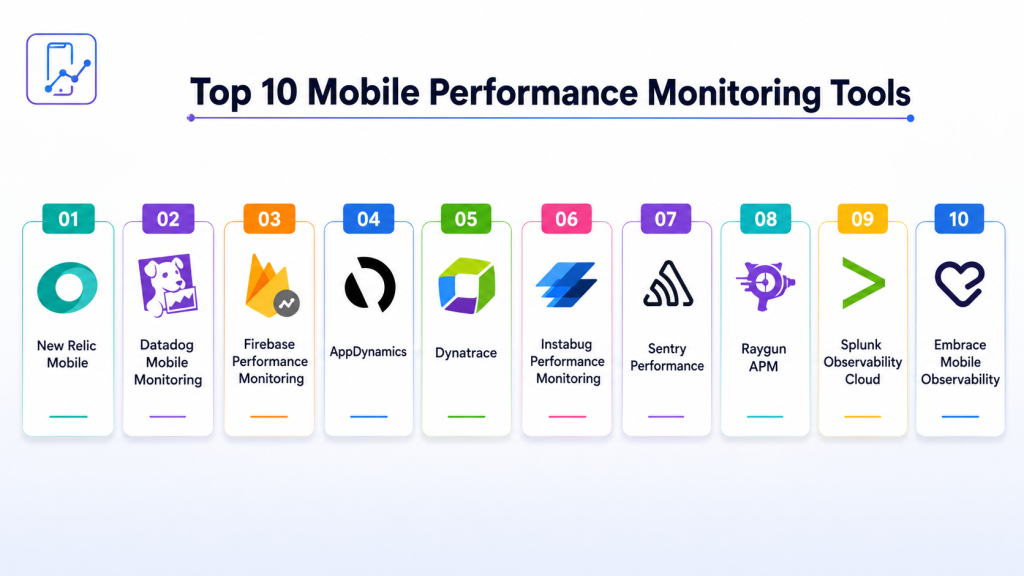
Top 10 Mobile Performance Monitoring Tools
#1 — New Relic Mobile
Short description: A comprehensive mobile monitoring tool offering deep insights into app performance, crashes, and user interactions.
Key Features
- Real-time performance monitoring
- Crash analytics
- Network request tracking
- User session insights
- Alerting and dashboards
- Distributed tracing
Pros
- Full-stack observability
- Strong analytics
Cons
- Pricing complexity
- Setup can be complex
Platforms / Deployment
iOS / Android
Cloud
Security & Compliance
Enterprise-grade security features
Not publicly stated certifications
Integrations & Ecosystem
- Cloud platforms
- DevOps tools
- CI/CD pipelines
Support & Community
Strong enterprise support.
#2 — Datadog Mobile Monitoring
Short description: A powerful observability platform that provides real-time performance monitoring and error tracking for mobile apps.
Key Features
- Real-time monitoring
- Crash tracking
- Network performance insights
- Log correlation
- Alerting system
Pros
- Strong observability features
- Scalable
Cons
- Expensive
- Complex setup
Platforms / Deployment
iOS / Android
Cloud
Security & Compliance
Enterprise compliance support
Not publicly stated certifications
Integrations & Ecosystem
- Cloud infrastructure
- DevOps tools
Support & Community
Enterprise-level support.
#3 — Firebase Performance Monitoring
Short description: A Google tool that tracks app performance metrics and network requests in real time.
Key Features
- App startup tracking
- Network latency monitoring
- Custom traces
- Real-time analytics
- Integration with Firebase
Pros
- Free and easy to use
- Seamless Firebase integration
Cons
- Limited advanced analytics
- Less customizable
Platforms / Deployment
iOS / Android
Cloud
Security & Compliance
Google security standards
Not publicly stated certifications
Integrations & Ecosystem
- Firebase suite
- Google Analytics
Support & Community
Large developer community.
#4 — AppDynamics
Short description: An enterprise application performance monitoring platform with strong mobile monitoring capabilities.
Key Features
- End-to-end performance visibility
- Business transaction monitoring
- Real-time alerts
- Crash analytics
- User experience tracking
Pros
- Enterprise-grade features
- Deep insights
Cons
- Expensive
- Complex setup
Platforms / Deployment
iOS / Android
Cloud / Hybrid
Security & Compliance
Enterprise compliance features
Not publicly stated certifications
Integrations & Ecosystem
- Enterprise systems
- DevOps tools
Support & Community
Strong enterprise support.
#5 — Dynatrace
Short description: A full-stack observability platform offering AI-driven performance monitoring for mobile applications.
Key Features
- AI-powered root cause analysis
- Real-time performance tracking
- Distributed tracing
- User session insights
- Automated alerts
Pros
- Advanced automation
- Deep observability
Cons
- High cost
- Learning curve
Platforms / Deployment
iOS / Android
Cloud
Security & Compliance
Enterprise-grade compliance
Not publicly stated certifications
Integrations & Ecosystem
- Cloud platforms
- DevOps pipelines
Support & Community
Enterprise-level support.
#6 — Instabug Performance Monitoring
Short description: A mobile-focused performance monitoring tool combined with crash reporting and user feedback features.
Key Features
- Performance tracking
- Crash reporting
- Session replay
- Network monitoring
- User feedback
Pros
- Strong UX insights
- Mobile-focused features
Cons
- Expensive
- SDK overhead
Platforms / Deployment
iOS / Android
Cloud
Security & Compliance
GDPR compliance support
Not publicly stated certifications
Integrations & Ecosystem
- Jira
- Slack
Support & Community
Strong mobile developer support.
#7 — Sentry Performance
Short description: A performance monitoring extension of Sentry offering transaction tracing and error tracking.
Key Features
- Transaction tracing
- Performance metrics
- Error tracking
- Release monitoring
- Alerting
Pros
- Strong developer experience
- Open-source options
Cons
- Requires configuration
- UI complexity
Platforms / Deployment
Cloud / Self-hosted
Security & Compliance
GDPR support
Not publicly stated certifications
Integrations & Ecosystem
- GitHub
- CI/CD tools
Support & Community
Strong developer community.
#8 — Raygun APM
Short description: A performance monitoring tool focused on real user monitoring and crash reporting.
Key Features
- Real user monitoring
- Performance tracking
- Error monitoring
- User session insights
- Alerting
Pros
- Easy integration
- Strong monitoring features
Cons
- Pricing
- Limited advanced analytics
Platforms / Deployment
Cloud
Security & Compliance
Not publicly stated
Integrations & Ecosystem
- DevOps tools
- Cloud platforms
Support & Community
Good technical support.
#9 — Splunk Observability Cloud
Short description: An enterprise observability platform that includes mobile performance monitoring capabilities.
Key Features
- Real-time monitoring
- Distributed tracing
- Metrics and logs
- Alerting
- Analytics dashboards
Pros
- Enterprise scalability
- Deep observability
Cons
- Complex setup
- Expensive
Platforms / Deployment
Cloud
Security & Compliance
Enterprise compliance support
Not publicly stated certifications
Integrations & Ecosystem
- Cloud infrastructure
- DevOps pipelines
Support & Community
Enterprise-level support.
#10 — Embrace Mobile Observability
Short description: A mobile-first observability platform focused on performance, stability, and user experience.
Key Features
- Mobile performance monitoring
- Crash tracking
- User session insights
- Network performance analysis
- Real-time alerts
Pros
- Mobile-first design
- Strong performance insights
Cons
- Smaller ecosystem
- Limited adoption
Platforms / Deployment
iOS / Android
Cloud
Security & Compliance
Not publicly stated
Integrations & Ecosystem
- Mobile analytics tools
- DevOps tools
Support & Community
Growing support ecosystem.
Comparison Table
| Tool Name | Best For | Platform(s) Supported | Deployment | Standout Feature | Public Rating |
|---|---|---|---|---|---|
| New Relic | Full-stack monitoring | iOS/Android | Cloud | Observability | N/A |
| Datadog | Enterprise apps | iOS/Android | Cloud | Real-time monitoring | N/A |
| Firebase | Developers | iOS/Android | Cloud | Free tool | N/A |
| AppDynamics | Enterprise | iOS/Android | Hybrid | Business insights | N/A |
| Dynatrace | AI monitoring | iOS/Android | Cloud | AI insights | N/A |
| Instabug | UX-focused apps | iOS/Android | Cloud | Session replay | N/A |
| Sentry | Developers | Mobile/Web | Cloud/Self | Tracing | N/A |
| Raygun | Monitoring | Mobile/Web | Cloud | User monitoring | N/A |
| Splunk | Enterprise | Mobile/Web | Cloud | Observability | N/A |
| Embrace | Mobile-first | iOS/Android | Cloud | UX insights | N/A |
Evaluation & Scoring of Mobile Performance Monitoring Tools
| Tool Name | Core (25%) | Ease (15%) | Integrations (15%) | Security (10%) | Performance (10%) | Support (10%) | Value (15%) | Weighted Total |
|---|---|---|---|---|---|---|---|---|
| New Relic | 10 | 8 | 9 | 9 | 10 | 9 | 8 | 9.1 |
| Datadog | 10 | 7 | 10 | 10 | 10 | 10 | 7 | 9.2 |
| Firebase | 8 | 9 | 8 | 8 | 9 | 9 | 10 | 8.8 |
| AppDynamics | 9 | 7 | 9 | 9 | 9 | 9 | 7 | 8.6 |
| Dynatrace | 10 | 7 | 10 | 10 | 10 | 10 | 6 | 9.0 |
| Instabug | 9 | 8 | 9 | 9 | 9 | 9 | 7 | 8.6 |
| Sentry | 9 | 8 | 9 | 9 | 9 | 9 | 8 | 8.8 |
| Raygun | 8 | 8 | 8 | 8 | 8 | 8 | 8 | 8.0 |
| Splunk | 10 | 7 | 10 | 10 | 10 | 10 | 6 | 9.0 |
| Embrace | 9 | 8 | 8 | 8 | 9 | 8 | 8 | 8.3 |
How to interpret the scores:
These scores are comparative and reflect real-world performance monitoring needs. Higher scores indicate stronger observability, scalability, and analytics capabilities. Enterprise tools offer deeper insights and automation, while simpler tools focus on ease of use and cost efficiency. Choose based on your app scale and monitoring depth needs.
Which Mobile Performance Monitoring Tool Is Right for You?
Solo / Developer
Firebase Performance Monitoring or Sentry for simplicity and cost efficiency.
SMB
Raygun or Instabug for balanced performance and usability.
Mid-Market
New Relic or Datadog for scalability and insights.
Enterprise
Dynatrace, Splunk, or AppDynamics for full observability.
Budget vs Premium
Firebase offers free monitoring, while enterprise tools provide advanced analytics.
Feature Depth vs Ease of Use
Firebase is simple; Dynatrace offers deep insights.
Integrations & Scalability
Datadog and New Relic provide strong ecosystems.
Security & Compliance Needs
Enterprise tools provide stronger compliance and governance.
Frequently Asked Questions (FAQs)
1. What is mobile performance monitoring?
It tracks app performance metrics like speed, crashes, and responsiveness.
2. Why is it important?
It improves user experience and prevents app uninstalls.
3. What metrics are tracked?
Load time, latency, crashes, and network performance.
4. Do these tools affect performance?
Lightweight SDKs have minimal impact.
5. Are free tools available?
Yes, Firebase offers a free solution.
6. What is real user monitoring?
It tracks actual user interactions in real time.
7. Can these tools integrate with DevOps?
Yes, most tools integrate with CI/CD pipelines.
8. What is APM?
Application Performance Monitoring tracks app health and performance.
9. Can I use multiple tools?
Yes, but it may increase complexity.
10. Which tool is best?
It depends on your app size and requirements.
Conclusion
Mobile Performance Monitoring Tools are essential for ensuring fast, reliable, and high-quality user experiences in modern mobile applications. Tools like Firebase Performance Monitoring provide a simple and cost-effective starting point, while platforms like New Relic and Datadog offer powerful observability and real-time insights. Enterprise solutions such as Dynatrace, AppDynamics, and Splunk Observability Cloud deliver advanced analytics, AI-driven monitoring, and full-stack visibility for large-scale applications. Mobile-focused tools like Instabug and Embrace add valuable user experience insights through session tracking and performance analytics. The right choice depends on your app’s scale, complexity, and performance requirements. Smaller teams often prioritize ease of use and affordability, while enterprises focus on scalability, automation, and integration depth. Since no single tool covers every use case, combining performance monitoring with crash reporting and analytics tools can provide a more complete view of app health. A practical approach is to start with a lightweight monitoring solution and expand as your app grows. This ensures a scalable, efficient, and user-focused performance strategy.