Introduction
Lead Generation Platforms help businesses attract, capture, qualify, enrich, nurture, and convert potential customers into sales opportunities. These tools support inbound forms, landing pages, outbound prospecting, website visitor identification, chat-based lead capture, data enrichment, email automation, and CRM handoff. Instead of managing leads manually across spreadsheets, email inboxes, and disconnected tools, teams use lead generation platforms to build a structured pipeline.
For marketing and sales teams, lead generation is not only about collecting contact details. The real goal is to identify the right prospects, understand their intent, engage them with relevant messaging, and pass qualified leads to sales at the right time. A strong platform helps reduce manual work, improve lead quality, and make campaign performance easier to measure.
Real-world use cases include:
- Capturing leads through forms, landing pages, popups, and chatbots
- Identifying website visitors and converting anonymous traffic into accounts
- Building outbound prospect lists with contact and company data
- Nurturing leads using automated email and workflow campaigns
- Enriching CRM records with firmographic and contact information
- Qualifying leads before routing them to sales teams
Buyer evaluation criteria should include:
- Lead capture flexibility
- Contact and company data quality
- CRM integration depth
- Workflow automation
- Email and campaign capabilities
- Lead scoring and qualification
- Personalization features
- Analytics and conversion reporting
- Compliance and consent controls
- Pricing, scalability, and support quality
Best for: Demand generation teams, sales teams, growth marketers, B2B companies, SaaS businesses, agencies, startups, SMBs, and enterprise teams that need a repeatable process for attracting and qualifying prospects.
Not ideal for: Businesses that rely only on referrals, companies without a clear sales process, teams that cannot follow up on leads consistently, or organizations that need only a simple contact form without automation, scoring, enrichment, or reporting.
Key Trends in Lead Generation Platforms
- AI-assisted prospecting: Platforms are using AI to identify better-fit accounts, recommend next actions, generate outreach messaging, and prioritize high-intent leads.
- Intent-led lead generation: Buyers increasingly want tools that show which accounts are researching relevant topics or visiting high-value pages.
- Data enrichment is becoming essential: Clean contact, company, role, industry, and firmographic data helps improve targeting and lead routing.
- Conversational lead capture is growing: Chatbots, live chat, and automated qualification flows are replacing static forms for many website journeys.
- CRM-native workflows are expected: Lead generation platforms must sync cleanly with CRM systems so sales teams can act quickly.
- Multi-channel campaigns are becoming standard: Teams now combine forms, chat, email, ads, social prospecting, webinars, and outbound sequences.
- Lead quality matters more than lead volume: Businesses are focusing less on collecting large lists and more on identifying prospects likely to convert.
- Privacy-aware growth is now important: Consent management, unsubscribe handling, data governance, and regional privacy expectations influence tool selection.
- Landing page optimization remains critical: Conversion-focused pages, A/B testing, and audience-specific messaging still drive meaningful lead volume.
- Sales and marketing alignment is a major differentiator: Platforms that connect campaign data with sales activity help teams reduce leakage and improve conversion.
How We Selected These Tools
The tools in this list were selected using practical buyer-focused evaluation logic:
- Strong recognition in lead generation, marketing automation, prospecting, conversion optimization, or sales intelligence
- Ability to support real lead generation workflows across inbound, outbound, website, or conversational channels
- Fit across startups, SMBs, mid-market companies, and enterprise teams
- Practical capabilities for lead capture, enrichment, qualification, nurturing, routing, and reporting
- Integration strength with CRM, marketing automation, email, sales engagement, analytics, and productivity tools
- Ease of use for marketers, sales reps, operations teams, and founders
- Data quality and segmentation depth where prospecting or enrichment is a key use case
- Reporting capabilities for conversion rates, source attribution, campaign performance, and sales handoff
- Security and compliance signals such as permissions, consent tools, access controls, and data handling options
- Overall value based on usability, scalability, automation, ecosystem strength, and business impact
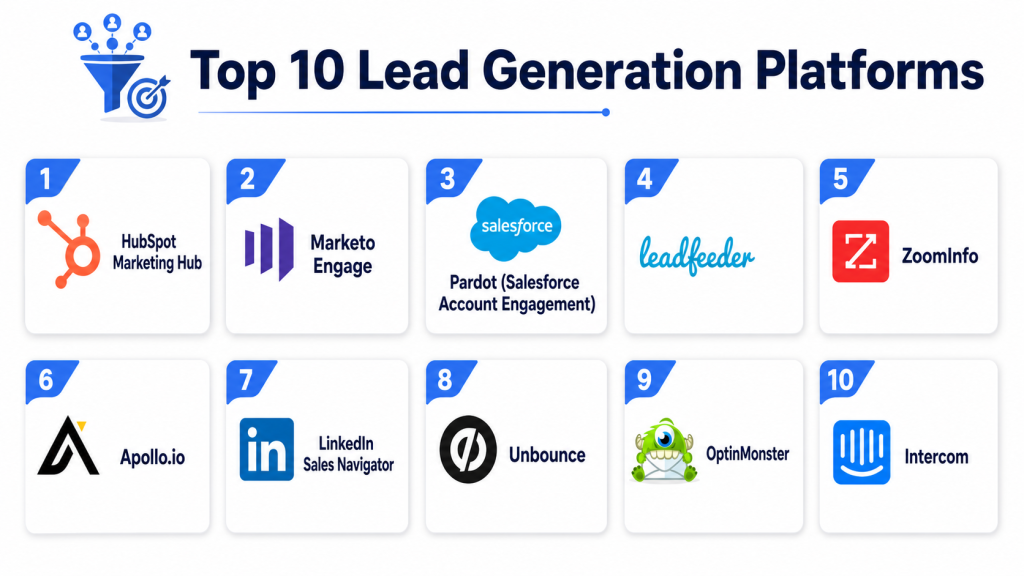
Top 10 Lead Generation Platforms
#1 — HubSpot Marketing Hub
Short description: HubSpot Marketing Hub is an all-in-one marketing platform that helps teams capture, nurture, score, and manage leads inside a connected CRM ecosystem. It is especially useful for businesses that want forms, landing pages, email automation, campaign reporting, chat, and CRM data in one place. HubSpot works well for SMBs, growing teams, and companies that want a user-friendly lead generation system.
Key Features
- Landing pages, forms, and lead capture tools
- Email marketing and automated nurturing workflows
- Built-in CRM connection for lead management
- Lead scoring and segmentation support
- Chatbots and live chat for website conversion
- Campaign analytics and source tracking
- App marketplace and workflow automation
Pros
- Easy to use for marketing and sales teams
- Strong all-in-one CRM and marketing ecosystem
- Good option for teams that want fast adoption and clean workflows
Cons
- Advanced automation and reporting may require higher plans
- Costs can increase as contact volume and feature needs grow
- Highly complex enterprise customization may need additional operations support
Platforms / Deployment
Cloud
Web-based platform
Mobile access available through HubSpot apps
Security & Compliance
HubSpot provides business security and administration features. Buyers should validate SSO, permissions, audit logs, encryption, data retention, and compliance requirements based on the selected plan.
Integrations & Ecosystem
HubSpot has a broad ecosystem for marketing, sales, service, analytics, ads, and productivity workflows. It is strongest when teams want lead generation connected directly to CRM and sales activity.
- CRM and sales tools
- Email and calendar tools
- Advertising platforms
- Webinar and event tools
- Analytics platforms
- Workflow automation apps
Support & Community
HubSpot provides documentation, learning resources, onboarding options, customer support, partner services, and a large user community. Support depth may vary by package.
#2 — Adobe Marketo Engage
Short description: Adobe Marketo Engage is a marketing automation platform designed for sophisticated lead generation, nurturing, scoring, segmentation, and campaign orchestration. It is commonly used by mid-market and enterprise marketing teams with complex buyer journeys. It is best for organizations that need advanced automation, multi-touch campaigns, and deep marketing operations control.
Key Features
- Advanced lead nurturing workflows
- Lead scoring and segmentation
- Email marketing automation
- Campaign orchestration and personalization
- CRM integration support
- Marketing analytics and attribution workflows
- Support for complex B2B demand generation programs
Pros
- Strong for enterprise and advanced marketing operations teams
- Highly flexible automation and segmentation capabilities
- Good fit for long sales cycles and complex nurturing programs
Cons
- Can be complex for beginners
- Requires skilled marketing operations support for best results
- Implementation and ongoing management may take planning
Platforms / Deployment
Cloud
Web-based platform
Enterprise marketing ecosystem integrations
Security & Compliance
Adobe provides enterprise-oriented security and administration capabilities. Buyers should validate specific Marketo Engage controls such as SSO, permissions, encryption, audit logs, data retention, and compliance needs directly.
Integrations & Ecosystem
Marketo Engage integrates with CRM, advertising, webinar, analytics, content, and data workflows. It is strongest for organizations that need advanced lead nurturing connected with broader marketing operations.
- Salesforce
- Microsoft Dynamics
- Adobe ecosystem
- Webinar platforms
- Data enrichment tools
- Analytics and attribution systems
Support & Community
Adobe provides documentation, partner services, training, customer support, and a strong marketing operations community. Support level may vary by contract and package.
#3 — Salesforce Account Engagement
Short description: Salesforce Account Engagement is a B2B marketing automation platform built for lead generation, lead nurturing, scoring, grading, email campaigns, and sales-marketing alignment. It is best suited for companies that already use Salesforce CRM and want marketing activity connected with sales workflows. It helps teams manage lead qualification and handoff inside the Salesforce ecosystem.
Key Features
- B2B lead nurturing and automation
- Lead scoring and grading
- Email marketing workflows
- Salesforce CRM integration
- Landing page and form support
- Sales alerts and activity visibility
- Campaign reporting and attribution support
Pros
- Strong fit for Salesforce-centered organizations
- Helps connect marketing leads with sales activity
- Useful for B2B lead qualification and nurturing
Cons
- Best value depends on Salesforce ecosystem usage
- May require admin and marketing operations expertise
- Some advanced use cases may need additional Salesforce configuration
Platforms / Deployment
Cloud
Web-based platform
Salesforce ecosystem
Security & Compliance
Salesforce provides enterprise security and administration capabilities across its platform. Buyers should validate specific Account Engagement settings for SSO, role permissions, encryption, audit logs, retention, and compliance requirements.
Integrations & Ecosystem
Salesforce Account Engagement works closely with Salesforce CRM and related sales workflows. It is especially valuable when lead generation, nurturing, opportunity management, and reporting need to operate inside one ecosystem.
- Salesforce CRM
- Salesforce reporting
- Email campaign workflows
- Landing page workflows
- Campaign attribution processes
- AppExchange ecosystem
Support & Community
Salesforce provides documentation, training resources, partner support, customer success options, and a large community. Support depth may vary by edition and agreement.
#4 — ZoomInfo
Short description: ZoomInfo is a B2B data and sales intelligence platform used for prospecting, lead enrichment, account targeting, and outbound lead generation. It helps sales and marketing teams find companies, contacts, buying signals, and firmographic data. ZoomInfo is best for teams that need strong prospect data to support outbound campaigns, account-based marketing, and sales pipeline development.
Key Features
- B2B contact and company database
- Firmographic and technographic data
- Lead enrichment and data cleansing
- Intent and buying signal support
- Account and contact search filters
- CRM and sales engagement integrations
- Workflow automation for prospecting teams
Pros
- Strong for outbound lead generation and prospect research
- Useful for data enrichment and account targeting
- Helps sales teams build more focused prospect lists
Cons
- Data accuracy can vary by region, industry, and contact type
- Pricing may be high for smaller teams
- Requires responsible data governance and outreach practices
Platforms / Deployment
Cloud
Web-based platform
CRM and sales workflow integrations
Security & Compliance
Buyers should validate data privacy controls, user permissions, data handling practices, retention options, and compliance requirements directly. Not publicly stated for any unverified certification.
Integrations & Ecosystem
ZoomInfo integrates with CRM, sales engagement, marketing automation, and workflow tools. It is most valuable when prospect data can flow directly into lead routing, outreach, enrichment, and reporting systems.
- Salesforce
- HubSpot
- Sales engagement tools
- Marketing automation platforms
- Workflow automation systems
- Data enrichment processes
Support & Community
ZoomInfo provides documentation, onboarding, customer support, training resources, and account support. Support level may vary by package and contract.
#5 — Apollo.io
Short description: Apollo.io combines B2B contact data, prospecting, email outreach, workflow automation, and sales engagement features. It is popular with startups, SMBs, and outbound sales teams that want prospect data and outreach tools in one platform. Apollo.io is useful for teams that need to build lists, run outbound sequences, and track prospect engagement.
Key Features
- Contact and company search
- Email sequencing and outbound automation
- Lead scoring and filtering
- CRM integration support
- Data enrichment workflows
- Engagement analytics
- Sales prospecting workspace
Pros
- Practical all-in-one option for outbound teams
- Strong value for startups and SMBs
- Combines data and outreach workflows
Cons
- Data accuracy may vary by market and segment
- Enterprise governance depth should be validated
- Teams must manage outreach quality to avoid low-value prospecting
Platforms / Deployment
Cloud
Web-based platform
Email, CRM, and sales workflow integrations
Security & Compliance
Security and compliance features should be verified directly. Buyers should validate user permissions, data handling, email compliance, retention, and access control requirements.
Integrations & Ecosystem
Apollo.io connects prospecting data with outbound engagement, CRM updates, and sales workflows. It is strongest for teams that want fewer disconnected tools for list building and outreach.
- CRM systems
- Email providers
- Sales engagement workflows
- Workflow automation tools
- Data enrichment processes
- Reporting tools
Support & Community
Apollo.io provides documentation, onboarding resources, support options, and product education materials. Support depth may vary by plan and team size.
#6 — LinkedIn Sales Navigator
Short description: LinkedIn Sales Navigator helps sales teams discover, track, and engage prospects through LinkedIn’s professional network. It is useful for account research, lead discovery, social selling, and relationship-based prospecting. Sales Navigator is especially valuable for B2B teams that rely on role, company, industry, and network-based targeting.
Key Features
- Advanced lead and account search
- Lead recommendations
- Account tracking and alerts
- Buyer and role-based filtering
- InMail messaging options
- CRM sync support
- Relationship and network insights
Pros
- Strong for B2B prospect discovery and account research
- Useful for social selling and relationship-based outreach
- Easy for sales reps to adopt if they already use LinkedIn
Cons
- Limited marketing automation compared with full lead generation platforms
- Outreach effectiveness depends on messaging quality and audience relevance
- Contact data workflows may require additional tools
Platforms / Deployment
Cloud
Web-based platform
Mobile access available through LinkedIn apps
Security & Compliance
Uses LinkedIn platform security and account controls. Buyers should validate administrative, data export, CRM sync, and compliance requirements for their organization.
Integrations & Ecosystem
LinkedIn Sales Navigator fits into sales prospecting, CRM research, account planning, and outreach workflows. It is best used alongside CRM and sales engagement tools.
- CRM systems
- Sales workflows
- Account research processes
- Outreach planning
- Relationship mapping
- Productivity tools
Support & Community
LinkedIn provides help resources, documentation, product education, and business support options. Support depth may vary by account type.
#7 — Leadfeeder
Short description: Leadfeeder helps businesses identify companies visiting their website and convert anonymous website traffic into sales opportunities. It is useful for B2B teams that already generate website traffic and want to know which companies are showing interest. Leadfeeder works best when connected with CRM and sales follow-up workflows.
Key Features
- Website visitor identification
- Company-level traffic insights
- Lead scoring and filtering
- CRM integration support
- Sales alerts and routing
- Page-level engagement visibility
- Account-based prospecting support
Pros
- Helps turn website traffic into actionable leads
- Useful for B2B sales and marketing alignment
- Easy to understand for sales teams
Cons
- Value depends on website traffic volume and quality
- Company identification may not always reveal individual buyers
- Works best when sales follow-up processes are clearly defined
Platforms / Deployment
Cloud
Web-based platform
Website tracking and CRM integrations
Security & Compliance
Buyers should validate website tracking consent, privacy controls, data handling, user permissions, and compliance requirements directly.
Integrations & Ecosystem
Leadfeeder connects website activity with CRM and sales workflows. It is strongest when sales teams can quickly act on account-level website engagement.
- CRM platforms
- Website analytics workflows
- Email alerts
- Sales prospecting workflows
- Marketing automation tools
- Reporting systems
Support & Community
Leadfeeder provides documentation, onboarding resources, help materials, and customer support options. Support level may vary by package.
#8 — Unbounce
Short description: Unbounce is a landing page and conversion optimization platform that helps marketers create campaign pages, forms, and conversion-focused experiences. It is useful for teams running paid campaigns, webinars, product launches, lead magnets, and targeted offers. Unbounce is best for businesses that need high-converting landing pages without relying heavily on developers.
Key Features
- Landing page builder
- Lead capture forms
- A/B testing and conversion optimization
- Campaign-specific page templates
- Personalization and smart traffic features
- Integration with CRM and email tools
- Analytics for page performance
Pros
- Strong for landing page conversion campaigns
- Easy for marketers to build and test pages
- Useful for paid ads, events, and lead magnets
Cons
- Not a full lead nurturing or CRM platform
- Requires traffic sources to generate leads
- Advanced funnel workflows may need other tools
Platforms / Deployment
Cloud
Web-based platform
Security & Compliance
Security and compliance details should be validated based on usage, forms, data handling, and integrations. Not publicly stated for any unverified certification.
Integrations & Ecosystem
Unbounce integrates with CRM, email, analytics, ads, and workflow tools. It works best as a conversion layer within a broader lead generation stack.
- CRM platforms
- Email marketing tools
- Analytics systems
- Advertising workflows
- Webinar tools
- Automation platforms
Support & Community
Unbounce provides documentation, templates, support options, onboarding resources, and conversion-focused learning materials. Support level may vary by plan.
#9 — OptinMonster
Short description: OptinMonster is a lead capture and conversion optimization platform that helps websites convert visitors using popups, forms, exit-intent campaigns, targeting rules, and A/B testing. It is best for businesses that already have website traffic and want to increase email signups, demo requests, content downloads, or offer conversions. It is simple, focused, and useful for website-based lead capture.
Key Features
- Popup and form campaigns
- Exit-intent targeting
- Behavior-based display rules
- A/B testing
- Lead capture analytics
- Segmentation and personalization
- Integrations with email and CRM tools
Pros
- Easy to deploy on websites
- Strong for improving visitor-to-lead conversion
- Good value for content, ecommerce, SaaS, and service websites
Cons
- Not a full lead generation suite
- Requires existing traffic to produce results
- Poorly designed popups can hurt user experience
Platforms / Deployment
Cloud
Web-based platform
Website-based deployment
Security & Compliance
Buyers should validate form data handling, consent features, integrations, and privacy requirements based on their website and region.
Integrations & Ecosystem
OptinMonster works well with email marketing, CRM, website, and analytics tools. It is best used as a website conversion layer inside a larger lead generation system.
- Email marketing tools
- CRM platforms
- Website builders
- Analytics tools
- Ecommerce platforms
- Workflow automation tools
Support & Community
OptinMonster provides documentation, templates, tutorials, and support options. Support depth may vary by plan.
#10 — Intercom
Short description: Intercom is a customer messaging platform that supports lead generation through live chat, chatbots, website messaging, qualification flows, and automated engagement. It is especially useful for SaaS companies and digital businesses that want to capture and qualify leads through conversations. Intercom helps teams engage visitors in real time instead of relying only on static forms.
Key Features
- Live chat and website messaging
- Chatbots and automated qualification
- Lead routing and conversation workflows
- Customer and prospect segmentation
- In-app messages and engagement campaigns
- CRM and help desk integrations
- Analytics for conversations and conversions
Pros
- Strong conversational lead capture experience
- Useful for SaaS, product-led, and digital businesses
- Helps qualify leads before sales handoff
Cons
- Pricing can increase with scale and feature usage
- Setup requires clear messaging and routing workflows
- Not focused on outbound prospecting or data enrichment
Platforms / Deployment
Cloud
Web-based platform
Web, app, and messaging-based deployment
Security & Compliance
Intercom provides business security and administration features. Buyers should validate SSO, permissions, encryption, retention, audit logs, and compliance requirements for their selected plan.
Integrations & Ecosystem
Intercom integrates with CRM, support, product analytics, marketing, and automation tools. It is strongest when conversational lead capture needs to connect with sales, support, and customer lifecycle workflows.
- CRM platforms
- Help desk tools
- Product analytics systems
- Marketing automation tools
- Workflow automation platforms
- Messaging and collaboration tools
Support & Community
Intercom provides documentation, onboarding resources, support options, product education, and a broad SaaS user community. Support level may vary by plan.
Comparison Table
| Tool Name | Best For | Platform(s) Supported | Deployment | Standout Feature | Public Rating |
|---|---|---|---|---|---|
| HubSpot Marketing Hub | Inbound lead generation and CRM-connected marketing | Web-based | Cloud | All-in-one marketing and CRM workflow | N/A |
| Adobe Marketo Engage | Enterprise marketing automation | Web-based | Cloud | Advanced lead nurturing and segmentation | N/A |
| Salesforce Account Engagement | Salesforce-centered B2B lead generation | Web-based | Cloud | Deep Salesforce CRM alignment | N/A |
| ZoomInfo | B2B prospecting and data enrichment | Web-based | Cloud | Contact and company intelligence | N/A |
| Apollo.io | Outbound prospecting and sales engagement | Web-based | Cloud | Prospect data plus outreach automation | N/A |
| LinkedIn Sales Navigator | Social selling and account research | Web-based, mobile app | Cloud | Professional network-based prospecting | N/A |
| Leadfeeder | Website visitor identification | Web-based | Cloud | Company-level website visitor tracking | N/A |
| Unbounce | Landing page lead capture | Web-based | Cloud | Conversion-focused landing pages | N/A |
| OptinMonster | Website conversion and popups | Web-based | Cloud | Exit-intent and behavior-based lead capture | N/A |
| Intercom | Conversational lead capture | Web-based, web/app messaging | Cloud | Chatbots and live qualification workflows | N/A |
Evaluation & Scoring of Lead Generation Platforms
| Tool Name | Core (25%) | Ease (15%) | Integrations (15%) | Security (10%) | Performance (10%) | Support (10%) | Value (15%) | Weighted Total (0–10) |
|---|---|---|---|---|---|---|---|---|
| HubSpot Marketing Hub | 10 | 9 | 9 | 8 | 9 | 9 | 8 | 8.95 |
| Adobe Marketo Engage | 10 | 7 | 9 | 9 | 9 | 8 | 7 | 8.50 |
| Salesforce Account Engagement | 9 | 8 | 9 | 9 | 8 | 8 | 7 | 8.35 |
| ZoomInfo | 9 | 8 | 8 | 8 | 8 | 8 | 7 | 8.10 |
| Apollo.io | 8 | 9 | 8 | 7 | 8 | 8 | 9 | 8.25 |
| LinkedIn Sales Navigator | 8 | 9 | 7 | 8 | 8 | 8 | 8 | 8.05 |
| Leadfeeder | 7 | 9 | 7 | 7 | 8 | 8 | 9 | 7.90 |
| Unbounce | 8 | 9 | 8 | 7 | 8 | 8 | 8 | 8.00 |
| OptinMonster | 7 | 9 | 7 | 7 | 8 | 8 | 9 | 7.85 |
| Intercom | 8 | 8 | 8 | 8 | 8 | 8 | 7 | 8.00 |
These scores are comparative and should be used as a shortlist guide. Enterprise marketing automation platforms score higher for workflow depth and scalability, while SMB-friendly tools often score higher for ease of use and value. Prospecting platforms are stronger for outbound lead discovery, while landing page and popup tools are stronger for inbound conversion. The best platform depends on your lead source, sales process, data quality, follow-up speed, and budget.
Which Lead Generation Platform Is Right for You?
Solo / Freelancer
Solo professionals should keep the stack simple. A landing page tool, website form, LinkedIn Sales Navigator, or lightweight CRM-connected lead capture workflow may be enough. Unbounce, OptinMonster, Apollo.io, and LinkedIn Sales Navigator can be practical depending on whether the main channel is inbound traffic or outbound prospecting. Avoid complex enterprise automation until there is enough lead volume to justify it.
SMB
SMBs should focus on speed, affordability, CRM integration, and easy lead follow-up. HubSpot Marketing Hub is a strong all-in-one option for inbound teams. Apollo.io is useful for outbound prospecting. Intercom helps SaaS and digital businesses convert website visitors through chat. Unbounce and OptinMonster are practical for campaign landing pages and website conversion improvements.
Mid-Market
Mid-market teams usually need better automation, segmentation, reporting, data enrichment, and sales handoff. HubSpot Marketing Hub, Salesforce Account Engagement, ZoomInfo, Apollo.io, Intercom, Leadfeeder, and Unbounce are strong candidates depending on the channel mix. Mid-market buyers should prioritize CRM integration, lead scoring, source tracking, and campaign reporting so sales and marketing can measure what is working.
Enterprise
Enterprises should prioritize scalability, governance, advanced automation, CRM alignment, data quality, segmentation, and security. Adobe Marketo Engage, Salesforce Account Engagement, HubSpot Marketing Hub, and ZoomInfo are strong enterprise candidates depending on the existing ecosystem. Enterprise teams should involve marketing operations, revenue operations, IT, security, and sales leadership before final selection.
Budget vs Premium
Budget-focused teams should start with tools that solve a specific lead generation problem clearly. Apollo.io, OptinMonster, Unbounce, Leadfeeder, and LinkedIn Sales Navigator can be effective depending on the channel. Premium buyers should evaluate HubSpot Marketing Hub, Adobe Marketo Engage, Salesforce Account Engagement, and ZoomInfo when they need deeper automation, data, reporting, and scale.
Feature Depth vs Ease of Use
If ease of use matters most, HubSpot Marketing Hub, Apollo.io, Unbounce, OptinMonster, and Intercom are practical choices. If feature depth matters more, Adobe Marketo Engage, Salesforce Account Engagement, HubSpot Marketing Hub, and ZoomInfo provide broader capabilities. The right decision depends on whether your team needs simple conversion tools, outbound data, or full-funnel marketing automation.
Integrations & Scalability
Lead Generation Platforms should integrate with CRM, marketing automation, email, sales engagement, analytics, advertising, chat, and workflow tools. Poor integrations can create duplicate records, slow follow-up, and unreliable reporting. As teams scale, they should also evaluate APIs, data exports, permission models, lead routing, deduplication, and reporting flexibility.
Security & Compliance Needs
Lead generation involves personal data, consent records, outreach activity, and customer intent signals. Buyers should validate data handling, consent management, unsubscribe workflows, access controls, encryption, retention policies, audit logs, and regional privacy requirements. Security and compliance should be reviewed early, especially for teams using enrichment data or outbound prospecting platforms.
Frequently Asked Questions
1. What are Lead Generation Platforms?
Lead Generation Platforms help businesses attract, capture, qualify, and manage potential customers.
They support workflows such as forms, landing pages, chat, outbound prospecting, data enrichment, and lead nurturing.
The goal is to create a repeatable process for turning interest into sales opportunities.
2. Why are Lead Generation Platforms important?
They help teams generate a consistent flow of prospects instead of relying on random outreach or manual tracking.
They also improve lead quality by adding scoring, segmentation, enrichment, and automation.
A strong platform helps marketing and sales teams work from the same data.
3. What features should buyers prioritize first?
Buyers should prioritize lead capture, CRM integration, automation, lead scoring, data quality, analytics, and compliance controls.
Inbound teams may need forms, landing pages, chat, and nurturing workflows.
Outbound teams may need contact data, enrichment, prospecting filters, and outreach automation.
4. Are Lead Generation Platforms useful for small businesses?
Yes, small businesses can benefit if they choose focused and easy-to-use tools.
A simple landing page, CRM, chatbot, or outbound prospecting tool may be enough at the beginning.
Small teams should avoid overly complex platforms until they have enough lead volume and follow-up capacity.
5. How much do Lead Generation Platforms cost?
Pricing varies based on users, contacts, features, lead volume, data access, automation, and support level.
Some tools are affordable for small teams, while enterprise marketing automation and data platforms can cost much more.
Buyers should compare total cost, including setup, training, integrations, and data usage.
6. Do Lead Generation Platforms integrate with CRM systems?
Yes, most strong platforms integrate with CRM systems to sync leads, contacts, companies, activities, and campaign data.
CRM integration is important because sales teams need clean and timely lead information.
Buyers should confirm whether the integration is native, API-based, or limited by plan.
7. What common mistakes should buyers avoid?
A common mistake is buying a platform before defining lead sources, qualification rules, and follow-up ownership.
Another mistake is focusing only on lead volume while ignoring quality and conversion rates.
Teams should also avoid tools that do not integrate cleanly with their CRM and reporting workflows.
8. Can Lead Generation Platforms automate lead nurturing?
Yes, many platforms can automate email sequences, follow-ups, segmentation, lead scoring, and sales notifications.
Automation helps keep prospects engaged until they are ready for sales conversations.
However, nurturing works best when messaging is relevant, personalized, and based on real buyer behavior.
9. Are Lead Generation Platforms secure?
Many reputable platforms provide security controls such as permissions, encryption, user management, and data handling settings.
However, security depth varies by vendor, plan, and deployment model.
Buyers should validate consent handling, retention, access controls, compliance needs, and data privacy requirements.
10. What are alternatives to dedicated Lead Generation Platforms?
Alternatives include manual outreach, spreadsheets, basic website forms, CRM-only workflows, social prospecting, and simple email tools.
These options may work for very small teams or early testing.
Dedicated platforms are better when teams need scale, automation, analytics, enrichment, and reliable sales handoff.
Conclusion
Lead Generation Platforms help businesses create a structured process for attracting, qualifying, nurturing, and converting prospects. They support inbound capture, outbound prospecting, website conversion, chat-based qualification, data enrichment, and CRM-connected workflows. HubSpot Marketing Hub is a strong all-in-one option for teams that want lead generation connected with CRM and marketing automation. Adobe Marketo Engage and Salesforce Account Engagement are better suited for larger teams with complex nurturing and campaign operations. ZoomInfo, Apollo.io, and LinkedIn Sales Navigator are strong for outbound prospecting and data-driven sales development. Leadfeeder, Unbounce, OptinMonster, and Intercom are practical choices for website visitor identification, landing page conversion, popup capture, and conversational lead generation. The best platform depends on your lead sources, sales motion, budget, CRM stack, campaign maturity, and follow-up process. Before choosing, shortlist two or three tools, test them with real campaigns, validate integrations, and review data quality.
This blog clearly explains lead generation platforms and how they help businesses attract and manage quality leads effectively.
The tools look good feature-wise, but managing lead sources over time can get complicated. Different channels often bring inconsistent data that’s hard to standardize.