Introduction
Data observability tools are designed to monitor the health, quality, and performance of data pipelines and systems. They provide insights into data reliability, detect anomalies, track lineage, and alert teams to issues before they impact downstream analytics or business operations. Essentially, they give organizations “visibility into data in motion” across their platforms.
In today’s complex data environments, ensuring data reliability is crucial for AI, analytics, and decision-making. Data observability helps teams reduce operational downtime, maintain trust in their data, and accelerate time-to-insight.
Real-world use cases include:
- Detecting and alerting on missing or delayed data in pipelines.
- Monitoring data quality metrics such as freshness, volume, and consistency.
- Root cause analysis for data errors across ETL, ELT, and streaming workflows.
- Supporting compliance and audit requirements by tracking data lineage.
- Proactively reducing analytics downtime for business-critical reports.
Key evaluation criteria for buyers:
- Real-time monitoring and alerting capabilities.
- Automated anomaly detection and AI-assisted insights.
- Lineage tracking and impact analysis.
- Integrations with cloud, on-prem, and modern data platforms.
- Usability and ease of dashboard configuration.
- Scalability for high-volume pipelines.
- Customizable metrics and health scoring.
- Security and compliance features.
- Support and community strength.
Best for:
Data observability tools are ideal for data engineers, analytics teams, DevOps, and IT operations in organizations with complex data pipelines across multiple environments.
Not ideal for:
Small teams or organizations with simple pipelines may not need a dedicated observability tool; lightweight monitoring or built-in pipeline alerts may suffice.
Key Trends in Data Observability Tools
- AI/ML-driven anomaly detection: Automatically detect unexpected changes in metrics or schema.
- End-to-end lineage tracking: Understanding data flow from source to analytics outputs.
- Automated monitoring of data quality metrics: Coverage of freshness, volume, distribution, and integrity.
- Integration with modern data stacks: Cloud warehouses, data lakes, BI platforms, ETL/ELT tools.
- Real-time alerting and incident management: Instant notifications for broken pipelines or delayed data.
- Self-service dashboards: Empower data teams to configure and monitor without engineering support.
- Cloud-native deployments with hybrid support: Scalability and flexibility across environments.
- Collaboration tools for data teams: Shared insights, alerts, and dashboards to improve response time.
- Flexible pricing models: Usage-based, subscription, or seat-based pricing depending on scale.
- Security and compliance monitoring: Access controls, audit logs, and encryption features to meet governance standards.
How We Selected These Tools (Methodology)
- Evaluated market adoption and visibility in the data engineering community.
- Reviewed feature completeness, including anomaly detection, monitoring, lineage, and dashboards.
- Assessed reliability and performance signals, including uptime, scalability, and accuracy.
- Examined security and compliance posture, including access controls and encryption.
- Considered integration ecosystem with cloud warehouses, BI tools, and ETL platforms.
- Checked suitability for various segments, from SMBs to large enterprises.
- Factored in ease of use and learning curve for engineering and analytics teams.
- Analyzed support and community strength for adoption and troubleshooting.
- Considered pricing and overall value relative to feature set.
- Prioritized tools offering AI-powered insights and proactive alerts.
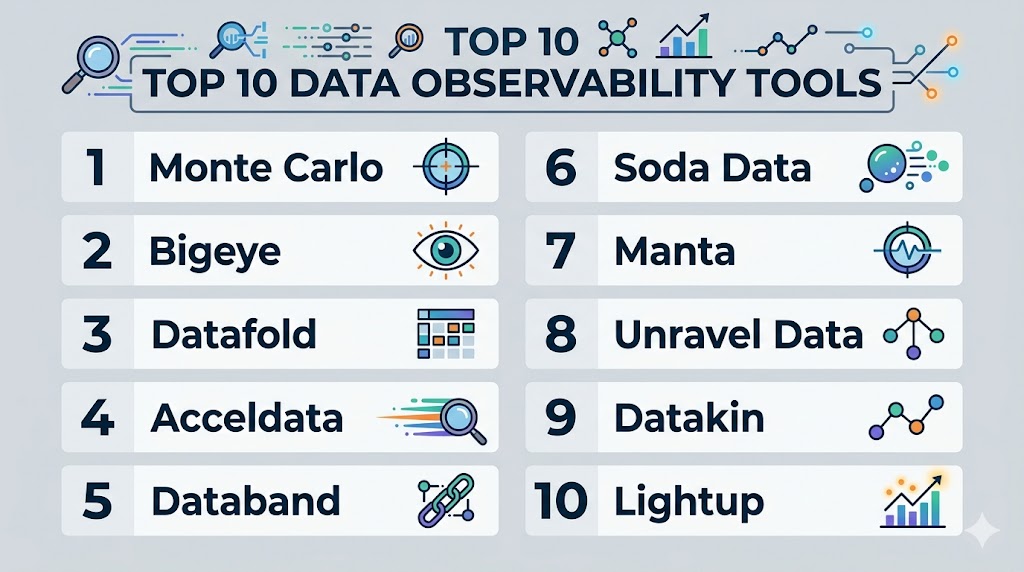
Top 10 Data Observability Tools
#1 — Monte Carlo
Short description: Monte Carlo provides full-stack data observability with automated monitoring, anomaly detection, and end-to-end lineage for modern data pipelines.
Key Features
- Real-time monitoring of data freshness, volume, and distribution
- AI-driven anomaly detection and root cause analysis
- Automated lineage tracking and impact analysis
- Alerts and incident management
- Integration with modern data warehouses and ETL tools
- Dashboards for health scoring and SLA tracking
Pros
- Proactive detection of broken or delayed pipelines
- User-friendly dashboards for data teams
Cons
- Can be costly for smaller teams
- Advanced configuration may require training
Platforms / Deployment
- Web
- Cloud
Security & Compliance
- SSO/SAML, encryption, RBAC
- SOC 2
Integrations & Ecosystem
- Snowflake, Redshift, BigQuery, Fivetran, DBT
- REST APIs for custom integrations
Support & Community
- Responsive support team
- Active user community
#2 — Bigeye
Short description: Bigeye automates data quality monitoring and observability to ensure accurate, reliable pipelines with minimal manual effort.
Key Features
- Automated metric tracking and anomaly detection
- Alerts on missing, delayed, or inconsistent data
- Lineage visualization and impact reporting
- Customizable dashboards and KPIs
- Integration with ETL, BI, and cloud platforms
Pros
- AI-driven alerts reduce manual monitoring
- Easy integration with existing data stack
Cons
- Smaller community than legacy competitors
- Custom rules setup may require technical knowledge
Platforms / Deployment
- Web
- Cloud
Security & Compliance
- SSO, encryption, RBAC
- SOC 2
Integrations & Ecosystem
- Snowflake, BigQuery, Redshift, DBT, Looker, Tableau
Support & Community
- Professional support tiers
- Growing knowledge base
#3 — Datafold
Short description: Datafold focuses on data quality observability with pipeline regression testing, monitoring, and lineage tracking.
Key Features
- Automated data regression testing
- Lineage tracking and impact analysis
- Anomaly detection in metrics and schema changes
- Integration with modern ETL pipelines
- Dashboards for SLA and health metrics
Pros
- Strong pipeline regression features
- Reduces production data errors
Cons
- Limited enterprise-scale support
- May require engineering resources for setup
Platforms / Deployment
- Web
- Cloud
Security & Compliance
- SSO, encryption, RBAC
- SOC 2
Integrations & Ecosystem
- Snowflake, DBT, BigQuery, Fivetran
Support & Community
- Support team and documentation
- Community growing steadily
#4 — Acceldata
Short description: Acceldata provides enterprise-grade data observability with real-time monitoring, AI insights, and pipeline performance optimization.
Key Features
- Full-stack observability across pipelines and warehouses
- AI-powered anomaly detection
- Lineage and impact visualization
- SLA monitoring and alerts
- Metrics dashboards and reporting
Pros
- Enterprise-scale observability
- Detailed insights for operational teams
Cons
- High complexity for small teams
- Pricing can be significant
Platforms / Deployment
- Web
- Cloud / Hybrid
Security & Compliance
- SSO, encryption, RBAC
- GDPR, SOC 2
Integrations & Ecosystem
- Snowflake, Redshift, BigQuery, Kafka, Spark
Support & Community
- Enterprise support
- Professional services
#5 — Databand
Short description: Databand helps monitor data pipelines with anomaly detection, tracking, and lineage for reliable analytics delivery.
Key Features
- Pipeline monitoring and health scoring
- AI-driven anomaly detection
- Lineage and impact visualization
- Alerts for broken or delayed pipelines
- Dashboarding and SLA tracking
Pros
- Simplifies pipeline observability
- Real-time alerts
Cons
- Smaller ecosystem integrations
- Advanced features may need technical setup
Platforms / Deployment
- Web
- Cloud
Security & Compliance
- SSO, encryption, RBAC
- SOC 2
Integrations & Ecosystem
- Snowflake, Redshift, BigQuery, DBT, Fivetran
Support & Community
- Responsive support
- Documentation and tutorials
#6 — Soda Data
Short description: Soda Data focuses on open-source and enterprise solutions for data quality monitoring and observability.
Key Features
- Data quality tests and anomaly detection
- Real-time monitoring dashboards
- Alerts for freshness, volume, and integrity
- Integration with pipelines and warehouses
- Data lineage and health scoring
Pros
- Open-source option available
- Flexible alerting rules
Cons
- Enterprise features require paid plan
- Setup may be technical
Platforms / Deployment
- Web
- Cloud / On-prem
Security & Compliance
- SSO, encryption, RBAC
- SOC 2
Integrations & Ecosystem
- Snowflake, Redshift, BigQuery, DBT, Spark
Support & Community
- Open-source community
- Enterprise support available
#7 — Monte Carlo (Free & Paid)
Short description: Monte Carlo enables observability with proactive monitoring, anomaly detection, and SLA management.
Key Features
- Data health scoring
- Automated alerts and anomaly detection
- Lineage tracking
- Dashboards and SLA monitoring
- Integration with cloud data stack
Pros
- Highly visual dashboards
- AI-driven anomaly detection
Cons
- Pricing may be high for small teams
- Some features require training
Platforms / Deployment
- Web
- Cloud
Security & Compliance
- SSO/SAML, encryption, RBAC
- SOC 2
Integrations & Ecosystem
- Snowflake, BigQuery, Redshift, DBT, Fivetran
Support & Community
- Enterprise support
- Active knowledge base
#8 — Manta
Short description: Manta focuses on automated lineage tracking and observability across complex data pipelines.
Key Features
- End-to-end lineage discovery
- Impact analysis for pipeline changes
- Data dependency visualization
- Integration with ETL and BI tools
Pros
- Deep lineage capabilities
- Supports complex enterprise pipelines
Cons
- Limited anomaly detection features
- Smaller monitoring dashboard
Platforms / Deployment
- Web
- Cloud / On-prem
Security & Compliance
- SSO, encryption, RBAC
- SOC 2
Integrations & Ecosystem
- Snowflake, BigQuery, Redshift, DBT
Support & Community
- Support and documentation available
#9 — Unravel Data
Short description: Unravel provides observability and performance monitoring for big data and cloud pipelines.
Key Features
- Monitoring of big data workloads
- Anomaly detection and root cause analysis
- Performance insights and optimization
- Pipeline SLA dashboards
Pros
- Strong performance monitoring
- Enterprise big data focus
Cons
- Less suitable for small pipelines
- Limited lineage depth
Platforms / Deployment
- Web
- Cloud / Hybrid
Security & Compliance
- SSO, encryption, RBAC
- SOC 2
Integrations & Ecosystem
- Spark, Kafka, Snowflake, Redshift
Support & Community
- Enterprise support
- Documentation and training
#10 — Datakin
Short description: Datakin provides end-to-end pipeline observability with automated anomaly detection and health scoring.
Key Features
- Real-time monitoring of pipelines
- AI-assisted anomaly detection
- Metrics dashboards for freshness, volume, and distribution
- Lineage visualization
Pros
- Lightweight deployment
- Easy-to-read dashboards
Cons
- Limited integrations
- Smaller user community
Platforms / Deployment
- Web
- Cloud
Security & Compliance
- SSO, encryption, RBAC
- SOC 2
Integrations & Ecosystem
- Snowflake, BigQuery, Redshift, DBT
Support & Community
- Support available
- Growing community
Comparison Table (Top 10)
| Tool Name | Best For | Platform(s) Supported | Deployment | Standout Feature | Public Rating |
|---|---|---|---|---|---|
| Monte Carlo | Full-stack observability | Web | Cloud | AI-driven anomaly detection | N/A |
| Bigeye | Automated data quality | Web | Cloud | AI alerts and metrics | N/A |
| Datafold | Regression testing pipelines | Web | Cloud | Data regression detection | N/A |
| Acceldata | Enterprise observability | Web | Cloud/Hybrid | Full-stack monitoring | N/A |
| Databand | Pipeline monitoring | Web | Cloud | Health scoring dashboards | N/A |
| Soda Data | Open-source + enterprise | Web | Cloud/On-prem | Flexible monitoring tests | N/A |
| Monte Carlo | Real-time monitoring | Web | Cloud | SLA monitoring | N/A |
| Manta | Lineage-focused | Web | Cloud/On-prem | Deep lineage visualization | N/A |
| Unravel Data | Big data observability | Web | Cloud/Hybrid | Performance insights | N/A |
| Datakin | Lightweight observability | Web | Cloud | Easy dashboards | N/A |
Evaluation & Scoring of Data Observability Tools
| Tool Name | Core (25%) | Ease (15%) | Integrations (15%) | Security (10%) | Performance (10%) | Support (10%) | Value (15%) | Weighted Total (0–10) |
|---|---|---|---|---|---|---|---|---|
| Monte Carlo | 9 | 8 | 8 | 9 | 8 | 8 | 7 | 8.1 |
| Bigeye | 8 | 8 | 7 | 8 | 8 | 7 | 8 | 7.7 |
| Datafold | 8 | 7 | 7 | 8 | 8 | 7 | 7 | 7.5 |
| Acceldata | 9 | 7 | 8 | 9 | 8 | 8 | 6 | 7.9 |
| Databand | 8 | 8 | 7 | 8 | 7 | 7 | 7 | 7.5 |
| Soda Data | 7 | 7 | 7 | 7 | 7 | 7 | 8 | 7.2 |
| Manta | 7 | 7 | 6 | 7 | 8 | 6 | 7 | 6.9 |
| Unravel | 8 | 7 | 7 | 8 | 8 | 7 | 6 | 7.3 |
| Datakin | 7 | 8 | 6 | 7 | 7 | 6 | 7 | 6.9 |
Which Data Observability Tool Is Right for You?
Solo / Freelancer
Lightweight, easy-to-deploy tools like Datakin or Soda Data allow monitoring small pipelines without enterprise complexity.
SMB
Bigeye and Datafold provide AI-powered anomaly detection and dashboards suitable for mid-sized data teams.
Mid-Market
Databand or Monte Carlo offer robust monitoring with health scoring and SLA tracking across multiple pipelines.
Enterprise
Acceldata, Monte Carlo, and Unravel are ideal for large-scale observability, deep lineage tracking, and integration with complex data ecosystems.
Budget vs Premium
Budget-conscious teams may prioritize Soda Data or Datakin, while enterprise teams needing full observability should invest in Acceldata or Monte Carlo.
Feature Depth vs Ease of Use
Feature-rich tools (Acceldata, Monte Carlo) provide comprehensive insights but require training. Modern, easier tools (Datakin, Soda Data) enable faster deployment and adoption.
Integrations & Scalability
Select tools with strong integrations into your data warehouses, pipelines, and BI platforms to ensure scalability as data grows.
Security & Compliance Needs
For regulated industries, prioritize tools with SSO, RBAC, encryption, audit logging, and SOC 2 or GDPR compliance.
Frequently Asked Questions (FAQs)
What is a data observability tool?
It monitors the health, quality, and reliability of data pipelines to ensure accurate analytics and operations.
How does AI help in observability?
AI identifies anomalies, predicts failures, and reduces manual monitoring by learning normal data behavior.
Can small teams use these tools?
Yes, lightweight tools like Datakin or Soda Data provide essential observability without enterprise complexity.
How do these tools integrate with my data stack?
Most tools offer connectors and APIs for warehouses, ETL pipelines, streaming platforms, and BI tools.
What is data lineage tracking?
Lineage tracking shows the flow of data from source to consumption, helping identify errors and dependencies.
How long does onboarding take?
Cloud-native tools can be operational in days, while enterprise solutions may require weeks for setup.
Are observability tools only for cloud pipelines?
No, most support hybrid pipelines, including on-premises, cloud, and multi-cloud architectures.
How do I measure ROI from observability?
ROI comes from reduced downtime, faster issue resolution, improved data quality, and reliable analytics.
Can these tools prevent pipeline failures?
They provide alerts and insights but do not automatically fix errors; proactive monitoring reduces impact.
Are there open-source options?
Yes, Soda Data offers an open-source observability option alongside its enterprise platform.
Conclusion
Data observability tools have become critical in ensuring that organizations can trust their data, detect issues early, and maintain high-quality analytics pipelines. Selecting the right tool depends on organizational size, pipeline complexity, compliance requirements, and integration needs. Smaller teams may opt for lightweight or open-source platforms like Datakin or Soda Data, while mid-market organizations benefit from AI-powered dashboards from Bigeye or Datafold. Enterprise-grade solutions like Acceldata, Monte Carlo, and Unravel provide comprehensive observability, lineage tracking, and performance insights. Prioritizing integrations, scalability, security, and ease of use ensures the platform fits both current and future needs. For actionable adoption, teams should shortlist 2–3 tools, run pilots on critical pipelines, validate integrations and alerts, and align monitoring metrics with business outcomes. With the right observability platform, organizations can confidently operationalize their data strategy, reduce downtime, and ensure reliable analytics for decision-making.