Introduction
IVR (Interactive Voice Response) and Voice Bot Platforms are technologies that enable businesses to automate voice-based customer interactions. These systems combine call routing, speech recognition, and AI-driven conversational capabilities to handle customer queries without human intervention.
Today, these platforms have evolved from basic keypad-based menus into intelligent voice assistants capable of understanding natural language, delivering personalized responses, and resolving issues in real time. Businesses are increasingly adopting them to improve efficiency, reduce support costs, and deliver consistent customer experiences.
Common use cases include:
- Customer support automation across industries
- Appointment scheduling and reminders
- Order tracking and delivery updates
- Lead qualification and outbound campaigns
- Internal IT or HR helpdesk automation
Key evaluation criteria buyers should consider:
- AI and natural language processing capabilities
- Ease of setup and usability
- Integration with CRM and business systems
- Scalability and uptime reliability
- Security and compliance readiness
- Omnichannel capabilities
- Analytics and reporting features
- Pricing flexibility and cost transparency
Best for: Enterprises, customer support teams, telecom providers, fintech companies, healthcare organizations, and any business handling high call volumes.
Not ideal for: Small teams with minimal call handling needs or businesses that only require basic phone systems without automation.
Key Trends in IVR & Voice Bot Platforms
- Shift from traditional IVR to conversational AI voice bots
- Increased use of generative AI for dynamic responses
- Unified voice and chat experiences across platforms
- Rise of no-code and low-code bot builders
- Growing demand for multilingual and regional language support
- Deeper CRM and customer data integration for personalization
- Advanced analytics including sentiment and intent detection
- Strong focus on security, privacy, and compliance
- API-first platforms enabling custom workflows
- Cloud-native architectures for scalability and flexibility
How We Selected These Tools (Methodology)
- Strong adoption across industries and market presence
- Comprehensive IVR and voice bot feature sets
- Reliability and performance consistency
- Security capabilities and compliance readiness signals
- Integration capabilities with CRM and enterprise tools
- Flexibility for developers and non-technical users
- Scalability for SMB to enterprise use cases
- Quality of documentation and support ecosystem
- Innovation in automation and AI capabilities
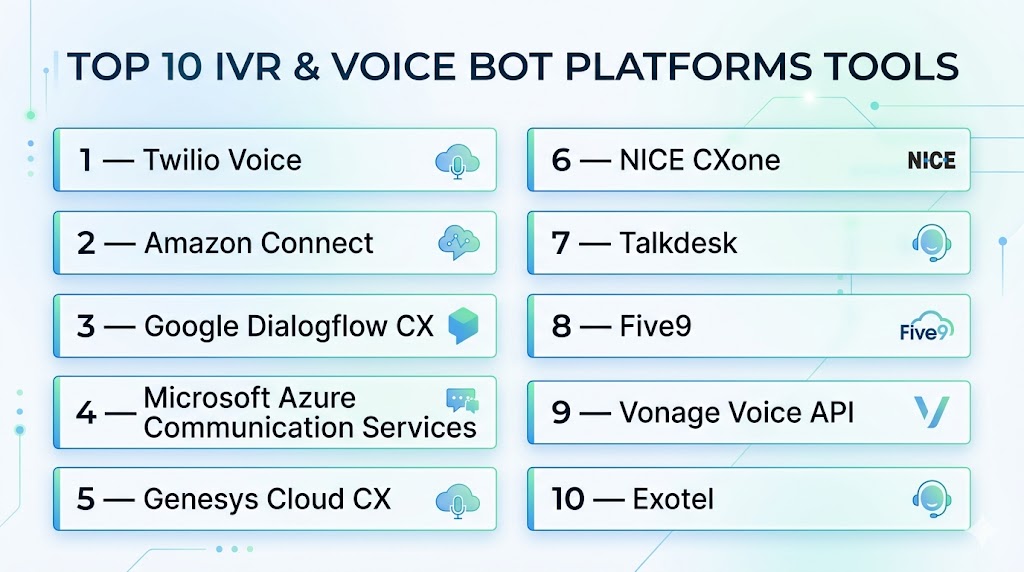
Top 10 IVR & Voice Bot Platforms Tools
#1 — Twilio Voice
Short description: A developer-focused communication platform offering programmable voice APIs and flexible IVR solutions for scalable applications.
Key Features
- Programmable voice APIs
- Custom IVR workflows
- Speech recognition capabilities
- Call routing and recording
- Global telephony infrastructure
- Real-time call control
Pros
- Highly customizable for developers
- Scales easily across regions
Cons
- Requires technical expertise
- Pricing can become complex
Platforms / Deployment
Cloud
Security & Compliance
Encryption, RBAC, GDPR. Other details not publicly stated.
Integrations & Ecosystem
Flexible API-driven ecosystem suitable for custom integrations.
- CRM platforms
- Webhooks
- Backend services
- Custom APIs
Support & Community
Extensive documentation with a strong global developer community.
#2 — Amazon Connect
Short description: A cloud-based contact center platform with built-in IVR and AI capabilities, designed for scalable customer support operations.
Key Features
- Intelligent IVR system
- Call routing and queuing
- Real-time analytics
- Speech recognition
- Workflow automation
- Integration with AI services
Pros
- Highly scalable infrastructure
- Strong ecosystem integration
Cons
- Requires familiarity with cloud services
- Setup can be complex
Platforms / Deployment
Cloud
Security & Compliance
Encryption, IAM, GDPR. Other details not publicly stated.
Integrations & Ecosystem
Deep integration with cloud services and enterprise tools.
- APIs
- Serverless functions
- CRM systems
Support & Community
Comprehensive documentation and enterprise support options.
#3 — Google Dialogflow CX
Short description: A conversational AI platform for building advanced voice bots with strong natural language understanding capabilities.
Key Features
- Natural language processing
- Visual conversation builder
- Multi-language support
- Intent recognition
- Voice and chat bot support
- Context-aware conversations
Pros
- Strong AI capabilities
- Flexible bot design
Cons
- Learning curve for advanced use
- Pricing varies
Platforms / Deployment
Cloud
Security & Compliance
Encryption, IAM, GDPR. Other details not publicly stated.
Integrations & Ecosystem
Works well within cloud ecosystems and custom integrations.
- APIs
- Webhooks
- Contact center tools
Support & Community
Well-documented with active developer support.
#4 — Microsoft Azure Communication Services
Short description: A communication platform offering voice, video, and IVR capabilities with strong enterprise integration options.
Key Features
- Voice and call automation APIs
- IVR capabilities
- SDK support
- AI integration
- Call recording
- Workflow customization
Pros
- Strong enterprise ecosystem
- Reliable infrastructure
Cons
- Requires technical expertise
- Setup complexity
Platforms / Deployment
Cloud
Security & Compliance
Encryption, identity management, GDPR. Other details not publicly stated.
Integrations & Ecosystem
Seamless integration with enterprise tools.
- Business applications
- APIs
- Workflow systems
Support & Community
Strong enterprise support and documentation.
#5 — Genesys Cloud CX
Short description: A comprehensive customer experience platform offering advanced IVR and AI-driven voice automation.
Key Features
- Omnichannel routing
- AI-powered voice bots
- Workforce management
- Analytics dashboards
- Call recording
- Customer journey tracking
Pros
- Feature-rich and scalable
- Strong analytics capabilities
Cons
- Higher pricing
- Implementation complexity
Platforms / Deployment
Cloud
Security & Compliance
SSO, encryption, GDPR. Other details not publicly stated.
Integrations & Ecosystem
Broad ecosystem with enterprise integrations.
- CRM systems
- APIs
- Contact center tools
Support & Community
Enterprise-grade support and onboarding services.
#6 — NICE CXone
Short description: A cloud contact center solution with advanced IVR, automation, and workforce optimization features.
Key Features
- Intelligent IVR
- AI automation tools
- Workforce optimization
- Analytics and reporting
- Omnichannel support
- Call management
Pros
- Robust enterprise capabilities
- Strong reporting features
Cons
- Expensive for smaller teams
- Learning curve
Platforms / Deployment
Cloud
Security & Compliance
Encryption, GDPR. Other details not publicly stated.
Integrations & Ecosystem
Supports enterprise integrations and automation workflows.
- CRM systems
- APIs
- Workforce tools
Support & Community
Comprehensive enterprise support.
#7 — Talkdesk
Short description: A user-friendly cloud contact center platform with AI-powered IVR and automation features.
Key Features
- AI voice bots
- Call routing
- Workflow automation
- Analytics dashboards
- Omnichannel support
- Easy setup tools
Pros
- Easy to use
- Fast deployment
Cons
- Limited deep customization
- Pricing varies
Platforms / Deployment
Cloud
Security & Compliance
Encryption, SSO. Other details not publicly stated.
Integrations & Ecosystem
Strong integration with customer support tools.
- CRM systems
- Helpdesk tools
- APIs
Support & Community
Good onboarding and customer support.
#8 — Five9
Short description: A cloud-based contact center platform offering intelligent IVR and automation for customer engagement.
Key Features
- Intelligent IVR
- Predictive dialing
- Call recording
- Analytics tools
- Workflow automation
- AI-driven insights
Pros
- Reliable performance
- Strong analytics
Cons
- Pricing not transparent
- Setup complexity
Platforms / Deployment
Cloud
Security & Compliance
Encryption, GDPR. Other details not publicly stated.
Integrations & Ecosystem
Flexible integration capabilities.
- CRM systems
- APIs
- Contact center tools
Support & Community
Enterprise-level support services.
#9 — Vonage Voice API
Short description: A developer-centric communication platform for building custom IVR and voice applications.
Key Features
- Voice APIs
- Call control
- IVR builder
- Webhooks
- Global coverage
- Programmable workflows
Pros
- Flexible API-based system
- Scalable globally
Cons
- Requires development resources
- Limited visual tools
Platforms / Deployment
Cloud
Security & Compliance
Encryption, GDPR. Other details not publicly stated.
Integrations & Ecosystem
Designed for custom integrations.
- APIs
- CRM systems
- Backend services
Support & Community
Developer-focused documentation and support.
#10 — Exotel
Short description: A cloud telephony platform offering IVR and voice automation, popular among growing businesses.
Key Features
- IVR automation
- Call tracking
- Voice bot capabilities
- SMS integration
- Analytics
- Easy deployment
Pros
- Simple setup
- Good value for SMBs
Cons
- Limited advanced features
- Smaller global presence
Platforms / Deployment
Cloud
Security & Compliance
Not publicly stated.
Integrations & Ecosystem
Supports integrations with business tools.
- CRM systems
- APIs
- Marketing tools
Support & Community
Reliable regional support with growing ecosystem.
Comparison Table
| Tool Name | Best For | Platform(s) Supported | Deployment | Standout Feature | Public Rating |
|---|---|---|---|---|---|
| Twilio Voice | Developers | Web | Cloud | Programmable APIs | N/A |
| Amazon Connect | Enterprises | Web | Cloud | Scalable infrastructure | N/A |
| Dialogflow CX | AI voice bots | Web | Cloud | NLP capabilities | N/A |
| Azure Communication Services | Enterprises | Web | Cloud | Enterprise integration | N/A |
| Genesys Cloud CX | Large enterprises | Web | Cloud | Omnichannel CX | N/A |
| NICE CXone | Enterprises | Web | Cloud | Workforce optimization | N/A |
| Talkdesk | SMB to enterprise | Web | Cloud | Ease of use | N/A |
| Five9 | Call centers | Web | Cloud | Predictive dialing | N/A |
| Vonage Voice API | Developers | Web | Cloud | Global APIs | N/A |
| Exotel | SMB | Web | Cloud | Easy deployment | N/A |
Evaluation & Scoring of IVR & Voice Bot Platforms
| Tool Name | Core (25%) | Ease (15%) | Integrations (15%) | Security (10%) | Performance (10%) | Support (10%) | Value (15%) | Weighted Total (0–10) |
|---|---|---|---|---|---|---|---|---|
| Twilio Voice | 9 | 6 | 10 | 8 | 9 | 8 | 7 | 8.3 |
| Amazon Connect | 9 | 7 | 9 | 9 | 9 | 8 | 7 | 8.5 |
| Dialogflow CX | 9 | 8 | 8 | 8 | 9 | 8 | 7 | 8.4 |
| Azure Communication Services | 8 | 7 | 9 | 9 | 9 | 8 | 7 | 8.3 |
| Genesys Cloud CX | 10 | 7 | 9 | 9 | 9 | 9 | 6 | 8.6 |
| NICE CXone | 9 | 7 | 9 | 9 | 9 | 9 | 6 | 8.5 |
| Talkdesk | 8 | 9 | 8 | 8 | 8 | 8 | 8 | 8.3 |
| Five9 | 8 | 7 | 8 | 8 | 9 | 8 | 7 | 8.1 |
| Vonage Voice API | 8 | 6 | 9 | 8 | 8 | 7 | 7 | 7.9 |
| Exotel | 7 | 8 | 7 | 6 | 7 | 7 | 8 | 7.5 |
How to interpret the scores:
These scores are comparative and based on feature depth, usability, integrations, and overall value. A higher score indicates a more balanced and capable platform, but the right choice depends on your specific needs. Enterprise tools typically score higher in features and performance, while SMB-friendly tools perform better in ease of use and value. Always evaluate based on your use case rather than relying solely on rankings.
Which IVR & Voice Bot Platforms Tool Is Right for You?
Solo / Freelancer
If you have technical skills, developer-focused platforms like Twilio or Vonage provide flexibility. Otherwise, IVR platforms may not be necessary.
SMB
Talkdesk and Exotel are ideal due to ease of use, faster deployment, and lower operational complexity.
Mid-Market
Five9 and Amazon Connect offer a strong balance between scalability and manageable complexity.
Enterprise
Genesys Cloud CX and NICE CXone are best suited for large-scale operations requiring advanced automation, analytics, and reliability.
Budget vs Premium
- Budget-friendly: Exotel, Talkdesk
- Premium solutions: Genesys, NICE CXone
Feature Depth vs Ease of Use
- Feature-rich: Genesys, NICE CXone
- Easy to use: Talkdesk
Integrations & Scalability
Twilio, Amazon Connect, and Azure Communication Services excel in integration flexibility and scalability.
Security & Compliance Needs
Large enterprises should prioritize platforms with strong identity management, encryption, and compliance readiness such as AWS, Azure, and Genesys.
Frequently Asked Questions (FAQs)
What is an IVR platform?
An IVR platform is a system that allows automated interaction with callers through voice prompts and menu options.
What is the difference between IVR and voice bots?
IVR uses predefined menus, while voice bots use AI to understand natural language and respond dynamically.
Do these platforms require coding?
Some platforms require development skills, while others offer no-code or low-code interfaces.
How much do IVR platforms cost?
Costs vary depending on usage, features, and deployment models. Pricing is often usage-based.
Can IVR platforms integrate with CRM systems?
Yes, most platforms support integrations with CRM and business applications.
Are voice bots secure?
Security features vary, but most platforms offer encryption and access control.
Can small businesses use IVR platforms?
Yes, especially with user-friendly tools designed for SMBs.
How scalable are these platforms?
Cloud-based platforms are highly scalable and can handle increasing call volumes.
What are common mistakes when implementing IVR?
Overly complex menus, poor voice design, and lack of testing are common issues.
Can I switch platforms later?
Yes, but migration may require effort depending on integrations and workflows.
Conclusion
IVR and voice bot platforms have transformed from simple call-routing tools into intelligent systems that drive customer engagement and operational efficiency. Businesses must carefully evaluate their needs, balancing automation capabilities with user experience and integration requirements. Enterprise-grade solutions offer deep functionality and scalability, while SMB-focused platforms prioritize simplicity and faster deployment. Developer-centric tools provide flexibility but require technical expertise. Ultimately, there is no one-size-fits-all solution, and the best choice depends on your organization’s goals, resources, and customer interaction complexity. Start by shortlisting a few platforms, test them through pilot deployments, and validate how well they align with your workflows and customer expectations.