Introduction
Service Discovery Tools are systems that automatically detect and track services running in a distributed environment, allowing applications to find and communicate with each other without hardcoding network locations. In simple terms, they act like a dynamic directory for services, ensuring applications always connect to the right instance.
In modern architectures like microservices and cloud-native systems, services are constantly scaling, restarting, or moving. Service discovery solves this by maintaining a real-time registry of services and their health status, enabling seamless communication and high availability.
Common use cases include:
- Microservices communication in distributed systems
- Dynamic scaling in container environments
- Failover and high availability routing
- Service mesh and API communication
- Multi-cloud and hybrid infrastructure management
What buyers should evaluate:
- Service registry and discovery mechanism
- Health checking and fault tolerance
- Scalability and performance
- Integration with Kubernetes and cloud platforms
- Security features like mTLS and access control
- Ease of deployment and configuration
- Observability and monitoring
- Multi-region and multi-datacenter support
Best for: DevOps teams, cloud engineers, backend developers, and enterprises managing microservices or distributed systems.
Not ideal for: Simple monolithic applications or small systems where services do not dynamically scale or change.
Key Trends in Service Discovery Tools
- Kubernetes-native discovery: Built-in service discovery becoming standard in container orchestration
- Service mesh integration: Discovery combined with traffic management and security
- Dynamic scaling support: Automatic updates as services scale up or down
- Zero Trust networking: Identity-based service communication
- Multi-cloud adoption: Tools supporting hybrid and multi-cloud environments
- Observability integration: Metrics, tracing, and logging built-in
- API-driven discovery: REST and DNS-based service lookup mechanisms
- Security-first architecture: mTLS and encryption becoming standard
- Decentralized architectures: Peer-to-peer discovery models for resilience
How We Selected These Tools (Methodology)
- Evaluated real-world adoption in microservices environments
- Assessed core discovery and registry capabilities
- Reviewed scalability and performance features
- Considered integration with Kubernetes and cloud platforms
- Analyzed security and networking features
- Included both open-source and managed solutions
- Evaluated ease of use and deployment flexibility
- Considered community and enterprise support
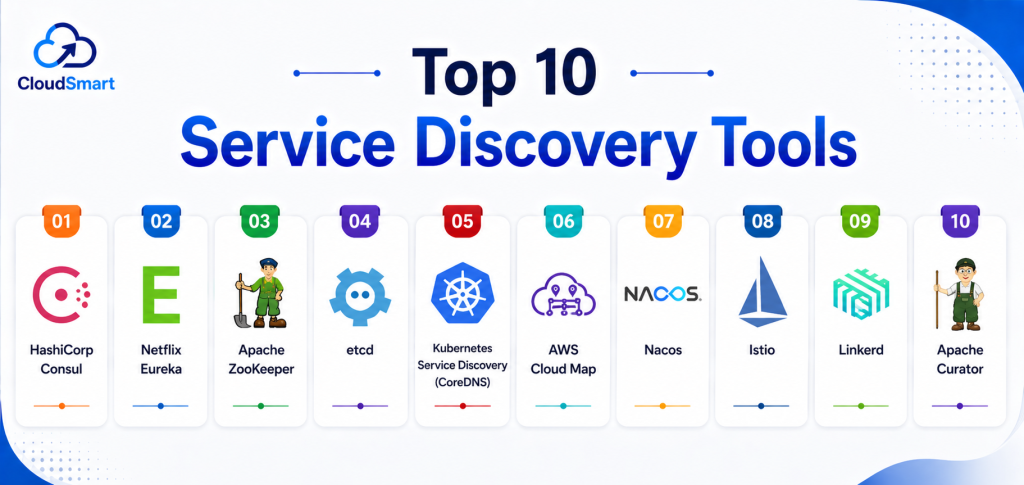
Top 10 Service Discovery Tools
#1 — HashiCorp Consul
Short description: A widely used service networking platform providing service discovery, configuration, and service mesh capabilities.
Key Features
- Service discovery with DNS and HTTP APIs
- Health checking and service monitoring
- Key-value store for configuration
- Multi-datacenter support
- Service mesh capabilities
- Secure communication with mTLS
Pros
- Highly scalable and reliable
- Works across cloud and on-prem environments
Cons
- Setup complexity for beginners
- Requires operational expertise
Platforms / Deployment
Cross-platform
Cloud / Self-hosted / Hybrid
Security & Compliance
mTLS, encryption, access control
Certifications: Not publicly stated
Integrations & Ecosystem
Consul integrates with modern infrastructure and orchestration tools.
- Kubernetes
- Nomad
- Docker
- Terraform
Support & Community
Strong enterprise backing and large open-source community.
#2 — Netflix Eureka
Short description: A service registry designed for cloud-based microservices, widely used with Java and Spring ecosystems.
Key Features
- Service registration and discovery
- Client-side load balancing
- REST-based communication
- Instance health tracking
- Integration with Spring Cloud
Pros
- Easy setup for Java environments
- Lightweight and simple
Cons
- Limited scalability for large systems
- Less feature-rich compared to modern tools
Platforms / Deployment
Java-based
Self-hosted
Security & Compliance
Not publicly stated
Integrations & Ecosystem
- Spring Boot
- Netflix OSS stack
Support & Community
Popular in Java ecosystems with solid documentation.
#3 — Apache ZooKeeper
Short description: A distributed coordination service used for configuration management and service discovery.
Key Features
- Distributed coordination
- Service registry
- High availability
- Strong consistency
- Configuration management
Pros
- Highly reliable
- Mature and proven
Cons
- Complex setup
- Not specialized for service discovery
Platforms / Deployment
Cross-platform
Self-hosted
Security & Compliance
Not publicly stated
Integrations & Ecosystem
- Hadoop
- Kafka
- Distributed systems
Support & Community
Large enterprise adoption and strong support.
#4 — etcd
Short description: A distributed key-value store used for service discovery and configuration in Kubernetes environments.
Key Features
- Strong consistency using Raft
- Key-value store
- High availability
- Fast performance
- Kubernetes integration
Pros
- Reliable and scalable
- Core component in Kubernetes
Cons
- Limited UI
- Requires expertise
Platforms / Deployment
Cross-platform
Self-hosted
Security & Compliance
Encryption support
Not publicly stated certifications
Integrations & Ecosystem
- Kubernetes
- CoreDNS
Support & Community
Strong open-source backing.
#5 — Kubernetes Service Discovery
Short description: Built-in service discovery system within Kubernetes clusters using DNS and environment variables.
Key Features
- Automatic service registration
- DNS-based discovery
- Load balancing
- Auto-scaling support
- Self-healing
Pros
- Native to Kubernetes
- Easy integration
Cons
- Limited outside Kubernetes
- Requires cluster setup
Platforms / Deployment
Cloud / Container
Cloud / Self-hosted
Security & Compliance
RBAC, network policies
Not publicly stated certifications
Integrations & Ecosystem
- Kubernetes ecosystem
- Cloud providers
Support & Community
Massive global community.
#6 — AWS Cloud Map
Short description: A managed service discovery tool that enables applications to discover AWS resources dynamically.
Key Features
- Service registry
- DNS and API discovery
- Health checks
- AWS integration
- Scalable architecture
Pros
- Fully managed
- Seamless AWS integration
Cons
- Vendor lock-in
- Limited outside AWS
Platforms / Deployment
Cloud
Cloud-managed
Security & Compliance
IAM integration, encryption
Not publicly stated certifications
Integrations & Ecosystem
- EC2
- ECS
- Lambda
Support & Community
Enterprise support available.
#7 — Nacos
Short description: A dynamic service discovery and configuration platform designed for cloud-native applications.
Key Features
- Service discovery
- Configuration management
- Dynamic updates
- Multi-environment support
Pros
- All-in-one platform
- Good for cloud-native apps
Cons
- Smaller global adoption
- Limited ecosystem
Platforms / Deployment
Cross-platform
Self-hosted
Security & Compliance
Not publicly stated
Integrations & Ecosystem
- Microservices frameworks
Support & Community
Growing community support.
#8 — Consul Connect
Short description: A service mesh extension of Consul providing secure service discovery and communication.
Key Features
- Service mesh
- mTLS encryption
- Service discovery
- Traffic management
Pros
- Secure service communication
- Integrated with Consul
Cons
- Requires Consul setup
- Complexity increases
Platforms / Deployment
Cross-platform
Hybrid
Security & Compliance
mTLS, encryption
Not publicly stated certifications
Integrations & Ecosystem
- Envoy
- Kubernetes
Support & Community
Backed by HashiCorp ecosystem.
#9 — CoreDNS
Short description: A flexible DNS server used for service discovery in cloud-native environments.
Key Features
- DNS-based discovery
- Plugin-based architecture
- Kubernetes integration
- High performance
Pros
- Lightweight and fast
- Highly customizable
Cons
- Limited standalone features
- Requires configuration
Platforms / Deployment
Cross-platform
Self-hosted
Security & Compliance
Not publicly stated
Integrations & Ecosystem
- Kubernetes
- Cloud platforms
Support & Community
Strong community support.
#10 — Apache Curator
Short description: A framework built on ZooKeeper that simplifies service discovery and distributed coordination.
Key Features
- Service registry
- Simplified ZooKeeper usage
- Distributed coordination
- High availability
Pros
- Easier than raw ZooKeeper
- Reliable
Cons
- Limited features
- Requires ZooKeeper
Platforms / Deployment
Java-based
Self-hosted
Security & Compliance
Not publicly stated
Integrations & Ecosystem
- Java ecosystem
- ZooKeeper
Support & Community
Moderate community support.
Comparison Table
| Tool Name | Best For | Platform(s) Supported | Deployment | Standout Feature | Public Rating |
|---|---|---|---|---|---|
| Consul | Enterprise | Cross-platform | Hybrid | Service mesh | N/A |
| Eureka | Java apps | Java | Self-hosted | Simplicity | N/A |
| ZooKeeper | Coordination | Cross-platform | Self-hosted | Reliability | N/A |
| etcd | Kubernetes | Cross-platform | Self-hosted | Consistency | N/A |
| Kubernetes | Containers | Cloud | Hybrid | Native discovery | N/A |
| AWS Cloud Map | AWS users | Cloud | Cloud | Managed service | N/A |
| Nacos | Cloud-native | Cross-platform | Self-hosted | Config + discovery | N/A |
| Consul Connect | Secure mesh | Cross-platform | Hybrid | mTLS | N/A |
| CoreDNS | DNS-based | Cross-platform | Self-hosted | Lightweight | N/A |
| Curator | Java | Java | Self-hosted | Simplicity | N/A |
Evaluation & Scoring of Service Discovery Tools
| Tool Name | Core (25%) | Ease (15%) | Integrations (15%) | Security (10%) | Performance (10%) | Support (10%) | Value (15%) | Weighted Total |
|---|---|---|---|---|---|---|---|---|
| Consul | 9 | 7 | 9 | 9 | 9 | 9 | 8 | 8.7 |
| Eureka | 7 | 8 | 7 | 6 | 7 | 8 | 9 | 7.6 |
| ZooKeeper | 8 | 6 | 8 | 7 | 9 | 9 | 8 | 8.1 |
| etcd | 9 | 6 | 9 | 8 | 9 | 8 | 8 | 8.4 |
| Kubernetes | 9 | 7 | 10 | 8 | 9 | 10 | 8 | 8.9 |
| AWS Cloud Map | 8 | 8 | 9 | 8 | 8 | 9 | 7 | 8.1 |
| Nacos | 7 | 7 | 7 | 6 | 7 | 7 | 8 | 7.2 |
| Consul Connect | 9 | 6 | 9 | 9 | 9 | 9 | 7 | 8.5 |
| CoreDNS | 8 | 7 | 8 | 7 | 8 | 8 | 8 | 7.9 |
| Curator | 7 | 7 | 7 | 6 | 7 | 7 | 8 | 7.1 |
How to interpret the scores:
These scores are comparative and reflect typical use cases across modern architectures. Higher scores indicate stronger overall capabilities, but the best tool depends on your environment. Kubernetes-native solutions excel in container ecosystems, while Consul provides enterprise-grade capabilities. Simpler tools offer ease of use but may lack advanced features. Always validate with real workloads before selecting.
Which Service Discovery Tool Is Right for You?
Solo / Freelancer
Use lightweight tools like CoreDNS or simple setups with Kubernetes for ease of deployment.
SMB
Consul or Eureka offer a balance of functionality and ease of use.
Mid-Market
etcd and AWS Cloud Map provide scalability and integration.
Enterprise
Consul and Kubernetes-based discovery systems are ideal for large-scale environments.
Budget vs Premium
Open-source tools provide strong value, while managed services simplify operations.
Feature Depth vs Ease of Use
Simple tools are easier to deploy, while advanced tools offer more control.
Integrations & Scalability
Kubernetes and Consul provide strong integration ecosystems.
Security & Compliance Needs
Service mesh tools provide enhanced security and encryption.
Frequently Asked Questions (FAQs)
1. What is service discovery?
Service discovery is the process of automatically detecting services in a network. It allows applications to locate each other dynamically. This reduces manual configuration and improves scalability.
2. Why is service discovery important?
It ensures services can communicate reliably in dynamic environments. It supports scaling and fault tolerance. Without it, systems become fragile and hard to maintain.
3. What is a service registry?
A service registry is a database of available services. It stores details like IP addresses and health status. Applications query it to find services.
4. How does service discovery work?
Services register themselves with a registry. Other services query the registry to find them. The system ensures only healthy instances are used.
5. What is the difference between client-side and server-side discovery?
Client-side discovery lets applications choose service instances. Server-side uses an intermediary to route requests. Both approaches have different use cases.
6. Can service discovery improve scalability?
Yes, it enables dynamic scaling of services. New instances are automatically registered. This ensures efficient load distribution.
7. Is Kubernetes enough for service discovery?
Kubernetes provides built-in discovery for container environments. However, external tools may be needed for hybrid systems. It depends on architecture complexity.
8. What are common service discovery tools?
Common tools include Consul, Eureka, etcd, and Kubernetes. These tools provide registry and discovery features.
9. How secure is service discovery?
Security depends on the tool used. Many support encryption and access control. Service mesh solutions provide advanced security.
10. What are common mistakes in service discovery?
Common mistakes include poor configuration and lack of monitoring. Not handling failures properly can cause issues. Proper design is critical.
Conclusion
Service Discovery Tools are essential for modern distributed systems, enabling dynamic communication between services without manual configuration. As microservices and cloud-native architectures continue to grow, these tools play a critical role in ensuring scalability, reliability, and performance. Solutions like Consul and Kubernetes provide powerful enterprise-grade capabilities, while tools like Eureka and CoreDNS offer simpler approaches for specific use cases. Open-source tools deliver flexibility and cost efficiency, whereas managed services reduce operational complexity. The best choice depends on your infrastructure, team expertise, and scalability requirements. Smaller teams may prioritize simplicity, while larger organizations focus on security, observability, and integration. There is no one-size-fits-all solution, and each tool has its strengths. The most effective approach is to shortlist a few tools, test them in your environment, and evaluate how well they align with your architecture. This ensures a reliable, scalable, and future-ready service discovery strategy.