Introduction
Account-Based Marketing ABM Platforms help B2B companies identify high-value accounts, target decision-makers, personalize campaigns, align sales and marketing, and measure account-level engagement. Instead of marketing broadly to thousands of leads, ABM focuses on the accounts most likely to become valuable customers.
These platforms matter because B2B buying groups are complex. A single deal may involve executives, technical evaluators, finance teams, procurement, and department leaders. ABM tools help teams understand which accounts are showing intent, which contacts are engaging, what content they care about, and when sales should act.
Real-world use cases include:
- Targeting high-value enterprise accounts
- Running personalized advertising campaigns
- Aligning sales and marketing around priority accounts
- Tracking account engagement and buying signals
- Supporting pipeline generation and expansion campaigns
- Improving campaign personalization across channels
Buyer evaluation criteria should include:
- Account identification and segmentation
- Intent data quality
- Advertising and campaign orchestration
- CRM and marketing automation integrations
- Account engagement analytics
- Personalization capabilities
- Sales and marketing alignment workflows
- Reporting and attribution depth
- Ease of use for marketing teams
- Data governance and security controls
Best for: B2B marketing teams, demand generation leaders, revenue operations teams, sales teams, enterprise SaaS companies, technology vendors, consulting firms, and organizations with longer sales cycles and high-value target accounts.
Not ideal for: Very small businesses with simple lead generation needs, consumer-focused brands, companies without a defined target account list, or teams that do not have enough sales and marketing coordination to support account-based execution.
Key Trends in Account-Based Marketing ABM Platforms
- AI-driven account prioritization: Platforms increasingly help teams identify which accounts are most likely to convert based on engagement, intent, fit, and behavior signals.
- Intent data is becoming central: Buyers want to know which accounts are researching relevant topics before they fill out a form.
- Sales and marketing alignment is a core requirement: ABM tools are most valuable when marketing campaigns, sales outreach, and account planning work together.
- Personalization is moving beyond email: Teams now personalize ads, landing pages, content hubs, web experiences, and sales follow-ups.
- Pipeline influence reporting is more important: Marketing leaders need to show how ABM contributes to opportunities, pipeline, revenue, and expansion.
- Multi-channel orchestration is becoming standard: Strong ABM platforms support advertising, email, web personalization, content experiences, direct sales alerts, and CRM workflows.
- Account engagement scoring is replacing simple lead scoring: Teams want to understand buying group activity, not only individual lead actions.
- Data quality is a major buying factor: Strong account matching, clean firmographics, contact enrichment, and CRM hygiene are essential.
- Privacy-aware targeting is becoming more important: Buyers are more careful about data usage, consent, regional privacy rules, and audience governance.
- ABM is expanding into customer expansion: Teams use ABM not only for new logos, but also for upsell, cross-sell, renewal, and customer retention campaigns.
How We Selected These Tools
The tools in this list were selected using practical buyer-focused evaluation logic:
- Strong recognition in account-based marketing, demand generation, revenue marketing, or B2B campaign orchestration
- Ability to support account targeting, segmentation, personalization, engagement tracking, and campaign execution
- Fit across SMB, mid-market, and enterprise B2B marketing teams
- Support for sales and marketing alignment through alerts, account insights, and CRM workflows
- Integration strength with CRM, marketing automation, advertising, data, and sales engagement tools
- Practical use of intent data, firmographic data, engagement scoring, and account analytics
- Reporting depth for pipeline influence, campaign performance, and account progression
- Ease of use for demand generation, ABM, field marketing, and revenue operations teams
- Security and administration capabilities suitable for business data and campaign governance
- Overall buyer value based on scalability, usability, feature depth, and revenue impact
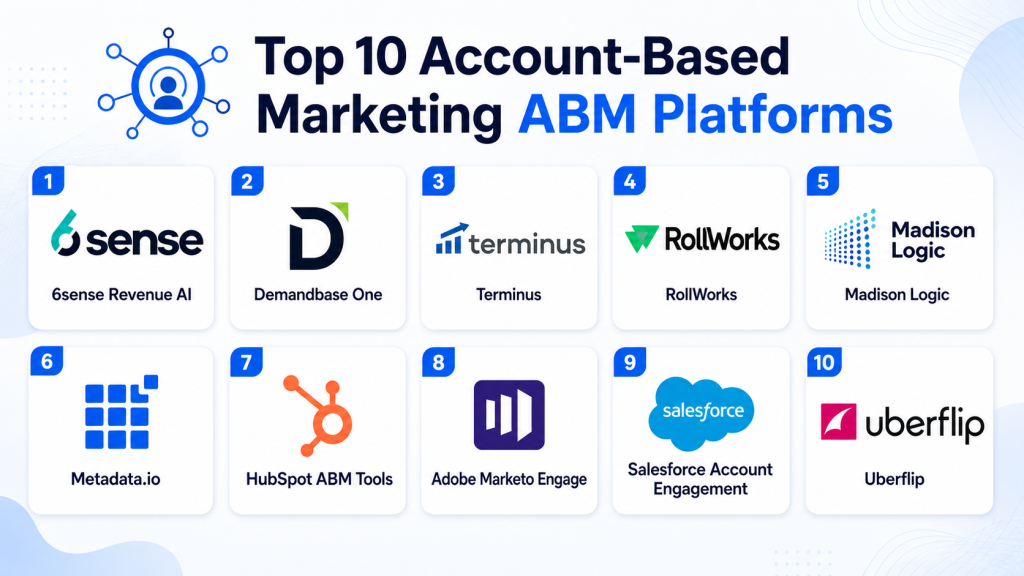
Top 10 Account-Based Marketing ABM Platforms
#1 — 6sense Revenue AI
Short description: 6sense Revenue AI is an ABM and revenue intelligence platform that helps B2B teams identify in-market accounts, understand buying intent, prioritize outreach, and orchestrate account-based campaigns. It is built for revenue teams that want predictive insights, account scoring, intent signals, and sales-marketing alignment. It is especially useful for organizations with complex B2B sales cycles and large target account lists.
Key Features
- Predictive account scoring and prioritization
- Intent data and buying-stage insights
- Account-based advertising and campaign orchestration
- Sales alerts and account insights
- CRM and marketing automation integrations
- Revenue analytics and pipeline visibility
- AI-supported account recommendations
Pros
- Strong fit for enterprise and mid-market B2B revenue teams
- Helps prioritize accounts based on intent and engagement signals
- Useful for aligning marketing campaigns with sales outreach
Cons
- May be complex for teams new to ABM
- Requires clean CRM and account data for best results
- Pricing and packaging may be too advanced for smaller teams
Platforms / Deployment
Cloud
Web-based platform
CRM and marketing automation integrations
Security & Compliance
Enterprise security and administration capabilities may be available. Buyers should validate SSO, role-based access, encryption, audit logs, data retention, and compliance requirements directly. Not publicly stated for any unverified certification.
Integrations & Ecosystem
6sense connects with CRM, marketing automation, sales engagement, advertising, and data systems. Its ecosystem is designed to help revenue teams act on intent signals and account insights across the funnel.
- Salesforce
- HubSpot
- Marketo Engage
- Sales engagement platforms
- Advertising channels
- Data and analytics workflows
Support & Community
6sense provides onboarding, customer success support, documentation, training resources, and implementation guidance. Support depth may vary by package, business size, and deployment scope.
#2 — Demandbase One
Short description: Demandbase One is a full ABM platform focused on account intelligence, advertising, intent data, personalization, engagement scoring, and revenue analytics. It helps B2B companies identify target accounts, run account-based campaigns, and measure marketing impact across the buyer journey. It is a strong choice for teams that want account data, advertising, and orchestration in one platform.
Key Features
- Account identification and targeting
- Intent and engagement signals
- Account-based advertising
- Web personalization and account experiences
- Sales insights and alerts
- CRM and marketing automation integrations
- Revenue and pipeline reporting
Pros
- Strong enterprise ABM feature depth
- Combines account data, advertising, and engagement analytics
- Useful for sales and marketing alignment
Cons
- May require ABM maturity to get full value
- Setup and data alignment can take planning
- Smaller teams may find the platform broad
Platforms / Deployment
Cloud
Web-based platform
CRM, marketing, and advertising integrations
Security & Compliance
Demandbase provides business and enterprise administration capabilities. Buyers should validate SSO, encryption, access controls, audit logs, retention settings, and compliance details directly.
Integrations & Ecosystem
Demandbase integrates with CRM, marketing automation, advertising, analytics, and sales workflows. It is best suited for teams that want ABM execution connected with account intelligence and revenue measurement.
- Salesforce
- Marketo Engage
- HubSpot
- Advertising platforms
- Sales engagement tools
- Analytics systems
Support & Community
Demandbase offers documentation, onboarding support, customer success resources, and implementation assistance. Support level may vary by package and customer agreement.
#3 — Terminus
Short description: Terminus is an account-based marketing platform focused on account targeting, digital advertising, engagement analytics, sales activation, and multi-channel ABM execution. It helps marketing teams reach priority accounts and coordinate campaigns with sales teams. It is useful for B2B teams that want to run account-based advertising and measure engagement across target accounts.
Key Features
- Account-based advertising
- Target account segmentation
- Engagement tracking and account analytics
- Sales alerts and account insights
- Campaign orchestration workflows
- CRM and marketing automation integrations
- Reporting for account progression and pipeline influence
Pros
- Strong for account-based advertising and engagement tracking
- Useful for marketing and sales alignment
- Good fit for mid-market and enterprise ABM programs
Cons
- Best value depends on target account strategy
- Advertising performance requires strong audience planning
- Advanced reporting may require configuration
Platforms / Deployment
Cloud
Web-based platform
CRM and marketing integrations
Security & Compliance
Security and compliance capabilities should be validated directly based on the selected package. Buyers should confirm access controls, encryption, SSO, audit logs, and retention requirements.
Integrations & Ecosystem
Terminus connects ABM advertising with CRM, marketing automation, sales workflows, and engagement reporting. It is designed for teams that want to activate target accounts across digital channels.
- Salesforce
- HubSpot
- Marketo Engage
- Advertising networks
- Sales workflows
- Reporting and analytics tools
Support & Community
Terminus provides onboarding resources, documentation, customer success support, and campaign guidance. Support level may vary by plan and business size.
#4 — RollWorks
Short description: RollWorks is an account-based marketing platform designed for B2B teams that want account identification, targeting, advertising, engagement tracking, and sales activation. It is often a practical option for SMB and mid-market companies starting or scaling ABM programs. It helps teams prioritize target accounts and run account-based campaigns without requiring an overly complex setup.
Key Features
- Account targeting and segmentation
- Account-based digital advertising
- Intent and engagement signals
- Sales alerts and account insights
- CRM and marketing automation integrations
- Account scoring and prioritization
- Campaign performance reporting
Pros
- Good fit for SMB and mid-market ABM teams
- Practical advertising and account targeting capabilities
- Easier entry point compared with some enterprise-heavy platforms
Cons
- May not offer the same enterprise depth as larger ABM suites
- Results depend on account list quality and campaign strategy
- Advanced customization needs should be validated
Platforms / Deployment
Cloud
Web-based platform
CRM and marketing automation integrations
Security & Compliance
Security features may include administrative controls and access management. Buyers should verify SSO, encryption, audit logs, data retention, and compliance requirements directly.
Integrations & Ecosystem
RollWorks integrates with CRM, marketing automation, and campaign systems to support target account advertising and sales activation. It is useful for teams that want practical ABM execution without excessive complexity.
- Salesforce
- HubSpot
- Marketo Engage
- Advertising workflows
- Sales alerts
- Reporting systems
Support & Community
RollWorks provides documentation, support resources, onboarding guidance, and customer success assistance. Support depth may vary by package and team size.
#5 — Madison Logic
Short description: Madison Logic is an ABM and B2B demand generation platform focused on account targeting, intent data, content syndication, advertising, and pipeline acceleration. It is useful for teams that want to reach buying committees across priority accounts using multi-channel programs. It is especially relevant for B2B marketers focused on demand generation and account-level engagement.
Key Features
- Account-based demand generation
- Intent data and account insights
- Content syndication campaigns
- Digital advertising support
- Multi-channel campaign activation
- Pipeline influence reporting
- Account engagement measurement
Pros
- Strong for demand generation and content-driven ABM
- Useful for targeting buying committees across priority accounts
- Supports multi-channel account engagement
Cons
- May be less focused on CRM-native ABM workflows than some platforms
- Best results depend on content quality and target account strategy
- Buyers should validate reporting depth for their revenue model
Platforms / Deployment
Cloud
Web-based platform
Campaign and data integrations may vary
Security & Compliance
Security and compliance details should be verified directly. Not publicly stated for any certification or compliance claim that is not confidently validated.
Integrations & Ecosystem
Madison Logic supports ABM and demand generation workflows through intent data, content programs, advertising, and account engagement measurement. It is useful for teams that rely on content-led account engagement.
- CRM workflows
- Marketing automation workflows
- Intent data workflows
- Content syndication campaigns
- Advertising programs
- Reporting and analytics processes
Support & Community
Madison Logic provides campaign support, onboarding guidance, documentation, and customer success resources. Support depth may vary by contract and campaign scope.
#6 — Metadata.io
Short description: Metadata.io is a B2B marketing automation and campaign execution platform that helps teams run paid campaigns, target accounts, automate experiments, and improve pipeline generation. It is often used by demand generation teams that want to automate campaign operations and test messaging across channels. It fits teams that want account targeting and campaign optimization with less manual campaign management.
Key Features
- Account-based campaign targeting
- Paid campaign automation
- Audience creation and segmentation
- Campaign experimentation and optimization
- CRM and marketing automation integrations
- Pipeline and revenue reporting
- Budget and performance tracking
Pros
- Strong for campaign automation and experimentation
- Useful for demand generation teams running paid programs
- Helps reduce manual work in audience and campaign management
Cons
- Not a traditional full-suite ABM platform for every use case
- Best suited for teams investing in paid acquisition
- Requires clear campaign strategy and strong data setup
Platforms / Deployment
Cloud
Web-based platform
Advertising, CRM, and marketing automation integrations
Security & Compliance
Security controls may be available, but buyers should validate SSO, encryption, user permissions, audit logs, and compliance requirements directly.
Integrations & Ecosystem
Metadata.io connects with CRM, marketing automation, advertising, analytics, and campaign systems. It is useful for teams that want to automate paid demand generation and account targeting workflows.
- Salesforce
- HubSpot
- Marketo Engage
- Advertising platforms
- Marketing analytics
- Campaign reporting workflows
Support & Community
Metadata.io provides onboarding, documentation, customer support, and campaign guidance. Support level may vary by package and customer size.
#7 — HubSpot ABM Tools
Short description: HubSpot ABM Tools help B2B teams manage target accounts, segment companies, track engagement, align sales and marketing, and run account-based campaigns inside the HubSpot ecosystem. It is a practical choice for SMB and mid-market teams already using HubSpot CRM and marketing tools. It works best when teams want ABM workflows inside a familiar CRM and marketing environment.
Key Features
- Target account management
- Company scoring and segmentation
- CRM-based account views
- Marketing automation workflows
- Sales and marketing alignment features
- Account engagement visibility
- Reporting dashboards
Pros
- Strong fit for companies already using HubSpot
- Easier to adopt than many enterprise ABM platforms
- Good for SMB and mid-market teams starting ABM
Cons
- May not match the intent data depth of specialized ABM platforms
- Advanced enterprise ABM needs may require additional tools
- Best value depends on HubSpot ecosystem usage
Platforms / Deployment
Cloud
Web-based platform
HubSpot CRM and marketing ecosystem
Security & Compliance
HubSpot provides business administration and security capabilities, but buyers should validate SSO, permissions, audit logs, encryption, retention, and compliance coverage based on their selected plan.
Integrations & Ecosystem
HubSpot ABM Tools work best inside the HubSpot CRM, marketing, sales, and service ecosystem. They are practical for teams that want ABM execution connected to existing contacts, companies, workflows, and campaigns.
- HubSpot CRM
- HubSpot Marketing Hub
- HubSpot Sales Hub
- Email workflows
- Reporting dashboards
- App marketplace integrations
Support & Community
HubSpot offers documentation, academy-style learning resources, customer support, onboarding partners, and a large user community. Support level may vary by plan.
#8 — Adobe Marketo Engage
Short description: Adobe Marketo Engage is a marketing automation platform with capabilities that support account-based marketing, lead management, campaign orchestration, personalization, and marketing analytics. It is best suited for mid-market and enterprise teams that need advanced B2B marketing workflows. It can support ABM when combined with strong account segmentation, CRM integration, scoring, and campaign strategy.
Key Features
- Marketing automation workflows
- Account and lead segmentation
- Email and nurture campaigns
- Personalization and campaign orchestration
- Lead and account scoring support
- CRM integrations
- Reporting and campaign analytics
Pros
- Strong for complex B2B marketing automation
- Suitable for larger marketing operations teams
- Flexible campaign and nurturing capabilities
Cons
- ABM may require configuration and strategy design
- Can be complex for smaller teams
- Advanced use often requires experienced marketing operations support
Platforms / Deployment
Cloud
Web-based platform
CRM and marketing ecosystem integrations
Security & Compliance
Adobe provides enterprise-oriented security and administration capabilities across its business products. Buyers should validate specific Marketo Engage security controls, SSO, permissions, audit logs, encryption, and compliance requirements directly.
Integrations & Ecosystem
Marketo Engage connects with CRM, advertising, analytics, personalization, content, and data workflows. It is strong for organizations that need ABM connected with advanced marketing automation.
- Salesforce
- Microsoft Dynamics
- Adobe ecosystem
- Webinar tools
- Data enrichment workflows
- Analytics systems
Support & Community
Adobe provides documentation, support resources, training, partner services, and a large marketing operations community. Support depth may vary by contract and package.
#9 — Salesforce Account Engagement
Short description: Salesforce Account Engagement is a B2B marketing automation platform that supports account-based marketing through CRM-connected campaigns, lead nurturing, account visibility, scoring, and sales-marketing alignment. It is best suited for companies using Salesforce CRM and looking to connect marketing programs with sales activity. It helps teams manage account engagement and campaign performance within the Salesforce ecosystem.
Key Features
- B2B marketing automation
- Account and lead nurturing
- Scoring and grading workflows
- Salesforce CRM integration
- Campaign reporting and attribution support
- Sales alerts and activity visibility
- Email and landing page workflows
Pros
- Strong fit for Salesforce-centered organizations
- Connects marketing activity with sales workflows
- Useful for B2B nurturing and account engagement tracking
Cons
- Best value depends on Salesforce ecosystem usage
- May require administration and operations expertise
- Specialized ABM advertising or intent features may require additional tools
Platforms / Deployment
Cloud
Web-based platform
Salesforce ecosystem
Security & Compliance
Salesforce provides enterprise security and administration capabilities across its platform. Buyers should validate specific Account Engagement controls, SSO, role permissions, audit logs, encryption, retention, and compliance requirements directly.
Integrations & Ecosystem
Salesforce Account Engagement works closely with Salesforce CRM and broader Salesforce workflows. It is useful when marketing and sales teams want account engagement and campaign activity inside one connected ecosystem.
- Salesforce CRM
- Salesforce reporting
- Email marketing workflows
- Landing page workflows
- Campaign attribution processes
- AppExchange ecosystem
Support & Community
Salesforce provides documentation, training resources, customer support, partner services, and a large community. Support level may vary by edition and contract.
#10 — Uberflip
Short description: Uberflip is a content experience platform that supports ABM by helping teams create personalized content destinations for target accounts, industries, campaigns, and buyer segments. It is especially useful for marketers who want to deliver relevant content journeys to specific accounts or buying groups. While it is not a full ABM suite, it can play an important role in ABM personalization and engagement.
Key Features
- Personalized content experiences
- Account-specific content destinations
- Campaign landing experiences
- Content recommendations
- Engagement analytics
- Sales content enablement support
- Marketing automation and CRM integrations
Pros
- Strong for ABM content personalization
- Useful for campaign-specific content hubs
- Helps improve buyer engagement with relevant content
Cons
- Not a full ABM platform for targeting, advertising, and intent data
- Best used alongside CRM, marketing automation, or ABM tools
- Value depends on quality and depth of content library
Platforms / Deployment
Cloud
Web-based platform
Marketing and sales integrations
Security & Compliance
Security and compliance details should be validated directly. Not publicly stated for any certification or compliance claim that is not confidently validated.
Integrations & Ecosystem
Uberflip fits into ABM and demand generation workflows by improving content delivery and buyer engagement. It is best used with marketing automation, CRM, advertising, and sales enablement tools.
- CRM workflows
- Marketing automation platforms
- Sales enablement tools
- Analytics systems
- Campaign landing pages
- Content engagement reporting
Support & Community
Uberflip provides documentation, onboarding support, customer success resources, and content experience guidance. Support depth may vary by package and customer agreement.
Comparison Table
| Tool Name | Best For | Platform(s) Supported | Deployment | Standout Feature | Public Rating |
|---|---|---|---|---|---|
| 6sense Revenue AI | Enterprise revenue teams | Web-based | Cloud | Predictive account intelligence and intent signals | N/A |
| Demandbase One | Full-suite ABM programs | Web-based | Cloud | Account intelligence plus ABM advertising | N/A |
| Terminus | Account-based advertising and engagement | Web-based | Cloud | Multi-channel ABM campaign activation | N/A |
| RollWorks | SMB and mid-market ABM teams | Web-based | Cloud | Practical account targeting and advertising | N/A |
| Madison Logic | Content-led demand generation | Web-based | Cloud | Intent-based content syndication and ABM programs | N/A |
| Metadata.io | Paid campaign automation | Web-based | Cloud | Automated audience and campaign experimentation | N/A |
| HubSpot ABM Tools | HubSpot users and SMB teams | Web-based | Cloud | ABM workflows inside HubSpot CRM | N/A |
| Adobe Marketo Engage | Enterprise marketing automation teams | Web-based | Cloud | Advanced B2B campaign orchestration | N/A |
| Salesforce Account Engagement | Salesforce-centered B2B teams | Web-based | Cloud | CRM-connected B2B marketing automation | N/A |
| Uberflip | ABM content personalization | Web-based | Cloud | Personalized content experiences for target accounts | N/A |
Evaluation & Scoring of Account-Based Marketing ABM Platforms
| Tool Name | Core (25%) | Ease (15%) | Integrations (15%) | Security (10%) | Performance (10%) | Support (10%) | Value (15%) | Weighted Total (0–10) |
|---|---|---|---|---|---|---|---|---|
| 6sense Revenue AI | 10 | 7 | 9 | 9 | 9 | 8 | 7 | 8.55 |
| Demandbase One | 10 | 7 | 9 | 9 | 9 | 8 | 7 | 8.55 |
| Terminus | 9 | 8 | 8 | 8 | 8 | 8 | 8 | 8.25 |
| RollWorks | 8 | 9 | 8 | 8 | 8 | 8 | 9 | 8.30 |
| Madison Logic | 8 | 7 | 7 | 7 | 8 | 8 | 8 | 7.65 |
| Metadata.io | 8 | 8 | 8 | 7 | 8 | 8 | 8 | 7.95 |
| HubSpot ABM Tools | 7 | 9 | 9 | 8 | 8 | 9 | 9 | 8.35 |
| Adobe Marketo Engage | 8 | 7 | 9 | 9 | 8 | 8 | 7 | 8.00 |
| Salesforce Account Engagement | 8 | 8 | 9 | 9 | 8 | 8 | 7 | 8.15 |
| Uberflip | 7 | 8 | 8 | 7 | 8 | 8 | 8 | 7.65 |
These scores are comparative and should be used as a shortlist guide, not a universal ranking. Enterprise ABM platforms often score higher in account intelligence, orchestration, and analytics. SMB-friendly platforms may score higher in ease of use and value. Content-focused tools may not replace full ABM suites, but they can be highly valuable for personalization. The best choice depends on your target account strategy, CRM setup, data quality, campaign channels, and sales-marketing alignment.
Which Account-Based Marketing ABM Platform Is Right for You?
Solo / Freelancer
Solo marketers and consultants usually do not need a full enterprise ABM platform. A CRM, email automation tool, content personalization workflow, and manual target account tracking may be enough. If you manage ABM campaigns for clients, HubSpot ABM Tools, RollWorks, or Uberflip-style content experiences can be practical depending on the campaign scope. The key is to avoid buying a large ABM suite before there is enough target account volume or sales coordination.
SMB
SMBs should focus on easy setup, CRM alignment, basic account targeting, practical advertising, and clear reporting. RollWorks and HubSpot ABM Tools are strong options for teams starting ABM without a large operations team. Metadata.io can be useful if paid campaign automation is a major priority. SMBs should begin with a clear target account list, simple segmentation, and a small number of campaigns before scaling.
Mid-Market
Mid-market teams usually need stronger targeting, sales alerts, CRM syncing, campaign orchestration, and pipeline influence reporting. Terminus, RollWorks, Demandbase One, 6sense Revenue AI, Metadata.io, and HubSpot ABM Tools are worth evaluating depending on maturity. If the team already uses Marketo Engage or Salesforce Account Engagement, ABM workflows may be built inside existing marketing automation systems. Mid-market buyers should prioritize integration depth and sales adoption.
Enterprise
Enterprises should prioritize account intelligence, intent data, governance, advanced segmentation, global campaign management, CRM integration, and pipeline analytics. 6sense Revenue AI and Demandbase One are strong candidates for mature enterprise ABM programs. Adobe Marketo Engage and Salesforce Account Engagement are also important when ABM must connect deeply with marketing automation and CRM workflows. Enterprises should involve marketing, sales, revenue operations, data, IT, and security stakeholders before final selection.
Budget vs Premium
Budget-focused buyers should start with HubSpot ABM Tools, RollWorks, Metadata.io, or targeted workflows inside their existing CRM and marketing automation tools. Premium buyers should evaluate 6sense Revenue AI, Demandbase One, Terminus, Adobe Marketo Engage, or Salesforce Account Engagement when they need deeper segmentation, intent data, orchestration, and account-level analytics. Uberflip can be a strong add-on when content personalization is a major ABM requirement.
Feature Depth vs Ease of Use
If ease of use matters most, HubSpot ABM Tools, RollWorks, and Metadata.io are practical choices. If feature depth matters more, 6sense Revenue AI, Demandbase One, Terminus, Adobe Marketo Engage, and Salesforce Account Engagement provide broader capabilities. Uberflip is best when content experiences are central to the ABM strategy. Madison Logic is useful when content syndication and intent-driven demand generation are priorities.
Integrations & Scalability
ABM platforms should connect with CRM, marketing automation, advertising platforms, data enrichment tools, sales engagement systems, analytics platforms, and content tools. Poor integrations can create disconnected campaigns and unreliable reporting. Enterprises should also evaluate APIs, permission models, data exports, identity provider support, and multi-region governance. Scalability depends not only on software, but also on clean account data and strong operational ownership.
Security & Compliance Needs
ABM platforms manage company data, contact data, campaign audiences, engagement signals, and sometimes third-party intent data. Buyers should validate access controls, encryption, data retention, consent handling, audience governance, audit logs, and privacy requirements. Regulated industries should involve legal, compliance, security, and IT teams early in the buying process. Privacy and data governance should be treated as core requirements, not final-stage checklist items.
Frequently Asked Questions
1. What is an Account-Based Marketing ABM Platform?
An Account-Based Marketing ABM Platform helps B2B teams identify, target, engage, and measure high-value accounts.
It focuses marketing and sales efforts on selected companies instead of broad lead generation.
These platforms often include account scoring, intent data, advertising, personalization, and analytics.
2. How is ABM different from traditional lead generation?
Traditional lead generation focuses on capturing individual leads, while ABM focuses on target accounts and buying groups.
ABM is more strategic because it aligns marketing and sales around specific companies.
It is especially useful for high-value B2B deals with longer buying cycles.
3. What features should buyers prioritize?
Buyers should prioritize account targeting, segmentation, intent data, CRM integration, campaign orchestration, engagement scoring, and reporting.
Sales alignment features such as alerts, account insights, and activity tracking are also important.
The best feature set depends on company size, target account strategy, and campaign maturity.
4. Are ABM Platforms useful for small businesses?
Yes, but small businesses should start simple.
SMBs may not need a large enterprise ABM suite at the beginning.
A practical CRM-based ABM workflow, basic account targeting, and focused campaigns may be enough before investing in advanced platforms.
5. How much do ABM Platforms cost?
Pricing usually depends on users, account volume, advertising spend, data features, intent signals, integrations, and enterprise requirements.
Some tools are priced as full ABM suites, while others are part of CRM or marketing automation platforms.
Buyers should request quotes based on target account volume and campaign needs.
6. Do ABM Platforms replace CRM systems?
No, ABM Platforms usually work alongside CRM systems.
CRM stores account, contact, opportunity, and activity data, while ABM platforms help target and engage priority accounts.
The strongest ABM programs depend on clean CRM data and strong integration between both systems.
7. What mistakes should buyers avoid?
A common mistake is buying an ABM tool before defining the target account list and sales process.
Another mistake is focusing only on ads while ignoring sales follow-up, content, and reporting.
Teams should also avoid using poor-quality account data because it weakens targeting and measurement.
8. How do ABM Platforms help sales teams?
ABM Platforms help sales teams identify engaged accounts, understand buying signals, and prioritize outreach.
They can provide account insights, alerts, content recommendations, and engagement history.
This helps sales reps focus on accounts that are more likely to be ready for meaningful conversations.
9. Are intent data and engagement scoring important?
Yes, intent data and engagement scoring help teams understand which accounts may be actively researching relevant topics.
They also help prioritize limited sales and marketing resources.
However, intent signals should be used with CRM context and sales judgment, not treated as perfect predictions.
10. What are alternatives to dedicated ABM Platforms?
Alternatives include CRM workflows, marketing automation tools, spreadsheet-based account lists, paid advertising platforms, and manual sales-marketing coordination.
These options can work for simple ABM programs or small teams.
Dedicated ABM platforms are better when teams need scalable targeting, orchestration, intent data, personalization, and account-level reporting.
Conclusion
Account-Based Marketing ABM Platforms help B2B teams focus on the accounts that matter most instead of spreading campaigns across broad, low-fit audiences.
They support account targeting, intent data, campaign orchestration, personalization, sales alerts, and pipeline measurement. Enterprise teams may prefer 6sense Revenue AI or Demandbase One when they need deep account intelligence, predictive scoring, and advanced orchestration.
Mid-market teams may evaluate Terminus, RollWorks, Metadata.io, HubSpot ABM Tools, or Salesforce Account Engagement depending on their CRM and campaign strategy.
Teams focused on demand generation and content engagement may consider Madison Logic or Uberflip as part of a broader ABM stack. The best platform depends on target account quality, sales-marketing alignment, integrations, budget, and reporting needs. Before choosing a tool, shortlist two or three platforms that match your current maturity and future growth plans. Run a pilot with a real target account segment, validate CRM integration, test reporting accuracy, and confirm sales adoption.
This blog clearly explains ABM platforms and how they help businesses target high value accounts more effectively.
I think measuring true ROI in ABM is still a challenge. Attribution across multiple channels and long sales cycles isn’t always straightforward.