Introduction
Genomics Analysis Pipelines are computational workflows designed to process, analyze, and interpret large-scale genomic data. These pipelines automate complex steps such as sequence alignment, variant calling, annotation, and data visualization, enabling researchers to extract meaningful biological insights from raw sequencing data.
With the rapid growth of next-generation sequencing and precision medicine initiatives, genomics pipelines have become essential infrastructure in research labs, healthcare organizations, and biotech companies. They reduce manual errors, improve reproducibility, and accelerate time-to-discovery in fields like cancer research, population genomics, and clinical diagnostics.
Common use cases include:
- Variant detection in clinical genomics
- Whole genome and exome sequencing analysis
- RNA sequencing and transcriptomics
- Population genetics studies
- Precision medicine and biomarker discovery
What buyers should evaluate:
- Workflow automation and reproducibility
- Scalability for large datasets
- Integration with sequencing platforms
- Cloud vs on-prem deployment flexibility
- Ease of customization and scripting
- Performance and compute efficiency
- Security and compliance readiness
- Community and ecosystem support
Best for: Bioinformatics teams, research institutions, biotech companies, and healthcare organizations working with high-throughput genomic data.
Not ideal for: Teams with minimal computational needs or small datasets where lightweight analysis tools may be sufficient.
Key Trends in Genomics Analysis Pipelines
- Increasing adoption of cloud-native genomics workflows
- AI-assisted variant calling and genomic interpretation
- Workflow standardization using containerization technologies
- Growth of reproducible research through pipeline automation
- Integration with clinical systems and electronic health records
- Expansion of multi-omics data integration
- GPU acceleration for genomic computation
- API-driven pipeline orchestration
- Enhanced data security for sensitive genomic datasets
- Collaborative research platforms for distributed teams
How We Selected These Tools (Methodology)
- Evaluated adoption across research and clinical environments
- Assessed feature completeness for genomics workflows
- Reviewed scalability and performance benchmarks
- Analyzed ease of customization and flexibility
- Considered integration with sequencing and data platforms
- Checked community adoption and documentation quality
- Included both enterprise and open-source pipelines
- Focused on real-world usability across different user segments
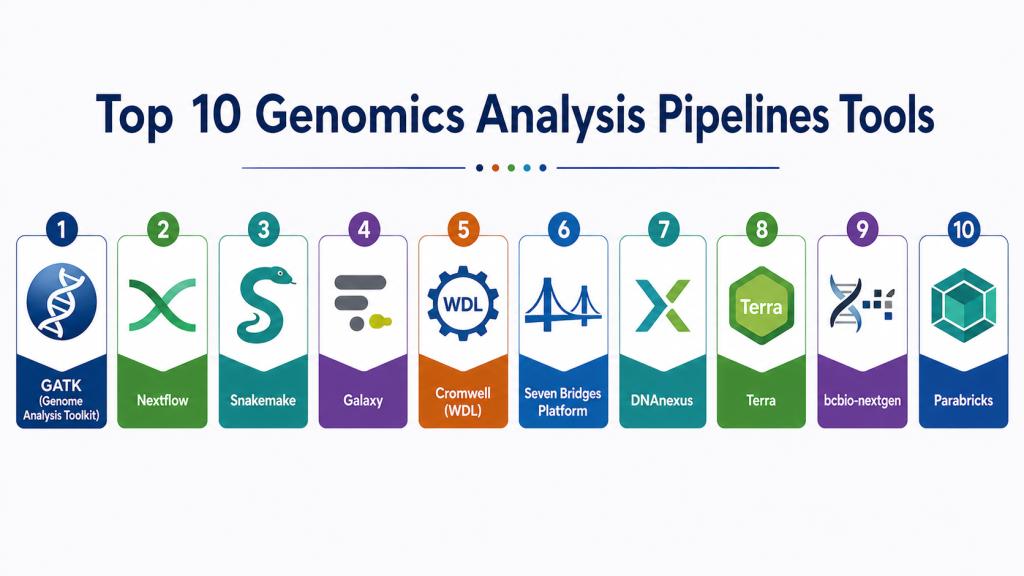
Top 10 Genomics Analysis Pipelines Tools
#1 — GATK (Genome Analysis Toolkit)
Short description: A widely adopted toolkit for variant discovery and genotyping, primarily used in research and clinical genomics workflows.
Key Features
- Variant discovery and genotyping
- Data preprocessing workflows
- High scalability for large datasets
- Best-practice pipelines
- Integration with sequencing data formats
Pros
- Industry standard in genomics
- Highly reliable and accurate
Cons
- Complex setup
- Requires bioinformatics expertise
Platforms / Deployment
Linux / Cloud
Security & Compliance
Not publicly stated
Integrations & Ecosystem
Works with sequencing platforms and bioinformatics tools
- Integration with workflow managers
- Supports standard genomic formats
Support & Community
Large global bioinformatics community
#2 — Nextflow
Short description: A flexible workflow management system designed to build scalable and reproducible genomics pipelines.
Key Features
- Pipeline orchestration
- Container support (Docker/Singularity)
- Cloud and HPC compatibility
- Reproducibility features
- Modular workflow design
Pros
- Highly scalable
- Strong community adoption
Cons
- Learning curve for beginners
- Requires scripting knowledge
Platforms / Deployment
Linux / Cloud / Hybrid
Security & Compliance
Not publicly stated
Integrations & Ecosystem
Integrates with cloud platforms and tools
- Supports multiple execution environments
- Plugin ecosystem
Support & Community
Active open-source community
#3 — Snakemake
Short description: A popular workflow engine for building reproducible and scalable genomics pipelines using Python-based syntax.
Key Features
- Rule-based workflow management
- Scalable execution
- Integration with cluster environments
- Reproducibility features
- Python-based configuration
Pros
- Easy to learn for Python users
- Flexible pipeline design
Cons
- Limited GUI
- Requires scripting
Platforms / Deployment
Linux / macOS
Security & Compliance
Not publicly stated
Integrations & Ecosystem
Works with multiple bioinformatics tools
- Cluster and cloud support
Support & Community
Strong developer community
#4 — Galaxy
Short description: A web-based platform for accessible, reproducible, and transparent genomics analysis.
Key Features
- Web-based interface
- Pre-built workflows
- Data sharing capabilities
- Visualization tools
- Workflow automation
Pros
- Beginner-friendly
- No coding required
Cons
- Limited customization
- Performance limitations
Platforms / Deployment
Web / Cloud / Self-hosted
Security & Compliance
Not publicly stated
Integrations & Ecosystem
Integrates with multiple bioinformatics tools
- Tool repository
- Workflow sharing
Support & Community
Large global community
#5 — Cromwell (WDL)
Short description: A workflow execution engine designed to run workflows described in WDL, widely used in genomics research.
Key Features
- Workflow execution engine
- Scalability across cloud and HPC
- Support for WDL language
- Fault tolerance
- Pipeline reproducibility
Pros
- Reliable execution
- Scalable infrastructure
Cons
- Requires WDL knowledge
- Limited UI
Platforms / Deployment
Linux / Cloud / Hybrid
Security & Compliance
Not publicly stated
Integrations & Ecosystem
Works with genomics workflows and tools
- Cloud platform integration
- API-based control
Support & Community
Strong community support
#6 — Seven Bridges Platform
Short description: A cloud-based platform for genomics data analysis, designed for large-scale research and collaboration.
Key Features
- Cloud-native workflows
- Data management tools
- Collaboration features
- Workflow automation
- Compliance-ready infrastructure
Pros
- Scalable and secure
- Enterprise-grade platform
Cons
- Cost considerations
- Cloud dependency
Platforms / Deployment
Cloud
Security & Compliance
Varies / N/A
Integrations & Ecosystem
Integrates with cloud and genomics tools
- API support
- Workflow marketplace
Support & Community
Enterprise support and documentation
#7 — DNAnexus
Short description: A cloud-based genomics analysis platform focused on secure and scalable data processing.
Key Features
- Cloud-based analysis
- Data security controls
- Workflow automation
- Collaboration tools
- Scalable infrastructure
Pros
- Strong security focus
- Enterprise-ready
Cons
- Expensive
- Learning curve
Platforms / Deployment
Cloud
Security & Compliance
Varies / N/A
Integrations & Ecosystem
Supports multiple genomics tools
- API integration
- Data pipeline support
Support & Community
Enterprise support
#8 — Terra
Short description: A collaborative platform for biomedical research that enables large-scale genomic data analysis in the cloud.
Key Features
- Cloud-based workflows
- Data sharing and collaboration
- Integration with genomics datasets
- Scalable compute resources
- Workflow automation
Pros
- Strong collaboration features
- Scalable infrastructure
Cons
- Cloud dependency
- Requires setup knowledge
Platforms / Deployment
Cloud
Security & Compliance
Varies / N/A
Integrations & Ecosystem
Integrates with research tools and datasets
- API support
- Workflow compatibility
Support & Community
Active research community
#9 — bcbio-nextgen
Short description: An automated pipeline for next-generation sequencing analysis with a focus on reproducibility and scalability.
Key Features
- Automated NGS pipelines
- Variant calling workflows
- RNA-seq support
- Cloud and HPC support
- Open-source framework
Pros
- Reproducible workflows
- Open-source flexibility
Cons
- Setup complexity
- Limited UI
Platforms / Deployment
Linux / Cloud
Security & Compliance
Not publicly stated
Integrations & Ecosystem
Works with genomics tools and workflows
- Data pipeline integration
Support & Community
Active open-source community
#10 — Parabricks
Short description: A GPU-accelerated genomics pipeline designed for high-performance variant analysis.
Key Features
- GPU acceleration
- Fast variant calling
- High-performance pipelines
- Scalable workflows
- Optimized algorithms
Pros
- Extremely fast processing
- Efficient for large datasets
Cons
- Requires GPU infrastructure
- Licensing cost
Platforms / Deployment
Linux / Cloud
Security & Compliance
Not publicly stated
Integrations & Ecosystem
Integrates with HPC and cloud systems
- API support
- Workflow compatibility
Support & Community
Professional support with documentation
Comparison Table
| Tool Name | Best For | Platform(s) Supported | Deployment | Standout Feature | Public Rating |
|---|---|---|---|---|---|
| GATK | Variant analysis | Linux | Cloud/Hybrid | Industry standard | N/A |
| Nextflow | Workflow orchestration | Linux | Hybrid | Reproducibility | N/A |
| Snakemake | Flexible pipelines | Linux/macOS | Self-hosted | Python-based workflows | N/A |
| Galaxy | Beginners | Web | Cloud/Self-hosted | GUI interface | N/A |
| Cromwell | Workflow execution | Linux | Hybrid | WDL support | N/A |
| Seven Bridges | Enterprise genomics | Cloud | Cloud | Collaboration | N/A |
| DNAnexus | Secure pipelines | Cloud | Cloud | Security focus | N/A |
| Terra | Research collaboration | Cloud | Cloud | Data sharing | N/A |
| bcbio-nextgen | Automated NGS | Linux | Hybrid | Automation | N/A |
| Parabricks | High-performance | Linux | Cloud | GPU acceleration | N/A |
Evaluation & Scoring of Genomics Analysis Pipelines
| Tool Name | Core (25%) | Ease (15%) | Integrations (15%) | Security (10%) | Performance (10%) | Support (10%) | Value (15%) | Weighted Total |
|---|---|---|---|---|---|---|---|---|
| GATK | 9 | 6 | 8 | 7 | 9 | 9 | 7 | 8.2 |
| Nextflow | 8 | 7 | 9 | 7 | 8 | 8 | 8 | 8.0 |
| Snakemake | 8 | 7 | 8 | 6 | 8 | 8 | 8 | 7.9 |
| Galaxy | 7 | 9 | 7 | 6 | 7 | 8 | 9 | 7.8 |
| Cromwell | 8 | 6 | 8 | 7 | 8 | 7 | 7 | 7.7 |
| Seven Bridges | 9 | 8 | 9 | 8 | 8 | 9 | 6 | 8.4 |
| DNAnexus | 9 | 7 | 8 | 9 | 8 | 9 | 6 | 8.3 |
| Terra | 8 | 7 | 9 | 7 | 8 | 8 | 7 | 8.0 |
| bcbio-nextgen | 8 | 6 | 7 | 6 | 8 | 7 | 8 | 7.6 |
| Parabricks | 9 | 6 | 7 | 7 | 10 | 8 | 7 | 8.3 |
How to interpret scores:
These scores provide a comparative view of each tool’s strengths across key criteria. Higher scores indicate balanced capabilities across enterprise and research needs, while lower scores may still reflect strong performance in specific use cases like open-source flexibility or ease of use.
Which Genomics Analysis Pipeline Is Right for You?
Solo / Freelancer
- Galaxy, Snakemake
- Easy to use and flexible
SMB
- Nextflow, bcbio-nextgen
- Scalable with moderate complexity
Mid-Market
- GATK, Cromwell
- Reliable and widely adopted
Enterprise
- DNAnexus, Seven Bridges, Terra
- Secure, scalable, and collaborative
Budget vs Premium
- Budget: Snakemake, bcbio-nextgen
- Premium: DNAnexus, Seven Bridges
Feature Depth vs Ease of Use
- Deep features: GATK, Cromwell
- Easy to use: Galaxy
Integrations & Scalability
- Cloud platforms offer better scalability
- Open-source tools require configuration
Security & Compliance Needs
- Enterprise tools provide stronger security controls
Frequently Asked Questions (FAQs)
1. What is a genomics analysis pipeline?
A genomics pipeline is a workflow that processes raw sequencing data into meaningful biological insights through automated computational steps.
2. Are these pipelines open-source?
Many tools like Snakemake and bcbio-nextgen are open-source, while others are commercial platforms.
3. Do I need coding skills?
Some tools require scripting knowledge, while platforms like Galaxy offer no-code interfaces.
4. Can pipelines run on the cloud?
Yes, many modern pipelines support cloud deployment for scalability.
5. What industries use genomics pipelines?
Healthcare, biotech, pharmaceuticals, and academic research rely heavily on these tools.
6. How secure is genomic data?
Security varies by platform; enterprise tools provide stronger data protection mechanisms.
7. What are common challenges?
Challenges include data size, compute requirements, and pipeline complexity.
8. Can these tools integrate with sequencing machines?
Yes, most pipelines support integration with sequencing outputs and data formats.
9. How scalable are these tools?
Most tools are designed to scale across large datasets and compute environments.
10. How do I choose the right pipeline?
Evaluate based on your data size, budget, technical expertise, and required features.
Conclusion
Genomics analysis pipelines have become essential for handling the growing complexity and volume of sequencing data. They enable researchers to automate workflows, improve reproducibility, and accelerate discoveries in fields like precision medicine and population genomics. The right pipeline depends on your specific requirements, including scale, expertise, and infrastructure. Open-source tools offer flexibility and cost advantages, while enterprise platforms provide advanced features, security, and collaboration capabilities. Choosing the right solution requires careful evaluation of performance, integration, and usability. It is important to consider how well the pipeline fits into your existing workflows and computational environment. Rather than selecting a single tool immediately, it is best to shortlist a few options and test them in real-world scenarios. Running pilot workflows helps validate performance, scalability, and ease of use. Ultimately, the best genomics analysis pipeline is the one that aligns with your research goals, technical capabilities, and long-term data strategy.
Nice guide. It clearly shows how bioinformatics is evolving with automation and scalable data processing.