Introduction
Transaction Monitoring (AML) Systems are specialized platforms that help financial institutions detect, investigate, and report suspicious transactions related to money laundering, fraud, and financial crime. These systems continuously analyze transaction data using rules, behavioral analytics, and machine learning to identify anomalies and high-risk activities.
They are essential because financial crime is evolving rapidly, and regulators require real-time monitoring, audit trails, and accurate reporting. Manual processes cannot keep up with transaction volumes, making automation critical. Common use cases include AML compliance, fraud detection, suspicious activity reporting, sanctions monitoring, and ongoing customer risk assessment.
Buyers should evaluate real-time monitoring capabilities, detection accuracy, false-positive reduction, AI/ML features, scalability, case management, reporting automation, integration with core systems, regulatory coverage, and vendor reliability.
Best for: Banks, fintech companies, payment processors, crypto exchanges, and insurance firms handling high transaction volumes.
Not ideal for: Small businesses with minimal transactions or limited regulatory obligations.
Key Trends in Transaction Monitoring (AML) Systems
- AI and machine learning models for anomaly detection and false-positive reduction
- Real-time transaction monitoring instead of batch processing
- Behavioral analytics and network analysis for detecting complex fraud patterns
- Cloud-native AML platforms for scalability and flexibility
- Integration with KYC, sanctions, and PEP screening systems
- Automation of case management and reporting workflows
- Explainable AI for regulatory transparency
- Cross-border compliance monitoring
- API-first platforms for fintech integration
- Focus on crypto and digital asset transaction monitoring
How We Selected These Tools (Methodology)
- Adoption across banks, fintechs, and regulated institutions
- Coverage of AML transaction monitoring and fraud detection
- Real-time monitoring and alerting capabilities
- AI/ML-based detection and analytics
- Integration with banking systems, payment platforms, and APIs
- Automation of compliance workflows and reporting
- Scalability for high-volume transaction environments
- Security posture and regulatory readiness indicators
- Vendor ecosystem and innovation in AML
- Fit across SMB, mid-market, and enterprise organizations
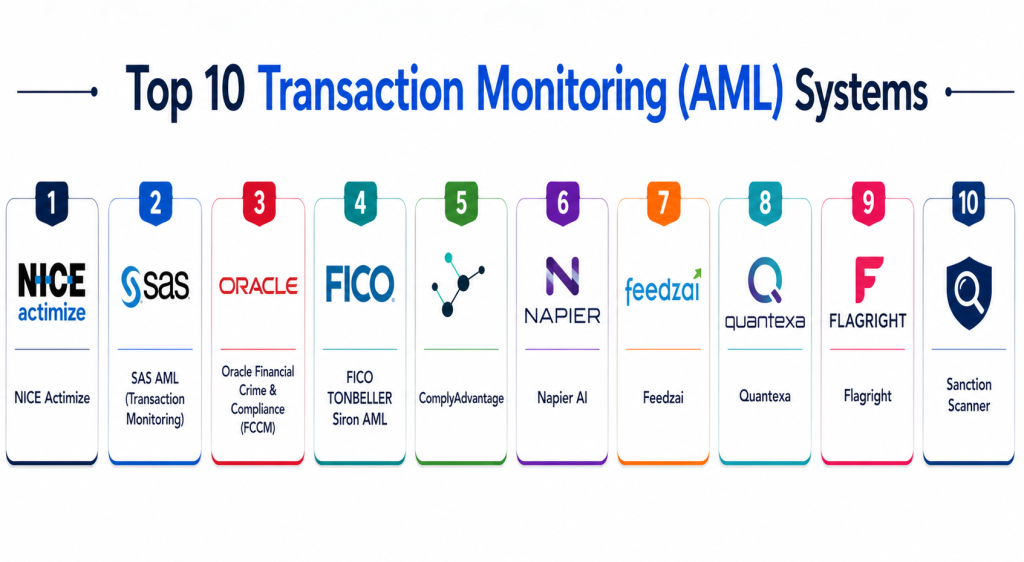
Top 10 Transaction Monitoring (AML) Systems
#1 — NICE Actimize
Short description: NICE Actimize provides enterprise-grade AML transaction monitoring with advanced analytics and real-time detection capabilities.
Key Features
- Real-time transaction monitoring
- AI-driven anomaly detection
- Case management workflows
- Risk scoring
- Regulatory reporting
Pros
- Enterprise-grade solution
- Strong analytics
- Scalable
- Comprehensive AML coverage
Cons
- Complex implementation
- Pricing varies
- Enterprise-focused
- Requires expertise
Platforms / Deployment
Web
Cloud / On-prem
Security & Compliance
Not publicly stated
Integrations & Ecosystem
Integrates with banking systems, risk platforms, and compliance tools
- Core banking systems
- Payment networks
- Analytics platforms
Support & Community
Enterprise support available
#2 — SAS AML (Transaction Monitoring)
Short description: SAS offers advanced AML monitoring with powerful analytics and risk modeling capabilities.
Key Features
- Transaction monitoring
- Risk modeling
- Fraud detection
- Case management
- Reporting tools
Pros
- Strong analytics engine
- Reliable
- Scalable
- Enterprise-ready
Cons
- Complex setup
- Pricing varies
- Requires expertise
- Enterprise focus
Platforms / Deployment
Web
Cloud / On-prem
Security & Compliance
Not publicly stated
Integrations & Ecosystem
- Data platforms
- Banking systems
- Risk tools
Support & Community
Enterprise support available
#3 — Oracle Financial Crime & Compliance (FCCM)
Short description: Oracle FCCM provides integrated AML transaction monitoring with risk analytics and compliance automation.
Key Features
- Transaction monitoring
- Risk scoring
- Compliance automation
- Case management
- Reporting dashboards
Pros
- Integrated platform
- Scalable
- Enterprise-ready
- Strong analytics
Cons
- Complex implementation
- Pricing varies
- Enterprise focus
- Requires training
Platforms / Deployment
Web
Cloud / On-prem
Security & Compliance
Not publicly stated
Integrations & Ecosystem
- ERP systems
- Banking platforms
- Compliance tools
Support & Community
Enterprise support available
#4 — FICO TONBELLER Siron AML
Short description: FICO provides AML monitoring with advanced analytics and workflow automation.
Key Features
- Transaction monitoring
- Risk scoring
- Compliance workflows
- Case management
- Reporting tools
Pros
- Strong analytics
- Scalable
- Reliable
- Automation features
Cons
- Enterprise-focused
- Pricing varies
- Setup complexity
- Integration required
Platforms / Deployment
Web
Cloud
Security & Compliance
Not publicly stated
Integrations & Ecosystem
- Banking systems
- Compliance tools
- Risk platforms
Support & Community
Enterprise support available
#5 — ComplyAdvantage
Short description: ComplyAdvantage offers AI-driven transaction monitoring with real-time risk scoring and AML detection.
Key Features
- Real-time monitoring
- Risk scoring
- AML detection
- API-first platform
- Adverse media integration
Pros
- AI-driven insights
- Easy integration
- Scalable
- Real-time updates
Cons
- Pricing varies
- Integration required
- Enterprise-focused
- Limited customization
Platforms / Deployment
Web
Cloud
Security & Compliance
Not publicly stated
Integrations & Ecosystem
- Fintech platforms
- Payment systems
- CRM tools
Support & Community
Professional support available
#6 — Napier AI
Short description: Napier AI provides intelligent AML monitoring with machine learning and workflow automation.
Key Features
- Transaction monitoring
- AI-based detection
- Case management
- Risk scoring
- Workflow automation
Pros
- Strong AI capabilities
- Scalable
- Flexible workflows
- Modern platform
Cons
- Pricing varies
- Setup complexity
- Integration required
- Enterprise focus
Platforms / Deployment
Web
Cloud
Security & Compliance
Not publicly stated
Integrations & Ecosystem
- Banking systems
- Payment platforms
- Analytics tools
Support & Community
Enterprise support available
#7 — Feedzai
Short description: Feedzai provides AI-driven transaction monitoring and fraud detection for financial institutions.
Key Features
- Real-time monitoring
- Behavioral analytics
- Fraud detection
- Risk scoring
- Case management
Pros
- Strong AI analytics
- Reduces false positives
- Scalable
- Real-time insights
Cons
- Complex setup
- Pricing varies
- Enterprise focus
- Integration effort
Platforms / Deployment
Web
Cloud
Security & Compliance
Not publicly stated
Integrations & Ecosystem
- Payment platforms
- Banking systems
- Fraud tools
Support & Community
Enterprise support available
#8 — Quantexa
Short description: Quantexa offers contextual decision intelligence for AML monitoring using network analytics.
Key Features
- Network analytics
- Transaction monitoring
- Risk scoring
- Case management
- Data integration
Pros
- Strong contextual analysis
- Scalable
- Advanced analytics
- Enterprise-grade
Cons
- Complex implementation
- Pricing varies
- Requires expertise
- Enterprise focus
Platforms / Deployment
Web
Cloud
Security & Compliance
Not publicly stated
Integrations & Ecosystem
- Data platforms
- Banking systems
- Risk tools
Support & Community
Enterprise support available
#9 — Flagright
Short description: Flagright provides real-time AML monitoring with API-first integration for fintechs.
Key Features
- Real-time monitoring
- Risk scoring
- API integration
- Workflow automation
- Reporting tools
Pros
- Easy integration
- Scalable
- Real-time detection
- Developer-friendly
Cons
- Limited enterprise depth
- Pricing varies
- Setup required
- Integration effort
Platforms / Deployment
Web
Cloud
Security & Compliance
Not publicly stated
Integrations & Ecosystem
- Fintech platforms
- Payment systems
- CRM tools
Support & Community
Support available
#10 — Sanction Scanner
Short description: Sanction Scanner provides AML transaction monitoring along with sanctions and PEP screening.
Key Features
- Transaction monitoring
- Risk scoring
- Sanctions screening
- PEP screening
- API integration
Pros
- Multi-functional
- Scalable
- Real-time data
- Easy integration
Cons
- Limited enterprise features
- Pricing varies
- Setup required
- Integration effort
Platforms / Deployment
Web
Cloud
Security & Compliance
Not publicly stated
Integrations & Ecosystem
- Payment platforms
- CRM systems
- Fintech tools
Support & Community
Support available
Comparison Table
| Tool Name | Best For | Platform(s) Supported | Deployment | Standout Feature | Public Rating |
|---|---|---|---|---|---|
| NICE Actimize | Enterprise AML | Web | Cloud/On-prem | AI-driven detection | N/A |
| SAS AML | Analytics-driven AML | Web | Cloud/On-prem | Risk modeling | N/A |
| Oracle FCCM | Enterprise compliance | Web | Cloud/On-prem | Integrated suite | N/A |
| FICO Siron | AML analytics | Web | Cloud | Risk scoring | N/A |
| ComplyAdvantage | Fintech AML | Web | Cloud | AI monitoring | N/A |
| Napier AI | AI AML monitoring | Web | Cloud | ML detection | N/A |
| Feedzai | Fraud + AML | Web | Cloud | Behavioral analytics | N/A |
| Quantexa | Network analytics | Web | Cloud | Contextual intelligence | N/A |
| Flagright | Fintech API AML | Web | Cloud | Real-time API | N/A |
| Sanction Scanner | AML + screening | Web | Cloud | Multi-function compliance | N/A |
Evaluation & Scoring of Transaction Monitoring (AML) Systems
| Tool | Core | Ease | Integrations | Security | Performance | Support | Value | Weighted Total |
|---|---|---|---|---|---|---|---|---|
| NICE Actimize | 9 | 7 | 9 | 8 | 9 | 8 | 7 | 8.3 |
| SAS AML | 9 | 7 | 8.5 | 8 | 9 | 8 | 7 | 8.2 |
| Oracle FCCM | 8.5 | 7 | 8.5 | 8 | 8.5 | 8 | 7 | 8.1 |
| FICO Siron | 8.5 | 7.5 | 8 | 8 | 8.5 | 8 | 7.5 | 8.1 |
| ComplyAdvantage | 8.5 | 8 | 9 | 8 | 8.5 | 8 | 8 | 8.4 |
| Napier AI | 8.5 | 7.5 | 8.5 | 8 | 8.5 | 8 | 7.5 | 8.2 |
| Feedzai | 9 | 7.5 | 8.5 | 8 | 9 | 8 | 7.5 | 8.3 |
| Quantexa | 9 | 7 | 8.5 | 8 | 9 | 8 | 7 | 8.2 |
| Flagright | 8 | 8.5 | 8.5 | 8 | 8 | 7.5 | 8.5 | 8.2 |
| Sanction Scanner | 8 | 8 | 8 | 8 | 8 | 7.5 | 8 | 8.0 |
How to interpret:
- Enterprise tools score higher on performance and analytics depth
- API-first tools offer better ease of use and value
- Mid-market tools balance cost and capability
- Scores are comparative, not absolute benchmarks
Which Transaction Monitoring (AML) System Is Right for You?
Solo / Freelancer
Not required unless operating in regulated financial services.
SMB
Choose Flagright or Sanction Scanner for simple and cost-effective monitoring.
Mid-Market
Consider ComplyAdvantage or Napier AI for scalable AML monitoring.
Enterprise
Use NICE Actimize, SAS, Oracle, FICO, Feedzai, or Quantexa for full compliance coverage.
Budget vs Premium
Budget tools focus on API-based monitoring; premium platforms provide advanced analytics and compliance ecosystems.
Feature Depth vs Ease of Use
Enterprise platforms offer deep analytics; API tools prioritize simplicity.
Integrations & Scalability
Ensure compatibility with banking, payment, and CRM systems.
Security & Compliance Needs
Critical—ensure audit trails, regulatory reporting, and data protection.
Frequently Asked Questions (numbring)
1. What is AML transaction monitoring?
It is the process of analyzing financial transactions to detect suspicious activities related to money laundering.
2. Why is it important?
It helps organizations comply with regulations and prevent financial crime.
3. Who uses AML monitoring systems?
Banks, fintechs, payment companies, and regulated enterprises.
4. What features matter most?
Real-time monitoring, AI detection, integration, and reporting.
5. Are these systems real-time?
Yes, modern systems support real-time monitoring and alerts.
6. Do they reduce false positives?
Yes, AI and analytics improve detection accuracy.
7. How do they integrate?
Via APIs with banking, payment, and CRM systems.
8. Are they secure?
Most platforms include encryption, audit logs, and compliance features.
9. How long does implementation take?
It varies from weeks to months depending on complexity.
10. What are alternatives?
Manual monitoring or basic tools, which are less scalable.
Conclusion
Transaction Monitoring (AML) Systems are essential for detecting financial crime and ensuring regulatory compliance.
They enable real-time monitoring, automated alerts, and advanced analytics across transactions.
Enterprise solutions like NICE Actimize, SAS, and Oracle provide comprehensive coverage.
Mid-market tools such as ComplyAdvantage and Napier AI offer flexibility and scalability.
API-first tools like Flagright simplify integration for fintechs.
The right solution depends on transaction volume, regulatory exposure, and integration needs.
Organizations should prioritize detection accuracy, automation, and scalability.
Pilot deployments can validate performance and reduce compliance risk.
Ultimately, the best system aligns with your AML strategy and operational requirements.
This article helps readers understand the importance of AML transaction monitoring tools in modern banking and financial security operations.