Introduction
Many beginners enter the stock market by looking only at share price, but this can be misleading because a low-priced stock is not always cheap and a high-priced stock is not always expensive. This is where Market Capitalization in Stocks becomes important. Market capitalization, or market cap, helps investors understand the total market value of a listed company based on its share price and outstanding shares. Without this basic idea, beginners may compare companies wrongly, follow random tips, or invest emotionally. This blog explains market capitalization in simple words, how it works, why it matters, and how beginners can use it to compare stocks more responsibly. It is useful for students, salaried investors, traders, finance learners, and anyone who wants to build practical stock market understanding before making decisions.
What Is Market Capitalization in Stocks
Market capitalization means the total value of a company in the stock market. It is calculated by multiplying the current share price by the total number of outstanding shares.
The simple formula is:
Market Capitalization = Current Share Price × Total Outstanding Shares
For example, if a company has 10 crore shares and each share trades at ₹100, its market capitalization is ₹1,000 crore. This does not mean the company has ₹1,000 crore in cash. It means the stock market is valuing the company at that amount based on its current share price.
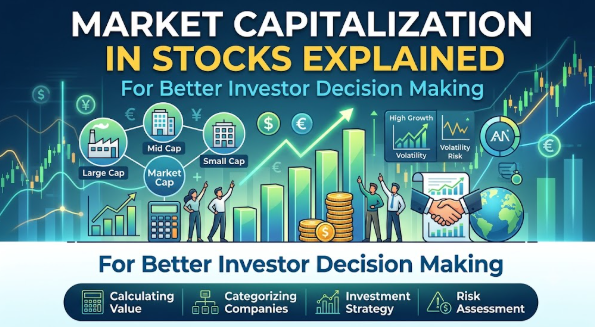
People search for market capitalization because they want to understand whether a company is large, medium, or small in size. Investors use market cap to classify companies into categories such as large-cap, mid-cap, and small-cap. These categories help investors understand risk, stability, growth potential, and volatility.
In real life, market cap is used when comparing companies, building a portfolio, choosing mutual funds, understanding index stocks, and judging the size of a business. For beginners, it is one of the first stock market basics that should be understood before looking at profits, dividends, debt, or valuation ratios.
A common misunderstanding is that a stock with a lower price is always cheaper. This is not correct. A ₹20 stock may belong to a very large company if it has many shares, while a ₹2,000 stock may belong to a smaller company if it has fewer shares. The practical takeaway is simple: never judge a stock only by its price. Always understand the company’s market capitalization and business fundamentals together.
Why Market Capitalization in Stocks Is Important
Market capitalization is important because it helps investors understand company size, risk level, and possible investment behavior. It does not tell everything about a company, but it gives a useful starting point.
For savings, market cap helps beginners decide how much money they should expose to different types of stocks. A person saving for a near-term goal may prefer more stable investments instead of taking high risk in very small companies.
For borrowing and personal finance, understanding market cap indirectly helps people avoid using borrowed money for risky stock decisions. A beginner who does not understand company size may borrow money, invest in a volatile small-cap stock, and face repayment stress if the stock falls.
For investing, market capitalization helps build balance. Large-cap stocks are generally considered more established, while small-cap stocks may offer growth potential but also higher uncertainty. Mid-cap stocks often fall between these two categories.
For trading, market cap matters because smaller companies may move faster due to lower liquidity. Traders must understand that volatility can be higher in lower market cap stocks.
For tax planning, market cap does not directly decide tax, but it affects investment choices, holding period decisions, and capital gains planning. For crypto decisions, a similar concept called market cap is also used, but crypto carries different risks and should not be treated like shares of a regulated company.
A practical scenario: A salaried beginner sees two stocks, one priced at ₹50 and another at ₹2,000. Without market cap knowledge, the beginner may think the ₹50 stock is cheaper. After checking market capitalization, they may realize the ₹50 stock belongs to a much larger company and the ₹2,000 stock belongs to a smaller business. This changes the way they compare both stocks.
The Real Problem Readers Face With Market Capitalization
The real problem is that many beginners enter the stock market without understanding the difference between price, value, and company size. They may watch social media videos, follow stock tips, or buy stocks because the price “looks affordable.” This creates confusion and increases the chance of poor decisions.
Online advice can also be confusing. Some people say large-cap stocks are safest, while others say small-cap stocks create wealth faster. Both statements can be incomplete. Large companies can also fall, and small companies can also fail. Market capitalization is helpful, but it should not be used alone.
Emotional decision-making is another problem. Beginners may buy small-cap stocks because they want fast returns. They may ignore risk, debt, weak earnings, poor management quality, and low liquidity. They may also panic when prices fall quickly.
Weak comparison is also common. Investors sometimes compare two companies only by share price. A better comparison includes market cap, revenue, profit, debt, industry position, cash flow, management quality, valuation, and future growth possibility.
Unrealistic expectations create another issue. A beginner may expect every small company to become a large company. In reality, business growth takes time and involves risk. Not every low market cap stock becomes successful.
Many investors also depend only on social media advice. They may not read annual reports, financial statements, exchange filings, or risk factors. The right next step is to learn the basics, compare carefully, and avoid investing under pressure.
How Market Capitalization Works Step by Step
Step 1: Understand the Share Price
Share price is the current trading price of one share in the stock market. It matters because market capitalization is calculated using this price. Beginners can apply this by checking the current market price from a reliable stock platform before making any comparison. For example, if a share trades at ₹500, that is only the price of one share, not the total value of the company. The common mistake is thinking a lower share price means a cheaper stock. The better approach is to use share price only as one part of the calculation.
Step 2: Check Total Outstanding Shares
Outstanding shares are the total shares of a company available after considering issued shares held by shareholders. This matters because two companies with the same share price can have very different market caps if their share count is different. Beginners can apply this by checking company details on stock exchange pages, financial websites, or company reports. For example, a company with 100 crore shares will have a much higher market cap than a company with 1 crore shares at the same share price. The common mistake is ignoring share count. The better approach is to always connect price with total shares.
Step 3: Calculate Market Capitalization
After knowing share price and outstanding shares, multiply both numbers. This gives the company’s market capitalization. It matters because it shows how the stock market is valuing the entire company at that moment. A beginner can apply this by using the formula or checking the ready-made market cap figure on reliable platforms. For example, ₹200 share price multiplied by 50 crore shares equals ₹10,000 crore market cap. The common mistake is assuming this value is permanent. The better approach is to remember that market cap changes whenever share price changes.
Step 4: Identify the Market Cap Category
Companies are commonly grouped as large-cap, mid-cap, and small-cap based on their market capitalization. This matters because each category has different risk and behavior. Beginners can apply this by checking whether the company is among established large companies, growing mid-sized companies, or smaller companies with higher uncertainty. For example, a large-cap company may offer stability, while a small-cap company may move sharply in both directions. The common mistake is choosing one category blindly. The better approach is to match the category with your risk capacity and time horizon.
Step 5: Compare Companies Within the Same Industry
Market cap becomes more useful when companies from the same sector are compared. This matters because comparing a bank with an IT company or a cement company may not give clear insight. Beginners can apply this by comparing companies within similar business models. For example, compare two private banks or two software companies instead of unrelated businesses. The common mistake is comparing market cap across unrelated sectors without context. The better approach is to compare industry position, revenue, profit, and valuation together.
Step 6: Connect Market Cap With Fundamentals
Market cap alone does not tell whether a stock is good or bad. It must be studied with profits, debt, revenue growth, cash flow, return ratios, and management quality. This matters because a large market cap company can still be overvalued, and a small market cap company can still be fundamentally weak. Beginners can apply this by preparing a simple research checklist. The common mistake is buying only because a company is large or small. The better approach is to study fundamentals before deciding.
Step 7: Understand Risk and Time Horizon
Market cap affects risk, but it does not remove risk. Large-cap stocks may be relatively stable, while mid-cap and small-cap stocks may be more volatile. This matters because beginners often invest without matching their time horizon. For example, money needed in six months should not be exposed heavily to volatile stocks. The common mistake is investing emergency money in risky stocks. The better approach is to keep emergency funds separate and invest according to goals.
Step 8: Review Market Cap Over Time
Market capitalization changes as share prices change. A company can move from small-cap to mid-cap or from mid-cap to large-cap over time if its value grows. It can also move down if business performance weakens or market confidence falls. This matters because investing is not a one-time decision. Beginners can apply this by reviewing their portfolio regularly. The common mistake is buying and forgetting without review. The better approach is to track business performance, valuation, and risk periodically.
Key Factors That Influence Market Capitalization
Risk and Return
Market capitalization helps investors understand the broad risk-return profile of a stock. Large-cap stocks are often linked with established businesses, while small-cap stocks may offer higher growth possibility with higher uncertainty. The mistake is assuming higher return is easy. A better approach is to check whether the risk is suitable for your financial situation.
Time Horizon
Time horizon means how long you can keep your money invested. Market cap matters because smaller companies may need more time to grow and may face stronger price fluctuations. If your goal is short-term, high-volatility stocks may not be suitable. A better approach is to match investments with goals.
Market Volatility
Volatility means price movement. Small-cap and some mid-cap stocks can move sharply due to lower liquidity, news, or market sentiment. Beginners should not panic during normal volatility but should also not ignore serious business problems. The better approach is to separate price movement from business performance.
Research Quality
Good research includes company financials, industry outlook, management quality, debt level, and valuation. Market cap gives a starting point, not a final answer. The common mistake is depending only on headlines or social media. The better approach is to use multiple reliable sources and written notes.
Diversification
Diversification means spreading money across different stocks, sectors, or asset classes. Market cap supports diversification by helping investors balance large-cap, mid-cap, and small-cap exposure. The mistake is putting all money into one stock category. The better approach is to build a balanced portfolio based on risk capacity.
Emotional Control
Market cap categories can create emotional bias. Some beginners chase small-cap stocks because they hope for fast growth. Others buy only large-cap stocks because they fear all risk. The better approach is to make decisions based on research, not excitement or fear.
Portfolio Review
Market cap changes over time, so portfolio review is important. A stock that was small earlier may become larger, or a large company may lose value. Reviewing helps investors rebalance risk. The mistake is never checking whether the original reason for investing is still valid.
Long-Term Discipline
Market capitalization is more useful when combined with long-term thinking. Strong companies may take time to reflect value, and weak companies may look attractive for short periods. The better approach is to focus on business quality, valuation, risk, and patience.
Detailed Breakdown of Market Capitalization in Stocks
Stock Market Basics
The stock market is a place where shares of listed companies are bought and sold. When you buy a share, you become a partial owner of that company. The price of the share changes based on demand, supply, company performance, market conditions, and investor expectations.
Market capitalization helps beginners move beyond only share price. It tells them how much the market currently values the entire company.
How Stocks Work
A company issues shares to raise capital or provide ownership to shareholders. These shares trade in the market. When more investors want to buy a stock, the price may rise. When more investors want to sell, the price may fall.
Because market cap depends on share price, it also changes with market movement. If the share price increases, market cap increases. If the share price falls, market cap falls.
Investing vs Trading
Investing usually focuses on long-term ownership based on business quality, growth, and valuation. Trading focuses on short-term price movement. Market cap is useful in both cases, but the use is different.
An investor may use market cap to decide portfolio allocation. A trader may use market cap to understand liquidity and volatility. The mistake is using trading logic for long-term investing or investing logic for short-term speculation.
Risk and Return
Every stock carries risk. A large company may have lower growth speed but more business stability. A smaller company may grow faster but may also face greater uncertainty. Market cap helps investors estimate broad risk but does not guarantee safety.
Market Volatility
Volatility is normal in stocks. Small-cap stocks often show higher volatility because they may have fewer buyers and sellers. Large-cap stocks can also fall sharply during market stress. The better approach is to prepare mentally and financially before investing.
Long-Term vs Short-Term Approach
Market capitalization becomes more meaningful when linked with time. A beginner with a long-term goal may allocate some money to different market cap categories. A person needing money soon should avoid unnecessary risk. The mistake is investing without knowing when the money is needed.
Research Basics
Before investing, beginners should check what the company does, how it earns money, whether profits are growing, whether debt is manageable, and whether the stock price is reasonable compared with business performance. Market cap gives size, but research gives understanding.
Fundamental Understanding
Fundamental analysis studies the real business. It includes revenue, profit, margins, debt, cash flow, management, industry position, and valuation ratios. Market capitalization should be read with these factors. A large market cap with weak earnings may be risky, while a smaller company with strong fundamentals may deserve deeper study.
Technical Understanding
Technical analysis studies price charts, trends, volume, and market behavior. It may be useful for traders, but beginners should not depend only on charts. Market cap and liquidity matter because low market cap stocks may be easier to move sharply.
Diversification
A portfolio should not depend only on one company, sector, or market cap category. Diversification can reduce the damage from one wrong decision. However, too much diversification can also make tracking difficult. The better approach is balanced and understandable diversification.
Portfolio Thinking
Portfolio thinking means looking at all investments together. A beginner should ask: How much money is in large-cap stocks? How much is in mid-cap or small-cap stocks? How much is in safer assets? This helps avoid hidden risk.
Emotional Control
Greed and fear are common in the stock market. Greed pushes people into risky small-cap stocks without research. Fear makes people sell good investments during temporary falls. Market cap knowledge helps create structure, but discipline is still needed.
Beginner Mistakes
Common beginner mistakes include comparing only share price, following random tips, buying because a stock has fallen, ignoring debt, and investing emergency funds. Market cap understanding reduces confusion but does not replace complete research.
Importance of Patience and Discipline
Good investing requires time, learning, review, and patience. Market capitalization is a basic tool, not a shortcut. Beginners should use it to compare companies better and build disciplined investment habits.
Why Following Random Tips Is Risky
Random tips often ignore risk, valuation, liquidity, and personal financial goals. A stock may be suitable for one person but unsuitable for another. Beginners should avoid copying others and should build their own understanding before investing.
Common Mistakes Beginners Make With Market Capitalization
Following Random Advice
This happens because beginners want simple answers. It is risky because the advice may not match their goals, risk capacity, or financial condition. What can go wrong is buying a stock without understanding the company. The better approach is to verify information and study the business.
Ignoring Risk
Many beginners focus only on possible returns. This is risky because every stock can fall. A small-cap stock can fall sharply if earnings disappoint or liquidity reduces. The better approach is to check risk before expected return.
Not Comparing Options
Some investors buy the first stock they hear about. This can lead to weak decisions. A better method is comparing companies in the same sector by market cap, revenue, profit, debt, and valuation.
Trusting Fake Profit Claims
Fake claims attract beginners with unrealistic expectations. This is risky because no one can guarantee stock market returns. The better approach is to avoid guaranteed-return language and focus on education.
Ignoring Hidden Financial Weakness
A company may have an attractive story but weak financials. Ignoring debt, poor cash flow, or falling profits can lead to losses. The better approach is to check financial statements and not depend only on market cap.
Making Emotional Decisions
Beginners may buy in greed or sell in panic. Emotional decisions often happen during sharp price movement. The better approach is to write your investment reason before buying and review it calmly.
Using Emergency Money for Risky Stocks
Emergency money should be kept safe and accessible. Investing it in volatile stocks can create stress during urgent needs. The better approach is to keep emergency funds separate from investments.
Depending Only on Social Media Advice
Social media can be useful for learning, but it can also spread incomplete or biased information. The better approach is to verify details from reliable sources and avoid acting under pressure.
Ignoring Tax and Compliance Responsibilities
Stock profits may have tax implications. Beginners sometimes ignore record keeping and later face confusion. The better approach is to maintain transaction records and consult a qualified professional when needed.
Don’t Do This Checklist
- Do not buy a stock only because its price is low.
- Do not assume large-cap stocks are risk-free.
- Do not invest borrowed money without understanding risk.
- Do not follow tips without research.
- Do not put emergency funds into volatile stocks.
- Do not ignore company debt and weak earnings.
- Do not compare unrelated companies blindly.
- Do not trust guaranteed profit claims.
- Do not share sensitive financial information with unknown sources.
- Do not panic-buy or panic-sell based on social media noise.
Practical Real-Life Examples of Market Capitalization
Example 1: Salaried Investor Comparing Two Stocks
A salaried person sees one stock at ₹80 and another at ₹1,500. The mistake is assuming the ₹80 stock is cheaper. The better action is to check market capitalization, earnings, debt, and industry position. The learning is that stock price alone does not show true size or value.
Example 2: Beginner Avoiding Random Stock Tips
A beginner receives a message saying a small-cap stock will grow fast. The challenge is excitement without research. The better action is to check company fundamentals, liquidity, and risk before investing. The learning is that market cap helps identify risk category but does not guarantee performance.
Example 3: Trader Understanding Liquidity Risk
A trader enters a low market cap stock without checking trading volume. The problem appears when selling becomes difficult during a fall. The better action is to check liquidity and volatility before trading. The learning is that small companies may move fast but can also become risky during exits.
Example 4: Finance Blogger Explaining Stock Basics
A finance blogger writes about stock market basics but only explains share price. The content feels incomplete. The better action is to explain market capitalization with examples, categories, and risks. The learning is that clear educational content builds better reader trust.
Example 5: Crypto Learner Comparing Market Cap Concepts
A crypto beginner compares a coin’s price with a stock’s price. The mistake is ignoring supply and market cap. The better action is to understand that market cap exists in both areas but risks are different. The learning is that price alone is not enough in stocks or crypto.
Table 1: Market Cap Categories and Beginner Understanding
| Market Cap Category | Basic Meaning | Common Investor View | Main Risk to Understand |
|---|---|---|---|
| Large-cap stocks | Established companies with higher market value | Often considered more stable than smaller companies | Can still fall due to valuation, business, or market risk |
| Mid-cap stocks | Medium-sized companies with growth potential | May offer a balance of growth and risk | Can be more volatile than large-cap stocks |
| Small-cap stocks | Smaller companies with lower market value | May offer growth opportunities | Higher volatility, liquidity risk, and business uncertainty |
Table 2: Beginner Mistake vs Better Approach
| Beginner Mistake | Why It Is Risky | Better Approach |
|---|---|---|
| Buying only because share price is low | Low price does not mean low valuation | Check market cap, earnings, and business quality |
| Ignoring company size | Risk level may be misunderstood | Identify whether the stock is large-cap, mid-cap, or small-cap |
| Following random tips | Advice may be biased or incomplete | Verify facts and study fundamentals |
| Investing emergency money | Market falls can create financial stress | Keep emergency funds separate |
| Comparing unrelated companies | Different sectors have different business models | Compare companies within the same industry |
Tools, Methods, and Frameworks Readers Can Use
Stock Watchlist
A stock watchlist is a simple list of companies you want to track. It helps beginners avoid random buying. You can include share price, market cap, sector, reason for interest, and risk notes. This avoids impulsive decisions.
Investment Journal
An investment journal records why you bought or avoided a stock. It helps you learn from decisions. Beginners can write the company name, market cap category, investment reason, expected risk, and review date. This avoids emotional investing.
Portfolio Review Method
A portfolio review method helps you check your investments regularly. You can review market cap exposure, sector allocation, gains, losses, and original investment reasons. This avoids blind holding or panic selling.
Risk Allocation Method
Risk allocation means deciding how much money should go into different risk categories. A beginner may keep higher exposure to stable assets and limited exposure to high-volatility stocks. This avoids overexposure to small-cap risk.
Fundamental Analysis Checklist
A fundamental checklist includes revenue, profit, debt, cash flow, return ratios, management quality, and valuation. Market cap should be part of this checklist. This avoids buying a company only because it looks popular.
Goal-Based Investing Framework
This framework connects investments with financial goals. Money needed soon should not be placed in highly volatile stocks. Long-term goals may allow more equity exposure depending on risk capacity. This avoids mismatched investing.
Risk Checklist
A risk checklist helps investors pause before investing. It may include market risk, liquidity risk, valuation risk, business risk, tax impact, and emotional risk. This avoids decisions based only on expected return.
Expert Tips to Make Better Decisions
1. Learn the Formula Before Comparing Stocks
The tip is to understand that market cap equals share price multiplied by outstanding shares. This matters because it prevents wrong comparison based only on price. Apply it by checking market cap every time you compare two stocks.
2. Never Judge a Stock Only by Share Price
A low-priced stock is not automatically cheap. This matters because beginners often confuse affordability with value. Apply this by checking market cap, valuation ratios, earnings, and business quality.
3. Compare Companies Within the Same Sector
Market cap comparison works better when companies belong to similar industries. This matters because different sectors have different profit models. Apply it by comparing banks with banks, IT companies with IT companies, and so on.
4. Match Market Cap Category With Risk Capacity
Large-cap, mid-cap, and small-cap stocks behave differently. This matters because your investment should match your financial comfort. Apply it by deciding how much volatility you can handle before investing.
5. Keep Emergency Money Separate
Emergency money should not be exposed to stock market risk. This matters because market falls can happen when you need cash. Apply it by maintaining a separate emergency fund before investing aggressively.
6. Use Market Cap With Fundamentals
Market cap tells company size, not business quality. This matters because a large company can be overvalued and a small company can be weak. Apply it by checking profit, debt, cash flow, and management quality.
7. Avoid Herd Mentality
Many people buy stocks because others are buying. This matters because crowd behavior can create overvaluation. Apply it by writing your own reason before investing.
8. Review Portfolio Allocation
Your portfolio may become unbalanced over time. This matters because one stock or category may become too large. Apply it by reviewing your holdings regularly.
9. Check Liquidity Before Trading
Low market cap stocks may have lower trading volume. This matters because entering and exiting may become difficult. Apply it by checking average volume and bid-ask spread before trading.
10. Be Careful With Small-Cap Excitement
Small-cap stocks can look attractive due to growth potential. This matters because they may also carry higher business and liquidity risk. Apply it by limiting exposure and researching deeply.
11. Do Not Trust Guaranteed Return Claims
No stock market investment can guarantee profits. This matters because fake claims often target beginners. Apply it by avoiding anyone promising fixed returns from stocks.
12. Track Mistakes and Improve
Every investor makes mistakes, but not everyone learns from them. This matters because repeated mistakes damage wealth. Apply it by reviewing past decisions and improving your process.
13. Understand Valuation Separately
Market cap is not the same as valuation quality. This matters because a company can be large and still expensive. Apply it by studying valuation ratios such as price-to-earnings carefully.
14. Take Professional Advice When Needed
Some decisions involve tax, legal, or large financial impact. This matters because mistakes can be costly. Apply it by consulting qualified professionals for major investment or tax decisions.
15. Focus on Long-Term Discipline
Market cap is useful, but discipline creates better investing behavior. This matters because wealth building needs patience and risk control. Apply it by avoiding panic and following a written plan.
Case Studies: How Better Understanding Changes Decisions
Case Study 1: The Salaried Beginner
Profile: Rohan is a salaried employee who recently started investing.
Situation: He wanted to buy stocks with low prices because they looked affordable.
Problem: He did not understand that share price alone does not show whether a company is cheap.
Wrong approach: He planned to buy several low-priced stocks without checking market capitalization or fundamentals.
Better approach: He learned to compare market cap, earnings, debt, and sector position before investing.
Result or learning: He realized that some low-priced stocks belonged to weak businesses, while some higher-priced stocks had stronger fundamentals.
Key takeaway: Market cap helps beginners compare company size, but it should be used with deeper research.
Case Study 2: The Small-Cap Trader
Profile: Meena is a beginner trader interested in fast-moving stocks.
Situation: She entered a small-cap stock after seeing it rise quickly.
Problem: She ignored liquidity and volatility.
Wrong approach: She bought based on price momentum without checking trading volume or risk.
Better approach: She started checking market cap, volume, price movement, and exit possibility before trades.
Result or learning: She understood that fast movement can create both opportunity and danger.
Key takeaway: Lower market cap stocks require stronger risk control and emotional discipline.
Case Study 3: The Long-Term Investor
Profile: Arjun is a long-term investor building a retirement portfolio.
Situation: His portfolio had too much exposure to small and mid-sized companies.
Problem: He did not realize that his overall portfolio risk was high.
Wrong approach: He selected stocks individually without checking total portfolio allocation.
Better approach: He reviewed his portfolio by market cap category and added balance based on his risk capacity.
Result or learning: He became more comfortable with market movement and avoided overdependence on one category.
Key takeaway: Market cap is useful not only for choosing stocks but also for building portfolio discipline.
Risk Awareness: What Readers Must Check First
Market Risk
Market risk means the chance of losing money due to overall market movement. It matters because even strong companies can fall during market weakness. Reduce this risk by diversifying and avoiding short-term panic.
Business Risk
Business risk means the company may face falling sales, rising costs, poor management, or competition. It matters because market cap can fall if business performance weakens. Reduce this risk by studying company fundamentals.
Valuation Risk
Valuation risk means paying too much for a stock compared with its earnings or growth. It matters because a good company can still be a poor investment if bought at an expensive price. Reduce this risk by checking valuation ratios.
Liquidity Risk
Liquidity risk means difficulty buying or selling a stock at a fair price. It is more common in some small-cap stocks. Reduce this risk by checking trading volume and avoiding oversized positions.
Volatility Risk
Volatility means sharp price movement. It matters because beginners may panic during sudden falls. Reduce this risk by investing according to time horizon and risk capacity.
Emotional Risk
Emotional risk comes from greed, fear, panic, or pressure. It matters because emotions can damage decision-making. Reduce this risk by using written plans and avoiding impulsive trades.
Misinformation Risk
Misinformation risk comes from fake tips, edited screenshots, and misleading claims. It matters because beginners may trust unverified advice. Reduce this risk by checking reliable sources and avoiding guaranteed-return promises.
Tax-Related Risk
Stock market transactions may have tax implications. It matters because poor record keeping can create confusion later. Reduce this risk by maintaining records and consulting a qualified tax professional when needed.
Data Privacy Risk
Beginners may share financial details with unknown groups or fake advisors. It matters because personal data can be misused. Reduce this risk by protecting account details, passwords, and identity information.
Readers should verify all details, understand their own risk profile, and consult a qualified financial, tax, legal, or investment professional before making major decisions.
Checklist Before Taking Action
- I understand what market capitalization means.
- I know the formula: share price multiplied by outstanding shares.
- I have checked whether the stock is large-cap, mid-cap, or small-cap.
- I have not judged the stock only by its share price.
- I have compared the company with similar companies in the same sector.
- I have reviewed revenue, profit, debt, cash flow, and valuation.
- I understand the risk level of the stock.
- I have checked whether the investment matches my time horizon.
- I have kept emergency money separate.
- I have avoided fake profit or guaranteed return claims.
- I have not borrowed money for risky stock decisions.
- I have protected my personal and financial data.
- I have considered tax and compliance impact.
- I have written my reason for investing.
- I have avoided panic, greed, and pressure-based decisions.
- I have considered professional advice where needed.
Use this checklist before investing, trading, or comparing stocks. It helps you slow down, think clearly, and avoid emotional decisions. A checklist does not remove risk, but it improves discipline and decision quality.
Strategic Insights for Better Decision-Making
Position Sizing
Position sizing means deciding how much money to invest in one stock. Market cap helps because smaller companies may carry higher volatility. For example, a beginner may choose smaller exposure in small-cap stocks and larger exposure only after deeper research.
Portfolio Review
Portfolio review means checking whether your investments still match your goals. A portfolio may become risky if one stock or one market cap category grows too large. Regular review helps you rebalance and stay disciplined.
Diversification
Diversification reduces dependency on one company or category. A beginner can diversify across large-cap, mid-cap, sectors, and safer assets. The aim is not to avoid all risk but to avoid concentrated risk.
Risk Allocation
Risk allocation means deciding how much risk you are willing to take. Younger investors with long-term goals may accept more equity risk, while people with short-term needs may prefer more stability. Market cap supports this decision.
Long-Term Mindset
A long-term mindset helps investors avoid reacting to every price movement. Market cap changes daily, but business quality develops over time. Beginners should focus on process, patience, and review.
Avoiding Herd Mentality
Herd mentality means buying because everyone else is buying. It often happens in popular stocks or trending small-cap names. A better approach is to ask whether the business, valuation, and risk make sense for you.
Investment Discipline
Investment discipline means following a written plan instead of emotions. Market capitalization gives structure, but discipline helps you apply it correctly. Beginners should track decisions, review outcomes, and improve slowly.
Key Terms Explained for Beginners
- Market Capitalization: Market capitalization is the total stock market value of a company. It is calculated by multiplying share price by total outstanding shares.
- Share Price: Share price is the current price of one share in the stock market. It changes based on demand, supply, company performance, and market sentiment.
- Outstanding Shares: Outstanding shares are the total shares of a company currently held by shareholders. This number is used to calculate market cap.
- Large-Cap Stocks: Large-cap stocks are shares of companies with high market value. They are usually established businesses but are not risk-free.
- Mid-Cap Stocks: Mid-cap stocks belong to medium-sized companies. They may offer growth potential but can be more volatile than large-cap stocks.
- Small-Cap Stocks: Small-cap stocks belong to smaller listed companies. They may grow over time but usually carry higher volatility and liquidity risk.
- Valuation: Valuation means judging whether a stock price is reasonable compared with the company’s earnings, assets, growth, and risk.
- Liquidity: Liquidity means how easily a stock can be bought or sold without a large price impact. Low liquidity can make exits difficult.
- Volatility: Volatility means fast or sharp price movement. It can create opportunity but also increases risk.
- Portfolio: A portfolio is the collection of all your investments. It may include stocks, mutual funds, deposits, bonds, or other assets.
- Diversification: Diversification means spreading investments across different companies, sectors, or asset types to reduce concentrated risk.
- Risk Capacity: Risk capacity means how much financial loss or price movement you can handle without damaging your financial life.
- Fundamental Analysis: Fundamental analysis studies a company’s real business, including revenue, profit, debt, cash flow, and management quality.
- Technical Analysis: Technical analysis studies price charts, volume, and trends. It is mainly used by traders, but it should be used carefully.
- Market Sentiment: Market sentiment means the overall mood of investors. Positive sentiment can push prices up, while negative sentiment can pull prices down.
Who Should Read This Blog
Beginners
Beginners should read this blog because market capitalization is one of the most important stock market basics. It helps them avoid comparing stocks only by price.
Students
Students learning finance, commerce, or investing can use this blog to understand company size and stock market value in simple language.
Salaried Employees
Salaried employees who invest from monthly income can use market cap knowledge to build a balanced and risk-aware portfolio.
Small Business Owners
Small business owners can understand how listed companies are valued and how business size affects investor perception.
New Investors
New investors can use this blog to compare large-cap, mid-cap, and small-cap stocks more carefully before investing.
Traders
Traders can use market cap to understand liquidity, volatility, and price movement risk before entering short-term trades.
Loan Seekers
Loan seekers should understand market risk before using borrowed money for investments. This blog helps them avoid risky financial decisions.
Crypto Learners
Crypto learners can understand that market cap is also used in crypto, but stocks and crypto are different and carry different risks.
Casino Content Creators
Casino content creators writing finance-related content can learn how responsible explanations, risk awareness, and clear language improve trust.
Finance Bloggers
Finance bloggers can use this topic to create educational content that explains stock market basics without misleading readers.
People Improving Money Awareness
Anyone trying to improve money awareness can use market cap knowledge to make better comparisons and avoid emotional decisions.
People Trying to Avoid Financial Mistakes
This blog helps readers avoid common mistakes such as following random tips, ignoring risk, and judging stocks only by price.
Frequently Asked Questions
1. What is market capitalization in stocks?
Market capitalization is the total market value of a listed company. It is calculated by multiplying the current share price by the total outstanding shares. It helps investors understand the size of a company in the stock market.
2. Why is What Is Market Capitalization in Stocks important for beginners?
What Is Market Capitalization in Stocks is important because beginners often confuse share price with company value. Market cap helps them compare companies more clearly. It also supports better risk understanding.
3. Is a low share price always better than a high share price?
No, a low share price does not always mean a stock is cheap. A company with many shares can have a high market cap even if its share price is low. Investors should check market cap, valuation, and fundamentals together.
4. How is market capitalization calculated?
Market capitalization is calculated by multiplying share price by outstanding shares. For example, if a company has many shares and each share trades at a certain price, the total gives the market value. This value changes with share price.
5. What are large-cap, mid-cap, and small-cap stocks?
These are categories based on company market capitalization. Large-cap companies are generally more established, mid-cap companies are medium-sized, and small-cap companies are smaller. Each category has different risk and growth behavior.
6. Does market cap show whether a stock is good or bad?
No, market cap only shows company size in the stock market. It does not prove that a stock is good, bad, cheap, or expensive. Investors should also study earnings, debt, cash flow, valuation, and management quality.
7. Can market capitalization change daily?
Yes, market capitalization can change daily because share prices move in the stock market. If the share price rises, market cap rises. If the share price falls, market cap falls.
8. What is the biggest mistake beginners make with market cap?
The biggest mistake is judging a stock only by its price. Beginners may think a low-priced stock is cheap, but the company’s total market value may still be high. Market cap gives a better comparison.
9. How does What Is Market Capitalization in Stocks help in investing?
What Is Market Capitalization in Stocks helps investors understand company size, risk category, and portfolio allocation. It gives a starting point for comparing stocks. However, it should be used with complete research.
10. Is small-cap investing risky?
Small-cap investing can carry higher risk because smaller companies may face more volatility, liquidity issues, and business uncertainty. Some may grow well, but others may fail. Beginners should research carefully and limit exposure.
11. Should I take professional advice before investing?
Professional advice can be helpful when investing large amounts, planning taxes, or making complex financial decisions. Beginners should verify information and consult qualified financial or tax professionals where needed.
12. What is the best next step after learning What Is Market Capitalization in Stocks?
After learning What Is Market Capitalization in Stocks, the next step is to study company fundamentals. Compare companies within the same sector, check risk, and create a written investment plan before taking action.
Conclusion and Next Steps
Market capitalization is one of the most useful concepts for anyone starting their stock market journey. It helps beginners understand that stock price alone does not show the real size or value of a company. By learning What Is Market Capitalization in Stocks, readers can compare companies more carefully, understand large-cap, mid-cap, and small-cap categories, and avoid common mistakes such as following random tips or buying only because a stock looks cheap. However, market cap should never be used as the only decision-making tool. A good investor also checks business quality, earnings, debt, cash flow, valuation, liquidity, risk level, time horizon, and personal financial goals. Beginners should remember that every investment carries risk, and even large companies can fall if market conditions or business performance weaken.
The practical next step is to create a watchlist, study companies within the same sector, maintain an investment journal, and review portfolio exposure regularly. Keep emergency money separate, avoid borrowed money for risky investing, and never trust guaranteed profit claims. Long-term financial discipline is built through learning, patience, review, and emotional control. Market capitalization gives structure, but responsible decision-making comes from combining knowledge with caution. If you are unsure about tax, legal, or investment impact, consult a qualified professional before making major financial decisions. With the right understanding, beginners can move from confused stock selection to more informed and confident financial planning.