Introduction
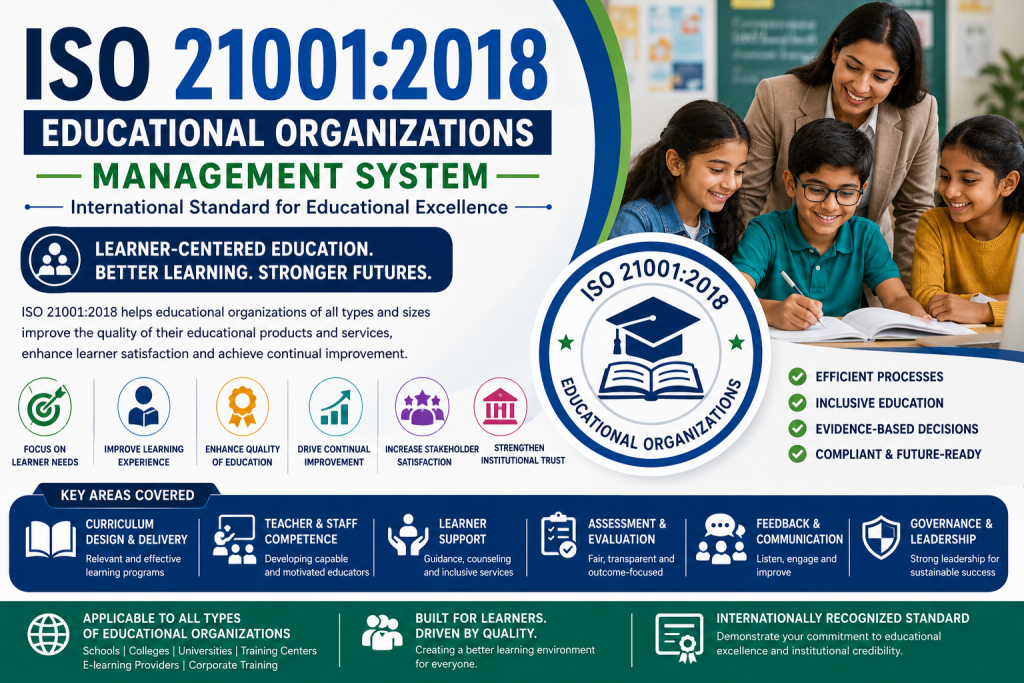
Education is not only about classrooms, teachers, books, online courses, exams, or certificates. A strong educational organization needs a proper system to understand learner needs, design effective learning programs, support teachers, manage resources, monitor performance, improve outcomes, and build trust with learners, parents, regulators, employers, and society. This is where ISO 21001:2018 becomes important. ISO 21001:2018 is an international management system standard created specifically for educational organizations. It helps schools, colleges, universities, training centers, coaching institutes, online learning platforms, and corporate training departments build a structured Educational Organizations Management System, also known as EOMS.
Important Note About ISO 21001:2018
ISO 21001:2018 was the first edition of the standard for educational organizations. It provided requirements with guidance for use and helped institutions improve learner satisfaction, educational processes, and competence development.
However, organizations should be aware that ISO standards may be updated over time. Before applying for certification or starting a formal implementation project, educational institutions should confirm the latest applicable edition with their certification body or standard provider.
This blog focuses on ISO 21001:2018 because it remains widely searched and understood in education management discussions, but institutions planning certification should verify the current version.
What Is ISO 21001:2018?
ISO 21001:2018 is an international standard for Educational Organizations Management Systems. It provides a framework for organizations that deliver education, training, learning, or research-based services.
In simple words, ISO 21001:2018 helps educational organizations manage education quality in a structured way.
It helps answer important questions such as:
- Are learners’ needs clearly understood?
- Are learning programs designed properly?
- Are teachers and trainers competent?
- Are educational resources adequate?
- Are learners supported fairly?
- Are learning outcomes measured?
- Are complaints handled properly?
- Is feedback collected and used?
- Are processes reviewed and improved?
- Is the organization inclusive and learner-centered?
The purpose of ISO 21001:2018 is not only to improve administration. Its main focus is to improve educational service delivery and learner satisfaction.
What Is an Educational Organizations Management System?
An Educational Organizations Management System, or EOMS, is a structured system used by an educational organization to manage its teaching, learning, research, support services, resources, responsibilities, policies, and improvement activities.
An EOMS helps educational institutions deliver learning services consistently and professionally.
It may include:
- Education policy
- Learning objectives
- Curriculum planning
- Admission process
- Teaching and training methods
- Learner support
- Assessment process
- Faculty competence
- Infrastructure management
- Feedback system
- Complaint handling
- Internal audits
- Performance monitoring
- Improvement actions
Without a proper management system, education quality may depend too much on individual teachers or departments. ISO 21001:2018 helps institutions create a repeatable and reliable education management structure.
Why ISO 21001:2018 Is Important
Educational organizations face many challenges today. Learners expect better support, parents want transparency, employers want job-ready skills, regulators demand compliance, and institutions must prove that they deliver meaningful learning outcomes.
ISO 21001:2018 helps educational organizations manage these expectations professionally.
It is important because it helps institutions:
- Improve learner satisfaction
- Improve teaching and learning processes
- Build a learner-centered culture
- Strengthen institutional governance
- Improve transparency and accountability
- Support inclusive and equitable education
- Improve curriculum design and delivery
- Monitor educational outcomes
- Improve staff and faculty competence
- Handle complaints and feedback better
- Build trust with learners, parents, employers, and regulators
- Create a culture of continual improvement
For many educational institutions, ISO 21001 certification can also support credibility, partnerships, tenders, international collaborations, and institutional branding.
ISO 21001:2018 Is Not Only for Schools
Many people think ISO 21001 is only for schools or colleges. That is not correct. ISO 21001:2018 can be applied to many types of educational organizations.
It can be useful for:
- Schools
- Colleges
- Universities
- Coaching institutes
- Vocational training centers
- Skill development organizations
- Online learning platforms
- E-learning companies
- Corporate training departments
- Professional certification bodies
- Research-based educational institutions
- Language training centers
- Distance learning institutions
- Technical training academies
- Non-profit education providers
The standard is flexible and can be applied to educational organizations of different sizes, types, and delivery methods.
Who Should Implement ISO 21001:2018?
ISO 21001:2018 is suitable for any organization that uses a curriculum to support the development of competence through teaching, learning, training, or research.
It is especially useful for organizations that want to:
- Improve education quality
- Increase learner satisfaction
- Build structured academic processes
- Improve institutional credibility
- Strengthen teacher and staff performance
- Improve feedback and complaint systems
- Support inclusive education
- Improve governance and accountability
- Prepare for certification
- Align education services with international standards
However, ISO 21001 is not meant for organizations that only manufacture or sell educational products without actually delivering education or training services.
Main Objective of ISO 21001:2018
The main objective of ISO 21001:2018 is to help educational organizations consistently provide educational products and services that meet learner needs and other beneficiary requirements.
In practical terms, it helps institutions improve:
- Teaching quality
- Learning support
- Curriculum relevance
- Educational planning
- Assessment fairness
- Learner communication
- Staff competence
- Resource management
- Institutional accountability
- Continual improvement
The standard encourages institutions to treat learners not only as customers, but as central participants in the education process.
Key Principles of ISO 21001:2018
1. Learner-Centered Approach
The most important idea behind ISO 21001:2018 is learner-centered education. This means the institution should understand learner needs, learning styles, expectations, challenges, and outcomes.
A learner-centered institution asks:
- What do learners need to achieve?
- Are teaching methods effective?
- Are learners receiving proper support?
- Are learning outcomes measurable?
- Are learners treated fairly?
- Is feedback being used for improvement?
This approach makes education more practical, inclusive, and outcome-focused.
2. Leadership and Governance
Top management plays a major role in ISO 21001. School leaders, principals, directors, department heads, trustees, and management teams must show commitment to educational quality.
Leadership responsibilities include:
- Defining education policy
- Setting objectives
- Providing resources
- Supporting teachers and staff
- Reviewing performance
- Promoting learner satisfaction
- Encouraging continual improvement
Without leadership commitment, ISO 21001 becomes only documentation. With leadership support, it becomes a real improvement system.
3. Inclusive and Equitable Education
ISO 21001 supports inclusive education. This means educational organizations should consider learners with different needs, backgrounds, abilities, learning speeds, languages, and social conditions.
Inclusive education may involve:
- Accessible learning materials
- Special support for learners with disabilities
- Flexible learning methods
- Fair assessment practices
- Equal opportunity policies
- Support for distance learners
- Respect for diversity
- Anti-discrimination practices
The goal is to make education more fair and accessible.
4. Competence Development
Education is successful only when it helps learners develop competence. Competence includes knowledge, skills, behavior, practical ability, and confidence.
ISO 21001 encourages institutions to define learning outcomes clearly and assess whether those outcomes are being achieved.
For example, a technical training institute should not only complete lessons. It should check whether learners can actually perform the required technical tasks.
5. Process-Based Management
ISO 21001 follows a process approach. This means educational activities are managed as connected processes.
Examples of educational processes include:
- Admission
- Curriculum design
- Class scheduling
- Teaching delivery
- Assessment
- Feedback collection
- Certification
- Learner support
- Placement support
- Faculty development
- Complaint handling
When these processes are defined and monitored, the institution becomes more consistent and professional.
6. Evidence-Based Improvement
Educational decisions should not be based only on assumptions. Institutions should use data and evidence.
Useful evidence may include:
- Learner feedback
- Exam results
- Attendance data
- Dropout rates
- Complaint records
- Placement results
- Faculty evaluation
- Internal audit findings
- Parent feedback
- Employer feedback
- Course completion rates
This helps management understand what is working and what needs improvement.
7. Continual Improvement
ISO 21001 encourages educational organizations to improve continuously. Education systems should not remain fixed. They should evolve based on learner needs, technology, industry expectations, feedback, and performance results.
Continual improvement may include:
- Updating curriculum
- Improving teaching methods
- Training teachers
- Improving digital learning systems
- Strengthening learner support
- Improving assessment methods
- Reducing complaints
- Improving communication
- Upgrading infrastructure
Main Clauses of ISO 21001:2018 Explained
ISO 21001 follows the common ISO management system structure. The main auditable clauses are generally from Clause 4 to Clause 10.
Clause 4: Context of the Organization
The educational organization must understand its internal and external environment.
This includes understanding:
- Type of learners
- Parent expectations
- Regulatory requirements
- Industry needs
- Community expectations
- Technology changes
- Institutional goals
- Social and cultural factors
The organization must also define the scope of its EOMS. For example, the scope may cover the full school, a university department, an online training platform, or a specific training service.
Clause 5: Leadership
Leadership must demonstrate commitment to the EOMS. Top management must ensure that education quality is part of the institution’s strategy.
This includes:
- Approving education policy
- Assigning responsibilities
- Promoting learner focus
- Providing resources
- Supporting staff
- Reviewing results
- Encouraging improvement
Leadership should not treat ISO 21001 as only an audit requirement. It should become part of institutional culture.
Clause 6: Planning
Planning focuses on risks, opportunities, objectives, and actions.
Educational organizations should plan for:
- Learner satisfaction
- Teaching quality
- Curriculum improvement
- Resource needs
- Risk management
- Compliance requirements
- Staff competence
- Inclusive learning
- Performance measurement
For example, if an institution has high dropout rates, it should identify causes and plan corrective actions.
Clause 7: Support
Support includes resources, competence, awareness, communication, and documented information.
An educational organization must ensure it has:
- Qualified teachers
- Suitable classrooms
- Learning materials
- Digital platforms
- Laboratories
- Libraries
- Student support services
- Administrative support
- Communication systems
- Controlled documents and records
Teachers and staff must be competent and aware of their responsibilities.
Clause 8: Operation
Clause 8 is where education delivery happens. It covers the planning and control of educational products and services.
This may include:
- Curriculum design
- Course planning
- Admission process
- Teaching delivery
- Assessment
- Learning support
- Communication with learners
- Control of outsourced services
- Certificates and results
- Handling changes in education delivery
The institution must ensure that education services are delivered as planned and monitored properly.
Clause 9: Performance Evaluation
The organization must monitor, measure, analyze, evaluate, audit, and review its EOMS.
Performance indicators may include:
- Learner satisfaction
- Learning outcomes
- Assessment results
- Course completion rate
- Attendance
- Complaint trends
- Faculty performance
- Parent feedback
- Placement results
- Internal audit results
- Objective achievement
This clause helps institutions understand whether their education system is effective.
Clause 10: Improvement
The organization must identify nonconformities, take corrective actions, and improve continually.
Improvement may come from:
- Learner feedback
- Internal audits
- Complaints
- Poor results
- Management reviews
- Teacher suggestions
- Regulatory updates
- Industry feedback
- Technology changes
The goal is to make the educational organization stronger over time.
ISO 21001:2018 Implementation Roadmap
| Phase | Key Action | Expected Output |
|---|---|---|
| Phase 1 | Understand ISO 21001 requirements | Awareness of EOMS framework |
| Phase 2 | Define scope | Clear boundary of certification |
| Phase 3 | Conduct gap analysis | List of missing processes |
| Phase 4 | Create education policy | Management direction |
| Phase 5 | Identify learners and beneficiaries | Stakeholder needs |
| Phase 6 | Define educational objectives | Measurable goals |
| Phase 7 | Document key processes | Controlled system |
| Phase 8 | Train teachers and staff | Competent team |
| Phase 9 | Implement EOMS | Working education system |
| Phase 10 | Monitor performance | Evidence and data |
| Phase 11 | Conduct internal audit | Audit findings |
| Phase 12 | Management review | Leadership evaluation |
| Phase 13 | Certification audit | External assessment |
| Phase 14 | Continual improvement | Better education outcomes |
Documents Commonly Required for ISO 21001:2018
The exact documents depend on the size and type of institution, but common documents include:
- EOMS scope
- Education policy
- Educational objectives
- Organization chart
- Roles and responsibilities
- Curriculum design procedure
- Admission procedure
- Teaching and learning procedure
- Assessment and examination procedure
- Learner support procedure
- Feedback procedure
- Complaint handling procedure
- Internal audit procedure
- Management review records
- Faculty competence records
- Training records
- Learner records
- Attendance records
- Result analysis
- Infrastructure records
- Risk and opportunity register
- Corrective action records
- Communication records
- Continual improvement register
Documentation should be useful and simple. It should support education quality, not create unnecessary paperwork.
ISO 21001:2018 Certification Process
ISO 21001 certification is usually done by an independent certification body. The certification body audits the educational organization’s EOMS and checks whether it meets the requirements of the standard.
Step 1: Management Decision
Top management decides to implement ISO 21001 and provides resources, direction, and commitment.
Step 2: Scope Definition
The institution defines what will be covered under certification. This may include the full institution, selected departments, online programs, training centers, or specific educational services.
Step 3: Gap Analysis
The organization compares its current system with ISO 21001 requirements. This helps identify missing policies, processes, records, controls, and responsibilities.
Step 4: Documentation
The institution prepares or updates required documents such as education policy, objectives, procedures, process maps, feedback forms, audit formats, and management review formats.
Step 5: Implementation
The documented system is applied in real operations. Teachers, staff, administrators, and management must follow the defined processes.
Step 6: Training and Awareness
Faculty and staff are trained on ISO 21001 requirements, learner-centered practices, documentation, feedback, complaint handling, and continual improvement.
Step 7: Internal Audit
Internal audit checks whether the EOMS is implemented properly and whether records are available.
Step 8: Management Review
Top management reviews performance data, audit findings, learner satisfaction, complaints, objectives, risks, and improvement actions.
Step 9: Certification Audit Stage 1
The certification body reviews documentation, scope, readiness, and basic system structure.
Step 10: Certification Audit Stage 2
The auditor checks actual implementation through interviews, records, observations, process reviews, and evidence.
Step 11: Corrective Actions
If nonconformities are found, the institution must correct them and submit evidence.
Step 12: Certificate Issuance
After successful audit closure, the certification body issues the ISO 21001 certificate.
Step 13: Surveillance Audits
Certification is maintained through periodic surveillance audits and continual improvement.
Benefits of ISO 21001:2018 for Educational Organizations
1. Better Learner Satisfaction
ISO 21001 helps institutions understand learner needs and improve learning support.
2. Improved Education Quality
It creates structured processes for curriculum, teaching, assessment, feedback, and improvement.
3. Stronger Institutional Credibility
Certification can improve trust among learners, parents, employers, partners, and regulators.
4. Better Governance
Roles, responsibilities, objectives, and review systems become clearer.
5. Improved Faculty Performance
The standard encourages competence management, training, and performance review.
6. Better Feedback Handling
Institutions can collect, analyze, and act on feedback more effectively.
7. More Inclusive Education
ISO 21001 supports fair access, diversity, and learner support.
8. Better Resource Management
Classrooms, labs, learning platforms, libraries, and support services can be managed more systematically.
9. Continual Improvement Culture
The institution becomes more focused on learning outcomes and regular improvement.
10. Support for Partnerships
ISO 21001 certification can support collaborations, tenders, international partnerships, and institutional reputation.
ISO 21001:2018 vs ISO 9001
ISO 9001 is a general quality management system standard. ISO 21001 is designed specifically for educational organizations.
| Point | ISO 9001 | ISO 21001 |
|---|---|---|
| Main Focus | Quality management | Educational organization management |
| Target Users | Any organization | Schools, colleges, universities, training providers |
| Core Attention | Customer satisfaction | Learner and beneficiary satisfaction |
| Education-Specific Guidance | Limited | Strong |
| Learning Outcomes | Not central | Very important |
| Inclusion and accessibility | General | More education-focused |
Many educational organizations may already use ISO 9001, but ISO 21001 provides more specific guidance for education services.
Practical Examples of ISO 21001:2018 in Action
Example 1: School
A school uses ISO 21001 to improve lesson planning, parent communication, student feedback, teacher training, and assessment transparency.
Example 2: University
A university applies ISO 21001 to improve curriculum review, student services, research support, faculty competence, and learning outcomes.
Example 3: Coaching Institute
A coaching institute uses ISO 21001 to manage admissions, batch planning, study materials, doubt-clearing sessions, test analysis, and student feedback.
Example 4: Online Learning Platform
An e-learning provider uses ISO 21001 to improve course design, learner support, platform reliability, assessment, and course completion rates.
Example 5: Corporate Training Department
A company’s training department uses ISO 21001 to plan employee learning, measure training effectiveness, and align programs with business skills needs.
Common Mistakes During ISO 21001 Implementation
1. Treating ISO 21001 Only as a Certificate
The goal should not be only to pass the audit. The real purpose is to improve educational quality and learner satisfaction.
2. Weak Learner Feedback System
If feedback is collected but not analyzed or acted upon, the system becomes ineffective.
3. Poor Faculty Involvement
Teachers and trainers must be actively involved. ISO 21001 cannot succeed through administration alone.
4. Copy-Paste Documentation
Generic documents may not reflect the real educational process of the institution.
5. No Measurable Objectives
Objectives should be clear and measurable, such as improving learner satisfaction, reducing complaints, or improving course completion rates.
6. Ignoring Inclusive Education
Institutions should consider learners with diverse needs and backgrounds.
7. Weak Internal Audit
Internal audits should check real implementation, not just files.
8. Poor Complaint Handling
Complaints should be recorded, investigated, resolved, and used for improvement.
9. Lack of Management Review
Top management must review performance and support improvement actions.
10. No Continual Improvement
An EOMS should evolve based on data, feedback, and changing educational needs.
ISO 21001:2018 Audit Preparation Checklist
Use this checklist before certification audit:
- Is the EOMS scope clearly defined?
- Is the education policy approved?
- Are educational objectives documented?
- Are learner needs identified?
- Are other beneficiaries identified?
- Are legal and regulatory requirements reviewed?
- Are curriculum processes defined?
- Are teaching processes controlled?
- Are assessment methods documented?
- Are learner support services available?
- Are teachers and staff competent?
- Are training records maintained?
- Is learner feedback collected?
- Are complaints recorded and resolved?
- Are internal audits completed?
- Is management review conducted?
- Are corrective actions tracked?
- Are improvement actions documented?
- Are communication processes defined?
- Are records controlled properly?
Best Practices for Successful ISO 21001 Implementation
Start With Learner Needs
Do not begin only with documents. Understand what learners need, what problems they face, and what outcomes they expect.
Involve Teachers and Staff
Teachers, trainers, administrators, counselors, and support staff should participate in implementation.
Keep Documentation Simple
Documents should be easy to understand and useful for daily education management.
Measure Learning Outcomes
Track whether learners are achieving intended outcomes, not only whether classes are completed.
Strengthen Feedback Systems
Collect feedback from learners, parents, employers, alumni, and staff where relevant.
Improve Faculty Competence
Regular faculty development helps improve teaching quality.
Use Data for Improvement
Use attendance, results, feedback, complaints, and completion rates for decision-making.
Review Curriculum Regularly
Curriculum should be updated based on learner needs, industry changes, and academic goals.
Support Inclusive Learning
Make learning accessible and fair for different types of learners.
Conduct Real Internal Audits
Audits should identify practical gaps and improvement opportunities.
Cost Factors for ISO 21001 Certification
The cost of ISO 21001 certification depends on several factors:
- Size of the institution
- Number of branches or campuses
- Number of learners
- Number of staff
- Scope of certification
- Existing documentation
- Current process maturity
- Certification body fees
- Consultant support
- Training needs
- Internal audit effort
- Corrective action effort
A small training center may need less effort than a large university with multiple departments and campuses.
How Long Does ISO 21001 Implementation Take?
The implementation timeline depends on institutional size, process maturity, documentation readiness, management commitment, and staff involvement.
Important factors include:
- Existing quality system
- Number of courses
- Number of departments
- Number of learners
- Availability of records
- Staff training needs
- Internal audit readiness
- Corrective action requirements
The focus should be on building a useful EOMS, not rushing only for certification.
Frequently Asked Questions
1. What is ISO 21001:2018?
ISO 21001:2018 is an international standard for Educational Organizations Management Systems. It helps educational institutions improve learning services, learner satisfaction, and education quality.
2. What does EOMS mean?
EOMS means Educational Organizations Management System. It is a structured system for managing educational services, learner needs, teaching processes, resources, feedback, and improvement.
3. Who can use ISO 21001?
Schools, colleges, universities, coaching institutes, e-learning providers, training centers, and corporate training departments can use ISO 21001.
4. Is ISO 21001 only for universities?
No. It can be applied to many types of educational organizations, including small training centers and online learning providers.
5. Is ISO 21001 certification mandatory?
In most cases, ISO 21001 certification is voluntary. However, some partnerships, tenders, or institutional requirements may prefer or request certification.
6. Who issues ISO 21001 certificates?
Certificates are issued by independent certification bodies after successful external audits. ISO itself does not issue certificates.
7. What is the difference between ISO 9001 and ISO 21001?
ISO 9001 is a general quality management standard. ISO 21001 is specifically designed for educational organizations and focuses strongly on learners and educational outcomes.
8. What documents are needed for ISO 21001?
Common documents include EOMS scope, education policy, objectives, curriculum procedures, learner feedback records, complaint records, internal audit reports, management review records, and training records.
9. Can an online education platform implement ISO 21001?
Yes. ISO 21001 can apply to online learning providers if they use a curriculum to support competence development through teaching, learning, or training.
10. What is the main benefit of ISO 21001?
The main benefit is a structured system for improving learner satisfaction, education quality, institutional governance, and continual improvement.
Conclusion
ISO 21001:2018 is a valuable management system standard for educational organizations that want to improve learning quality, learner satisfaction, institutional governance, and educational outcomes. It gives schools, colleges, universities, training centers, online learning platforms, and corporate training departments a structured way to manage education services professionally. The standard encourages learner-centered education, inclusive practices, leadership involvement, competent staff, clear processes, measurable objectives, feedback analysis, and continual improvement. The real value of ISO 21001 is not only certification, but the disciplined education culture it creates. When implemented properly, it helps institutions become more transparent, accountable, learner-focused, and trusted.
One challenge that often goes unnoticed is balancing standardization with educational innovation. As institutions formalize processes to meet management system requirements, they must ensure that governance frameworks support new teaching methods and technologies rather than unintentionally slowing educational improvement.