For decades, Human Resources was viewed primarily as an administrative function—the department responsible for payroll, processing paperwork, and managing compliance. However, as the global economy shifted toward an intangible, service-and-technology-driven landscape, organizations realized that their ultimate value driver isn’t their machinery or real estate. It’s their human capital.
But how do you measure, standardize, and optimize “people practices” across different cultures, industries, and countries?
In 2011, the International Organization for Standardization launched ISO/TC 260. This Technical Committee was explicitly created to develop global, evidence-based standards for Human Resource Management (HRM).
This deep dive explores what ISO/TC 260 is, the crucial global standards it has produced, and why it is revolutionizing how organizations attract, develop, and retain talent.
1. What is ISO/TC 260?
ISO/TC 260 is the specific Technical Committee within ISO dedicated to standardization in the field of human resource management.
- The Mission: To create internationally agreed-upon, evidence-based frameworks that improve strategic HR processes, elevate the worker experience, and optimize organizational performance.
- The Structure: The committee brings together HR practitioners, academic experts, and researchers from dozens of countries. The Secretariat of ISO/TC 260 is led by the American National Standards Institute (ANSI), which delegates its operational leadership to the HR Certification Institute (HRCI).
- Alignment with Global Goals: ISO/TC 260 doesn’t operate in a vacuum. Its standards are explicitly designed to align with and support the United Nations Sustainable Development Goals (SDGs), notably SDG 3 (Good Health and Wellbeing), SDG 5 (Gender Equality), and SDG 8 (Decent Work and Economic Growth).
Crucial Guardrail: ISO/TC 260 standards are voluntary guidelines. They are intended to complement, not supplant or undermine, local labor laws, legal obligations, or collective bargaining agreements.
2. The Core Pillars: Key Standards Developed under ISO/TC 260
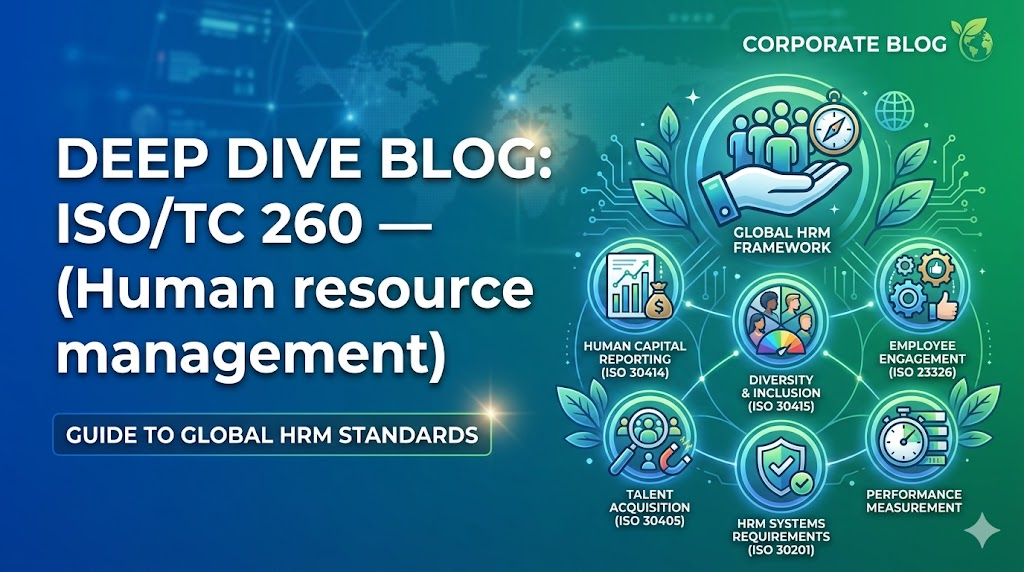
Rather than releasing one massive book of rules, ISO/TC 260 uses the ISO 30400 series to target distinct facets of the employee lifecycle and corporate human governance. Let’s break down the most influential standards published by the committee.
A. Human Capital Reporting: ISO 30414
Historically, finance teams viewed employees strictly as an expense line on an income statement. ISO 30414 completely flips this paradigm by providing clear guidelines for both internal and external human capital reporting.
- It establishes standardized metrics for tracking workforce costs, turnover, productivity, leadership effectiveness, and health and safety.
- This standard gained massive traction globally after regulatory shifts (like the U.S. SEC mandating human capital disclosures) forced publicly traded companies to prove how they manage their workforce.
B. Diversity and Inclusion (D&I): ISO 30415
Diversity and Inclusion programs can easily devolve into superficial PR exercises. ISO 30415:2021 provides a highly structural, continuous-improvement framework for embedding D&I into an organization’s DNA.
- It details specific responsibilities, accountabilities, and actions required throughout the lifecycle—from unbiased recruitment and equitable allocation of work to fair compensation practices.
C. Employee Engagement: ISO 23326
Employee engagement directly correlates with productivity and retention. ISO 23326:2022 offers guidance on building an organizational culture aligned with shared purpose and values.
- It outlines actionable steps for managers to foster clear, two-way internal communication, capture worker feedback cyclically, and create opportunities for professional fulfillment.
D. Talent Acquisition and Metrics: ISO 30405 & ISO/TS 30430
Recruitment is often plagued by localized, proprietary, and unstandardized data formats, making it hard to benchmark hiring efficiency. ISO 30405 establishes global guidelines on recruitment, while its accompanying Technical Specifications (ISO/TS 30430) standardize critical performance indicators like:
- Cost-per-hire
- Impact-of-hire
- Quality-of-hire
3. The Future: Moving to a Management Systems Standard (ISO 30201)
The work of ISO/TC 260 is rapidly evolving. Historically, the committee focused primarily on “Guidelines” (documents offering advice). However, a massive shift is underway: the development of ISO 30201 (Human Resource Management System — Requirements).
Current Approach: ISO Guidelines (Advice & Best Practices)
                          │
                          ▼
Future Approach: ISO 30201 Management Systems Standard (Certifiable Requirements)
Similar to how ISO 9001 revolutionized Quality Management, ISO 30201 will establish a formal framework of requirements for a sustainable HRM system. Once finalized, organizations will be able to seek formal, third-party certification for their HR management systems, sending a powerful signal to investors, clients, and prospective talent that their people management is elite.
4. Why Should Your Organization Adopt ISO/TC 260 Standards?
Adopting international standards for human resources might seem daunting, but it delivers massive strategic value:
📊 Breaking the Data Silos
One of the greatest challenges in HR analytics is that different software vendors use proprietary data architectures, making interfirm benchmarking impossible. By adopting ISO/TC 260’s metrics clusters, organizations can cleanly analyze internal statistics and confidently compare their performance against global industry baselines.
💸 Attracting Institutional Investment
Modern institutional investors weigh ESG (Environmental, Social, and Governance) factors heavily. The “S” (Social) in ESG heavily scrutinizes how a company treats its workforce. Implementing standards like ISO 30414 gives investors a transparent, verified, and risk-assessed look into your human capital investments.
🌍 Facilitating Mergers, Acquisitions, and Globalization
When companies merge globally, integrating distinct corporate cultures and HR workflows is historically chaotic. ISO/TC 260 provides a universal language. If a firm in Germany and a firm in Japan both align their HR systems with ISO frameworks, integrating talent structures becomes drastically smoother.
Final Thoughts: People are an Asset, Not an Expense
The standardization of Human Resource Management marks a paradigm shift in business history. Through the meticulous, consensus-driven work of ISO/TC 260, HR is finally moving past the era of “gut-feeling” management into a mature, evidence-based science.
By adopting these global frameworks, organizations don’t just protect themselves against operational risks—they actively unlock the maximum potential of their greatest value creators: their people.