Introduction
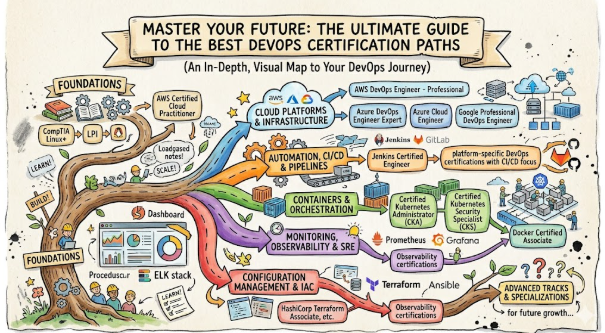
The rapid evolution of modern infrastructure has turned software delivery into a high-stakes discipline. As organizations transition toward cloud-native architectures, the demand for professionals who can bridge the gap between development, operations, security, and data science has skyrocketed. Navigating this landscape can feel overwhelming, but a structured approach—anchored by the Best DevOps Certification—provides the roadmap needed to validate your expertise and accelerate your career trajectory.
What is a DevOps Certification?
A professional certification serves as a structured validation of your technical proficiency and operational knowledge within the DevOps ecosystem. It is more than just a credential; it is a comprehensive framework that forces you to master essential tools, methodologies, and cultural practices. By pursuing a recognized certification, you gain access to a curated learning path that moves beyond theoretical knowledge, emphasizing hands-on practice, automated workflows, and standardized industry best practices.
Why DevOps Certifications Matter
Certifications provide a standardized baseline that employers look for when vetting talent for mission-critical roles. They validate your ability to manage complex cloud environments, implement robust security protocols, and maintain high-availability systems.
The Step-by-Step Value Process:
- Skill Gap Identification: Assess your current knowledge against industry requirements.
- Structured Learning: Engage with a defined syllabus that ensures no critical topic is left uncovered.
- Credential Validation: Earn a globally recognized mark of competence that distinguishes your resume.
- Career Transition: Leverage the certification to pivot into high-demand roles like SRE, DevSecOps, or MLOps.
- Continuous Improvement: Adopt a mindset of lifelong learning essential for keeping pace with AI and automation tools.
Who Should Take DevOps Certifications
These certifications are designed for professionals who are ready to transition from manual tasks to automated, scalable workflows. They are ideal for:
- Software Engineers aiming to master infrastructure-as-code.
- System Administrators looking to move into cloud and site reliability engineering.
- QA Engineers transitioning into automated testing and deployment.
- Data Engineers interested in MLOps and AI-driven infrastructure.
- IT Managers wanting to lead high-performing, agile engineering teams.
Core Skills Covered
A comprehensive certification program covers the entire lifecycle of software delivery. Key skills include:
- Infrastructure as Code (IaC): Automating environment provisioning using tools like Terraform.
- Containerization & Orchestration: Managing microservices at scale using Docker and Kubernetes.
- CI/CD Pipeline Design: Building automated testing and deployment workflows.
- Observability: Implementing monitoring and logging to ensure system health.
- Cloud Security (DevSecOps): Integrating security checks into the software development lifecycle.
- GitOps: Utilizing Git as the single source of truth for infrastructure and application states.
Table 1: Best DevOps Certifications
| Certification Name | Best For | Skill Level | Career Direction |
| AWS Certified DevOps Engineer | Cloud Infrastructure | Advanced | Cloud Architect |
| Certified Kubernetes Administrator | Container Orchestration | Intermediate | Kubernetes Specialist |
| Google Professional Cloud DevOps | GCP Ecosystem | Advanced | Site Reliability Engineer |
| HashiCorp Terraform Associate | IaC Automation | Beginner | DevOps Engineer |
| Certified Jenkins Engineer | CI/CD Mastery | Intermediate | Build & Release Engineer |
| Microsoft Certified: DevOps Expert | Azure Integration | Advanced | Azure DevOps Specialist |
| Docker Certified Associate | Containerization | Beginner | Cloud Engineer |
| Certified GitOps Associate | Infrastructure GitOps | Intermediate | Platform Engineer |
| Certified DevSecOps Professional | Pipeline Security | Advanced | DevSecOps Engineer |
| Certified MLOps Engineer | AI/ML Pipelines | Advanced | MLOps Specialist |
| Certified AIOps Engineer | AI Operations | Advanced | AIOps Architect |
| Certified SRE Foundation | System Reliability | Intermediate | SRE Professional |
| Ansible Automation Certification | Configuration Mgmt | Beginner | Automation Engineer |
| Prometheus & Grafana Pro | Observability | Intermediate | Observability Engineer |
| Certified FinOps Practitioner | Cloud Cost Mgmt | Intermediate | FinOps Lead |
| Certified DataOps Engineer | Data Pipelines | Advanced | DataOps Engineer |
| Certified Kubernetes Security | Cluster Security | Advanced | Security Specialist |
| Certified Helm Practitioner | K8s Package Mgmt | Beginner | Platform Engineer |
| Istio Service Mesh Expert | Service Networking | Advanced | Platform Architect |
| Certified Python for DevOps | Scripting/Automation | Beginner | DevOps Developer |
Certification Deep Dive: What to Expect
When embarking on a certification journey, understanding the practical application is vital.
- Real-World Use Case: Automatically scaling an e-commerce platform during high-traffic events using Kubernetes and Terraform to ensure 99.99% uptime.
- Skills You Will Learn: Proficiency in IaC, container orchestration, automated monitoring, and security integration.
- Career Scope: High-growth potential in cloud-native industries, ranging from startups to multinational corporations.
- Difficulty Level: Ranges from entry-level (scripting/tools) to expert-level (architecting entire ecosystems).
- Best Career Fit: Professionals aiming for roles that require high autonomy and technical depth in automation.
- Who Should Take It: Anyone currently working in technical operations or software development looking to modernize their skill set.
- Hands-On Projects: Building a full-stack CI/CD pipeline, deploying a multi-node Kubernetes cluster, and implementing automated security vulnerability scanning.
DevOps Certification Roadmap
| Career Goal | Recommended Path | Why It Fits |
| Cloud DevOps Engineer | AWS/Azure + Terraform | Focuses on cloud scale and automation. |
| SRE Professional | SRE Foundation + Observability | Prioritizes reliability and system health. |
| DevSecOps Engineer | DevSecOps Pro + K8s Security | Embeds security into the development flow. |
| MLOps Specialist | MLOps + DataOps | Bridges the gap between ML models and production. |
Types of DevOps Certifications
- Vendor-Specific: Focus on cloud-native platforms like AWS, Azure, or GCP. These are essential for mastering specific ecosystem tools.
- Tool-Specific: Target mastery of foundational tools like Docker, Kubernetes, or Terraform. These provide deep technical specialization.
- Methodology-Based: Certifications like SRE or DevSecOps focus on the cultural and operational frameworks needed to run modern systems.
Common Mistakes to Avoid
- Ignoring Hands-on Practice: Certification is useless without applying concepts in a lab environment.
- Over-relying on Brain Dumps: Relying on memorized answers rather than understanding the underlying architecture will hinder your performance in real interviews.
- Focusing on Too Many Tools: Don’t try to learn every tool; master the core pillars first, then expand.
- Neglecting Fundamentals: Skipping Linux, networking, or basic scripting makes advanced cloud engineering much harder.
Real-Life Examples
- A system admin uses a Kubernetes certification to migrate legacy monolithic applications to a microservices architecture, reducing deployment time by 70%.
- A software engineer pivots to a DevSecOps role after earning a security certification, enabling the team to catch vulnerabilities before code reaches production.
- A QA lead gains MLOps certification to automate the testing and deployment of AI models for a pharmaceutical supply chain company.
- An IT manager achieves an SRE certification to introduce Error Budgets and SLOs, drastically improving system reliability for an algorithmic trading platform.
- A cloud engineer uses an IaC certification to replace manual server configurations with Terraform, ensuring consistent environments across development and production.
FAQs
- Which certification is best for beginners?
Start with a foundational tool certification like Docker or a basic cloud certification to gain confidence. - How long does it take to get certified?
Depending on your prior experience, it typically takes 2 to 4 months of dedicated study and practice. - Do I need a degree to be a DevOps Engineer?
No, certifications and proven hands-on project experience are often more valuable to employers. - Are these certifications valid for my career in India?
Yes, these are globally recognized and highly valued by companies in India and international markets. - Should I choose vendor-specific or tool-specific?
Ideally, a mix. Use tool-specific for depth and vendor-specific for platform-wide knowledge. - Can I become a DevOps engineer without a certification?
While possible, certifications provide a structured path that significantly reduces the time required to reach a professional level. - What if I fail the exam?
Don’t be discouraged; use the exam report to identify your weak areas and re-evaluate your study approach. - Do I need to know programming?
Yes, a basic understanding of Python or Go is highly recommended for automation. - How do I practice for these?
Use cloud free tiers, local virtual machines, and GitHub projects to build your hands-on labs. - How often should I update my certifications?
Technology evolves rapidly; aim to refresh your skills or pursue advanced levels every 1–2 years.
Conclusion
Choosing the right certification is the essential catalyst for transforming your technical trajectory, serving as both a structured roadmap and a formal validation of your expertise in an increasingly complex cloud-native landscape. Success in this field is not merely about passing an exam; it is about adopting a disciplined, step-by-step approach that balances theoretical knowledge with intensive, hands-on practice in automation, security, and observability. By aligning your chosen path with specific career goals—whether in SRE, DevSecOps, or MLOps—and consistently applying these skills to solve real-world architectural challenges, you distinguish yourself as a high-impact professional capable of navigating the demands of modern infrastructure. We encourage you to move beyond passive
One thing that could be added is how to choose certifications based on current market demand. Not all certifications give equal value