Introduction
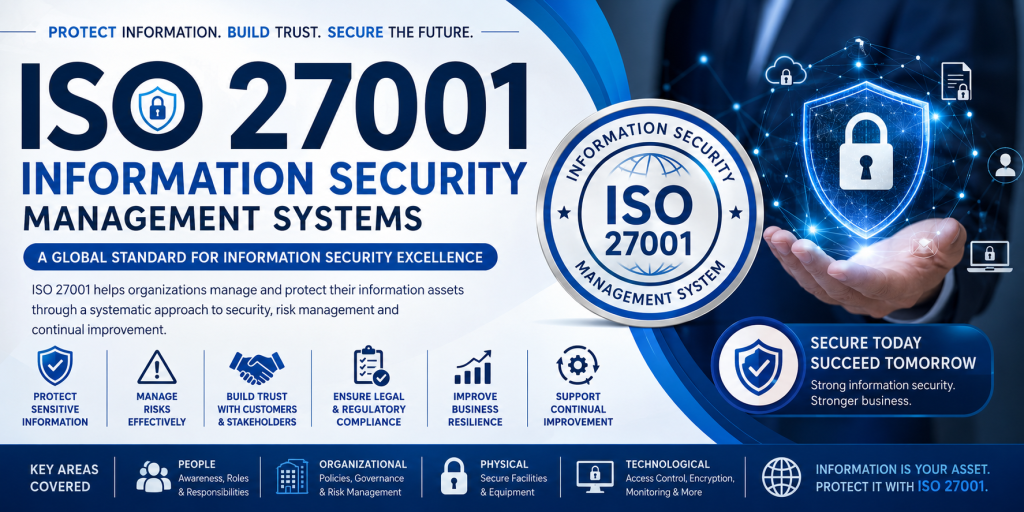
In today’s digital business environment, information is one of the most valuable assets an organization owns. Customer data, employee records, financial details, business strategies, intellectual property, contracts, passwords, cloud systems, payment information, and internal communication all need strong protection. A single data breach, cyberattack, insider mistake, or weak access control can damage reputation, disrupt operations, create legal problems, and reduce customer trust. This is why ISO 27001 has become one of the most important international standards for organizations that want to manage information security professionally. ISO 27001 helps businesses build a structured Information Security Management System, also known as an ISMS, to identify risks, protect information, respond to incidents, and improve security continuously.
What Is ISO 27001?
ISO 27001, formally known as ISO/IEC 27001, is an international standard for Information Security Management Systems. It provides requirements for establishing, implementing, maintaining, and continually improving an ISMS.
In simple words, ISO 27001 helps an organization answer important security questions:
- What information assets do we have?
- What risks can affect those assets?
- Who has access to sensitive information?
- How do we protect customer and business data?
- What should we do if a security incident occurs?
- Are our employees trained in information security?
- Are our suppliers and cloud providers secure enough?
- Are we improving our security controls over time?
ISO 27001 is not only about IT systems. It covers people, processes, technology, physical security, supplier relationships, business continuity, legal compliance, and management responsibility.
What Is an ISMS?
An ISMS stands for Information Security Management System. It is a structured framework of policies, procedures, controls, responsibilities, records, and improvement activities used to protect information.
An ISMS helps protect three key security principles:
1. Confidentiality
Confidentiality means information is accessible only to authorized people. For example, customer data should not be visible to employees who do not need it for their job.
2. Integrity
Integrity means information remains accurate, complete, and protected from unauthorized modification. For example, financial records should not be changed without approval.
3. Availability
Availability means information and systems are accessible when needed. For example, business applications should remain available for employees and customers during normal operations.
These three principles are often called the CIA triad: Confidentiality, Integrity, and Availability.
Why ISO 27001 Is Important
ISO 27001 is important because information security cannot depend only on antivirus software, firewalls, or passwords. Technology is important, but security also needs governance, risk assessment, policies, training, monitoring, supplier control, incident response, and continuous improvement.
Organizations need ISO 27001 because modern businesses face risks such as:
- Phishing attacks
- Ransomware
- Data breaches
- Insider misuse
- Weak passwords
- Cloud misconfiguration
- Unauthorized access
- Lost laptops or mobile devices
- Poor backup practices
- Supplier security failures
- Human error
- Lack of incident response planning
ISO 27001 helps businesses manage these risks in a structured way instead of reacting only after damage occurs.
Who Needs ISO 27001?
ISO 27001 is useful for any organization that handles sensitive, confidential, personal, financial, technical, or business-critical information.
It is especially useful for:
- IT companies
- SaaS companies
- Cloud service providers
- FinTech companies
- Healthcare organizations
- Banks and financial institutions
- BPO and KPO companies
- E-commerce businesses
- Educational institutions
- Government contractors
- Manufacturing companies
- Consulting firms
- Legal firms
- HR and payroll companies
- Data centers
- Cybersecurity service providers
- Startups handling customer data
- Enterprises with multiple systems and locations
Even small businesses can benefit from ISO 27001 if they store customer data, process payments, use cloud tools, or work with enterprise clients.
ISO 27001 Is Not Only for IT Teams
A common misunderstanding is that ISO 27001 is only an IT department standard. In reality, ISO 27001 is a business-level security management system.
It involves:
- Top management
- IT team
- HR team
- Legal team
- Finance team
- Operations team
- Procurement team
- Facility team
- Sales team
- Customer support team
- Vendors and suppliers
- Employees and contractors
For example, HR manages employee onboarding and exit processes. Procurement manages supplier contracts. Facility teams manage physical access. Legal teams manage compliance obligations. IT teams manage systems and technical controls. Management provides leadership and resources.
This means ISO 27001 works best when the whole organization participates.
Main Objectives of ISO 27001
The main objective of ISO 27001 is to protect information through a risk-based management system.
Key objectives include:
- Protect sensitive business information
- Reduce cybersecurity and data breach risks
- Improve customer and stakeholder trust
- Build a formal information security governance system
- Define clear security roles and responsibilities
- Improve legal, regulatory, and contractual compliance
- Manage supplier and third-party security risks
- Improve incident detection and response
- Support business continuity and resilience
- Create a culture of security awareness
- Continuously improve information security performance
The focus is not only on installing security tools. The focus is building a complete management system that works in real business conditions.
Key Benefits of ISO 27001 Certification
1. Stronger Data Protection
ISO 27001 helps organizations identify sensitive information and apply suitable controls to protect it.
2. Better Customer Trust
Many customers prefer working with companies that follow recognized security standards. ISO 27001 certification can show that the organization takes information security seriously.
3. Improved Risk Management
The standard requires organizations to identify risks, assess them, treat them, and monitor them regularly.
4. Competitive Advantage
For IT, SaaS, cloud, BPO, and consulting companies, ISO 27001 certification can support sales, tenders, vendor onboarding, and enterprise client trust.
5. Better Internal Discipline
ISO 27001 improves documentation, access control, employee awareness, incident reporting, backup practices, and supplier management.
6. Legal and Regulatory Support
ISO 27001 can support compliance efforts by helping organizations manage information security obligations in a structured way.
7. Improved Incident Response
The organization becomes better prepared to identify, report, investigate, and respond to information security incidents.
8. Continual Improvement
ISO 27001 requires regular review, audits, corrective actions, and improvements.
ISO 27001 and Risk-Based Thinking
ISO 27001 is based strongly on risk management. This means organizations do not apply controls randomly. They first identify what needs protection, what threats exist, what weaknesses are present, and what impact a security failure may create.
A basic information security risk process includes:
- Identify information assets
- Identify threats and vulnerabilities
- Assess likelihood and impact
- Decide risk level
- Select suitable controls
- Create a risk treatment plan
- Monitor and review risks
- Improve controls when required
For example, a company storing customer payment data may identify risks related to unauthorized access, weak encryption, insecure APIs, or poor logging. Based on risk level, the company may implement access control, encryption, monitoring, secure development practices, and incident response procedures.
Main Clauses of ISO 27001 Explained
ISO 27001 follows a management system structure. The main clauses are designed to help organizations plan, implement, review, and improve their ISMS.
Clause 4: Context of the Organization
The organization must understand internal and external issues that affect information security. It must also understand the needs of interested parties such as customers, regulators, employees, suppliers, and business partners.
This clause helps define the scope of the ISMS.
Clause 5: Leadership
Top management must show leadership and commitment. They must approve the information security policy, assign responsibilities, provide resources, and support the ISMS.
Security cannot succeed if leadership treats it as only a technical matter.
Clause 6: Planning
The organization must identify risks and opportunities, define information security objectives, and plan how to manage risks.
This includes risk assessment and risk treatment planning.
Clause 7: Support
This clause covers resources, competence, awareness, communication, and documented information.
Employees must be trained and aware of their security responsibilities.
Clause 8: Operation
The organization must implement planned security processes, perform risk assessments, and apply risk treatment actions.
This is where policies and plans become real controls.
Clause 9: Performance Evaluation
The organization must monitor, measure, analyze, audit, and review the ISMS.
This includes internal audits and management reviews.
Clause 10: Improvement
The organization must handle nonconformities, corrective actions, and continual improvement.
The goal is to make the ISMS stronger over time.
ISO 27001 Annex A Controls
Annex A is a reference set of information security controls used for risk treatment. In ISO 27001:2022, Annex A controls are grouped into four broad themes:
| Control Theme | Meaning | Examples |
|---|---|---|
| Organizational Controls | Governance, policies, supplier control, incident management, legal requirements | Information security policy, risk management, supplier security, incident response |
| People Controls | Employee and contractor-related security | Awareness training, confidentiality agreements, remote work rules |
| Physical Controls | Protection of physical locations and equipment | Access cards, CCTV, secure offices, equipment protection |
| Technological Controls | Technical security controls for systems and data | Access control, encryption, backups, logging, malware protection |
Organizations do not blindly apply every control in the same way. They choose controls based on risk assessment, business needs, legal requirements, and the Statement of Applicability.
What Is a Statement of Applicability?
The Statement of Applicability, often called SoA, is one of the most important ISO 27001 documents. It explains which Annex A controls are applicable to the organization, which are not applicable, and why.
The SoA usually includes:
- List of controls
- Applicability status
- Justification for inclusion or exclusion
- Current implementation status
- Reference to related policies or procedures
For example, if a company does not operate a physical data center, some physical infrastructure controls may be limited or managed through cloud provider agreements. However, the company must explain its reasoning clearly.
A weak SoA can create audit problems because auditors use it to understand how the organization selected and implemented controls.
ISO 27001 Certification Process
ISO 27001 certification is usually issued by an independent certification body after a successful external audit. ISO itself develops standards but does not certify organizations directly.
The certification process usually follows these steps:
Step 1: Management Decision
Top management decides to implement ISO 27001 and provides support, budget, resources, and direction.
Step 2: Define ISMS Scope
The organization defines what part of the business will be covered. The scope may include the full company, a department, a product, a data center, a SaaS platform, or a specific location.
A clear scope is very important because the audit will be based on it.
Step 3: Conduct Gap Analysis
The company compares its current security practices with ISO 27001 requirements. This helps identify missing policies, weak controls, incomplete records, and process gaps.
Step 4: Identify Assets
The organization identifies important information assets such as databases, applications, servers, laptops, documents, cloud services, networks, intellectual property, and customer records.
Step 5: Perform Risk Assessment
Risks are identified and evaluated based on likelihood and impact.
Step 6: Create Risk Treatment Plan
The organization decides how to handle each risk. It may reduce, avoid, transfer, or accept the risk.
Step 7: Prepare Policies and Procedures
Required documents are created or updated. These may include access control policy, information security policy, incident management procedure, backup policy, asset management procedure, supplier security procedure, and acceptable use policy.
Step 8: Implement Controls
Controls are applied in real operations. This may include MFA, encryption, monitoring, backup testing, access reviews, staff training, vendor checks, physical access controls, and secure development practices.
Step 9: Conduct Awareness Training
Employees and contractors must understand their security responsibilities. Training should be practical and role-based.
Step 10: Internal Audit
An internal audit checks whether the ISMS meets ISO 27001 requirements and whether processes are actually followed.
Step 11: Management Review
Top management reviews ISMS performance, audit findings, risks, incidents, objectives, resources, and improvement needs.
Step 12: Certification Audit
The certification body performs external audits. Stage 1 usually checks documentation and readiness. Stage 2 checks implementation and evidence.
Step 13: Corrective Actions
If nonconformities are found, the organization must fix them and provide evidence.
Step 14: Certification and Surveillance
After successful audit closure, certification is issued. Surveillance audits are then conducted periodically to ensure the ISMS remains effective.
Documents Commonly Required for ISO 27001
ISO 27001 does not mean creating unnecessary paperwork. However, the organization must maintain enough documented information to prove that the ISMS is planned, implemented, monitored, and improved.
Common ISO 27001 documents include:
- ISMS scope
- Information security policy
- Risk assessment methodology
- Risk assessment report
- Risk treatment plan
- Statement of Applicability
- Information security objectives
- Asset inventory
- Access control policy
- Acceptable use policy
- Password or authentication policy
- Incident management procedure
- Backup policy
- Supplier security procedure
- Business continuity or ICT continuity procedure
- Internal audit procedure
- Management review records
- Corrective action records
- Training and awareness records
- Legal and regulatory requirement register
- Change management records
- Access review records
- Security incident records
The exact documentation depends on organization size, risks, scope, and certification body expectations.
ISO 27001 Implementation Roadmap
| Phase | Key Action | Expected Output |
|---|---|---|
| Phase 1 | Understand business and security needs | Clear reason for ISMS |
| Phase 2 | Define ISMS scope | Approved scope statement |
| Phase 3 | Perform gap analysis | List of missing areas |
| Phase 4 | Identify assets | Asset inventory |
| Phase 5 | Assess risks | Risk register |
| Phase 6 | Plan risk treatment | Risk treatment plan |
| Phase 7 | Select controls | Statement of Applicability |
| Phase 8 | Create policies and procedures | ISMS documentation |
| Phase 9 | Implement controls | Working security system |
| Phase 10 | Train employees | Security-aware workforce |
| Phase 11 | Conduct internal audit | Audit findings |
| Phase 12 | Management review | Leadership evaluation |
| Phase 13 | Certification audit | External assessment |
| Phase 14 | Improve continuously | Stronger ISMS |
Practical Examples of ISO 27001 Controls
Example 1: Access Control
An organization limits access to customer data based on job roles. Employees get access only to systems they need. Access is reviewed regularly.
Example 2: Multi-Factor Authentication
A SaaS company enables MFA for admin accounts, cloud platforms, email systems, and remote access tools.
Example 3: Backup and Recovery
A business creates regular backups and tests restoration to ensure data can be recovered after ransomware or system failure.
Example 4: Supplier Security
A company reviews cloud providers, payment gateways, and IT vendors before sharing sensitive information.
Example 5: Incident Response
An organization creates a process for reporting, investigating, escalating, and learning from security incidents.
Example 6: Employee Exit Control
When an employee leaves, HR and IT coordinate to remove system access, collect company devices, and protect confidential information.
Example 7: Security Awareness
Employees receive training on phishing, password safety, data handling, remote work, and incident reporting.
ISO 27001 for Small Businesses
Small businesses often think ISO 27001 is only for large enterprises. This is not true. Small businesses can implement ISO 27001 in a practical and proportionate way.
For a small business, ISO 27001 may focus on:
- Customer data protection
- Cloud account security
- Password and MFA rules
- Employee awareness
- Device security
- Backup process
- Access control
- Supplier management
- Incident reporting
- Basic business continuity
The system does not need to be overly complex. It should match the size, risks, and operations of the business.
ISO 27001 for IT and SaaS Companies
IT and SaaS companies often pursue ISO 27001 because enterprise customers want assurance that their data is protected.
Important focus areas include:
- Application security
- Cloud security
- Secure software development
- Access control
- Logging and monitoring
- Vulnerability management
- Incident response
- Customer data segregation
- Backup and recovery
- Supplier and hosting provider security
- Change management
- Business continuity
- Privacy-related controls
For SaaS businesses, ISO 27001 can support customer onboarding, vendor security questionnaires, enterprise contracts, and international business credibility.
ISO 27001 and Data Privacy
ISO 27001 is an information security standard, not a complete privacy law. However, it can support privacy protection because strong security controls help protect personal data.
Privacy-focused organizations may also consider related privacy standards, legal requirements, or data protection frameworks depending on their country and customer base.
Important privacy-related controls may include:
- Access control
- Encryption
- Data classification
- Data retention
- Secure deletion
- Incident response
- Supplier agreements
- Logging and monitoring
- Confidentiality agreements
- Awareness training
A company should not assume ISO 27001 automatically means full privacy compliance. It should separately identify applicable privacy laws and obligations.
ISO 27001 and Cybersecurity
ISO 27001 and cybersecurity are closely connected. Cybersecurity focuses on protecting systems, networks, applications, and data from digital threats. ISO 27001 provides the management system to govern, control, monitor, and improve those security efforts.
Cybersecurity tools may include:
- Firewalls
- Endpoint protection
- Security monitoring
- Vulnerability scanning
- Patch management
- Encryption
- Identity management
- Email security
- Backup systems
- SIEM tools
ISO 27001 ensures these tools are connected to policies, risks, responsibilities, audits, training, and continual improvement.
Common Mistakes During ISO 27001 Implementation
1. Treating ISO 27001 Only as a Certificate
Some organizations focus only on passing the audit. This creates a paper-based system with weak real security.
2. Defining Scope Too Narrowly
A very narrow scope may reduce effort, but it can confuse customers if critical systems are excluded.
3. Weak Risk Assessment
Risk assessment should be realistic and business-specific. Copy-paste risk registers do not reflect actual threats.
4. Poor Asset Inventory
If the organization does not know its assets, it cannot protect them properly.
5. Ignoring Human Risk
Employees are often involved in security incidents through phishing, mistakes, weak passwords, or poor data handling.
6. Lack of Top Management Support
Without leadership support, security initiatives may not receive resources or attention.
7. Overcomplicated Documentation
Policies should be clear, practical, and usable. Long documents that employees never read are not effective.
8. No Evidence of Implementation
Auditors need evidence. A policy alone is not enough. Records, screenshots, logs, reviews, tickets, and training evidence may be needed.
9. Ignoring Suppliers
Third-party vendors can create major security risks. Supplier security must be reviewed and monitored.
10. Not Improving After Incidents
Every incident should lead to learning and corrective action.
ISO 27001 Audit Preparation Checklist
Use this checklist before certification audit:
- Is the ISMS scope clearly defined?
- Is the information security policy approved?
- Are roles and responsibilities assigned?
- Is asset inventory maintained?
- Is risk assessment completed?
- Is risk treatment planned?
- Is the Statement of Applicability prepared?
- Are Annex A controls reviewed?
- Are employees trained?
- Are access rights reviewed?
- Are supplier risks assessed?
- Are incidents recorded and investigated?
- Are backups tested?
- Are security objectives defined?
- Are internal audits completed?
- Is management review completed?
- Are corrective actions tracked?
- Are legal and contractual requirements identified?
- Are documents controlled?
- Is evidence available for implemented controls?
Best Practices for Successful ISO 27001 Implementation
Start With Business Risks
Do not begin only with templates. Understand what information matters most to the business.
Keep Scope Clear
Define the scope carefully so employees, customers, and auditors understand what is covered.
Involve All Departments
Information security is not only IT. Include HR, legal, procurement, operations, finance, and management.
Use Practical Policies
Policies should be simple enough for employees to understand and follow.
Train Employees Regularly
Awareness training should cover phishing, password safety, data handling, remote work, reporting incidents, and acceptable use.
Review Access Frequently
Access rights should match job roles and be removed when no longer needed.
Test Backups
Backup is useful only if recovery works. Regular restoration testing is important.
Monitor Suppliers
Supplier security should be checked before onboarding and reviewed periodically.
Track Corrective Actions
Audit findings, incidents, and weaknesses should be corrected with evidence.
Improve Continuously
ISO 27001 should become part of regular business management, not a one-time project.
ISO 27001 Certification Cost Factors
The cost of ISO 27001 certification varies depending on many factors:
- Organization size
- Number of employees
- Number of locations
- Scope of certification
- Complexity of IT systems
- Type of business
- Current security maturity
- Documentation readiness
- Consultant involvement
- Certification body fees
- Internal team effort
- Training needs
- Tooling requirements
A small company with simple cloud systems may need less effort than a large enterprise with multiple locations, legacy systems, and complex supplier relationships.
The cheapest option is not always the best. A poor implementation may pass paperwork temporarily but fail to improve real security.
Real-Life Scenarios
Scenario 1: SaaS Startup
A SaaS startup wants to sell to enterprise customers. Clients ask for ISO 27001 certification before signing contracts. The company implements access control, cloud security, incident response, secure development, supplier review, and internal audits.
Scenario 2: BPO Company
A BPO handles customer records for international clients. ISO 27001 helps the company strengthen data handling, employee background checks, access restrictions, workstation security, and incident reporting.
Scenario 3: Healthcare Organization
A healthcare provider stores sensitive patient data. ISO 27001 helps protect medical records through access control, encryption, backups, staff awareness, and supplier security.
Scenario 4: E-Commerce Business
An e-commerce company processes customer details, order records, and payment-related data. ISO 27001 helps improve system security, vendor controls, incident response, and data protection practices.
Scenario 5: Consulting Firm
A consulting company handles confidential client documents. ISO 27001 helps control document access, secure email usage, device security, cloud storage, and employee confidentiality.
Frequently Asked Questions
1. What is ISO 27001?
ISO 27001 is an international standard for Information Security Management Systems. It helps organizations protect information through risk management, policies, controls, monitoring, audits, and continual improvement.
2. What is an ISMS?
An ISMS is an Information Security Management System. It is a structured system used to manage and protect information assets.
3. Is ISO 27001 only for IT companies?
No. ISO 27001 can be used by any organization that handles important information, including healthcare, finance, education, manufacturing, consulting, e-commerce, and government-related businesses.
4. Is ISO 27001 certification mandatory?
In most cases, ISO 27001 certification is voluntary. However, some clients, contracts, tenders, or industries may require it.
5. Who issues ISO 27001 certificates?
Certificates are issued by independent certification bodies after successful external audits.
6. What is Annex A in ISO 27001?
Annex A is a set of information security controls used to treat risks. The controls cover organizational, people, physical, and technological areas.
7. What is a Statement of Applicability?
A Statement of Applicability explains which controls are applicable to the organization, which are excluded, and why.
8. How long does ISO 27001 implementation take?
The timeline depends on organization size, scope, complexity, existing security maturity, and resource availability.
9. Does ISO 27001 prevent all cyberattacks?
No standard can guarantee zero cyberattacks. ISO 27001 helps reduce risks, improve controls, and strengthen response capability.
10. Can small businesses implement ISO 27001?
Yes. Small businesses can implement ISO 27001 in a simple and practical way based on their risks and business needs.
Conclusion
ISO 27001 is one of the most trusted standards for managing information security. It helps organizations protect sensitive data, reduce cybersecurity risks, improve customer confidence, and build a structured Information Security Management System. The real value of ISO 27001 is not only the certificate but the discipline it brings into daily operations. A strong ISMS connects leadership, risk assessment, employee awareness, access control, supplier management, incident response, monitoring, audits, and continual improvement. Whether the organization is a startup, IT company, healthcare provider, financial business, or enterprise, ISO 27001 provides a practical framework for managing information security in a professional and globally recognized way.
One often-overlooked aspect of ISO 27001 is security debt. Organizations may pass audits with well-documented controls, but unresolved legacy systems, outdated integrations, and temporary risk exceptions can gradually accumulate into a significant long-term security exposure.