Introduction
The fast adoption of cloud services has transformed how modern software is built and shipped. Vast computing resources can be provisioned with a single click, allowing engineering teams to deploy products faster than ever before. However, this operational speed often comes with a major downside: uncontrolled and unpredictable cloud bills.
Many organizations spend thousands of dollars on cloud resources that are left idle, oversized, or unallocated. This happens because engineering decisions are traditionally made without a clear view of their financial impact. To fix this gap, cloud financial management has become an essential practice for modern engineering teams.
Managing cloud spend is no longer a task that can be left solely to the accounting team. It requires a deep technical understanding paired with a strategic mindset. The gap between engineering, finance, and leadership must be bridged so that software systems remain high-performing while staying highly cost-efficient.
This is where specialized professional validation comes into play. To help professionals master the balance between infrastructure velocity and budget accountability, targeted training programs have been established. This master guide explores the premier certification path designed to build elite skills in cloud cost optimization.
What is Certified FinOps Professional
The Certified FinOps Professional is an advanced validation program focused on the intersection of cloud infrastructure architecture and financial accountability. It teaches technical professionals how to design, manage, and maintain cloud environments without wasting enterprise capital.
This program moves far beyond simple cost-cutting tips like turning off unused staging servers. Instead, the focus is placed on embedding financial awareness directly into daily engineering workflows and sprint-level planning.
A professional holding this credential knows exactly how to analyze large-scale cloud bills, spot hidden waste, and implement automated scaling policies. The program ensures that every dollar spent on cloud resources directly drives business growth and measurable value.
Why it matters today’s ?
In the current technology landscape, cloud infrastructure budgets are being scrutinized more than ever by corporate leadership. Organizations can no longer afford to over-provision resources just to play it safe against traffic spikes.
Wastage in modern cloud environments is frequently driven by forgotten databases, oversized virtual instances, and unoptimized storage tiers. A professional who understands how to build systems with cost as a core metric is highly valuable to any business.
Companies are shifting away from reactive firefighting when the monthly bill arrives. Instead, proactive cloud financial practices are being adopted where cost efficiency is treated as a major non-functional requirement, just like security, scalability, or reliability.
Why Certified FinOps Professional certifications are important
Earning an official certification is a proven way to validate your skills in a highly competitive global job market. It shows employers that your operational knowledge has been tested against rigorous industry standards.
For engineers, it proves that you do not just know how to spin up infrastructure, but you also know how to run it efficiently. Many enterprise organizations now look specifically for certified professionals to lead their platform cost management initiatives.
Having this certification opens clear pathways to senior roles, architectural positions, and technical leadership. It gives individuals the confidence to speak with executive leaders about finance while maintaining technical respect among development teams.
why choose Finopsschool ?
Finopsschool stands out because its training curriculum is built entirely by active industry practitioners who face real-world enterprise challenges daily. The courses move away from dry, abstract theories and focus heavily on production-focused implementations.
Learners are given exposure to actual billing datasets, hands-on scenarios, and practical optimization workflows that can be applied immediately to their jobs. The learning structure is carefully tailored to support working professionals, providing flexible paths to master cloud financial management.
Furthermore, the programs are designed to align seamlessly with modern DevOps and site reliability engineering practices, making it the preferred choice for technical professionals seeking true career advancement.
Certification Deep-Dive
What is this certification?
The Certified FinOps Professional is an advanced credential that validates a professional’s ability to implement complex cloud financial operations in production. It focuses on driving accountability, building cost optimization automation, and bridging the communication gap between finance and engineering teams.
Who should take this certification?
This program is highly beneficial for DevOps engineers, cloud architects, site reliability engineers, and platform engineers who manage cloud spend. It is also ideal for engineering managers and technical leaders who are responsible for department budgets and unit economics.
Certification Overview Table
| Track | Level | Who it’s for | Prerequisites | Skills Covered | Recommended Order |
| Cloud Financial Operations | Foundation | Newcomers, Finance Analysts, Junior Engineers | None | FinOps framework pillars, basic terminology, cloud billing structures | 1st |
| Cost Optimization Engineering | Professional | DevOps Engineers, SREs, Cloud Engineers | Foundation level understanding | Automated cleanup, rightsizing, commitment coverage management | 2nd |
| Cloud Governance Architecture | Advanced | Senior Architects, Platform Leaders | Professional level tracking | Multi-cloud cost portability, policy enforcement, unit economics | 3rd |
| Enterprise Cost Strategy | Leadership | Engineering Managers, Director of Operations | Advanced level experience | Shared responsibility culture, vendor negotiations, forecasting | 4th |
Skills you will gain
- Deep mastery of the core cloud financial lifecycle phases: Inform, Optimize, and Operate.
- Ability to implement complex tagging, labeling, and resource allocation strategies across multi-cloud setups.
- Expertise in automating the shutdown of non-production environments and setting up automated cleanup scripts.
- Capability to calculate unit economics, cost per transaction, and cost per user for complex application architectures.
- Skills to analyze commitment coverage and programmatically manage Reserved Instances and Savings Plans.
- Proficiency in building real-time cost dashboards and configuring automated budget anomaly alerts for engineering teams.
Real-world projects you should be able to do after this certification
- Build an automated server rightsizing pipeline that identifies underutilized instances and resizes them via code.
- Create a centralized multi-cloud tagging enforcement system that flags untagged resources and alerts owners.
- Design a comprehensive cloud spend forecasting dashboard that tracks unit economics across different microservices.
- Establish a programmatic governance framework to automatically manage and optimize cloud vendor savings commitments.
Preparation plan
7–14 days plan
Focus entirely on learning the core vocabulary and the foundational pillars of cloud financial frameworks. Review the official glossaries, read enterprise case studies on cloud optimization, and take practice quizzes to test your understanding of basic billing data structures.
30 days plan
Diverge into practical application by analyzing sample cloud billing exports and writing basic automation scripts. Practice setting up resource tags in a sandbox environment and configure basic alerting rules to catch cost anomalies early.
60 days plan
Implement a small-scale, end-to-end optimization project in a non-production environment. Write automation scripts to manage idle resources, build real-time monitoring dashboards, and draft a cost governance policy document tailored for a business team.
Common mistakes to avoid
- Treating cost as a one-time project: Cost optimization must be treated as a continuous engineering practice integrated into sprints, not a quarterly cleanup task.
- Over-relying on automated recommendations: Cloud provider recommendations are general; they must always be validated against actual architectural requirements and traffic patterns.
- Ignoring organizational culture: Focus should not just be placed on technical tools; building a culture of financial accountability among all engineering teams is critical.
- Failing to align with business metrics: Technical cost cutting must be mapped to business value and unit economics to ensure that performance is never compromised.
Best next certification after this
Same track
Certified FinOps Professional – Advanced / Architect Level
Cross-track
Certified Kubernetes Administrator (CKA)
Leadership / management
Cloud Cost Governance Manager
Choose Your Learning Path
DevOps
This path is tailored for engineers who want to embed financial governance directly into continuous integration and continuous deployment pipelines. It focuses on automated resource provisioning, automated cleanup routines, and infrastructure-as-code optimization. This path is best for DevOps practitioners aiming to prevent cost leaks before code ever hits production.
DevSecOps
This path combines cloud financial accountability with security compliance monitoring. It teaches professionals how to design cost policies that do not break security controls and how to track the financial overhead of security tools. This path is best for security-focused infrastructure engineers who want to manage budgets without risking system safety.
Site Reliability Engineering (SRE)
This path is designed to balance infrastructure performance metrics, like uptime and latency, with financial efficiency. SREs learn to configure autoscaling thresholds intelligently, manage container resources, and track cost as a critical reliability metric. This path is best for engineers responsible for maintaining massive production systems at minimal cost.
AIOps / MLOps
This path focuses heavily on managing the specialized, high-cost infrastructure required for machine learning and artificial intelligence workloads. It covers tracking GPU utilization, optimizing model training costs, and managing heavy data pipeline expenses. This path is best for data scientists and ML engineers running production-grade AI systems.
DataOps
This path targets the unique financial challenges of managing large-scale data warehouses, data lakes, and analytical pipelines. Professionals learn how to optimize big data storage tiers, manage query costs, and enforce data retention rules to reduce waste. This path is best for data engineers and database administrators handling enterprise data platforms.
FinOps
This is the dedicated path for professionals who want to fully specialize in cloud financial operations as their primary career focus. It deepens expertise across all framework capabilities, stakeholder communication strategies, and enterprise-wide cost governance models. This path is best for practitioners aiming to lead dedicated cloud financial management teams.
Role → Recommended Certifications Mapping
| Job Role | Primary Recommended Certification | Secondary Alignment Certification | Core Focus Area |
| DevOps Engineer | Certified FinOps Professional | Infrastructure Automation Specialist | Pipeline Cost Control |
| Site Reliability Engineer (SRE) | Certified FinOps Professional | Advanced Production Architect | Performance vs. Budget |
| Platform Engineer | Certified FinOps Professional | Cloud Native Systems Expert | Internal Platform Visibility |
| Cloud Engineer | Certified FinOps Professional | Multi-Cloud Operations Engineer | Infrastructure Efficiency |
| Security Engineer | Certified FinOps Professional | DevSecOps Governance Practitioner | Secure and Cost-Aware Operations |
| Data Engineer | Certified FinOps Professional | Enterprise Data Architect | Big Data Spend Management |
| FinOps Practitioner | Certified FinOps Professional | Cloud Governance Strategy Leader | Full Lifecycle FinOps |
| Engineering Manager | Certified FinOps Professional | Strategic Leadership Professional | Unit Economics & Team Culture |
Next Certifications to Take
One same-track certification
The Advanced Cloud Financial Architecture certification can be pursued next to deepen strategic governance skills, master complex enterprise multi-cloud cost portability, and learn advanced forecasting methodology for large engineering operations.
One cross-track certification
The Certified Kubernetes Administrator program can be taken to gain deep technical expertise in managing cloud-native containerized workloads, configuring resource quotas, and optimizing cluster infrastructure directly inside production environments.
One leadership-focused certification
The Strategic Cloud Management for Leaders credential can be targeted to build executive communication skills, master vendor contract negotiations, and successfully drive cultural transformation across cross-functional engineering and finance teams.
Training & Certification Support Institutions
DevOpsSchool
This platform provides comprehensive, instructor-led training programs that focus heavily on practical, hands-on labs for cloud infrastructure and automation tools. Detailed preparation support is delivered for a wide variety of IT certifications, ensuring that candidates gain real-world implementation skills that align perfectly with modern industry requirements.
Cotocus
This institution specializes in delivering tailored enterprise training solutions and advanced consulting support across cloud and DevOps technologies. Production-grade scenarios are used within their curriculum to help senior technical professionals master complex structural patterns, architectural cost control, and platform governance models efficiently.
ScmGalaxy
A well-established community and knowledge platform that offers extensive educational resources, deep-dive tutorials, and structured bootcamps for configuration management and cloud operations. Strong focus is placed on building foundational technical clarity and helping engineers prepare thoroughly for industry-recognized validation exams.
BestDevOps
This platform focuses on curated high-quality learning tracks, specialized practice assessments, and self-paced study modules for modern infrastructure engineers. The materials are designed by experienced practitioners to help technical professionals upgrade their skillsets quickly and clear professional certification evaluations with confidence.
devsecopsschool.com
This online academy is dedicated entirely to the intersection of software development, security operations, and automated compliance frameworks. Comprehensive training modules are provided to teach professionals how to integrate security controls directly into deployment workflows without slowing down engineering velocity.
sreschool.com
This educational platform centers completely on site reliability engineering principles, production stability, and system performance optimization. In-depth training is delivered on monitoring setups, incident response strategies, and balancing operational reliability metrics with infrastructure cost tracking.
aiopsschool.com
A specialized training hub that focuses on using artificial intelligence and machine learning operations to automate IT infrastructure management. Technical professionals are guided through implementing predictive monitoring tools, automated anomaly detection, and managing complex AI computing infrastructure.
dataopsschool.com
This institution delivers expert-led learning paths focused on data lifecycle management, big data infrastructure automation, and data reliability engineering. The curriculum helps data professionals design scalable pipelines, optimize large data storage architectures, and implement cost-aware data operations.
finopsschool.com
The premier educational center dedicated entirely to cloud financial management, cost visibility, and cloud spend optimization frameworks. Highly practical training courses and comprehensive evaluation paths are hosted here to help cross-functional teams master the skills needed to maximize the business value of every cloud dollar.
FAQs Section
What is the overall difficulty level of these infrastructure optimization programs?
The foundational programs are structured to be accessible for beginners, while the professional and advanced tracks present a moderate to high difficulty level that requires hands-on infrastructure experience.
How much time is typically required to prepare for a professional validation exam?
For working professionals, an average of 30 to 45 days of consistent study for roughly one hour a day is generally recommended to master the technical concepts.
Are there strict technical prerequisites before taking the professional level test?
No formal prerequisites are enforced for the starting levels, but a basic familiarity with cloud computing concepts and infrastructure provisioning is highly advantageous.
What is the recommended certification sequence for a software engineer?
It is best to start with a foundation level course to grasp the core terminology, progress to the professional track for technical execution, and finish with the advanced architect track.
What long-term career value does cloud cost management training offer?
It elevates an engineer from a simple resource provider to a business-aware technical leader, making them highly indispensable to organizations aiming to reduce operational overhead.
Which job roles benefit the most from these specialized courses?
DevOps engineers, cloud architects, platform engineers, site reliability engineers, and engineering managers find immediate applicability and career growth through these programs.
How do these certifications help in getting senior leadership roles?
They provide the exact vocabulary and analytical skills needed to discuss engineering infrastructure budgets and return on investment directly with corporate financial executives.
Can a finance professional clear these technical optimization exams?
Yes, the foundational levels are specifically designed to help finance and procurement specialists understand engineering workflows and cloud variable spend models.
Are practical hands-on labs included in the certification preparation?
Yes, production-grade lab scenarios and actual billing data analysis exercises are integrated into the recommended training paths to build execution confidence.
How often do these cloud financial credentials need to be renewed?
Most professional credentials in this fast-evolving domain are valid for a period of 24 to 36 months, after which a recertification process is required.
Do these programs cover optimization strategies for multi-cloud setups?
Yes, advanced tracks cover strategies that apply across major cloud providers, focusing on universal patterns rather than vendor-specific tools.
What is the impact of these skills on enterprise infrastructure budgets?
Certified individuals are regularly able to identify and eliminate between 20% to 40% of cloud waste through architectural rightsizing and automation.
Certified FinOps Professional
- What specific concepts are covered under the Certified FinOps Professional exam?
The exam covers cost allocation, cloud tagging strategies, anomaly detection, commitment management, unit economics, and building an organizational culture of financial accountability. - How long does it take to complete the Certified FinOps Professional course modules?
The comprehensive training program generally requires approximately 40 to 50 hours of study completed over several weeks of self-paced or instructor-led learning. - What are the core eligibility requirements for the Certified FinOps Professional level?
An active foundational practitioner credential paired with a few months of practical cloud operations experience is highly recommended for success. - How does this professional course handle automated cloud cost governance?
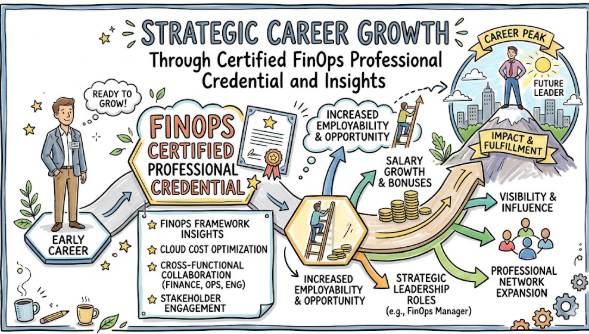
Detailed technical strategies are taught to write automated cleanup scripts, implement scheduled shutdown policies, and configure programmatic alerts for infrastructure spend. - What career advancement can be expected after clearing the Certified FinOps Professional test?
Professionals frequently move into specialized roles such as Cloud FinOps Lead, Principal Platform Architect, or Director of Cloud Financial Operations. - Is the Certified FinOps Professional examination performance-based?
The assessment includes scenario-based evaluations and problem-solving questions designed to test how a practitioner handles real-world enterprise billing inefficiencies. - How does this credential differ from basic cloud provider cost certificates?
This program focuses on an overarching, vendor-neutral framework and deep cultural integration rather than just using a single provider’s basic pricing tools. - What tools and automation frameworks are explored during this professional training?
Open-source billing analysis tools, cloud native monitoring APIs, and programmatic infrastructure tracking scripts are analyzed throughout the course.
Testimonials
The technical strategies taught in this course were applied directly to our production cluster within a week. A massive amount of hidden idle resource waste was successfully eliminated by our team.
— Amit
Total clarity regarding our multi-cloud deployment expenses was finally achieved. The ability to calculate unit economics transformed how infrastructure decisions are now made by our core platform group.
— Sarah
My confidence in discussing engineering budgets with corporate executives grew immensely. Career progression into a senior infrastructure management role was accelerated because of this validation.
— Rohan
Automated cleanup pipelines and strict tagging policies were seamlessly integrated into our CI/CD workflows. Financial accountability is now handled naturally within our regular development sprints.
— Elena
Every modern software engineering group needs this training. A strategic bridge was built between our operational speed and budget tracking, allowing us to scale efficiently without unexpected surprises.
— Vikram
Conclusion
The evolution of modern cloud operations demands a new balance between development speed and financial responsibility. The Certified FinOps Professional certification provides the definitive framework needed to master this intersection, ensuring that technical infrastructure scales efficiently without creating budget surprises.
Long-term career benefits are unlocked for engineers who can successfully translate complex architectural decisions into measurable business value. Organizations continuously prioritize technical professionals who possess verified expertise in driving financial accountability and eliminating infrastructure waste.
Strategic learning and certification planning should be prioritized by any cloud professional aiming to stay competitive in the global market. Investing time into mastering cloud financial management is a powerful step toward securing senior technical leadership roles.
One missing aspect is how FinOps practices are applied in real cloud environments. Managing cost visibility across teams and enforcing budgets can be challenging. It would be useful to explain how organizations implement governance, alerts, and accountability to control cloud spending effectively.
One thing missing is the operational side of FinOps adoption. Many professionals earn the certification, but real impact only happens when engineering, finance, and leadership workflows actually align around cloud accountability.
One gap I noticed is around real time decision making. Static reports are useful, but live insights are what teams actually rely on.