Introduction
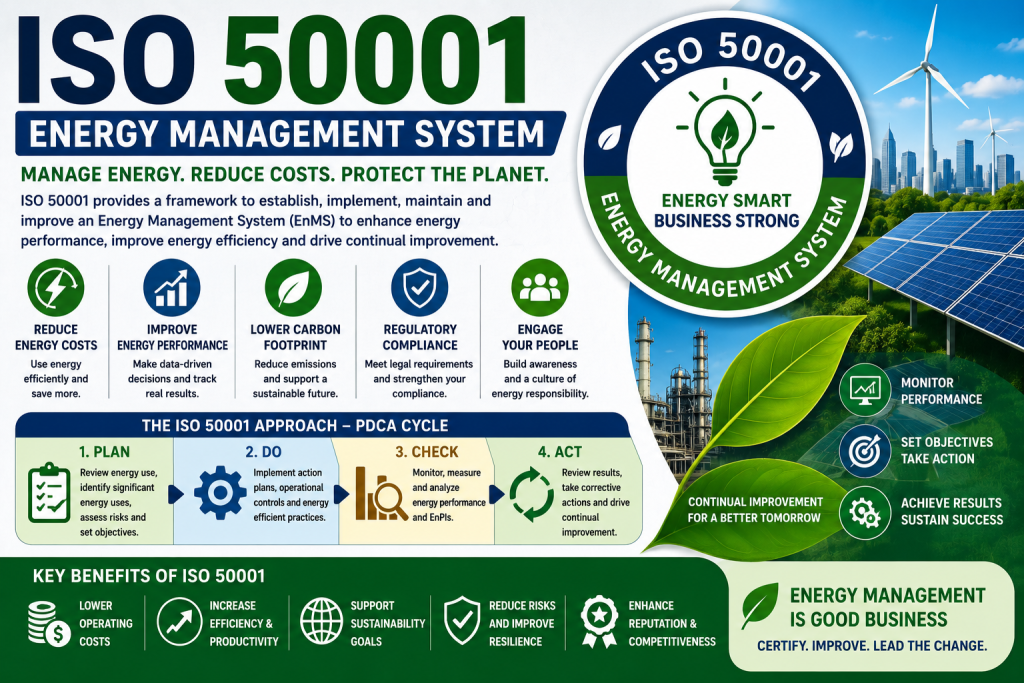
Energy is one of the most important resources for every organization. Whether a business runs a factory, office, hospital, hotel, data center, school, warehouse, shopping mall, or public facility, energy affects cost, productivity, environmental impact, and long-term sustainability. Rising electricity prices, fuel costs, climate concerns, carbon reduction goals, and pressure for responsible operations have made energy management a serious business priority. ISO 50001 helps organizations manage energy in a structured, measurable, and continuous way. It provides an international framework for building an Energy Management System, also known as EnMS, so organizations can improve energy performance, reduce waste, control energy costs, and make better energy-related decisions.
What Is ISO 50001?
ISO 50001 is an international standard for Energy Management Systems. It gives organizations a structured method to establish, implement, maintain, and improve an energy management system.
In simple words, ISO 50001 helps organizations use energy more efficiently and manage energy performance professionally.
It helps answer important questions such as:
- How much energy does the organization use?
- Where is energy being consumed the most?
- Which equipment, process, or building area uses significant energy?
- Are there energy-saving opportunities?
- Are energy objectives clearly defined?
- Is energy performance being measured?
- Are employees aware of energy-saving responsibilities?
- Are energy improvements verified with data?
- Are energy-related legal requirements being followed?
- Is top management involved in energy performance improvement?
ISO 50001 is not only about saving electricity. It covers all forms of energy used by an organization, such as electricity, fuel, gas, steam, compressed air, heating, cooling, renewable energy, and process energy.
What Is an Energy Management System?
An Energy Management System, or EnMS, is a structured system of policies, processes, records, responsibilities, data, controls, objectives, and improvement activities used to manage energy performance.
An EnMS helps organizations:
- Understand current energy use
- Identify significant energy uses
- Set energy baselines
- Define energy performance indicators
- Plan energy-saving actions
- Monitor energy data
- Improve energy efficiency
- Reduce energy waste
- Review results regularly
- Continue improving over time
Without an EnMS, energy management often becomes random. Organizations may take one-time actions such as replacing lights or servicing equipment, but they may not know whether those actions actually improved energy performance. ISO 50001 turns energy saving into a measurable management system.
Why ISO 50001 Is Important
ISO 50001 is important because energy is a major operating cost for many organizations. Poor energy management can lead to high bills, equipment inefficiency, unnecessary waste, production losses, higher emissions, and missed savings opportunities.
ISO 50001 helps organizations move from reactive energy control to proactive energy management.
Reactive energy control means acting only when bills increase or equipment fails. Proactive energy management means monitoring energy performance continuously, identifying improvement opportunities, planning actions, measuring results, and improving the system regularly.
ISO 50001 is important because it helps organizations:
- Reduce energy consumption
- Improve energy efficiency
- Lower energy costs
- Improve environmental performance
- Reduce greenhouse gas emissions
- Strengthen energy monitoring
- Improve operational control
- Support sustainability goals
- Build employee awareness
- Improve equipment performance
- Meet energy-related legal and regulatory requirements
- Improve decision-making through energy data
- Demonstrate commitment to responsible energy use
For energy-intensive industries, ISO 50001 can become a major tool for cost reduction and sustainability improvement.
ISO 50001 Is Not Only for Large Factories
Many people think ISO 50001 is only for large manufacturing companies. This is not true. ISO 50001 can be applied by organizations of all sizes and sectors.
It can be useful for:
- Manufacturing plants
- Hospitals
- Hotels
- Shopping malls
- Airports
- Data centers
- Schools and universities
- Government buildings
- Warehouses
- Food processing units
- Textile companies
- Steel and cement plants
- Chemical industries
- IT parks
- Residential facility management companies
- Transport and logistics businesses
- Commercial office buildings
- Energy-intensive service providers
Any organization that uses energy and wants to improve energy performance can benefit from ISO 50001.
Main Objective of ISO 50001
The main objective of ISO 50001 is to help organizations improve energy performance through a systematic approach.
Energy performance includes:
- Energy efficiency
- Energy use
- Energy consumption
This means ISO 50001 is not limited to reducing the total energy bill. It also focuses on how energy is used, where energy is consumed, whether energy is being used efficiently, and whether improvements are measurable.
For example, a factory may increase production and still improve energy performance if energy used per unit of production decreases. This is why energy performance indicators are important.
Key Terms in ISO 50001
1. Energy Management System
An EnMS is the management system used to control and improve energy performance.
2. Energy Performance
Energy performance means measurable results related to energy efficiency, energy use, and energy consumption.
3. Energy Use
Energy use refers to how energy is applied. Examples include lighting, heating, cooling, production machinery, compressed air, pumping, ventilation, transportation, and data processing.
4. Energy Consumption
Energy consumption means the amount of energy used. It may be measured in kWh, liters of fuel, cubic meters of gas, tonnes of steam, or other suitable units.
5. Energy Efficiency
Energy efficiency means using less energy to achieve the same or better output.
6. Significant Energy Use
Significant Energy Use, or SEU, refers to energy uses that consume large amounts of energy or offer major improvement opportunities.
7. Energy Baseline
An energy baseline is a reference point used to compare energy performance over time.
8. Energy Performance Indicator
An Energy Performance Indicator, or EnPI, is a measurable value used to track energy performance.
Examples include:
- kWh per unit produced
- fuel per kilometer
- energy per occupied room
- electricity per square meter
- compressed air energy per production batch
- cooling energy per operating hour
Key Principles of ISO 50001
1. Leadership Commitment
Top management must support energy management. Without leadership commitment, energy-saving actions may remain temporary or underfunded.
Leadership responsibilities include:
- Approving energy policy
- Providing resources
- Assigning responsibilities
- Supporting energy objectives
- Reviewing performance
- Promoting energy awareness
- Removing barriers to improvement
Energy management should be part of business strategy, not only a maintenance activity.
2. Data-Based Energy Decisions
ISO 50001 encourages decisions based on energy data. Organizations should measure, monitor, and analyze energy use instead of relying on assumptions.
Examples of useful energy data include:
- Electricity bills
- Fuel records
- Meter readings
- Production data
- Operating hours
- Equipment performance
- Weather data
- Occupancy data
- Maintenance records
- Energy audit findings
Data helps identify where energy is wasted and where improvements are possible.
3. Significant Energy Use Focus
Not all energy uses have the same impact. ISO 50001 encourages organizations to identify Significant Energy Uses and prioritize them.
Examples of SEUs may include:
- Boilers
- Furnaces
- Compressors
- HVAC systems
- Chillers
- Pumps
- Motors
- Lighting systems
- Production lines
- Data center cooling
- Refrigeration systems
- Diesel generators
Focusing on SEUs helps organizations get better results from improvement actions.
4. Continual Improvement
ISO 50001 is built around continual improvement. Energy management is not a one-time project. Organizations must regularly review energy performance, identify gaps, take actions, and improve the EnMS.
Continual improvement may include:
- Equipment optimization
- Process improvement
- Automation
- Preventive maintenance
- Energy-efficient purchasing
- Staff awareness
- Renewable energy adoption
- Better monitoring
- Improved operating controls
- Waste reduction
5. Employee Awareness
Energy saving cannot be achieved only by management or technical teams. Employees also play an important role.
Employee awareness can help reduce:
- Unnecessary lighting
- Idle machines
- Air leakage
- Poor temperature settings
- Improper equipment use
- Compressed air misuse
- Excessive heating or cooling
- Wasteful operating habits
Small behavioral changes can create meaningful savings when applied consistently.
ISO 50001 and the PDCA Cycle
ISO 50001 follows the Plan-Do-Check-Act cycle.
| PDCA Stage | Meaning in ISO 50001 | Practical Example |
|---|---|---|
| Plan | Review energy use, identify SEUs, set objectives, create action plans | Identify compressors as major energy users |
| Do | Implement energy controls and improvement actions | Repair air leaks and optimize compressor pressure |
| Check | Monitor energy performance and verify results | Compare kWh before and after improvement |
| Act | Take corrective action and improve the system | Update operating procedure and set new target |
The PDCA cycle ensures that energy management continues over time instead of stopping after one improvement project.
Main Clauses of ISO 50001 Explained
ISO 50001 follows a management-system structure similar to many other ISO standards. The main operational clauses are Clause 4 to Clause 10.
Clause 4: Context of the Organization
The organization must understand internal and external issues that affect energy performance and the EnMS.
Examples include:
- Energy prices
- Production demand
- Legal requirements
- Sustainability goals
- Climate conditions
- Technology availability
- Building condition
- Customer expectations
- Utility supply reliability
- Corporate carbon targets
The organization must also identify interested parties and define the scope and boundaries of the EnMS.
Clause 5: Leadership
Top management must demonstrate leadership and commitment to energy management.
This includes:
- Establishing energy policy
- Assigning roles and responsibilities
- Providing resources
- Supporting energy performance improvement
- Promoting energy awareness
- Reviewing EnMS performance
- Integrating energy management into business processes
Leadership is essential because many energy improvements require investment, coordination, and long-term commitment.
Clause 6: Planning
Planning is a key part of ISO 50001. The organization must identify risks, opportunities, energy review results, significant energy uses, legal requirements, objectives, targets, and action plans.
Energy planning may include:
- Energy review
- Energy baseline
- Energy performance indicators
- Significant energy uses
- Energy objectives
- Improvement opportunities
- Action plans
- Legal and other requirements
Planning creates the foundation for measurable improvement.
Clause 7: Support
Support includes resources, competence, awareness, communication, and documented information.
The organization must ensure that people involved in energy management are competent and aware of their responsibilities.
Support may include:
- Energy team
- Training programs
- Metering systems
- Monitoring tools
- Maintenance resources
- Energy documentation
- Communication channels
- Awareness campaigns
- Technical expertise
Without support, the EnMS may remain only a document.
Clause 8: Operation
Operation focuses on controlling processes related to significant energy use.
This may include:
- Operating criteria
- Maintenance controls
- Procurement requirements
- Design considerations
- Equipment operation
- Energy-efficient purchasing
- Process control
- Start-up and shutdown practices
- Monitoring of SEUs
For example, a chiller plant may need defined temperature settings, maintenance schedules, operating controls, and performance monitoring.
Clause 9: Performance Evaluation
The organization must monitor, measure, analyze, evaluate, audit, and review energy performance.
Performance evaluation may include:
- Energy consumption tracking
- EnPI monitoring
- Energy baseline comparison
- Internal audits
- Compliance evaluation
- Action plan progress
- Management review
- Corrective action tracking
This clause helps the organization verify whether energy performance is improving.
Clause 10: Improvement
The organization must address nonconformities, take corrective actions, and continually improve the EnMS and energy performance.
Improvement may come from:
- Energy data
- Internal audits
- Management reviews
- Equipment failures
- Maintenance findings
- Employee suggestions
- Energy audits
- New technology
- Legal changes
- Cost analysis
The goal is to make energy management stronger and more effective over time.
ISO 50001 Certification Process
ISO 50001 certification is usually performed by an independent certification body. The certification body audits the organization’s EnMS and checks whether it meets ISO 50001 requirements.
Step 1: Understand ISO 50001 Requirements
The organization should first understand what ISO 50001 requires and how it applies to its facilities, processes, and energy use.
Step 2: Define Scope and Boundaries
The organization defines what is included in the EnMS.
The scope may include:
- Full organization
- One manufacturing plant
- A group of buildings
- A hotel property
- A data center
- A campus
- A production unit
- A facility management operation
Boundaries should clearly state physical locations, activities, and energy types covered.
Step 3: Conduct Energy Review
Energy review is a core activity. It helps understand current energy use, energy consumption, and improvement opportunities.
Energy review includes:
- Identifying energy sources
- Analyzing energy consumption
- Identifying significant energy uses
- Reviewing current energy performance
- Finding improvement opportunities
- Identifying relevant variables
Step 4: Establish Energy Baseline
An energy baseline provides a reference point for measuring future improvement.
For example:
- Monthly electricity consumption
- Energy per unit produced
- Energy per occupied room
- Fuel per kilometer
- Steam per production batch
The baseline should be based on reliable data.
Step 5: Define Energy Performance Indicators
Energy Performance Indicators help track energy performance.
Examples include:
- kWh per product unit
- kWh per square meter
- diesel consumption per operating hour
- compressed air energy per production line
- cooling energy per ton of refrigeration
- boiler efficiency percentage
Good EnPIs should be measurable, relevant, and linked to significant energy uses.
Step 6: Set Energy Objectives and Targets
The organization should set realistic energy objectives and targets.
Examples include:
- Reduce electricity consumption by a defined percentage
- Improve boiler efficiency
- Reduce compressed air leakage
- Reduce energy per unit of production
- Improve HVAC performance
- Increase renewable energy share
- Reduce diesel generator usage
Objectives should be supported by action plans.
Step 7: Prepare Energy Action Plans
Action plans explain how objectives will be achieved.
An action plan should include:
- Action description
- Responsible person
- Timeline
- Required resources
- Expected savings
- Method of verification
- Progress tracking
- Completion status
Step 8: Implement Operational Controls
The organization implements controls for significant energy uses.
Examples include:
- Equipment operating procedures
- Maintenance schedules
- Temperature control settings
- Compressed air pressure limits
- Shutdown procedures
- Lighting control rules
- Energy-efficient procurement
- Preventive maintenance plans
Step 9: Train Employees
Employees should understand energy policy, objectives, roles, and energy-saving practices.
Training may include:
- Energy awareness
- Equipment operation
- SEU control
- Data recording
- Maintenance practices
- Reporting abnormalities
- Efficient start-up and shutdown
- Energy-saving behavior
Step 10: Monitor and Measure Energy Performance
The organization must track energy data and compare results against baselines and targets.
Monitoring may include:
- Meter readings
- Utility bills
- Production-linked energy data
- Equipment-level monitoring
- Energy dashboards
- Monthly reports
- SEU performance
- Corrective action status
Step 11: Conduct Internal Audit
Internal audit checks whether the EnMS meets ISO 50001 requirements and whether processes are implemented properly.
Step 12: Conduct Management Review
Top management reviews energy performance, audit results, objectives, resources, risks, opportunities, and improvement actions.
Step 13: Certification Audit Stage 1
The certification body reviews documentation, readiness, scope, and basic system structure.
Step 14: Certification Audit Stage 2
The auditor checks actual implementation through records, interviews, site observations, energy data, monitoring results, and evidence of improvement.
Step 15: Corrective Actions
If nonconformities are found, the organization must take corrective action and provide evidence.
Step 16: Certificate Issuance
After successful audit closure, the certification body issues the ISO 50001 certificate.
Step 17: Surveillance Audits
Certification is maintained through periodic surveillance audits. The organization must continue improving energy performance and maintaining the EnMS.
ISO 50001 Implementation Roadmap
| Phase | Key Action | Expected Output |
|---|---|---|
| Phase 1 | Understand ISO 50001 requirements | Management and team awareness |
| Phase 2 | Define EnMS scope and boundaries | Clear certification coverage |
| Phase 3 | Conduct energy review | Energy use and consumption data |
| Phase 4 | Identify significant energy uses | SEU list |
| Phase 5 | Establish energy baseline | Reference point for improvement |
| Phase 6 | Define EnPIs | Energy performance tracking system |
| Phase 7 | Set objectives and targets | Energy improvement goals |
| Phase 8 | Create action plans | Practical energy-saving roadmap |
| Phase 9 | Implement operational controls | Controlled energy use |
| Phase 10 | Train employees | Energy-aware workforce |
| Phase 11 | Monitor and measure performance | Energy performance records |
| Phase 12 | Conduct internal audit | Audit findings |
| Phase 13 | Conduct management review | Leadership evaluation |
| Phase 14 | Complete certification audit | External assessment |
| Phase 15 | Improve continually | Better energy performance |
Documents Commonly Required for ISO 50001
The exact documents depend on organization size, energy complexity, and scope. Common documents include:
- EnMS scope and boundaries
- Energy policy
- Energy objectives and targets
- Energy review records
- Significant energy use records
- Energy baseline records
- Energy Performance Indicators
- Energy action plans
- Legal and other requirement register
- Roles and responsibility matrix
- Competence and training records
- Communication records
- Operational control procedures
- Maintenance records
- Energy procurement criteria
- Design review records where applicable
- Monitoring and measurement plan
- Meter calibration records where applicable
- Energy data reports
- Internal audit reports
- Management review records
- Nonconformity records
- Corrective action records
- Continual improvement records
Documentation should be practical and connected with real energy performance. It should not be created only for audit purposes.
What Is an Energy Review?
An energy review is a detailed analysis of energy use and consumption. It helps the organization understand where energy is used, which areas are significant, and where improvements can be made.
An energy review may include:
- Energy sources
- Energy bills
- Meter readings
- Production data
- Equipment operating data
- Building energy use
- Process energy use
- Energy losses
- Maintenance issues
- Operational patterns
- Improvement opportunities
For example, a factory may discover that compressed air leakage is a major source of energy waste. A hotel may discover that HVAC and hot water systems are its largest energy users. A data center may identify cooling as a significant energy use.
What Are Significant Energy Uses?
Significant Energy Uses are energy uses that consume substantial energy or offer high improvement potential.
Examples include:
- Chillers
- Boilers
- Furnaces
- Motors
- Pumps
- Compressors
- HVAC systems
- Refrigeration
- Lighting
- Production machinery
- Data center cooling
- Steam systems
- Fuel-fired equipment
Once SEUs are identified, the organization should control them carefully and monitor their performance.
What Is an Energy Baseline?
An energy baseline is the reference point used to compare future energy performance.
For example, if a plant uses 100,000 kWh per month before implementing improvements, that period may be used as a baseline. After improvement actions, energy performance can be compared against that baseline.
However, energy baselines should consider relevant variables such as:
- Production volume
- Weather
- Operating hours
- Occupancy
- Seasonal demand
- Raw material type
- Equipment load
Without considering relevant variables, energy performance results may be misleading.
What Are Energy Performance Indicators?
Energy Performance Indicators, or EnPIs, are measurable values used to track energy performance.
Examples include:
- kWh per unit produced
- kWh per square meter
- kWh per employee
- kWh per occupied room
- fuel per kilometer
- steam per ton of product
- compressed air energy per production line
- cooling energy per operating hour
Good EnPIs help organizations understand whether energy performance is improving, even when business activity changes.
Benefits of ISO 50001 Certification
1. Reduced Energy Costs
ISO 50001 helps organizations identify waste, improve efficiency, and reduce unnecessary energy consumption.
2. Improved Energy Performance
The standard focuses on measurable energy performance improvement, not just policy creation.
3. Better Environmental Performance
Lower energy consumption can reduce greenhouse gas emissions and environmental impact.
4. Stronger Operational Control
ISO 50001 improves control over equipment, processes, maintenance, and energy-intensive activities.
5. Better Data-Based Decision Making
Energy data helps management make better decisions about investments, maintenance, and process improvements.
6. Improved Legal and Regulatory Readiness
Organizations can identify and monitor energy-related legal and other requirements more systematically.
7. Enhanced Sustainability Reputation
Certification can show customers, regulators, investors, and stakeholders that the organization takes energy management seriously.
8. Better Employee Engagement
Energy awareness programs help employees participate in energy-saving activities.
9. Stronger Asset Performance
Energy management often improves maintenance, equipment efficiency, and operating discipline.
10. Continual Improvement Culture
ISO 50001 encourages ongoing improvement instead of one-time energy-saving projects.
ISO 50001 and ISO 14001
ISO 50001 and ISO 14001 are closely related but different.
ISO 14001 focuses on environmental management. ISO 50001 focuses specifically on energy management and energy performance improvement.
| Standard | Main Focus | Key Purpose |
|---|---|---|
| ISO 14001 | Environmental management | Control environmental impacts |
| ISO 50001 | Energy management | Improve energy performance |
An organization can use both standards together. ISO 14001 may address waste, emissions, water, pollution, and environmental compliance, while ISO 50001 gives deeper control over energy use and efficiency.
ISO 50001 and ISO 9001
ISO 9001 focuses on quality management. ISO 50001 focuses on energy management.
However, both use structured management system thinking and can be integrated.
| Standard | Main Focus | Benefit |
|---|---|---|
| ISO 9001 | Quality management | Consistent products and services |
| ISO 50001 | Energy management | Improved energy performance |
| Integrated Approach | Business management | Better efficiency and control |
Organizations with ISO 9001 experience may find it easier to implement ISO 50001 because they already understand policies, objectives, audits, management review, and corrective actions.
ISO 50001 and Energy Audits
Energy audits and ISO 50001 are connected but not the same.
An energy audit is usually a technical assessment that identifies energy-saving opportunities. ISO 50001 is a full management system that ensures energy improvement is planned, implemented, monitored, and improved continuously.
Energy audit may identify opportunities such as:
- Replace inefficient motors
- Repair compressed air leaks
- Improve insulation
- Optimize boiler operation
- Upgrade lighting
- Improve chiller performance
- Install variable frequency drives
- Improve power factor
- Recover waste heat
ISO 50001 helps ensure these opportunities are evaluated, prioritized, implemented, verified, and reviewed.
Practical Examples of ISO 50001 in Action
Example 1: Manufacturing Plant
A manufacturing plant identifies compressed air as a significant energy use. It repairs leaks, reduces pressure, installs monitoring, trains operators, and tracks kWh per production unit. Energy consumption reduces without affecting production.
Example 2: Hotel
A hotel identifies HVAC and hot water systems as major energy users. It adjusts temperature settings, improves maintenance, installs occupancy controls, and tracks energy per occupied room.
Example 3: Data Center
A data center identifies cooling as its biggest energy use. It improves airflow management, optimizes cooling temperature, monitors power usage, and improves equipment efficiency.
Example 4: Hospital
A hospital uses ISO 50001 to monitor lighting, HVAC, boilers, medical equipment, and backup power systems. Energy savings are achieved while maintaining patient comfort and safety.
Example 5: Educational Campus
A university campus tracks electricity use across buildings, improves lighting controls, trains facility staff, and monitors energy per square meter.
Common Mistakes During ISO 50001 Implementation
1. Treating ISO 50001 Only as a Certificate
Certification should not be the only goal. The real goal is measurable energy performance improvement.
2. Weak Energy Data
Poor energy data makes it difficult to identify savings and prove improvement.
3. No Clear Energy Baseline
Without a baseline, the organization cannot measure progress properly.
4. Wrong Energy Performance Indicators
If EnPIs are not meaningful, energy performance tracking becomes weak.
5. Ignoring Significant Energy Uses
The organization should focus on major energy users, not only small visible actions.
6. Lack of Top Management Support
Many energy improvements require investment and cross-department support.
7. Poor Employee Awareness
Employees may continue wasteful habits if they are not trained and engaged.
8. No Verification of Savings
Energy-saving actions should be verified with data.
9. Ignoring Maintenance
Poor maintenance often causes energy waste in motors, compressors, chillers, boilers, and HVAC systems.
10. Not Updating Energy Review
Energy use changes over time. The energy review should be updated regularly.
ISO 50001 Audit Preparation Checklist
Use this checklist before certification audit:
- Is the EnMS scope clearly defined?
- Is the energy policy approved?
- Are energy objectives and targets documented?
- Has an energy review been completed?
- Are energy sources identified?
- Are significant energy uses identified?
- Are energy baselines established?
- Are EnPIs defined?
- Are action plans prepared?
- Are legal and other requirements identified?
- Are operational controls implemented?
- Are employees trained?
- Is energy data monitored and analyzed?
- Are savings verified?
- Are energy procurement requirements considered?
- Are design-related energy requirements considered where applicable?
- Are internal audits completed?
- Is management review conducted?
- Are nonconformities recorded?
- Are corrective actions tracked?
- Is continual improvement demonstrated?
Best Practices for ISO 50001 Implementation
Start With Reliable Energy Data
Collect utility bills, meter readings, equipment data, and production data before setting targets.
Focus on Significant Energy Uses
Prioritize major energy users because they usually offer the biggest savings.
Set Practical EnPIs
Choose indicators that reflect real performance and business activity.
Involve Maintenance and Operations Teams
Energy performance depends heavily on equipment operation and maintenance.
Train Employees Regularly
Awareness helps reduce everyday energy waste.
Verify Savings With Data
Do not assume improvement. Measure before and after results.
Use Energy-Efficient Procurement
Consider energy performance when buying equipment, motors, lighting, HVAC systems, compressors, and machinery.
Review Energy Performance Monthly
Frequent review helps detect abnormal consumption quickly.
Integrate With Existing Systems
ISO 50001 can be integrated with ISO 9001, ISO 14001, ISO 45001, and other management systems.
Keep Improving
Once one improvement is completed, identify the next opportunity.
Cost Factors for ISO 50001 Certification
The cost of ISO 50001 certification depends on several factors:
- Organization size
- Number of sites
- Energy complexity
- Number of significant energy uses
- Availability of energy data
- Metering system maturity
- Existing management systems
- Consultant support
- Certification body fees
- Training requirements
- Internal audit effort
- Technical studies
- Energy audit needs
- Corrective action effort
A small office building may require less effort than a large multi-site manufacturing group with boilers, compressors, furnaces, chillers, and complex production processes.
How Long Does ISO 50001 Implementation Take?
The timeline depends on the organization’s current energy management maturity.
Important factors include:
- Availability of energy data
- Metering and monitoring systems
- Number of facilities
- Complexity of operations
- Existing documentation
- Energy team competence
- Management support
- Internal audit readiness
- Corrective action needs
The goal should not be only fast certification. The goal should be a working EnMS that improves energy performance.
Frequently Asked Questions
1. What is ISO 50001?
ISO 50001 is an international standard for Energy Management Systems. It helps organizations improve energy performance through structured planning, monitoring, control, and continual improvement.
2. What does EnMS mean?
EnMS means Energy Management System. It is a structured system used to manage energy use, energy consumption, energy efficiency, and energy performance.
3. Is ISO 50001 certification mandatory?
In most cases, ISO 50001 certification is voluntary. However, some customers, government programs, tenders, or sustainability commitments may encourage or require it.
4. Who can implement ISO 50001?
Any organization can implement ISO 50001, including factories, offices, hospitals, hotels, malls, data centers, schools, warehouses, and public facilities.
5. What is the main benefit of ISO 50001?
The main benefit is measurable energy performance improvement, which can reduce energy costs and environmental impact.
6. What is a Significant Energy Use?
A Significant Energy Use is an energy use that consumes major energy or offers strong improvement potential.
7. What is an energy baseline?
An energy baseline is a reference point used to compare future energy performance.
8. What is an EnPI?
An EnPI, or Energy Performance Indicator, is a measurable value used to track energy performance.
9. Does ISO 50001 reduce carbon emissions?
ISO 50001 can help reduce emissions when energy consumption is reduced or energy use becomes more efficient.
10. Who issues ISO 50001 certificates?
ISO 50001 certificates are issued by independent certification bodies after successful audits. ISO itself does not issue certificates.
Conclusion
ISO 50001 is a powerful international standard for organizations that want to manage energy professionally and improve energy performance. It helps businesses move beyond random energy-saving actions and build a structured Energy Management System based on data, leadership, planning, operational control, monitoring, audits, and continual improvement. Whether an organization is a factory, office, hospital, hotel, data center, school, or public facility, ISO 50001 can help reduce energy waste, control costs, improve sustainability, and support responsible business operations. The real value of ISO 50001 is not only certification. Its real value is creating a disciplined energy culture where every department understands energy performance and contributes to continuous improvement.
One area rarely discussed is the risk of “efficiency rebound.” As energy costs decrease through optimization, some facilities unintentionally increase equipment utilization, partially offsetting the expected savings. Measuring operational behavior alongside energy metrics can help prevent this effect.