Introduction
Footwear quality is not only judged by design, color, style, or brand name. A good shoe must also perform well during regular use. One of the most important hidden parts of footwear is the insole. The insole sits inside the shoe and directly supports the wearer’s foot. It faces repeated rubbing, pressure, sweat, movement, bending, friction, and contact with socks or bare feet. If the insole wears out quickly, the shoe may become uncomfortable, unhygienic, weak, or unsuitable for long-term use. This is why abrasion resistance testing is important.
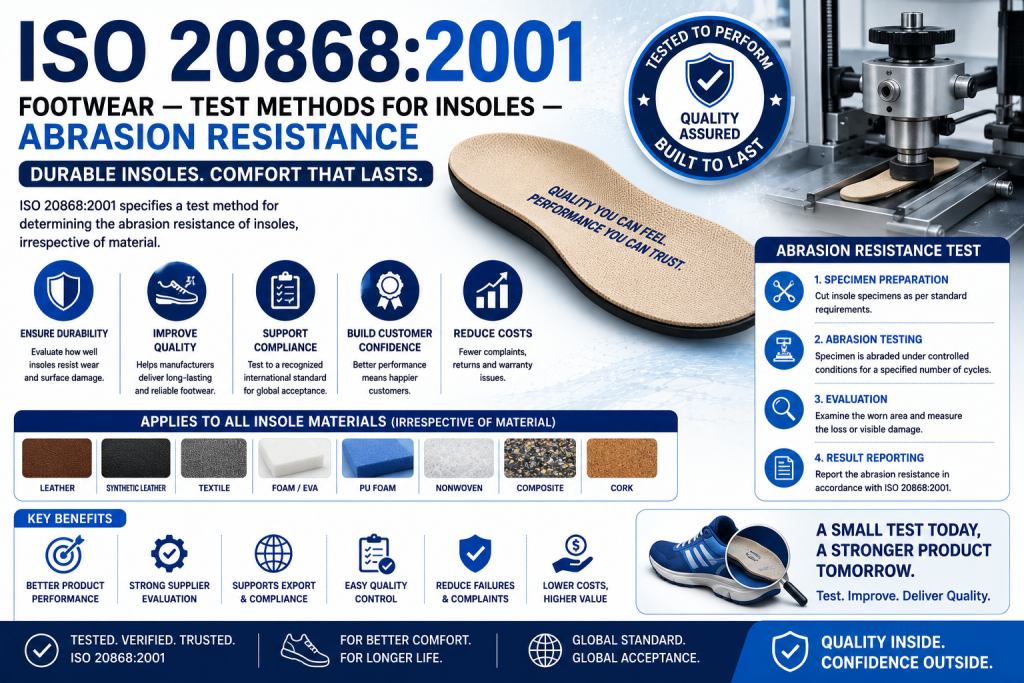
ISO 20868:2001 is an international standard that specifies a test method for determining the abrasion resistance of footwear insoles. It helps manufacturers, exporters, laboratories, quality teams, suppliers, and buyers evaluate how well insole materials resist surface wear under controlled laboratory conditions. This blog explains ISO 20868:2001 in a simple, practical, and detailed way.
What Is ISO 20868:2001?
ISO 20868:2001 is an international footwear testing standard titled Footwear — Test methods for insoles — Abrasion resistance.
In simple words, it provides a standardized laboratory method to check how resistant an insole material is to abrasion. Abrasion means wear caused by rubbing or friction. In footwear, abrasion can happen when the foot moves inside the shoe, when socks rub against the insole surface, or when repeated walking causes internal friction.
The standard is useful because it creates a common testing method. Instead of every factory or laboratory using a different approach, ISO 20868:2001 provides a recognized method for comparing insole abrasion performance.
It is especially useful for:
- Footwear manufacturers
- Insole manufacturers
- Shoe material suppliers
- Footwear testing laboratories
- Quality control departments
- Exporters
- Importers
- Retail brands
- Safety footwear companies
- Sports footwear brands
- School shoe manufacturers
- Formal and casual footwear producers
The main purpose is to help determine whether the insole material can resist wear during use.
Why Abrasion Resistance Matters in Insoles
The insole is one of the most used parts of a shoe, even though customers may not notice it at first. Every step creates pressure and movement between the foot, sock, and insole surface. Over time, this can cause the insole to wear, peel, crack, thin out, tear, or lose comfort.
Abrasion resistance matters because it affects:
- Footwear durability
- Comfort during use
- Internal shoe quality
- Product life
- Customer satisfaction
- Brand reputation
- Warranty claims
- Export acceptance
- Buyer approval
- Material selection
- Product development
A weak insole may fail before the outsole or upper, causing the entire shoe to feel poor in quality. For this reason, insole abrasion testing is an important part of footwear quality assurance.
Why ISO 20868:2001 Is Important for Footwear Businesses
Footwear businesses operate in a competitive market where buyers expect consistent quality. A shoe may look attractive, but if the internal materials wear quickly, customers may complain. ISO 20868:2001 helps businesses test insole performance in a structured way before products reach the market.
Key Reasons ISO 20868:2001 Is Important
- It provides a standardized insole abrasion test method.
- It helps compare different insole materials.
- It supports quality control in footwear production.
- It helps reduce product failures.
- It supports buyer and export documentation.
- It improves supplier evaluation.
- It helps brands choose better materials.
- It supports product development and testing.
- It improves customer satisfaction.
- It helps prevent avoidable complaints.
For footwear exporters, test reports based on recognized standards can also support buyer confidence and international trade documentation.
What Is an Insole in Footwear?
An insole is the internal part of a shoe that lies directly under the foot. It may be fixed, removable, cushioned, molded, flat, foam-based, leather-based, textile-covered, synthetic, or multi-layered.
Insoles may perform several functions:
- Support the foot
- Improve comfort
- Absorb pressure
- Reduce impact
- Improve fit
- Provide cushioning
- Support hygiene
- Improve internal appearance
- Assist moisture control
- Add insulation
- Improve walking comfort
Because the insole is in direct contact with the foot or sock, it must be durable enough to resist repeated rubbing.
Common Insole Materials
Footwear insoles may be made from different materials depending on shoe type, cost, performance requirement, and target customer.
Common insole materials include:
- Leather
- Synthetic leather
- Textile-covered board
- Cellulose board
- Nonwoven material
- EVA foam
- PU foam
- Latex foam
- Rubber-based material
- Cork material
- Fiberboard
- Felt
- Gel-based material
- Composite laminated material
- Orthotic-grade materials
Each material behaves differently during abrasion. Some materials may resist rubbing well, while others may wear quickly. Testing helps identify actual performance instead of relying only on appearance.
What Is Abrasion Resistance?
Abrasion resistance is the ability of a material to resist surface wear caused by rubbing, friction, or scraping.
In footwear insoles, abrasion resistance shows how well the insole surface can handle repeated contact with the foot, sock, or internal shoe movement.
A material with good abrasion resistance will show less wear after testing. A material with poor abrasion resistance may show:
- Surface damage
- Fiber loss
- Peeling
- Thinning
- Roughness
- Material breakdown
- Hole formation
- Color change
- Delamination
- Loss of comfort layer
Abrasion resistance is important because insole wear can directly affect user comfort and shoe life.
ISO 20868:2001 Scope Explained Simply
The scope of ISO 20868:2001 is focused on determining the abrasion resistance of insoles. The standard applies irrespective of the insole material. This means it can be used for different types of insole materials, not only one specific category.
In practical terms, this makes the standard useful for:
- Leather insoles
- Textile insoles
- Synthetic insoles
- Foam insoles
- Composite insoles
- Laminated insoles
- Footbed materials
- Insole boards
- Insole covering materials
The test helps laboratories and manufacturers assess how the insole material behaves under controlled abrasion conditions.
ISO 20868:2001 Is a Test Method, Not a Management System
It is important to understand that ISO 20868:2001 is not like ISO 9001, ISO 14001, ISO 45001, or ISO 50001. Those are management system standards. ISO 20868:2001 is a product testing standard.
This means ISO 20868:2001 does not certify an entire company’s quality management system. Instead, it provides a test method for a specific footwear component: the insole.
A company may use ISO 20868:2001 as part of:
- Product testing
- Quality control
- Supplier approval
- Material development
- Buyer inspection
- Export documentation
- Laboratory evaluation
- Internal product validation
- Footwear certification programs
The result is usually a test report, not a company-wide ISO certificate.
Who Should Use ISO 20868:2001?
ISO 20868:2001 is useful for any organization involved in footwear development, production, testing, or sourcing.
Footwear Manufacturers
Manufacturers can use the standard to test insole materials before bulk production.
Insole Suppliers
Insole suppliers can use test results to prove durability to footwear brands and buyers.
Footwear Brands
Brands can use the standard to compare materials and set quality requirements.
Testing Laboratories
Laboratories can use the standard to perform consistent abrasion testing.
Exporters
Exporters can provide test reports to buyers or importers when required.
Importers and Retailers
Importers and retailers can use test reports to verify product quality before placing orders.
Safety Footwear Companies
Safety footwear often needs stronger durability, and insole testing helps confirm performance.
Sports Footwear Companies
Sports shoes face repeated movement and sweat conditions, making insole durability important.
Why Insole Testing Is Important Before Bulk Production
Many footwear quality problems become expensive when discovered after production. If an insole material fails after thousands of pairs are manufactured, the business may face returns, complaints, discounts, replacement costs, or buyer rejection.
Testing before bulk production helps businesses:
- Select better materials
- Avoid weak suppliers
- Reduce production risk
- Improve product durability
- Meet buyer specifications
- Reduce after-sales complaints
- Improve confidence before export
- Control quality from the beginning
A small laboratory test before production can prevent large commercial losses later.
How ISO 20868:2001 Supports Footwear Quality Control
ISO 20868:2001 supports quality control by providing a consistent way to test insole abrasion resistance. When the same test method is used, manufacturers and buyers can compare results more reliably.
It helps quality teams answer questions such as:
- Is this insole material durable enough?
- Which supplier provides better material?
- Does the new batch match the approved sample?
- Is the material suitable for heavy-use footwear?
- Is the insole surface likely to wear quickly?
- Should this material be rejected or improved?
- Does the test result meet buyer specifications?
This makes the standard useful for both development and production control.
General Testing Concept of ISO 20868:2001
ISO 20868:2001 describes a laboratory test method for assessing the abrasion resistance of insoles. The exact laboratory procedure, apparatus details, specimen preparation, conditioning, and result expression should be followed from the official standard.
At a general level, the testing concept includes:
- Preparing test specimens from insole material
- Conditioning the samples as required
- Exposing the sample to controlled abrasion
- Observing or measuring wear behavior
- Recording the test result
- Preparing a test report
The purpose is to simulate controlled rubbing conditions so that the abrasion performance of insole materials can be evaluated consistently.
Key Factors That Can Affect Insole Abrasion Resistance
Several factors can influence how well an insole resists abrasion.
1. Material Type
Leather, textile, foam, synthetic, and board materials behave differently under friction.
2. Surface Finish
A smooth, coated, or laminated surface may perform differently from a rough or fibrous surface.
3. Thickness
Thicker materials may resist wear longer, but thickness alone does not guarantee abrasion resistance.
4. Fiber Strength
For textile and fiber-based insoles, fiber bonding and density can affect wear.
5. Coating Quality
Some insoles have protective coatings that improve resistance.
6. Adhesion Between Layers
Multi-layer insoles can fail if layers separate during rubbing.
7. Moisture Exposure
Sweat and humidity can weaken some materials.
8. Manufacturing Quality
Poor production control can cause inconsistent abrasion performance.
9. Supplier Variation
Different supplier batches may perform differently.
10. End-Use Conditions
Sports shoes, work shoes, school shoes, and formal shoes may experience different levels of internal wear.
Insole Abrasion Testing in Different Footwear Categories
Formal Shoes
Formal shoes often use leather, synthetic leather, or fiberboard insoles. Abrasion resistance helps maintain comfort and internal finish.
Sports Shoes
Sports footwear faces repeated movement, sweat, and pressure. Strong insole abrasion resistance is important for comfort and product life.
Safety Shoes
Safety footwear is used in demanding workplaces. Insoles should resist wear under long daily use.
School Shoes
School shoes are worn for long hours and often receive rough use. Abrasion-resistant insoles can reduce complaints.
Casual Shoes
Casual footwear needs balanced comfort and durability. Insole testing helps brands maintain consistent quality.
Sandals and Open Footwear
In some footwear designs, the insole or footbed surface is directly exposed to the foot. Abrasion performance becomes highly visible.
Orthopedic Footwear
Orthopedic insoles must maintain comfort, support, and surface integrity. Abrasion testing can support material selection.
ISO 20868:2001 and Buyer Requirements
Many footwear buyers create technical specifications for suppliers. These specifications may include insole abrasion resistance requirements. A buyer may ask the manufacturer to submit laboratory test reports based on ISO 20868:2001 or other recognized footwear test methods.
Buyer requirements may include:
- Minimum abrasion performance
- Test report from an accredited laboratory
- Material specification
- Batch-level testing
- Pre-production sample approval
- Production sample testing
- Supplier declaration
- Corrective action if failure occurs
Manufacturers should clearly understand buyer specifications before production.
ISO 20868:2001 and Laboratory Test Reports
A test report based on ISO 20868:2001 should be clear, traceable, and complete. It should help the buyer or quality team understand what was tested and what result was obtained.
A good test report may include:
- Laboratory name
- Test standard used
- Sample description
- Sample identification number
- Material type
- Customer name
- Date of sample receipt
- Date of testing
- Test conditions
- Equipment reference
- Test result
- Observations
- Pass or fail status if a specification is provided
- Authorized signature
- Report number
The test report should match the actual product or material being supplied. A report for one material should not be used for a different material unless technically justified.
Documents Commonly Needed for Insole Abrasion Testing
Footwear manufacturers and laboratories may need several documents for proper testing and quality control.
Common documents include:
- Product specification
- Material specification
- Insole material datasheet
- Sample submission form
- Purchase order
- Buyer testing requirement
- Test request form
- Batch number or lot number
- Supplier details
- Material composition information
- Production date
- Sample identification record
- Laboratory test report
- Internal quality inspection record
- Corrective action report if failure occurs
- Approved sample record
Good documentation improves traceability and reduces disputes between supplier, manufacturer, buyer, and laboratory.
Step-by-Step Practical Process for Using ISO 20868:2001
Step 1: Identify the Insole Material
The manufacturer should first identify the exact insole material to be tested. This includes material type, supplier, batch number, thickness, finish, and intended footwear category.
Step 2: Understand Buyer or Internal Requirement
Before testing, confirm whether there is a defined acceptance criterion. The standard provides the test method, but the buyer, brand, or internal quality team may define the minimum acceptable performance.
Step 3: Prepare Representative Samples
Samples should represent the actual material used in production. Testing a special sample that is better than production material can lead to misleading results.
Step 4: Send Samples to a Competent Laboratory
The laboratory should be capable of performing footwear insole abrasion testing according to ISO 20868:2001.
Step 5: Conduct Testing Under Standard Conditions
The laboratory performs the test using the official method. The details should follow the standard and laboratory quality procedures.
Step 6: Review Test Results
The manufacturer or buyer reviews the result against the required specification. If the result is acceptable, the material may be approved.
Step 7: Take Corrective Action if Needed
If the material fails, the team should investigate the cause. Possible actions may include changing material, improving coating, changing supplier, increasing thickness, or improving bonding.
Step 8: Maintain Records
Keep test reports and approval records for future production, buyer audits, supplier evaluation, and quality traceability.
ISO 20868:2001 Implementation Roadmap for Footwear Businesses
| Phase | Key Action | Expected Output |
|---|---|---|
| Phase 1 | Identify insole materials | Material list |
| Phase 2 | Define quality requirements | Abrasion performance target |
| Phase 3 | Select testing laboratory | Reliable testing partner |
| Phase 4 | Prepare representative samples | Traceable test specimens |
| Phase 5 | Conduct ISO 20868 testing | Laboratory test result |
| Phase 6 | Review performance | Pass or improvement decision |
| Phase 7 | Approve supplier or material | Approved material record |
| Phase 8 | Control production batches | Consistent quality |
| Phase 9 | Retest when changes occur | Continued confidence |
| Phase 10 | Maintain documentation | Audit-ready quality file |
Benefits of ISO 20868:2001 Testing
1. Better Insole Durability
The test helps identify materials that can resist internal wear better.
2. Improved Product Quality
Strong insole materials improve overall footwear quality and user satisfaction.
3. Reduced Customer Complaints
Testing helps prevent premature insole damage and related complaints.
4. Better Supplier Control
Manufacturers can compare suppliers based on test results instead of only price.
5. Stronger Buyer Confidence
Recognized test reports help buyers trust product quality.
6. Support for Export Documentation
Footwear exporters can use test reports as part of quality documentation.
7. Better Product Development
Design and material teams can compare different insole options during development.
8. Lower Rework and Rejection Risk
Testing before production reduces the chance of bulk rejection.
9. Improved Brand Reputation
Durable footwear builds customer trust and repeat business.
10. More Consistent Production
Regular testing helps control batch-to-batch material variation.
Common Mistakes in Insole Abrasion Testing
1. Testing Non-Representative Samples
Testing a better-quality sample than actual production material can create false confidence.
2. Ignoring Batch Variation
Material from one batch may pass, while another batch may fail. Batch control is important.
3. Confusing Insole Testing With Outsole Testing
ISO 20868 is for insoles. Outsole abrasion testing is covered by different standards.
4. No Clear Acceptance Criteria
The test method gives a way to test, but the buyer or quality team must define what result is acceptable.
5. Using Old Test Reports for New Materials
A test report should match the current material, supplier, formulation, and production batch.
6. Ignoring Moisture and Use Conditions
Insoles may face sweat and humidity during use. Material selection should consider actual wearing conditions.
7. Poor Sample Identification
If samples are not clearly identified, test results may become difficult to trace.
8. Choosing Material Only by Cost
Low-cost insole material may fail faster and damage brand reputation.
9. Not Retesting After Supplier Change
Any supplier, material, coating, or process change may affect abrasion resistance.
10. Treating Testing as a Formality
Testing should support real product quality decisions, not only documentation.
ISO 20868:2001 Testing Checklist
Use this checklist before requesting insole abrasion testing:
- Is the insole material clearly identified?
- Is the supplier name recorded?
- Is the batch or lot number available?
- Is the material intended for actual production?
- Is the footwear category known?
- Is the buyer requirement available?
- Is the correct test standard selected?
- Is the sample size sufficient for the laboratory?
- Are samples packed properly?
- Is the sample submission form complete?
- Is the acceptance criterion defined?
- Is the laboratory competent for this test?
- Is the final test report reviewed carefully?
- Is the tested sample linked to approved production material?
- Are records stored properly?
- Is retesting planned after material changes?
ISO 20868:2001 and Supplier Evaluation
Supplier evaluation is important in footwear production. A supplier may offer attractive pricing, but quality must be verified. ISO 20868:2001 test reports can help compare suppliers objectively.
Supplier evaluation may include:
- Test performance
- Material consistency
- Batch traceability
- Delivery reliability
- Cost stability
- Corrective action response
- Technical support
- Compliance documentation
- Production capacity
- Quality history
A supplier with slightly higher cost but better abrasion performance may be more valuable than a cheaper supplier that creates complaints or rejections.
ISO 20868:2001 and Product Development
During product development, brands often test multiple material options. ISO 20868:2001 can help compare these options before final selection.
For example, a footwear brand may compare:
- Leather insole vs synthetic insole
- Textile-covered insole vs foam insole
- Standard foam vs high-density foam
- Coated material vs uncoated material
- Local supplier vs imported supplier
- Low-cost option vs premium option
The test result helps product teams make better decisions based on performance data.
ISO 20868:2001 and Quality Assurance
Quality assurance teams can use ISO 20868:2001 as part of a broader footwear testing plan. Insole abrasion testing may be combined with other tests depending on product type.
Other footwear quality tests may include:
- Flex resistance
- Tear strength
- Bond strength
- Water absorption
- Color fastness
- Sole abrasion
- Upper abrasion
- Lining abrasion
- Dimensional stability
- Slip resistance
- Chemical safety
- Fit and comfort evaluation
A complete quality program does not depend on one test only. ISO 20868:2001 is important, but it should be part of a full footwear quality strategy.
Difference Between Insole, Insock, Midsole, and Outsole
Footwear terms can be confusing. Understanding them helps avoid selecting the wrong test.
Insole
The insole is the internal part under the foot. It supports comfort and structure inside the shoe.
Insock
The insock is the layer that directly contacts the foot or sock. In some shoes, it may be removable.
Midsole
The midsole is usually between the insole and outsole. It provides cushioning and shock absorption.
Outsole
The outsole is the bottom part of the shoe that touches the ground.
ISO 20868 is focused on insoles, not outsoles. Outsole abrasion resistance uses different test methods.
Practical Example: Shoe Manufacturer
A footwear manufacturer plans to produce school shoes for bulk supply. The buyer requires durable insoles because students wear the shoes daily for long hours. The manufacturer selects three insole materials from different suppliers and sends samples for abrasion resistance testing according to ISO 20868:2001.
After reviewing the test results, one material shows poor surface wear, one shows moderate performance, and one shows strong abrasion resistance. The manufacturer chooses the best-performing material, updates the approved supplier list, and keeps the test report in the quality file. This reduces the risk of customer complaints after delivery.
Practical Example: Export Footwear Brand
An exporter receives an order for formal shoes from an international buyer. The buyer asks for evidence that the insole material is suitable for normal wear. The exporter provides a laboratory test report based on ISO 20868:2001 along with material specifications and production batch records. This improves buyer confidence and supports product approval.
Practical Example: Insole Supplier
An insole supplier wants to sell material to multiple footwear factories. The supplier tests its material according to ISO 20868:2001 and shares performance data with customers. This helps the supplier prove quality and compete against lower-cost alternatives.
Cost Factors for ISO 20868:2001 Testing
The cost of insole abrasion testing may depend on:
- Laboratory location
- Number of samples
- Number of materials
- Urgency of testing
- Report format
- Accreditation requirement
- Buyer-specific reporting needs
- Sample preparation complexity
- Additional tests requested
- Retesting after failure
Testing cost is usually small compared to the cost of bulk production failure, buyer rejection, or customer complaints.
How Long Does ISO 20868:2001 Testing Take?
The testing timeline depends on the laboratory workload, sample readiness, test method requirements, report preparation, and whether additional tests are requested.
Delays may occur if:
- Samples are insufficient
- Sample identification is unclear
- Test request form is incomplete
- Buyer requirement is missing
- Material information is unavailable
- Urgent testing slots are unavailable
- Retesting is needed after failure
Manufacturers should plan testing early during product development, not after bulk production begins.
Best Practices for Footwear Manufacturers
Start Testing During Development
Do not wait until production starts. Test insole materials during sampling and development.
Use Representative Samples
The tested material should match actual production material.
Keep Supplier Records
Maintain supplier details, batch numbers, material specifications, and test reports.
Define Acceptance Criteria
Agree on acceptable abrasion performance before testing.
Compare Multiple Options
Testing different materials helps select the best balance of durability, comfort, and cost.
Retest After Changes
Retest if supplier, material composition, coating, thickness, or production method changes.
Use Competent Laboratories
Choose laboratories experienced in footwear testing.
Maintain Quality Records
Keep test reports in product quality files for buyer audits and future reference.
Train Quality Teams
Quality teams should understand the difference between insole, insock, midsole, and outsole testing.
Integrate Testing With Supplier Approval
Use test performance as part of supplier qualification and ongoing monitoring.
Frequently Asked Questions
1. What is ISO 20868:2001?
ISO 20868:2001 is an international standard that specifies a test method for determining the abrasion resistance of footwear insoles.
2. What does abrasion resistance mean?
Abrasion resistance means the ability of a material to resist surface wear caused by rubbing or friction.
3. Which footwear part does ISO 20868 test?
ISO 20868 is used for insoles. It is not intended for outsole abrasion testing.
4. Can ISO 20868 be used for all insole materials?
Yes. The standard is intended for determining abrasion resistance of insoles irrespective of material.
5. Is ISO 20868 a certification standard?
No. It is a test method standard. It usually supports laboratory testing and test reports, not company-wide certification.
6. Who needs ISO 20868 testing?
Footwear manufacturers, insole suppliers, testing laboratories, exporters, buyers, and quality teams may use ISO 20868 testing.
7. Why is insole abrasion testing important?
It helps check whether the insole material can resist wear during use, supporting footwear durability and customer satisfaction.
8. Does a test report guarantee full shoe quality?
No. It confirms test results for insole abrasion resistance only. Complete shoe quality may require several other tests.
9. When should insole abrasion testing be done?
It should be done during material selection, product development, supplier approval, buyer approval, and after material or supplier changes.
10. What is the difference between ISO 20868 and ISO 20871?
ISO 20868 is for insole abrasion resistance. ISO 20871 is related to outsole abrasion resistance.
Conclusion
ISO 20868:2001 is an important footwear testing standard for determining the abrasion resistance of insoles. Although insoles are hidden inside the shoe, their performance strongly affects comfort, durability, product life, and customer satisfaction. A weak insole can damage the user experience even if the shoe looks good from the outside. By using ISO 20868:2001, footwear manufacturers, suppliers, exporters, laboratories, and buyers can evaluate insole materials through a recognized and consistent test method. The real value of this standard is not only the test report. Its real value is better material selection, stronger supplier control, fewer complaints, improved product durability, and greater confidence in footwear quality.