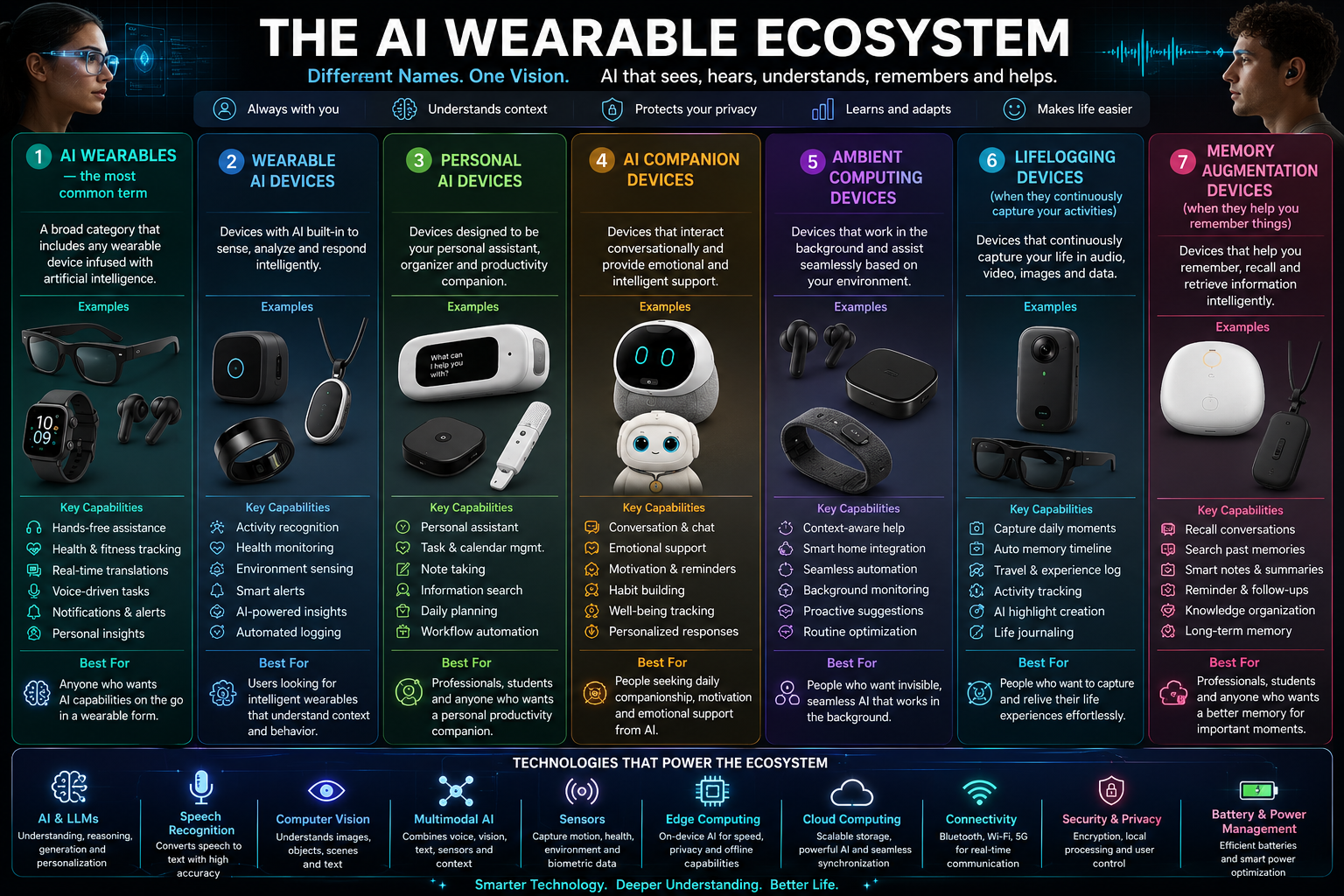
The Emerging Market of AI Wearables, Personal AI Devices, AI Companion Devices, Ambient Computing, Lifelogging Devices, and Memory Augmentation Technology
Introduction
Artificial Intelligence is moving beyond screens. For many years, people interacted with AI through laptops, smartphones, web apps, and chatbots. But a new wave of technology is now bringing AI closer to the human body, daily routine, personal memory, work life, health, travel, communication, and lifestyle.
This new category is commonly known as AI Wearables, but it also includes several related names such as Wearable AI Devices, Personal AI Devices, AI Companion Devices, Ambient Computing Devices, Lifelogging Devices, and Memory Augmentation Devices.
These devices are not just gadgets. They represent a major shift in how humans may interact with computers in the future. Instead of opening an app, typing a question, or searching manually, people may soon wear devices that can listen, observe, remember, summarize, assist, translate, guide, and respond in real time.
The market is still young, but it is growing fast. AI wearables may become one of the most important technology categories of the next decade.
What Are AI Wearables?
AI Wearables are smart devices worn on the body that use artificial intelligence to help users in real-world situations.
They may come in many forms, including:
- Smart glasses
- AI pins
- AI pendants
- AI rings
- AI earbuds
- Smart watches
- Clip-on cameras
- Wearable voice recorders
- Health monitoring devices
- AR and mixed-reality glasses
- Personal memory devices
The main purpose of these devices is to make AI more natural, personal, and always available.
Instead of using AI only when sitting at a computer, people can use AI while walking, driving, working, shopping, traveling, attending meetings, cooking, learning, exercising, or spending time with family.
Why This Market Is Emerging Now
The AI wearable market is growing because several technologies have become mature at the same time.
First, AI models have become much more powerful. They can now understand voice, images, video, text, location, and context. This makes it possible for a small wearable device to act like a smart assistant.
Second, hardware has improved. Cameras, microphones, sensors, batteries, and wireless chips have become smaller and more efficient. This allows companies to build lightweight devices that people can wear comfortably.
Third, people are looking for hands-free computing. Smartphones are powerful, but they still require users to look down, unlock screens, open apps, and type. AI wearables promise a more natural experience.
Fourth, productivity needs are increasing. Professionals attend many meetings, handle many tasks, and consume large amounts of information. Devices that can summarize conversations, capture action items, and remember details can save time.
Fifth, people want better memory support. Modern life is overloaded with messages, meetings, calls, videos, ideas, and tasks. Memory augmentation devices try to solve this problem by helping people recall important moments.
Sixth, the creator economy is growing. Many people now create content for social media, learning platforms, business branding, and personal storytelling. Wearable cameras and AI smart glasses can help capture natural point-of-view content.
Together, these trends are creating a strong foundation for the AI wearable market.
Different Names Used in This Market
Although people often use the term AI wearables, the market has many subcategories. Each term describes a slightly different type of device or use case.
1. AI Wearables
AI Wearables is the most common and broadest term. It includes any wearable device that uses artificial intelligence to provide assistance, automation, analysis, memory, health tracking, communication, or real-world understanding.
Examples include AI glasses, AI pendants, AI pins, AI rings, AI earbuds, AI smart watches, and wearable AI recorders.
Common Use Cases
- Voice assistant
- Real-time translation
- Meeting summaries
- Health tracking
- Fitness coaching
- Visual search
- Navigation support
- Hands-free photo and video capture
- Personal memory search
- Productivity reminders
Best For
AI wearables are best for users who want AI support throughout the day without depending only on a phone or laptop.
2. Wearable AI Devices
Wearable AI Devices is a more technical way to describe AI-powered hardware worn on the body.
This term is often used by companies, researchers, investors, and technology analysts. It focuses on the device itself and its AI capabilities.
A wearable AI device may include:
- Microphones
- Cameras
- Motion sensors
- Biometric sensors
- Location sensors
- Speakers
- Displays
- Cloud AI integration
- On-device AI processing
Common Use Cases
- Capturing voice notes
- Recording meetings
- Monitoring health data
- Detecting user activity
- Providing contextual suggestions
- Giving reminders
- Recognizing objects or scenes
- Supporting accessibility
Best For
Wearable AI devices are best for professionals, students, creators, healthcare users, travelers, and people who want a smarter daily assistant.
3. Personal AI Devices
Personal AI Devices are designed to act as personal assistants. They may be wearable or pocket-sized, but their main purpose is to help users with daily tasks, decisions, reminders, communication, search, and automation.
These devices try to become a personal layer between the user and the digital world.
Common Use Cases
- Answering questions
- Managing reminders
- Translating conversations
- Summarizing information
- Recording ideas
- Searching personal notes
- Helping with daily planning
- Connecting with apps and services
- Providing quick voice-based assistance
Best For
Personal AI devices are best for people who want a dedicated AI assistant that is separate from their smartphone.
They are especially useful for busy professionals, entrepreneurs, students, consultants, travelers, and people who prefer voice-first computing.
4. AI Companion Devices
AI Companion Devices focus on emotional interaction, personal conversation, companionship, and social support.
Unlike productivity-first AI devices, AI companion devices are designed to feel more personal. They may listen to users, respond to their emotions, send supportive messages, and create a feeling of digital companionship.
This category is both exciting and controversial.
Common Use Cases
- Emotional support
- Casual conversation
- Personal reflection
- Mood-based interaction
- Daily check-ins
- Loneliness reduction
- Friendly reminders
- Context-aware messages
Best For
AI companion devices may be useful for people who enjoy personal AI interaction, emotional journaling, reflective conversations, or experimental technology.
However, users should be careful. AI companionship can feel powerful, but it should not replace real human relationships, medical care, therapy, or professional support.
5. Ambient Computing Devices
Ambient Computing Devices are devices that work quietly in the background. The user does not need to actively open an app or type commands every time.
The idea of ambient computing is that technology becomes part of the environment. It understands context and offers help at the right moment.
In AI wearables, ambient computing means the device may listen, observe, detect, summarize, and assist without constant manual input.
Common Use Cases
- Passive meeting capture
- Automatic reminders
- Context-aware suggestions
- Daily summaries
- Location-based notes
- Activity detection
- Smart notifications
- Personal routine tracking
- Hands-free assistance
Best For
Ambient computing devices are best for people who want AI to support them naturally in the background.
This category has strong potential in offices, homes, healthcare, education, logistics, field work, customer service, and personal productivity.
6. Lifelogging Devices
Lifelogging Devices continuously or regularly capture parts of a person’s life. They may record photos, videos, audio, location, activities, or daily events.
The goal is to create a searchable personal timeline.
Lifelogging is not a new idea, but AI has made it more powerful. Earlier lifelogging devices could capture data, but they could not understand it very well. Modern AI can organize, summarize, tag, search, and convert raw life data into meaningful memories.
Common Use Cases
- Capturing daily moments
- Creating personal vlogs
- Remembering travel experiences
- Recording family activities
- Capturing events hands-free
- Searching past memories
- Creating AI-generated journals
- Building visual timelines
- Documenting hobbies, fitness, and lifestyle
Best For
Lifelogging devices are best for travelers, creators, parents, vloggers, researchers, athletes, and people who want to capture personal memories.
They are also useful for people who want a visual record of important experiences.
Important Concern
Lifelogging devices raise serious privacy questions because they may capture other people without their permission. This makes social acceptance very important.
7. Memory Augmentation Devices
Memory Augmentation Devices are designed to help people remember information, conversations, tasks, meetings, and decisions.
These devices are especially useful in modern work life, where people attend many meetings and manage many responsibilities.
Instead of depending only on human memory, users can search their recorded conversations, summaries, notes, and action items.
Common Use Cases
- Remembering meetings
- Finding past conversations
- Creating action items
- Summarizing calls
- Capturing lectures
- Recording interviews
- Preparing follow-ups
- Building a personal knowledge base
- Supporting people with memory challenges
Best For
Memory augmentation devices are best for managers, founders, engineers, consultants, sales professionals, students, teachers, doctors, lawyers, journalists, and anyone who handles large amounts of spoken information.
This may become one of the most practical AI wearable categories because it solves a real daily problem.
Main Product Categories in the AI Wearable Market
1. AI Smart Glasses
AI smart glasses are one of the most promising product categories. They combine eyewear with cameras, microphones, speakers, and AI assistants.
Basic Use Cases
- Take photos and videos hands-free
- Ask AI about what you see
- Listen to music
- Make calls
- Translate conversations
- Capture point-of-view content
- Get navigation help
- Read messages
- Create social media content
Best For
AI smart glasses are best for creators, travelers, professionals, students, and users who want hands-free computing.
They may become one of the most mainstream AI wearable formats because people are already comfortable wearing glasses.
2. AI Pendants
AI pendants are small devices worn around the neck or clipped to clothing. They usually focus on voice capture, memory, conversation summaries, or companionship.
Basic Use Cases
- Record conversations
- Summarize meetings
- Capture personal thoughts
- Send reminders
- Provide companionship
- Create memory timelines
- Search past conversations
Best For
AI pendants are best for professionals, students, researchers, consultants, and people who want memory support throughout the day.
They are also popular among startups because pendants are easier to design than smart glasses.
3. AI Pins
AI pins are small wearable devices attached to clothing. They are usually designed to work as personal assistants.
Basic Use Cases
- Voice commands
- AI search
- Translation
- Camera-based queries
- Messaging
- Quick information access
Best For
AI pins are best for users who want an assistant without wearing glasses or holding a phone.
However, this category is still risky because earlier AI pin products struggled with battery life, speed, usefulness, and user adoption.
4. AI Rings
AI rings are mainly focused on health, sleep, recovery, and wellness. Many AI rings use sensor data and machine learning to provide health insights.
Basic Use Cases
- Sleep tracking
- Heart rate monitoring
- Recovery insights
- Activity tracking
- Stress tracking
- Readiness scores
- Women’s health tracking
- Long-term wellness analysis
Best For
AI rings are best for health-conscious users, athletes, executives, biohackers, and people who want passive health tracking without wearing a bulky watch.
5. AI Earbuds
AI earbuds are becoming more intelligent with real-time translation, voice assistance, noise control, meeting transcription, and contextual audio.
Basic Use Cases
- Live translation
- Voice assistant
- Meeting transcription
- Smart noise cancellation
- Audio summaries
- Hands-free calling
- Language learning
Best For
AI earbuds are best for travelers, remote workers, students, language learners, and professionals who spend a lot of time in calls.
6. AI Watches and Fitness Wearables
Smart watches are already popular, and AI is making them more useful. AI can analyze patterns in sleep, fitness, stress, heart rate, and daily routine.
Basic Use Cases
- Health tracking
- Fitness coaching
- Sleep analysis
- Stress detection
- Workout suggestions
- Heart alerts
- Smart notifications
- Personal habit tracking
Best For
AI watches are best for general users, fitness lovers, professionals, and health-conscious people.
This is currently one of the most mature wearable categories.
7. AI Clip-on Cameras
AI clip-on cameras are small wearable cameras designed to capture photos, videos, or moments from daily life.
Basic Use Cases
- Lifelogging
- Travel recording
- Personal vlogging
- Family memories
- Event documentation
- AI-generated highlight videos
- Searchable visual memories
Best For
AI clip-on cameras are best for creators, travelers, parents, vloggers, and people who want visual memory capture.
However, they may face privacy and social acceptance challenges.
Why AI Wearables Could Become a Huge Market
1. They Reduce Phone Dependency
People spend too much time looking at phones. AI wearables may reduce screen time by allowing users to interact with AI through voice, gestures, audio, or visual overlays.
2. They Make AI More Personal
AI becomes more useful when it understands personal context. Wearables can collect real-world signals such as voice, activity, location, health data, and visual surroundings.
3. They Improve Productivity
Meeting summaries, reminders, action items, and searchable conversations can save many hours for professionals.
4. They Support Health and Wellness
AI wearables can help users understand sleep, stress, recovery, activity, heart rate, and habits.
5. They Help Creators Capture Content
Hands-free recording is useful for vloggers, educators, travelers, fitness creators, and social media professionals.
6. They Support Accessibility
AI wearables can help people with visual, hearing, language, mobility, or memory challenges.
7. They Enable Real-Time Translation
Travelers and global professionals can use AI wearables to translate conversations more naturally.
8. They Create a New Personal Data Layer
Over time, AI wearables may become personal knowledge systems that understand a user’s history, habits, preferences, and routines.
Business Opportunities in the AI Wearable Market
The AI wearable market creates opportunities across many industries.
1. Hardware Manufacturing
Companies can build glasses, pendants, rings, earbuds, watches, cameras, and sensors.
2. AI Software Platforms
AI wearables need software for transcription, summarization, object recognition, translation, search, personalization, and automation.
3. Healthcare and Wellness
AI wearables can support remote health monitoring, chronic disease management, sleep improvement, stress tracking, elderly care, and preventive health.
4. Enterprise Productivity
Companies can use AI wearable tools for meetings, training, field support, inspections, customer service, and documentation.
5. Education
Students can use AI devices to record lectures, summarize lessons, translate content, and create study notes.
6. Travel and Hospitality
AI wearables can help tourists with translation, navigation, local recommendations, and travel documentation.
7. Creator Economy
Creators can use AI glasses and cameras to capture content naturally and generate videos, captions, summaries, and posts.
8. Personal Knowledge Management
Memory augmentation devices may become the next version of personal knowledge tools.
9. Accessibility Technology
AI wearables can help visually impaired users, hearing-impaired users, elderly users, and people with memory difficulties.
10. Workplace Safety and Field Operations
Workers in factories, construction, logistics, and maintenance can use AI wearables for real-time instructions, documentation, safety alerts, and remote support.
Challenges in the AI Wearable Market
The opportunity is large, but the market also has serious challenges.
1. Privacy
Many AI wearables record audio, video, or personal data. This creates concerns for users and people around them.
2. Social Acceptance
People may feel uncomfortable around devices that can record them. Smart glasses and lifelogging cameras must solve this problem carefully.
3. Battery Life
Always-on AI devices need strong battery life. If the device dies quickly, users will stop wearing it.
4. Accuracy
AI summaries, translations, and memory search must be reliable. Wrong information can create confusion or risk.
5. Data Security
Personal recordings, health data, and private conversations must be protected with strong security.
6. Comfort
A wearable device must be lightweight, comfortable, and stylish. If it feels awkward, users will not wear it daily.
7. Clear Use Case
Many AI gadgets fail because they are interesting but not necessary. Successful devices must solve a real problem.
8. Cost
Some AI wearables are expensive. Wider adoption will require better pricing.
9. Regulation
Different countries may create rules around recording, biometric data, health data, and AI-generated decisions.
10. Long-Term Support
AI hardware depends heavily on cloud services. If a company shuts down, the device may lose major features.
Future of AI Wearables
The future of AI wearables will likely move in several directions.
1. Smaller and More Natural Devices
Devices will become lighter, more stylish, and easier to wear.
2. More On-Device AI
More processing will happen directly on the device, improving speed, privacy, and offline support.
3. Better Personal Memory
AI devices will become better at remembering conversations, tasks, relationships, places, and routines.
4. Integration With Daily Apps
AI wearables will connect with calendars, email, messaging apps, health platforms, maps, productivity tools, and workplace systems.
5. More Enterprise Adoption
Companies may use AI wearables for training, operations, safety, field work, and meeting productivity.
6. Growth of AI Smart Glasses
Smart glasses may become the most important AI wearable category because they combine vision, voice, audio, camera, and display.
7. Stronger Privacy Controls
Successful companies will need visible recording indicators, consent controls, local storage options, encryption, and clear data deletion features.
8. Rise of Personal AI Memory
In the future, people may have personal AI systems that remember their work, learning, health, relationships, and life experiences.
This could become a new form of digital identity.
Who Should Buy AI Wearables Today?
Professionals
Buy AI note-taking or memory devices if you attend many meetings or need better follow-up tracking.
Students
Use AI recorders or smart glasses for lectures, study notes, translation, and research.
Creators
Use AI glasses or lifelogging cameras for hands-free content capture.
Travelers
Use AI glasses or earbuds for translation, navigation, and travel documentation.
Health-Conscious Users
Use AI rings, watches, and wellness wearables for sleep, recovery, activity, and stress insights.
Developers
Use open-source AI wearable platforms to experiment with new AI applications.
Early Adopters
Try AI companion devices, ambient computing devices, and personal AI gadgets if you enjoy exploring future technology.
Which Category Has the Biggest Potential?
The biggest market potential may come from five areas:
1. AI Smart Glasses
Because they combine camera, voice, audio, display, and real-world AI.
2. AI Meeting and Memory Devices
Because they solve a clear productivity problem.
3. AI Health Wearables
Because health tracking is already proven and AI can make it more useful.
4. AI Translation Wearables
Because global travel and international work are increasing.
5. AI Ambient Assistants
Because people want AI that works naturally in the background.
Final Thoughts
AI wearables are still in the early stage, but the direction is clear. Technology is moving from screens to the human environment. AI is becoming more personal, more contextual, and more connected to daily life.
The market includes many names: AI Wearables, Wearable AI Devices, Personal AI Devices, AI Companion Devices, Ambient Computing Devices, Lifelogging Devices, and Memory Augmentation Devices.
Each name represents a different part of the same big shift: AI is becoming something we carry, wear, and live with.
The winners in this market will not be the devices with the most hype. The winners will be the devices that are useful, comfortable, affordable, private, secure, socially acceptable, and reliable.
For businesses, this is an emerging market with huge opportunities in hardware, software, healthcare, productivity, education, travel, accessibility, and personal knowledge management.
For users, AI wearables may become the next big step after smartphones.
The future of AI may not only be on your desk or in your pocket. It may be on your face, wrist, finger, ear, shirt, or around your neck — quietly helping you remember, understand, communicate, and live smarter.
One perspective that could strengthen this discussion is the hidden operational complexity behind AI wearables as they scale from novelty products into daily infrastructure. Most discussions focus on market growth and user convenience, but the harder challenge is sustaining these ecosystems over time. Personal AI devices rely heavily on cloud inference, continuous synchronization, model updates, and long-term data retention — all of which introduce rising infrastructure costs, latency concerns, and vendor lock-in risks. From an engineering standpoint, the real differentiator may not be who launches the smartest companion device first, but who can maintain reliability, privacy guarantees, low-cost inference, and seamless interoperability across ecosystems for years. Similar to IoT platforms, device observability, OTA updates, security patching, consent management, and export portability will likely become critical adoption factors, especially as users accumulate years of personal memory and behavioral data.
Nice explanation of the emerging AI wearable market, clearly shows how fast this industry is growing.
An important factor often overlooked is long-term usability. As AI wearables become more capable, managing privacy, battery life, and seamless integration across different devices may be just as important as adding new AI features.
AI wearables are quickly becoming more than just gadgets — they are turning into personal assistants that help with daily life and productivity. From smart rings to AI pendants, the focus is now shifting toward real use cases like memory, health, and communication. Still, privacy and practicality will decide how widely they are adopted.
A big challenge for AI wearables will be maintaining user trust over time. Beyond new features, privacy, transparent data handling, battery life and seamless integration into daily life will be key to whether these devices go mainstream or stay as niche products.
A key missing aspect in AI wearable devices is the real-world impact of always-on data capture, especially around privacy and data retention challenges.
Continuous audio and visual processing can quickly increase storage, cloud costs, and battery drain.Most solutions still rely heavily on cloud inference, which adds latency and dependency on network stability.Edge AI helps, but running advanced models locally on small devices is still a major limitation.Ultimately, user trust and privacy acceptance will decide real adoption more than features.
A great read that explains the growing AI wearables market in a simple way and highlights where these devices can fit into everyday life.
One aspect that deserves more attention is what happens after users have accumulated months or years of personal context inside these devices. The article discusses market growth and emerging products, but long-term data portability and vendor lock-in could become major adoption barriers. If a user switches from one AI wearable ecosystem to another, can their memories, preferences, interaction history, and personalized models move with them, or do they start from scratch? The industry may eventually need standards similar to data portability frameworks in cloud platforms. Without interoperability, organizations building AI wearables could face rising support costs, user trust issues, regulatory scrutiny, and customer churn as personal AI companions become repositories of highly valuable behavioral data rather than just hardware products.
This was a fascinating read because it explains emerging AI devices in a simple way while highlighting their potential impact.
The StocksMantra article highlights how AI wearables are evolving into a new computing era where devices are becoming always-on personal assistants that combine memory, productivity, and real-world awareness, reshaping how we interact with technology every day.
Really enjoyed this article! The way you explained the growing AI wearables market made it easy to understand and very insightful.
The AI wearables market is rapidly evolving, driven by edge AI, LLMs, and ambient computing, enabling smarter, always-on, and highly personalized digital experiences. Thanks for sharing this valuable insight!
Nice article with a clear view of the growing AI wearables market. Thanks for sharing such helpful insights in a simple way.
Love this breakdown! It really highlights how AI is becoming more of a personal partner than just a tool. Thanks for sharing such a clear and thoughtful perspective!
A key challenge for AI wearables may not be the AI capability itself but how these devices fit into daily workflows. Battery life, continuous data processing, privacy controls, offline functionality, and user trust will strongly influence adoption. The companies that solve these practical engineering constraints may have a bigger advantage than those focusing only on advanced AI features.