Introduction
Container Image Scanners are essential tools for identifying security vulnerabilities, misconfigurations, outdated packages, and compliance risks inside container images before they are deployed in production. They enable DevSecOps, cloud security, and platform engineering teams to ensure that containerized workloads are secure, compliant, and free from exploitable weaknesses. As containerized applications become the backbone of cloud-native architectures, scanning container images has become a mandatory step in the software delivery pipeline.
Modern container image scanners provide more than basic vulnerability detection. They offer Software Bill of Materials (SBOM) generation, policy enforcement, CI/CD integration, Kubernetes runtime scanning, license compliance, vulnerability prioritization, and automated remediation guidance. These tools help organizations maintain secure pipelines, meet regulatory requirements, and prevent exposure of critical applications to threats.
Real-world use cases include:
- Detecting vulnerabilities in container images and dependencies
- Identifying insecure or misconfigured packages
- Enforcing security policies in CI/CD pipelines
- Generating SBOMs for compliance and supply chain management
- Prioritizing and remediating critical risks before deployment
Evaluation Criteria for Buyers
Organizations evaluating container image scanners should consider:
- Coverage of container platforms and registries
- Accuracy and completeness of vulnerability detection
- CI/CD and GitOps pipeline integration
- Policy enforcement and compliance capabilities
- SBOM generation and license checking
- Detection of misconfigurations and embedded secrets
- Kubernetes runtime scanning support
- Scan performance and speed
- Developer workflow integration and ease of use
- Enterprise reporting and remediation guidance
Best for: DevSecOps teams, platform engineers, cloud security teams, enterprises using Kubernetes or Docker, SaaS providers, fintech companies, healthcare organizations, and any team deploying containerized workloads.
Not ideal for: Teams not using containers or only running basic VM workloads. Lightweight scanning may still be useful for minimal container use.
Key Trends in Container Image Scanners
- Shift-left scanning in CI/CD pipelines prevents vulnerabilities before deployment
- SBOM generation is becoming a regulatory requirement for software supply chain visibility
- Runtime scanning detects threats in active container workloads
- Policy enforcement is integrated into pipelines for automated compliance
- AI-assisted prioritization helps teams focus on the most critical vulnerabilities
- Multi-cloud and multi-registry support is expanding
- Integration with GitOps and Infrastructure as Code workflows is accelerating
- Detection of misconfigurations and secrets is increasing
- Developer-friendly remediation workflows are in high demand
- Container security is converging with cloud-native security posture management
How We Selected These Tools
The Top 10 container image scanners were selected based on practical DevSecOps relevance, cloud-native adoption, container coverage, reporting capabilities, and suitability across enterprise, SMB, and developer-focused environments:
- Strong vulnerability detection and accuracy
- Multi-platform container support
- CI/CD and GitOps integration
- Policy enforcement and compliance reporting
- SBOM generation and management
- Runtime container scanning capability
- Developer-friendly remediation workflows
- Enterprise reporting and governance
- Compatibility with registries and Kubernetes
- Open-source and commercial options balance
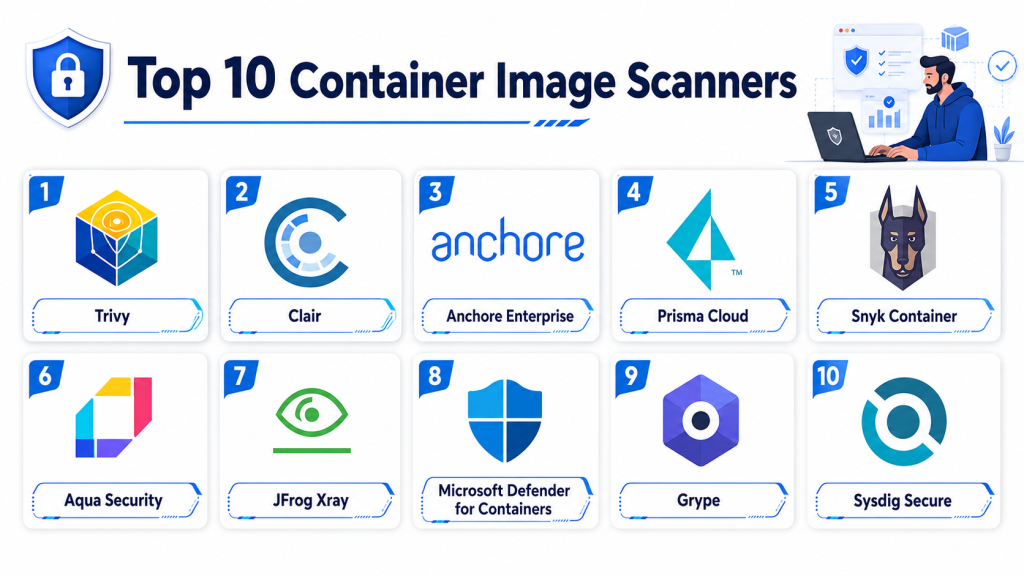
Top 10 Container Image Scanners
1- Trivy
Short description: Trivy is an open-source, lightweight, and fast container image scanner that detects vulnerabilities, misconfigurations, and outdated packages in images, filesystems, and Kubernetes workloads.
Key Features
- OS and application package scanning
- Container image scanning
- IaC and Kubernetes configuration scanning
- SBOM generation support
- CLI and CI/CD integration
- JSON and table output reports
- Fast local scanning for developers
Pros
- Lightweight and fast
- Broad adoption in cloud-native environments
- Easy CI/CD integration
Cons
- Enterprise governance features are limited
- Remediation must be handled externally
- Large-scale scanning requires orchestration
Platforms / Deployment
- Linux / macOS / Windows / Cloud / CI/CD
Security & Compliance
Supports pipeline validation and local scanning. Governance depends on integration into workflows.
Integrations & Ecosystem
- Docker, Kubernetes, Helm, GitHub Actions, GitLab CI/CD, Jenkins
Support & Community
Large open-source community with active cloud-native adoption.
2- Anchore Enterprise
Short description: Anchore Enterprise provides container image scanning, policy enforcement, and SBOM management for cloud-native applications.
Key Features
- Container image vulnerability scanning
- Policy enforcement
- SBOM generation and analysis
- Registry integration
- CI/CD pipeline scanning
- Kubernetes runtime support
- Remediation guidance
Pros
- Policy-driven governance
- SBOM and container support
- Enterprise reporting
Cons
- Enterprise deployment planning required
- Complex multi-cluster setups
- Source-code SCA needs additional tools
Platforms / Deployment
- Cloud / Self-hosted / Kubernetes
Security & Compliance
Supports RBAC, audit reporting, and policy enforcement.
Integrations & Ecosystem
- Kubernetes, Docker, Docker registries, CI/CD platforms, Helm, SBOM pipelines
Support & Community
Enterprise support ecosystem with open-source roots.
3- Clair
Short description: Clair is an open-source static analysis tool for vulnerabilities in container images, detecting CVEs in OS packages and layers.
Key Features
- OS-level vulnerability scanning
- CI/CD integration
- JSON report outputs
- OCI image support
- API for automation
Pros
- Open-source and lightweight
- Good OS package detection
- CI/CD integration
Cons
- Limited enterprise reporting
- Remediation guidance is minimal
- Not focused on application packages
Platforms / Deployment
- Linux / Cloud / CI/CD / Self-hosted
Security & Compliance
Supports pipeline scanning and vulnerability reporting.
Integrations & Ecosystem
- Docker registries, Kubernetes, Jenkins, GitHub Actions, GitLab CI/CD
Support & Community
Active open-source community.
4- Aqua Trivy Enterprise
Short description: Aqua Trivy Enterprise extends Trivy for enterprise use with enhanced governance, policy enforcement, and multi-cloud support.
Key Features
- Container image and registry scanning
- Policy enforcement
- Vulnerability and misconfiguration reporting
- SBOM generation
- Multi-cloud support
- Kubernetes runtime scanning
- CI/CD integration
Pros
- Enterprise governance workflows
- Multi-cloud and Kubernetes support
- CI/CD integration
Cons
- Premium pricing
- Policy configuration required
- Large deployments need planning
Platforms / Deployment
- Cloud / Kubernetes / CI/CD
Security & Compliance
Supports RBAC, policy enforcement, audit visibility.
Integrations & Ecosystem
- Kubernetes, Docker, CI/CD, Helm, SBOM pipelines
Support & Community
Enterprise support with cloud-native adoption.
5- Sysdig Secure
Short description: Sysdig Secure provides container image scanning, runtime security, Kubernetes compliance, and DevSecOps integration.
Key Features
- Container vulnerability scanning
- Kubernetes runtime scanning
- Policy enforcement
- CI/CD integration
- Compliance dashboards
- SBOM generation
- Remediation guidance
Pros
- Runtime scanning
- Enterprise policy enforcement
- Kubernetes coverage
Cons
- Enterprise pricing
- Setup complexity
- Platform familiarity required
Platforms / Deployment
- Cloud / Kubernetes / On-premises
Security & Compliance
Supports RBAC, audit logging, policy enforcement.
Integrations & Ecosystem
- Kubernetes, Docker, CI/CD pipelines, Helm, Artifact registries
Support & Community
Enterprise-focused support ecosystem.
6- Prisma Cloud Compute
Short description: Prisma Cloud Compute offers container and host security, runtime protection, image scanning, and compliance monitoring.
Key Features
- Container and host scanning
- Runtime security
- CI/CD integration
- Policy enforcement
- Vulnerability management
- Kubernetes runtime protection
- Compliance dashboards
Pros
- Enterprise-grade security
- Container ecosystem coverage
- Compliance workflows
Cons
- Premium product
- Learning curve
- Large-scale setup planning required
Platforms / Deployment
- Cloud / Kubernetes / Hybrid
Security & Compliance
Supports RBAC, policy enforcement, audit visibility.
Integrations & Ecosystem
- Kubernetes, Docker, CI/CD, Cloud registries
Support & Community
Enterprise support and cloud-native adoption.
7- Harbor
Short description: Harbor is an open-source container registry with built-in scanning and policy enforcement.
Key Features
- Container image scanning
- Policy enforcement
- RBAC support
- Multi-tenant registry
- CI/CD integration
- SBOM support
- Web UI and API
Pros
- Open-source
- Registry and vulnerability scanning
- Multi-tenant support
Cons
- Limited vulnerability intelligence
- Remediation minimal
- Enterprise reporting requires integration
Platforms / Deployment
- Cloud / Self-hosted / Kubernetes
Security & Compliance
Supports RBAC, policy enforcement, audit logs.
Integrations & Ecosystem
- Docker, Kubernetes, CI/CD pipelines, Helm, SBOM pipelines
Support & Community
Active open-source community.
8- Twistlock Community
Short description: Twistlock Community provides free container image scanning and basic vulnerability detection for small teams.
Key Features
- Basic container scanning
- CI/CD integration
- Limited policy enforcement
- Container registry scanning
- Community updates
Pros
- Free
- Lightweight
- Easy adoption
Cons
- Limited feature set
- Enterprise governance not supported
- Manual remediation required
Platforms / Deployment
- Cloud / Kubernetes / CI/CD
Security & Compliance
Supports basic scanning and reporting.
Integrations & Ecosystem
- Docker, Kubernetes, CI/CD pipelines
Support & Community
Open-source community support.
9- Clair Enterprise (Quay.io)
Short description: Clair Enterprise integrates with Quay.io to provide container scanning and alerts for enterprise registries.
Key Features
- Vulnerability detection
- Registry integration
- CI/CD pipeline scanning
- Policy enforcement
- Kubernetes compatibility
- Notification workflows
Pros
- Quay.io registry integration
- Automated vulnerability alerts
- Enterprise support
Cons
- Quay.io focused
- Limited reporting
- Requires expertise
Platforms / Deployment
- Cloud / Kubernetes / Self-hosted
Security & Compliance
Supports policy enforcement, RBAC, audit visibility.
Integrations & Ecosystem
- Quay.io, Kubernetes, CI/CD, Docker registries
Support & Community
Enterprise support with community contributions.
10- Grype
Short description: Grype is an open-source container image and SBOM scanner for vulnerability detection.
Key Features
- Container and filesystem scanning
- SBOM-based vulnerability detection
- CI/CD integration
- Multiple output formats
- Lightweight CLI
Pros
- Open-source and lightweight
- SBOM integration
- Fast scanning
Cons
- Remediation workflows minimal
- Enterprise reporting limited
- Large-scale orchestration requires setup
Platforms / Deployment
- Linux / macOS / Windows / Self-hosted / CI/CD
Security & Compliance
Supports SBOM-driven vulnerability analysis and pipeline scanning.
Integrations & Ecosystem
- Syft, Docker, Kubernetes, CI/CD, artifact repositories
Support & Community
Active open-source community.
Comparison Table
| Tool Name | Best For | Platform Supported | Deployment | Standout Feature | Public Rating |
|---|---|---|---|---|---|
| Trivy | Lightweight CI/CD scanning | Linux / macOS / Windows / Cloud | Self-hosted / CI/CD | Fast container scanning | N/A |
| Anchore Enterprise | Enterprise container scanning | Cloud / Kubernetes | Cloud / Self-hosted | Policy-driven SBOM scanning | N/A |
| Clair | Open-source CVE detection | Linux / Cloud | Self-hosted | OS package scanning | N/A |
| Aqua Trivy Enterprise | Multi-cloud scanning | Cloud / Kubernetes | Cloud / Hybrid | Kubernetes governance | N/A |
| Sysdig Secure | Runtime & CI/CD scanning | Cloud / Kubernetes | Cloud / On-prem | Runtime vulnerability detection | N/A |
| Prisma Cloud Compute | Enterprise runtime security | Cloud / Kubernetes | Cloud / Hybrid | Runtime & compliance | N/A |
| Harbor | Registry scanning | Cloud / Kubernetes | Cloud / Self-hosted | Multi-tenant registry scanning | N/A |
| Twistlock Community | Lightweight open-source scanning | Cloud / Kubernetes | Cloud / CI/CD | Free container scanning | N/A |
| Clair Enterprise | Enterprise registry integration | Cloud / Kubernetes | Cloud / Self-hosted | Quay.io integration | N/A |
| Grype | SBOM-driven scanning | Linux / macOS / Windows | Self-hosted / CI/CD | SBOM vulnerability detection | N/A |
Evaluation & Scoring of Container Image Scanners
| Tool Name | Core 25% | Ease 15% | Integrations 15% | Security 10% | Performance 10% | Support 10% | Value 15% | Weighted Total |
|---|---|---|---|---|---|---|---|---|
| Trivy | 9 | 9 | 8 | 8 | 9 | 8 | 10 | 8.9 |
| Anchore Enterprise | 9 | 7 | 8 | 9 | 8 | 8 | 7 | 8.0 |
| Clair | 8 | 8 | 7 | 8 | 8 | 7 | 8 | 7.7 |
| Aqua Trivy Enterprise | 9 | 7 | 8 | 9 | 8 | 8 | 7 | 8.0 |
| Sysdig Secure | 9 | 7 | 8 | 9 | 8 | 8 | 7 | 8.0 |
| Prisma Cloud Compute | 9 | 7 | 8 | 9 | 8 | 8 | 7 | 8.0 |
| Harbor | 8 | 8 | 7 | 8 | 8 | 7 | 8 | 7.7 |
| Twistlock Community | 7 | 9 | 7 | 7 | 8 | 6 | 10 | 7.8 |
| Clair Enterprise | 8 | 7 | 8 | 8 | 8 | 7 | 7 | 7.6 |
| Grype | 8 | 8 | 8 | 8 | 8 | 7 | 10 | 8.2 |
Which Container Image Scanner Is Right for You?
Solo / Freelancer
Trivy, Grype, or Twistlock Community are ideal for lightweight scanning and easy CI/CD integration.
SMB
Trivy, Harbor, Sysdig Secure, or Aqua Trivy Enterprise provide container scanning, policy enforcement, and CI/CD integration.
Mid-Market
Anchore Enterprise, Sysdig Secure, Prisma Cloud Compute, or Aqua Trivy Enterprise are suited for container-heavy workloads with SBOM and compliance needs.
Enterprise
Anchore Enterprise, Prisma Cloud Compute, Sysdig Secure, Aqua Trivy Enterprise, Clair Enterprise, or Harbor Enterprise are recommended for runtime security, multi-cloud scanning, policy enforcement, and SBOM governance.
Budget vs Premium
Open-source scanners like Trivy, Grype, Clair, and Twistlock Community are cost-effective. Premium platforms offer governance, SBOM, enterprise reporting, and remediation workflows.
Feature Depth vs Ease of Use
Lightweight scanners provide fast adoption; enterprise platforms offer deeper governance and policy management.
Integrations & Scalability
Scanners should integrate with container registries, Kubernetes, CI/CD, Helm, and SBOM pipelines for scalable security.
Security & Compliance Needs
Prioritize RBAC, audit visibility, policy enforcement, SBOM generation, vulnerability prioritization, and enterprise reporting.
Frequently Asked Questions FAQs
1- What are container image scanners?
Tools that detect vulnerabilities, misconfigurations, outdated packages, and secrets inside container images.
2- Why are container image scanners important?
Containers may contain vulnerable packages or misconfigurations that can compromise cloud-native workloads.
3- Can scanners detect misconfigurations?
Yes. Modern scanners identify insecure configurations and application-level misconfigurations.
4- What is SBOM generation?
SBOM lists all components inside an image, enabling vulnerability management, compliance, and audit.
5- Can scanners integrate with CI/CD pipelines?
Yes. Most integrate with pipelines, registries, and GitOps workflows for automated security checks.
6- Are open-source scanners available?
Yes. Trivy, Grype, Clair, Harbor, and Twistlock Community are widely used.
7- What should teams do after detecting a vulnerability?
Assess severity, patch, update dependencies, rotate credentials if exposed, and document remediation.
8- Can scanners work across multiple container registries?
Yes. Enterprise scanners typically support Docker Hub, AWS ECR, GCP Artifact Registry, Azure Container Registry, and private registries.
9- Do scanners provide remediation guidance?
Many provide automated pull requests, patch recommendations, or alerts for manual fixes.
10- Which scanner is best for enterprise use?
Anchore Enterprise, Prisma Cloud Compute, Sysdig Secure, Aqua Trivy Enterprise, Clair Enterprise, or Harbor Enterprise depending on container usage and compliance needs.
Conclusion
Container Image Scanners are essential for DevSecOps and cloud-native security because containerized workloads are increasingly complex, multi-layered, and dependent on third-party libraries. Open-source scanners like Trivy, Grype, and Clair provide fast, lightweight solutions for small teams, while enterprise platforms such as Anchore, Sysdig Secure, Prisma Cloud Compute, and Aqua Trivy Enterprise provide deeper governance, policy enforcement, SBOM generation, and runtime scanning. The ideal scanner depends on development ecosystem, container registry usage, Kubernetes adoption, compliance needs, and scale. Buyers should shortlist two or three scanners, test them on representative images, evaluate false positives, validate CI/CD integration, and implement clear remediation and governance processes to secure containerized workloads.