Introduction
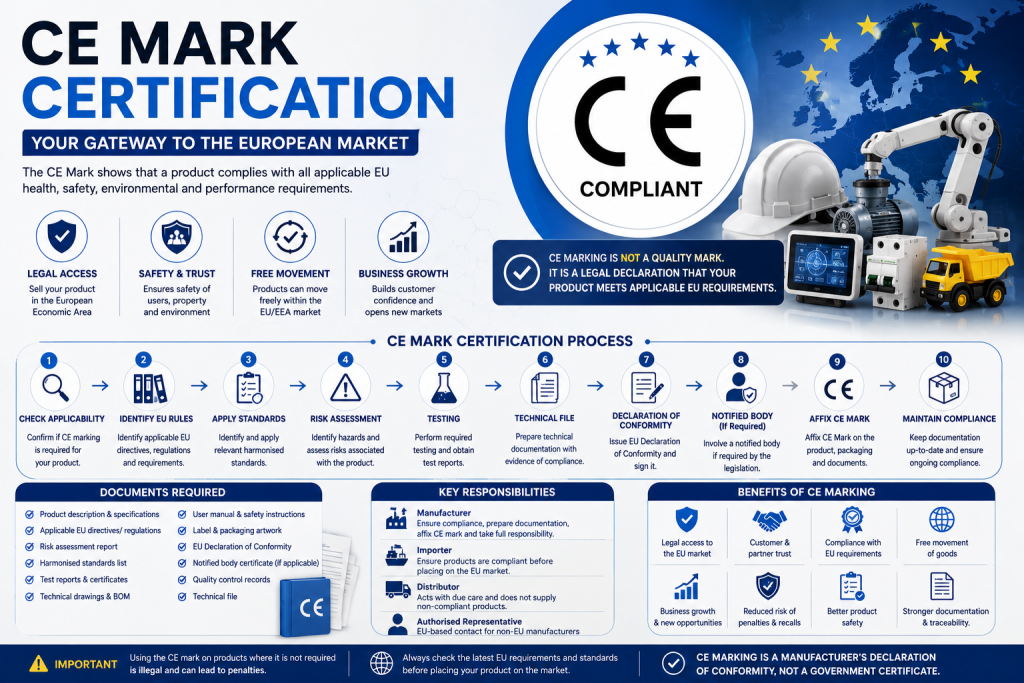
CE Mark Certification is one of the most important compliance requirements for businesses that want to sell certain products in the European Economic Area. Many manufacturers, exporters, importers, and private-label sellers hear about CE marking when they plan to enter the European market, but the process is often misunderstood. Some people think CE is a quality award. Some think it is a general certificate issued by the European Union. Others believe every product needs CE marking. In reality, CE marking is a legal conformity mark that shows a product meets applicable EU health, safety, environmental, and performance requirements. This guide explains CE Mark Certification in a simple, practical, and business-friendly way.
What Is CE Mark Certification?
CE Mark Certification, commonly called CE marking, is a conformity marking used for certain products sold in the European Economic Area. The CE mark shows that the product has been assessed and meets applicable EU requirements.
CE stands for European conformity. When a manufacturer places the CE mark on a product, it means the manufacturer declares that the product complies with relevant EU laws and can be legally placed on the European market.
However, it is important to understand one thing clearly: CE marking is not always a certificate issued by a government body. In many cases, the manufacturer can assess the product and issue the Declaration of Conformity by itself. In some higher-risk product categories, an independent notified body must be involved.
Why CE Marking Is Important
CE marking is important because it allows regulated products to move freely within the European market. It also protects consumers, workers, property, and the environment by ensuring that products meet essential safety and compliance requirements.
For businesses, CE marking matters because it helps with:
- Legal access to the European market
- Product safety compliance
- Customer and distributor confidence
- Import and customs clearance
- Reduced risk of market rejection
- Better documentation and traceability
- Stronger product responsibility
- Easier movement of goods within the European Economic Area
A product that requires CE marking but does not have it may be blocked, withdrawn, recalled, or penalized by market surveillance authorities.
CE Marking Is Not a Quality Mark
One of the biggest misunderstandings is that CE marking means a product is premium quality. This is not correct. CE marking does not mean the product is better than competing products. It means the product meets the minimum legal requirements under applicable EU legislation.
For example, two products may both have CE marking, but one may have better design, durability, features, or performance than the other. CE marking focuses on compliance, safety, and legal market access, not brand superiority.
Who Needs CE Mark Certification?
CE Mark Certification is needed by businesses that manufacture, import, distribute, or sell products covered by EU legislation requiring CE marking.
This may include:
- Manufacturers inside or outside Europe
- Exporters selling products to the EU or EEA
- Importers placing products on the EU market
- Private-label sellers using their own brand name
- Distributors selling regulated products
- Online sellers shipping products to European customers
- Businesses supplying products to European clients
If a company sells a product under its own name or brand, it may be treated as the manufacturer and may carry full responsibility for CE compliance.
Products That Commonly Require CE Marking
CE marking applies only to specific product groups covered by EU harmonised legislation. It is not required for every product.
Common product categories that may require CE marking include:
- Electrical and electronic equipment
- Toys
- Machinery
- Medical devices
- Personal protective equipment
- Construction products
- Gas appliances
- Measuring instruments
- Lifts
- Pressure equipment
- Radio equipment
- Batteries
- Drones
- Recreational craft
- Pyrotechnic products
- Some types of safety equipment
A product may also fall under more than one EU directive or regulation. For example, an electronic toy may need to comply with toy safety rules, electromagnetic compatibility requirements, and restrictions on hazardous substances.
Products That Should Not Carry CE Marking
Not every product should carry CE marking. If a product is not covered by EU rules requiring CE marking, the CE mark should not be placed on it.
Examples of products that may not automatically require CE marking include many ordinary consumer goods, furniture, clothing, cosmetics, and general food products, unless they fall under a specific CE-related regulation.
Using CE marking incorrectly can mislead customers and regulators. Businesses should always check whether CE marking is legally required before applying it.
Main Purpose of CE Marking
The main purpose of CE marking is to show that a product complies with applicable EU product safety and performance requirements.
CE marking helps confirm that:
- The product has been assessed for applicable risks.
- Relevant EU legislation has been identified.
- Applicable standards have been considered.
- Required testing or conformity assessment has been completed.
- Technical documentation has been prepared.
- The Declaration of Conformity has been issued.
- The manufacturer accepts responsibility for compliance.
This makes CE marking a legal responsibility, not just a label.
CE Mark Certification vs CE Marking
Many people use the term “CE Mark Certification,” but the more accurate official term is “CE marking.”
The difference is important:
| Term | Meaning |
|---|---|
| CE Marking | The official conformity mark placed on a product |
| CE Certification | Common business term used to describe the CE compliance process |
| Declaration of Conformity | Legal document signed by the manufacturer declaring compliance |
| Notified Body Certificate | Certificate issued by an approved body when third-party assessment is required |
In simple words, CE marking is the final mark. Certification may or may not involve an external certification body, depending on the product and law.
Main Responsibilities in CE Marking
1. Manufacturer
The manufacturer has the main responsibility for CE compliance. This includes product design, testing, risk assessment, technical documentation, Declaration of Conformity, and proper CE marking.
A manufacturer may be located inside or outside the European Union. If the manufacturer is outside the EU, it still must ensure compliance before placing the product on the EU market.
2. Importer
An importer brings products from outside the EU and places them on the EU market. Importers must ensure that the manufacturer has completed the required conformity assessment and that the product has proper documentation and CE marking.
Importers should check:
- Product compliance
- Manufacturer details
- Technical documentation availability
- Declaration of Conformity
- Product labeling
- Instructions and safety information
- Traceability information
3. Distributor
A distributor sells or supplies products already placed on the EU market. Distributors must act with due care and should not sell products they know or suspect are non-compliant.
Distributors should check:
- CE marking presence where required
- Required documents
- Instructions and safety warnings
- Product traceability
- Proper storage and transport conditions
4. Authorised Representative
An authorised representative is a person or organization based in the EU that is appointed by a non-EU manufacturer to perform certain compliance tasks on its behalf.
This role may include keeping documentation available, cooperating with authorities, and supporting compliance communication.
Step-by-Step CE Mark Certification Process
Step 1: Identify Whether CE Marking Is Required
The first step is to confirm whether your product falls under EU legislation that requires CE marking. This is the most important starting point.
Ask these questions:
- What type of product is it?
- Where will it be sold?
- Is it covered by EU harmonised product rules?
- Does it fall under one or more CE-related directives or regulations?
- Are there special rules for safety, health, environmental protection, or performance?
If CE marking is not required, do not place the CE mark on the product.
Step 2: Identify Applicable EU Directives and Regulations
Once you confirm that CE marking may be required, identify all applicable EU laws.
Examples may include rules related to:
- Machinery
- Electrical safety
- Electromagnetic compatibility
- Radio equipment
- Toys
- Medical devices
- Construction products
- Personal protective equipment
- Pressure equipment
- Hazardous substances
- Ecodesign
- Energy labeling
A product may be covered by multiple rules at the same time. You must comply with all applicable requirements before affixing the CE mark.
Step 3: Identify Applicable Harmonised Standards
Harmonised standards are technical standards that help manufacturers demonstrate compliance with EU requirements. These standards may cover design, testing, safety performance, labeling, instructions, risk control, and technical methods.
Using harmonised standards is often the easiest way to show conformity. However, the manufacturer must ensure that the chosen standards are relevant to the product and current requirements.
Examples of standards may involve:
- Electrical safety testing
- Mechanical safety
- Fire resistance
- Chemical limits
- Electromagnetic compatibility
- Biocompatibility
- Performance testing
- User safety instructions
Step 4: Perform Product Risk Assessment
Risk assessment is a core part of CE compliance. The manufacturer must identify possible hazards linked to the product and decide how those risks will be controlled.
A risk assessment may cover:
- Electrical shock
- Fire hazard
- Mechanical injury
- Sharp edges
- Chemical exposure
- Overheating
- Incorrect use
- Child safety risks
- Pressure failure
- Software malfunction
- Environmental impact
- Installation risks
- Maintenance risks
The goal is to reduce risks through safe design, protective measures, warnings, instructions, and testing.
Step 5: Decide Whether a Notified Body Is Required
Not every product needs a notified body. Some products can be self-assessed by the manufacturer. Other products require third-party assessment by a notified body.
A notified body may be required for higher-risk products or specific conformity assessment procedures. Examples may include certain medical devices, personal protective equipment, pressure equipment, machinery categories, and construction products.
Before choosing a notified body, confirm that the body is legally authorized for your product category and specific conformity assessment procedure.
Step 6: Test the Product
Product testing is often required to prove compliance. Testing may be done in-house if allowed, or through an external laboratory depending on the product and requirements.
Testing may include:
- Safety testing
- Electrical testing
- EMC testing
- Mechanical testing
- Chemical testing
- Material testing
- Environmental testing
- Performance testing
- Durability testing
- Radio frequency testing
- Usability testing
Test reports should be included in the technical documentation.
Step 7: Prepare Technical Documentation
Technical documentation, also called a technical file, is the evidence package that proves the product complies with applicable EU rules.
A technical file may include:
- Product description
- Product model or serial number
- Intended use
- Design drawings
- Manufacturing drawings
- Bill of materials
- Component details
- Risk assessment
- Applicable EU legislation
- Applicable standards
- Test reports
- Quality control records
- User manual
- Safety instructions
- Label artwork
- Packaging details
- Declaration of Conformity
- Notified body certificate, if applicable
The technical file should be clear, organized, and available for authorities if requested.
Step 8: Prepare the EU Declaration of Conformity
The EU Declaration of Conformity is a formal legal document signed by the manufacturer or authorized representative. It states that the product complies with applicable EU requirements.
The Declaration of Conformity generally includes:
- Manufacturer name and address
- Product identification
- Product model or type
- Applicable EU legislation
- Applied standards
- Notified body details, if applicable
- Responsible person name and signature
- Date and place of issue
This document is very important because it connects the product, legal requirements, and manufacturer responsibility.
Step 9: Affix the CE Mark Correctly
After completing conformity assessment and preparing the required documentation, the CE mark can be affixed.
The CE mark should be:
- Visible
- Legible
- Indelible
- Properly proportioned
- At least minimum required size unless product-specific rules say otherwise
- Placed on the product where possible
- Placed on packaging or documents if product placement is not possible
If a notified body was involved in production control, its identification number may need to appear beside the CE mark.
Step 10: Keep Records and Maintain Compliance
CE compliance does not end after placing the product on the market. The manufacturer must keep documentation, monitor changes, review compliance, and respond to authority requests.
Compliance should be reviewed when:
- Product design changes
- Components change
- Suppliers change
- Manufacturing process changes
- Standards are updated
- EU legislation changes
- Product incidents occur
- Customer complaints indicate safety issues
- Market surveillance authorities request information
A CE-marked product must remain compliant as placed on the market.
CE Mark Certification Process Summary
| Step | Action | Output |
|---|---|---|
| 1 | Check if CE marking applies | Product compliance decision |
| 2 | Identify EU laws | List of applicable directives or regulations |
| 3 | Identify standards | Harmonised standards list |
| 4 | Assess risks | Risk assessment report |
| 5 | Check notified body requirement | Self-assessment or third-party route |
| 6 | Test product | Test reports |
| 7 | Prepare technical file | Compliance evidence |
| 8 | Issue Declaration of Conformity | Signed legal declaration |
| 9 | Affix CE mark | Product ready for EU market |
| 10 | Maintain records | Ongoing compliance |
Documents Required for CE Mark Certification
The exact documents depend on the product category, but commonly required documents include:
- Product description
- Product model details
- Manufacturer details
- Design drawings
- Manufacturing process details
- Component list
- Bill of materials
- Supplier documents
- Risk assessment report
- Test reports
- Standards applied
- User manual
- Safety instructions
- Product label
- Packaging artwork
- Technical file
- EU Declaration of Conformity
- Quality control records
- Notified body certificate, if required
- Importer or authorized representative details, where applicable
Good documentation is essential because authorities may ask for evidence of compliance.
What Is a CE Technical File?
A CE technical file is a collection of documents that proves how the product meets applicable EU requirements.
It should answer these questions:
- What is the product?
- What is its intended use?
- Which EU laws apply?
- Which standards were used?
- What risks were identified?
- How were risks controlled?
- What tests were performed?
- What results were achieved?
- What instructions are given to users?
- Who is responsible for compliance?
The technical file does not usually need to be submitted to a central EU authority before selling, unless product-specific rules or notified body procedures require it. However, it must be available if market surveillance authorities request it.
What Is the EU Declaration of Conformity?
The EU Declaration of Conformity is a signed statement that the product complies with applicable EU legislation.
It is one of the most important documents in the CE marking process. Without it, the CE mark is incomplete.
The declaration should be accurate, product-specific, and supported by technical evidence. A generic declaration copied from the internet can create serious compliance risk.
What Is a Notified Body?
A notified body is an independent organization designated by an EU country to assess product conformity when required by EU legislation.
Notified bodies may perform:
- Product examination
- Type testing
- Quality system assessment
- Factory production control review
- Certification
- Ongoing surveillance
- Technical file review
A notified body is not required for every CE-marked product. The need depends on the product category and applicable conformity assessment procedure.
Self-Declaration vs Notified Body Assessment
Some products allow self-declaration, while others require notified body involvement.
| Route | Meaning | Suitable For |
|---|---|---|
| Self-Declaration | Manufacturer assesses product and signs Declaration of Conformity | Lower-risk products where legislation permits |
| Notified Body Assessment | Independent approved body checks conformity | Higher-risk products or legally required categories |
Businesses should never assume that self-declaration is always allowed. The correct route must be confirmed from applicable EU legislation.
Common Product Examples
Electrical Product
An electrical charger may need electrical safety, electromagnetic compatibility, hazardous substance, and labeling compliance. Testing and technical documentation are important.
Toy Product
A toy may require safety assessment for choking hazards, chemicals, sharp edges, flammability, and age-related warnings.
Machinery
A machine may require mechanical safety assessment, guarding, emergency stop features, user instructions, risk assessment, and sometimes notified body involvement.
Medical Device
A medical device usually has more complex conformity requirements, classification rules, clinical evidence, technical documentation, and notified body involvement for many categories.
Personal Protective Equipment
PPE may require testing and certification depending on risk category. Examples include helmets, gloves, masks, safety footwear, and protective clothing.
CE Marking for Importers and Private Label Sellers
Importers and private-label sellers must be careful. If a business imports a product and sells it under its own brand name, it may take on manufacturer responsibilities.
This means it may need to ensure:
- The product is correctly assessed.
- The CE mark is valid.
- The Declaration of Conformity is available.
- Technical documentation can be obtained.
- Labels and instructions are correct.
- The product matches the tested version.
- The supplier has not changed materials or components.
- The product is safe for intended use.
Buying a CE-marked product from a supplier does not automatically remove responsibility from the importer or brand owner.
CE Marking for Online Sellers
Online sellers also need to understand CE compliance. If a product is sold online to customers in the EU or EEA, the product may still need CE marking if it falls under CE-related rules.
Online sellers should check:
- Product category
- Supplier documents
- Test reports
- Declaration of Conformity
- Labeling
- User instructions
- EU contact details where required
- Product traceability
- Safety warnings
Marketplaces may request compliance documents before allowing certain products to be listed.
Common Mistakes in CE Mark Certification
1. Using CE Marking on Products That Do Not Need It
CE marking should only be used where required by EU legislation. Incorrect use can be misleading.
2. Thinking CE Is a Quality Award
CE marking does not prove premium quality. It proves conformity with applicable legal requirements.
3. Copying a Declaration of Conformity
A Declaration of Conformity must be specific to the product, manufacturer, legislation, and standards.
4. Not Identifying All Applicable EU Laws
Many products fall under more than one directive or regulation. Missing one can make the product non-compliant.
5. No Risk Assessment
Risk assessment is a major part of product compliance. Skipping it weakens the technical file.
6. Weak Technical Documentation
Incomplete technical files can create problems during authority checks.
7. Using Invalid Test Reports
Test reports must match the product model, version, components, and applicable standards.
8. Ignoring Product Changes
If design, material, supplier, or component changes, compliance may need review.
9. Choosing the Wrong Notified Body
A notified body must be authorized for the specific product category and procedure.
10. Treating CE Marking as a One-Time Task
CE compliance must be maintained as products, standards, and laws change.
CE Mark Certification Checklist
Use this checklist before placing a product on the EU market:
- Is the product covered by CE marking legislation?
- Have all applicable EU directives or regulations been identified?
- Have relevant harmonised standards been checked?
- Has a product risk assessment been completed?
- Is a notified body required?
- Has product testing been completed?
- Are test reports valid for the exact product model?
- Has the technical file been prepared?
- Has the EU Declaration of Conformity been signed?
- Is the CE mark correctly placed?
- Are labels and instructions complete?
- Are importer or EU representative details included where required?
- Are safety warnings clear?
- Are documents stored properly?
- Is there a process to manage product changes?
- Is market surveillance response planned?
Benefits of CE Mark Certification for Businesses
1. Market Access
CE marking allows eligible products to be placed on the European market.
2. Legal Compliance
It helps businesses meet applicable EU product safety and performance requirements.
3. Customer Confidence
Distributors, importers, and customers are more likely to trust properly documented CE-marked products.
4. Better Product Control
The CE process forces businesses to review design, materials, testing, labeling, and instructions.
5. Reduced Market Risk
Proper compliance reduces the risk of product withdrawal, recall, penalty, or shipment rejection.
6. Improved Documentation
A strong technical file helps the business respond to customer, authority, and distributor questions.
CE Marking Cost Factors
The cost of CE Mark Certification depends on several factors:
- Product type
- Applicable directives or regulations
- Testing requirements
- Need for notified body
- Number of product models
- Technical documentation readiness
- Design complexity
- Risk level
- Laboratory fees
- Consultant support
- Translation and labeling requirements
- Factory inspection, if required
A simple low-risk product may cost less than a medical device, machine, pressure product, or complex electronic equipment.
How Long Does CE Mark Certification Take?
The timeline depends on the product and route. Some products may be assessed quickly if documentation and testing are ready. Complex products may take longer because they require detailed testing, technical review, notified body involvement, design changes, or additional evidence.
The timeline may depend on:
- Product complexity
- Testing laboratory availability
- Technical file quality
- Notified body schedule
- Number of nonconformities
- Design changes needed
- Supplier document availability
Businesses should plan CE compliance early, not after production is complete.
Best Practices for CE Mark Certification
Start Compliance During Product Design
It is easier and cheaper to build compliance into product design than to fix problems after manufacturing.
Use Current Standards
Make sure the standards used are current and relevant.
Keep Supplier Records
Components, materials, and suppliers can affect compliance. Keep supplier declarations, specifications, and test evidence.
Maintain Version Control
Track product versions, design changes, software updates, and component changes.
Prepare Clear Instructions
User manuals and safety instructions are part of compliance. They should be clear and suitable for the target market.
Do Not Depend Only on Supplier Claims
Always verify documents. A supplier saying “CE approved” is not enough.
Keep the Technical File Organized
Authorities may request documents. A messy or incomplete file creates risk.
Review Compliance Regularly
CE compliance should be reviewed when product or legal requirements change.
Real-Life Examples
Example 1: Electronics Importer
An importer buys electronic lamps from outside Europe. The supplier provides a CE logo but no valid test reports. The importer requests EMC and electrical safety reports, prepares documentation, and verifies the Declaration of Conformity before selling.
Example 2: Toy Manufacturer
A toy company designs a new plastic toy. It checks toy safety requirements, chemical limits, small parts hazards, age warnings, and labeling before applying CE marking.
Example 3: Machinery Exporter
A machinery manufacturer wants to sell equipment in the EU. It performs risk assessment, adds guards, prepares manuals, conducts testing, and checks whether notified body involvement is required.
Example 4: Medical Device Startup
A startup develops a medical device. It identifies device classification, prepares technical documentation, builds a quality system, and works with a notified body where required.
Example 5: Private Label Seller
A brand owner sells imported products under its own label. Because the product carries its brand name, it ensures the technical file, Declaration of Conformity, and label details are correct before selling.
Frequently Asked Questions
1. What is CE Mark Certification?
CE Mark Certification is the process of proving that a product meets applicable EU requirements and can carry the CE mark where required.
2. Is CE marking required for all products?
No. CE marking is required only for products covered by EU harmonised rules that specifically require it.
3. Who is responsible for CE marking?
The manufacturer is mainly responsible. Importers, distributors, private-label sellers, and authorized representatives may also have legal responsibilities.
4. Is CE marking a quality certificate?
No. CE marking is not a quality award. It shows conformity with applicable EU legal requirements.
5. Can a manufacturer self-declare CE compliance?
Yes, for some products where EU legislation allows self-assessment. Other products require notified body involvement.
6. What is a notified body?
A notified body is an independent organization authorized to assess conformity for certain products when EU law requires third-party assessment.
7. What is a Declaration of Conformity?
It is a legal document signed by the manufacturer declaring that the product complies with applicable EU requirements.
8. What is a CE technical file?
A CE technical file is a set of documents proving product compliance, including design details, risk assessment, standards, test reports, labels, and instructions.
9. Can I use CE marking without testing?
Testing requirements depend on the product and applicable law. However, the manufacturer must have sufficient evidence to prove compliance.
10. What happens if CE marking is used incorrectly?
Authorities may require correction, withdrawal, recall, sales restriction, penalties, or other enforcement action.
Conclusion
CE Mark Certification is a critical requirement for businesses that want to sell regulated products in the European market. It is not just a symbol printed on packaging. It is a legal declaration that the product meets applicable EU requirements for safety, health, environmental protection, and performance. The process begins with identifying whether CE marking applies, checking relevant EU legislation, assessing risks, testing the product, preparing technical documentation, issuing the Declaration of Conformity, and affixing the CE mark correctly. For manufacturers, importers, exporters, and private-label sellers, proper CE compliance reduces market risk, builds trust, and supports smooth access to the European Economic Area. The best approach is to treat CE marking as a complete product compliance system, not a last-minute label.
A commonly overlooked challenge is managing CE compliance after product launch. Design updates, firmware changes, supplier substitutions, and material modifications can all affect conformity status, making change-control governance just as important as the initial certification process.