Introduction
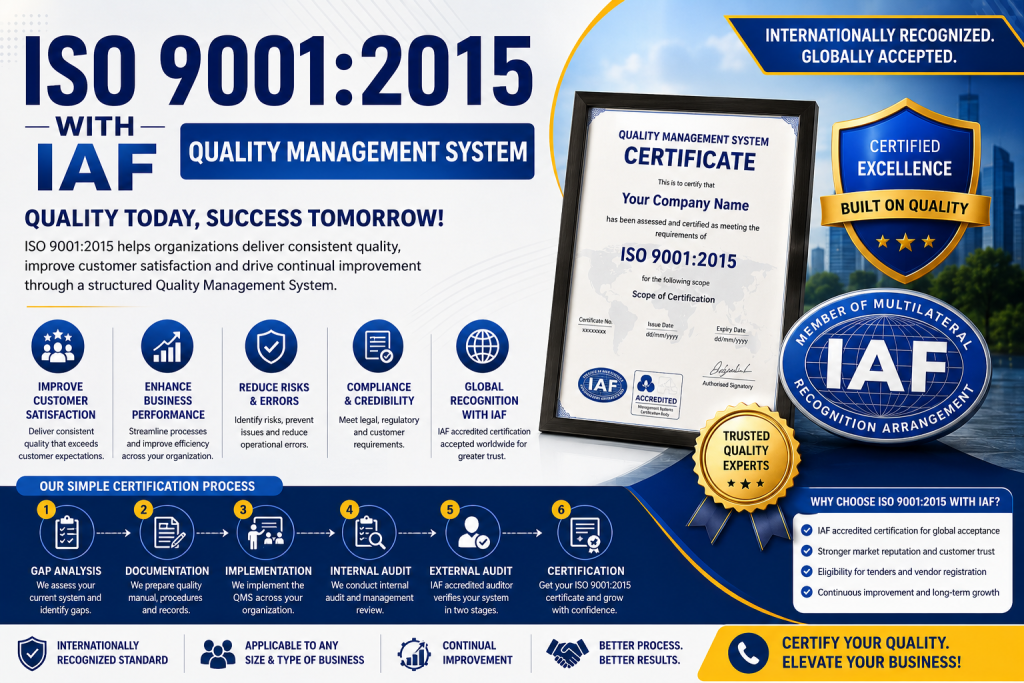
ISO 9001:2015 With IAF is one of the most trusted quality management system certifications for businesses that want to improve process quality, customer satisfaction, documentation, compliance, and business credibility. Many companies apply for ISO 9001:2015 certification because customers, tenders, vendors, and government departments often ask for a recognized quality management certificate.
ISO 9001:2015 is an international standard for Quality Management System, also known as QMS. It helps organizations build a proper system to manage quality in products, services, processes, customer handling, records, responsibilities, audits, and continual improvement.
When people say “ISO 9001:2015 With IAF,” they usually mean an ISO 9001:2015 certificate issued by a certification body that is accredited under the IAF recognition system. This type of certificate has better acceptance because it is linked with an accredited certification process.
This tutorial explains ISO 9001:2015 With IAF in a simple and practical way. It covers meaning, importance, IAF role, documents, requirements, certification process, benefits, mistakes, and FAQs.
What Is ISO 9001:2015?
ISO 9001:2015 is an international standard for Quality Management System. It gives requirements for creating a structured system that helps an organization provide consistent products and services.
In simple words, ISO 9001:2015 helps a business manage quality properly.
It focuses on:
- Customer satisfaction
- Process control
- Quality planning
- Risk-based thinking
- Leadership involvement
- Documentation
- Employee competence
- Product and service control
- Internal audit
- Corrective action
- Continual improvement
ISO 9001:2015 does not certify a product. It certifies the management system of the organization.
What Is IAF in ISO Certification?
IAF stands for International Accreditation Forum. In ISO certification, IAF is connected with accredited certification recognition.
IAF does not directly issue ISO certificates to companies. Instead, certification bodies issue ISO certificates, and accreditation bodies accredit those certification bodies. If the accreditation body is recognized under the IAF system, then the certificate is commonly called an IAF-accredited ISO certificate.
In simple words:
- ISO creates the standard.
- Certification body audits and issues the certificate.
- Accreditation body approves the certification body.
- IAF supports international recognition of accredited certification.
This is why ISO 9001:2015 With IAF is considered more reliable than a non-accredited ISO certificate.
ISO 9001:2015 With IAF Meaning
ISO 9001:2015 With IAF means the organization has received ISO 9001:2015 certification from an accredited certification body whose accreditation is recognized under the IAF framework.
This type of certificate is generally preferred for:
- Government tenders
- Corporate vendor registration
- Export business
- Supplier approval
- Customer compliance
- Business credibility
- International recognition
- Third-party audit acceptance
A certificate without proper accreditation may not be accepted in many tenders or customer audits. That is why businesses often prefer ISO 9001:2015 With IAF.
Why ISO 9001:2015 With IAF Is Important
ISO 9001:2015 With IAF is important because it adds credibility to the certification. It shows that the certificate was issued through a recognized certification process.
Key Importance
- Builds customer trust
- Improves business credibility
- Helps in tender participation
- Supports vendor approval
- Improves process control
- Reduces mistakes and rework
- Improves documentation
- Supports continual improvement
- Helps meet customer requirements
- Gives better acceptance than non-accredited certificates
For businesses that deal with corporate clients, government departments, exporters, large vendors, or international buyers, IAF-recognized certification is often more valuable.
ISO 9001:2015 Is Not a Product Certificate
Many business owners think ISO 9001:2015 means their product is certified. This is not correct.
ISO 9001:2015 is a management system certificate. It certifies that the organization has implemented a Quality Management System according to ISO 9001:2015 requirements.
It does not mean every product is automatically approved, tested, or certified.
For example, if a manufacturing company gets ISO 9001:2015 certification, it means the company has a quality management system for its processes. It does not mean each product has a separate product approval.
Who Can Apply for ISO 9001:2015 With IAF?
ISO 9001:2015 can be applied by almost any type of organization. It is suitable for small, medium, and large businesses.
Suitable For
- Manufacturing companies
- Trading companies
- Service providers
- IT companies
- Construction companies
- Engineering companies
- Healthcare organizations
- Educational institutions
- Consultants
- Logistics companies
- Export businesses
- Import-export companies
- Government contractors
- Startups
- MSMEs
- NGOs
- Warehouses
- Food businesses
- Packaging companies
Any organization that wants to improve quality management, customer satisfaction, and process control can apply for ISO 9001:2015 With IAF.
Main Objectives of ISO 9001:2015
The main objective of ISO 9001:2015 is to help organizations consistently provide products and services that meet customer and applicable requirements.
Main Objectives Include
- Improve customer satisfaction
- Create clear business processes
- Reduce errors and complaints
- Improve product and service quality
- Define roles and responsibilities
- Maintain proper records
- Improve employee awareness
- Control documents and data
- Identify risks and opportunities
- Improve decision-making
- Build continual improvement culture
ISO 9001:2015 helps organizations move from informal working to a structured quality system.
Key Principles of ISO 9001:2015
ISO 9001:2015 is based on quality management principles. These principles help organizations build a strong quality culture.
1. Customer Focus
The organization should understand customer requirements and work to improve customer satisfaction.
2. Leadership
Top management should guide the quality system and take responsibility for its effectiveness.
3. Engagement of People
Employees should understand their roles and contribute to quality improvement.
4. Process Approach
Work should be managed as connected processes, not as random activities.
5. Improvement
The organization should continually improve its systems, services, and performance.
6. Evidence-Based Decision Making
Important decisions should be based on data, records, analysis, and facts.
7. Relationship Management
The organization should manage relationships with suppliers, customers, vendors, and interested parties properly.
Main Clauses of ISO 9001:2015
ISO 9001:2015 follows a structured clause-based approach. The main operational clauses are explained below.
Clause 4: Context of the Organization
The organization must understand internal and external issues that can affect the Quality Management System.
This includes:
- Business environment
- Customer expectations
- Market requirements
- Legal requirements
- Competitor pressure
- Supplier dependency
- Internal strengths and weaknesses
- Interested parties
The organization must also define the scope of the QMS. The scope explains which activities, locations, products, services, and departments are covered under ISO 9001:2015.
Clause 5: Leadership
Top management must take responsibility for the Quality Management System. ISO 9001:2015 is not only the responsibility of the quality manager or consultant.
Management should:
- Create quality policy
- Set quality objectives
- Assign responsibilities
- Support process owners
- Promote customer focus
- Review QMS performance
- Provide required resources
- Support continual improvement
A strong QMS needs active leadership involvement.
Clause 6: Planning
Planning is very important in ISO 9001:2015. The organization must identify risks, opportunities, quality objectives, and plans to achieve them.
Planning Includes
- Risk identification
- Opportunity identification
- Quality objectives
- Action plans
- Change planning
- Process planning
- Resource planning
Risk-based thinking helps the organization prevent problems before they happen.
Clause 7: Support
Support means providing the resources required to run the Quality Management System properly.
Support Includes
- People
- Infrastructure
- Work environment
- Monitoring resources
- Employee competence
- Training
- Awareness
- Communication
- Documented information
Employees should know the quality policy, their responsibilities, and how their work affects quality.
Clause 8: Operation
Operation is the practical part of ISO 9001:2015. It covers how the organization plans and controls its products or services.
Operation Includes
- Customer requirement review
- Product or service planning
- Design and development, if applicable
- Supplier control
- Production or service delivery
- Quality checking
- Identification and traceability
- Control of customer property
- Control of nonconforming output
- Delivery control
This clause helps ensure that products and services are delivered as per customer requirements.
Clause 9: Performance Evaluation
The organization must monitor, measure, analyze, and evaluate QMS performance.
Performance Evaluation Includes
- Customer satisfaction monitoring
- Internal audit
- Process performance review
- Quality objective tracking
- Complaint analysis
- Nonconformity review
- Supplier performance review
- Management review
This helps the organization understand whether the QMS is working properly.
Clause 10: Improvement
ISO 9001:2015 requires continual improvement. The organization must take corrective action when problems happen and improve processes over time.
Improvement Includes
- Corrective action
- Root cause analysis
- Complaint handling
- Process improvement
- Error reduction
- Customer feedback action
- Internal audit action
- Management review action
Improvement should be practical and measurable.
Documents Required for ISO 9001:2015 With IAF
ISO 9001:2015 does not require unnecessary paperwork, but proper documented information is needed to prove implementation.
Common Documents Required
- Quality policy
- QMS scope
- Quality objectives
- Organization chart
- Roles and responsibilities
- Process flow chart
- Risk and opportunity register
- Document control procedure
- Record control process
- Customer complaint procedure
- Internal audit procedure
- Corrective action procedure
- Supplier evaluation process
- Training records
- Calibration records, if applicable
- Customer feedback records
- Management review records
- Internal audit records
- Nonconformity records
- Purchase records
- Production or service records
Documents should match actual business activities. Copy-paste documents that do not match the company’s work can create audit problems.
Records Required for ISO 9001:2015
Records prove that the quality system is actually implemented.
Important Records Include
- Customer inquiry records
- Order review records
- Purchase records
- Supplier evaluation records
- Inspection records
- Service delivery records
- Complaint records
- Training attendance records
- Internal audit reports
- Management review minutes
- Corrective action reports
- Quality objective tracking records
- Calibration records, if applicable
- Nonconforming output records
- Customer feedback records
Good records make the audit smoother and help the company improve its processes.
Step-by-Step ISO 9001:2015 With IAF Certification Process
The ISO 9001:2015 With IAF certification process should be completed in a proper sequence.
Step 1: Understand Business Processes
First, identify all major business processes such as sales, purchase, production, service delivery, HR, quality checking, customer support, and management review.
Step 2: Define QMS Scope
Decide what will be covered under ISO 9001:2015 certification. The scope may include products, services, departments, branches, or locations.
Step 3: Conduct Gap Analysis
Compare current business practices with ISO 9001:2015 requirements. Identify missing documents, weak processes, training gaps, and record gaps.
Step 4: Prepare Quality Policy
Create a quality policy that reflects customer focus, quality commitment, compliance, and continual improvement.
Step 5: Set Quality Objectives
Set measurable quality objectives.
Examples:
- Reduce customer complaints
- Improve delivery time
- Reduce rework
- Improve customer satisfaction
- Improve supplier performance
- Reduce process errors
- Improve training completion
Step 6: Prepare Required Documents
Prepare simple and practical documents, procedures, formats, registers, and records required for QMS implementation.
Step 7: Train Employees
Train employees about quality policy, procedures, responsibilities, customer requirements, document control, and process controls.
Step 8: Implement the QMS
Start following the documented processes in daily business activities. Maintain records as proof of implementation.
Step 9: Conduct Internal Audit
Internal audit checks whether the QMS is implemented properly. It identifies gaps before the external certification audit.
Step 10: Conduct Management Review
Top management should review QMS performance, audit results, customer complaints, objectives, risks, resources, and improvement actions.
Step 11: Select IAF-Accredited Certification Body
Choose a certification body that is accredited by a recognized accreditation body under the IAF system. This is important if you need an ISO 9001:2015 With IAF certificate.
Step 12: Stage 1 Audit
The auditor reviews QMS documentation, scope, readiness, and basic implementation.
Step 13: Stage 2 Audit
The auditor checks actual implementation, records, employee awareness, process control, customer focus, and improvement actions.
Step 14: Close Nonconformities
If the auditor finds any nonconformity, the organization must take corrective action and submit evidence.
Step 15: Receive ISO 9001:2015 With IAF Certificate
After successful audit and closure of nonconformities, the certification body issues the ISO 9001:2015 certificate.
Stage 1 Audit Explained
Stage 1 audit is the first external audit by the certification body. It mainly checks documentation and readiness.
The auditor may review:
- QMS scope
- Quality policy
- Quality objectives
- Process documents
- Internal audit records
- Management review records
- Risk register
- Legal or customer requirements
- Readiness for Stage 2 audit
If major gaps are found, the organization may need to correct them before Stage 2.
Stage 2 Audit Explained
Stage 2 audit checks actual implementation. The auditor verifies whether the organization is following its QMS in real work.
The auditor may check:
- Employee awareness
- Customer order process
- Purchase process
- Supplier control
- Production or service delivery
- Quality inspection
- Complaint handling
- Corrective actions
- Internal audit effectiveness
- Management review effectiveness
- Records and evidence
If the QMS is properly implemented, the auditor recommends certification.
ISO 9001:2015 Certificate Validity
ISO 9001:2015 certificates are commonly issued for a three-year certification cycle, subject to surveillance audits.
During the certification cycle, the organization must maintain the QMS and continue following ISO requirements.
If the organization does not maintain the system, the certificate may be suspended or withdrawn by the certification body.
Surveillance Audit
Surveillance audit is a periodic audit conducted after certification. It checks whether the organization is still maintaining ISO 9001:2015 requirements.
During surveillance audit, the auditor may check:
- QMS records
- Customer complaints
- Internal audit
- Management review
- Corrective actions
- Quality objectives
- Process controls
- Employee awareness
- Supplier performance
- Continual improvement
Surveillance audit helps ensure the certificate remains meaningful.
Recertification Audit
Before the certificate cycle ends, the organization must go through a recertification audit to renew the certificate.
The recertification audit checks the full QMS again and confirms whether the organization still meets ISO 9001:2015 requirements.
How to Verify ISO 9001:2015 With IAF Certificate
Verification is important because many fake or non-accredited certificates exist in the market.
To verify a certificate, check:
- Name of certified organization
- Certificate number
- Certification body name
- Accreditation body name
- Standard name: ISO 9001:2015
- Scope of certification
- Issue date
- Expiry date
- Accreditation mark
- IAF recognition
- Certificate status
A genuine IAF-accredited certificate should be traceable through the certification body, accreditation body, or IAF-related verification platform.
Difference Between IAF and Non-IAF ISO Certificate
Both certificates may look similar, but their acceptance can be very different.
| Point | IAF ISO Certificate | Non-IAF ISO Certificate |
|---|---|---|
| Recognition | Higher acceptance | Limited acceptance |
| Accreditation | Issued by accredited certification body | May not be accredited |
| Tender Use | Often preferred | May be rejected |
| Credibility | Stronger | Weaker |
| Verification | Easier to verify | May be difficult |
| Cost | Usually higher | Usually cheaper |
| Audit Process | More structured | May be weak |
If your business needs certification for tenders, large clients, export, or vendor approval, ISO 9001:2015 With IAF is usually a better choice.
Benefits of ISO 9001:2015 With IAF
ISO 9001:2015 With IAF gives many benefits to organizations.
1. Better Customer Trust
Customers trust businesses that follow a recognized quality management system.
2. Tender Eligibility
Many government and private tenders ask for ISO 9001:2015 certification, especially with proper accreditation.
3. Improved Process Control
The organization gets clear processes, responsibilities, records, and controls.
4. Reduced Mistakes
Better process control helps reduce errors, complaints, rework, and delays.
5. Stronger Business Credibility
IAF-accredited certification improves the company’s professional image.
6. Better Vendor Approval
Large companies may prefer vendors with recognized ISO certification.
7. Improved Customer Satisfaction
ISO 9001:2015 focuses on understanding and meeting customer requirements.
8. Continual Improvement
The system encourages regular review and improvement of business performance.
9. Better Documentation
Proper records make business operations more organized and traceable.
10. Global Recognition
IAF-accredited certification can improve acceptance in national and international markets.
ISO 9001:2015 With IAF Certification Cost
The cost depends on several factors. There is no single fixed cost for every organization.
Cost Depends On
- Size of company
- Number of employees
- Number of locations
- Scope of certification
- Nature of business
- Risk level
- Certification body charges
- Consultant charges
- Audit duration
- Documentation requirements
- Existing system readiness
IAF-accredited certification usually costs more than a non-accredited certificate because the audit and accreditation process is more structured.
Common Mistakes to Avoid
Many companies face audit issues because they treat ISO certification as only a certificate instead of a working system.
Avoid These Mistakes
- Taking certificate without real implementation
- Choosing wrong certification body
- Not checking accreditation
- Poor documentation
- No internal audit
- No management review
- No employee training
- Weak customer complaint handling
- No corrective action evidence
- No quality objectives tracking
- Copy-paste procedures
- Records not maintained
- Scope not matching actual business
- Using ISO logo incorrectly
- Not verifying certificate status
A strong ISO system should work in daily business, not only during audit time.
ISO 9001:2015 With IAF Certification Service Includes
Professional ISO 9001:2015 With IAF assistance may include:
- Basic consultation
- Gap analysis
- QMS scope preparation
- Quality policy drafting
- Quality objective planning
- Process documentation
- Format and record preparation
- Employee awareness training
- Internal audit support
- Management review support
- Certification body coordination
- Stage 1 audit support
- Stage 2 audit support
- Nonconformity closure support
- Certificate verification guidance
Professional support helps organizations prepare for audit in a structured way.
Important Points Before Applying
Before applying for ISO 9001:2015 With IAF, keep these points in mind:
- ISO 9001:2015 is a Quality Management System standard.
- It is not a product certificate.
- ISO does not issue certificates directly.
- Certification is issued by certification bodies.
- IAF-accredited certification has better acceptance.
- The certificate scope should match actual business activities.
- Internal audit and management review are required.
- Employee awareness is important.
- Records must prove implementation.
- Cheap non-accredited certificates may not be accepted in tenders.
- Always verify the certification body and certificate status.
Difference Between ISO 9001 and ISO 14001
ISO 9001 and ISO 14001 are different management system standards.
| Point | ISO 9001 | ISO 14001 |
|---|---|---|
| Focus | Quality management | Environmental management |
| Main Purpose | Customer satisfaction and process quality | Environmental protection and compliance |
| System Name | Quality Management System | Environmental Management System |
| Suitable For | Any organization | Any organization with environmental responsibilities |
| Main Result | Better quality control | Better environmental control |
Many organizations implement both standards together for better business management.
Difference Between ISO 9001 and ISO 45001
ISO 9001 and ISO 45001 also have different purposes.
| Point | ISO 9001 | ISO 45001 |
|---|---|---|
| Focus | Quality | Occupational health and safety |
| Protects | Customer requirements and quality | Employees and workplace safety |
| Main System | Quality Management System | OH&S Management System |
| Main Benefit | Process and customer satisfaction improvement | Accident and hazard control |
Companies can integrate ISO 9001, ISO 14001, and ISO 45001 into one management system.
Who Should Choose ISO 9001:2015 With IAF?
ISO 9001:2015 With IAF is suitable for businesses that need a credible and widely accepted certificate.
Best Suitable For
- Tender-based businesses
- Government suppliers
- Exporters
- Manufacturers
- Corporate vendors
- Service companies
- MSMEs
- Startups
- Construction companies
- IT service providers
- Hospitals
- Educational institutions
- Logistics companies
- Engineering firms
- Trading businesses
If your customer or tender asks for accredited ISO certification, you should choose ISO 9001:2015 With IAF.
FAQs
1. What is ISO 9001:2015?
ISO 9001:2015 is an international standard for Quality Management System. It helps organizations improve quality, customer satisfaction, and process control.
2. What is IAF in ISO certification?
IAF stands for International Accreditation Forum. In ISO certification, it is connected with internationally recognized accredited certification.
3. Does ISO issue ISO 9001 certificates?
No. ISO does not issue certificates. Certification is issued by external certification bodies.
4. What does ISO 9001:2015 With IAF mean?
It means the certificate is issued by a certification body accredited under an IAF-recognized accreditation system.
5. Is ISO 9001:2015 a product certificate?
No. ISO 9001:2015 is a management system certificate, not a product certificate.
6. Who can apply for ISO 9001:2015 With IAF?
Any organization such as manufacturer, trader, service provider, startup, MSME, exporter, hospital, school, IT company, or contractor can apply.
7. Is IAF certificate better than non-IAF certificate?
Yes, IAF-accredited certificates usually have better acceptance, especially for tenders, vendor approval, and international recognition.
8. What documents are required?
Common documents include quality policy, QMS scope, objectives, process records, internal audit report, management review, training records, and corrective action records.
9. How long is ISO 9001:2015 certificate valid?
ISO 9001:2015 certificates are commonly issued for a three-year certification cycle, subject to surveillance audits.
10. What is a surveillance audit?
A surveillance audit is a periodic audit after certification to check whether the organization is maintaining the QMS.
11. Can a small business apply for ISO 9001:2015 With IAF?
Yes. Small businesses, MSMEs, and startups can apply if they want recognized quality management certification.
12. How can I verify an ISO certificate?
You can verify it through the certification body, accreditation body, or IAF-related certificate verification platform.
Conclusion
ISO 9001:2015 With IAF is a valuable certification for organizations that want a recognized and credible Quality Management System certificate. It helps businesses improve process control, customer satisfaction, documentation, quality planning, internal audits, corrective actions, and continual improvement.
The “With IAF” part is important because it means the certificate is connected with an accredited certification process. This improves acceptance in tenders, vendor registration, customer audits, export business, and corporate approvals.
A successful ISO 9001:2015 certification requires more than just documents. The organization must actually implement the Quality Management System, train employees, maintain records, conduct internal audits, hold management reviews, and improve processes regularly.
With proper preparation and an IAF-accredited certification body, ISO 9001:2015 can help a business build trust, improve quality, reduce mistakes, and grow with a stronger management system.
A common challenge after ISO certification is preventing the quality management system from becoming only a documentation exercise. The real value comes when teams use audit findings, customer feedback, process metrics, and continuous improvement data to drive daily operational decisions. Embedding quality practices into workflows is what keeps the system effective beyond the certification milestone.