Introduction
Dental Practice Management Software is a specialized platform designed to help dental clinics manage clinical, administrative, and financial workflows in a unified system. It centralizes patient records, appointment scheduling, billing, treatment planning, and reporting—allowing dental teams to operate efficiently and deliver better patient care.
In modern dental practices, these platforms are no longer optional. With increasing patient expectations, regulatory requirements, and digital transformation in healthcare, dental software now integrates AI, cloud infrastructure, cybersecurity controls, and identity-based access management. These systems act as the operational backbone of dental clinics, ensuring accuracy, compliance, and scalability.
Common use cases include:
- Appointment scheduling and patient management
- Digital dental records and charting
- Billing, insurance claims, and payments
- Treatment planning and clinical workflows
- Patient communication and engagement
Key evaluation criteria:
- Scheduling and workflow automation
- Patient record management (EHR/EMR)
- Billing and insurance capabilities
- Integration with imaging and devices
- Security and compliance (HIPAA, encryption)
- Ease of use for staff
- Scalability and multi-location support
- Deployment model (cloud/on-premise)
Dental software centralizes scheduling, billing, and patient records, improving workflow efficiency and reducing administrative burden.
Best for: Dental clinics, multi-location dental chains, orthodontic practices, and dental service organizations.
Not ideal for: Solo practitioners using minimal digital tools or clinics with very low patient volume.
Key Trends in Dental Practice Management Software
- Cloud-first platforms: Reduced infrastructure and remote access flexibility
- AI-powered diagnostics & workflows: Automated treatment suggestions and analytics
- Patient self-service portals: Online booking, payments, and communication
- Integrated imaging & devices: Seamless connection with dental imaging tools
- Cybersecurity enhancements: Encryption, MFA, and zero-trust access models
- Automation of admin tasks: Scheduling, reminders, billing, and follow-ups
- Data analytics dashboards: Performance tracking and revenue insights
- Mobile-first access: Manage clinics from smartphones or tablets
- Interoperability: Integration with EHR, payment systems, and APIs
- Subscription-based pricing: SaaS adoption increasing across clinics
How We Evaluated Dental Practice Management Software (Methodology)
- Assessed market adoption and vendor credibility
- Evaluated clinical and administrative feature depth
- Reviewed integration with imaging systems and EHR
- Analyzed security and compliance readiness
- Measured performance and reliability
- Compared AI and automation capabilities
- Evaluated ease of use and onboarding
- Considered deployment flexibility (cloud/on-premise)
- Reviewed support, training, and ecosystem strength
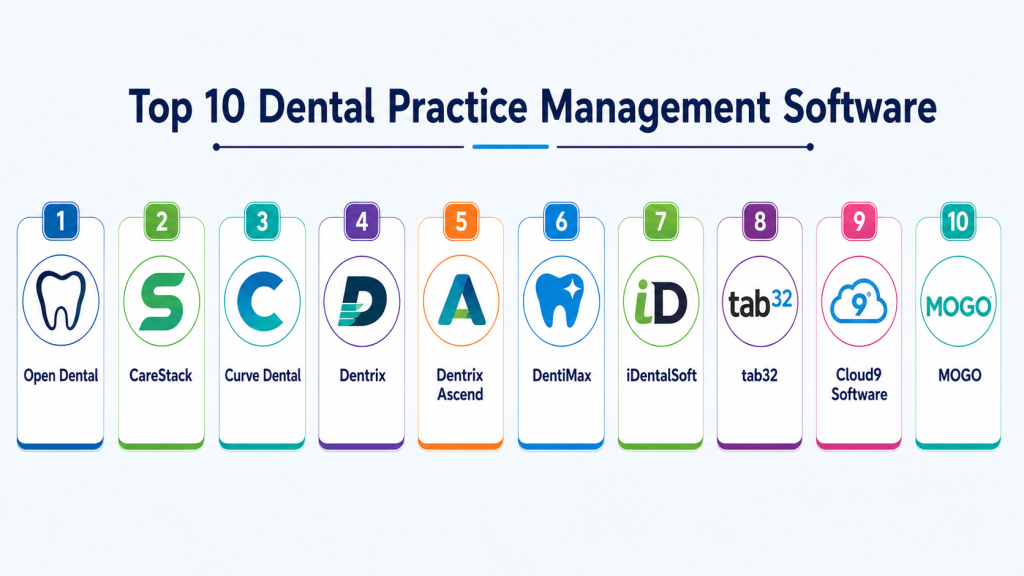
Top 10 Dental Practice Management Software
#1 — Dentrix
Short description: Dentrix is one of the most widely used dental practice management systems, offering comprehensive tools for scheduling, charting, billing, and reporting. It is designed for dental clinics of all sizes and provides strong integration with imaging systems. The platform supports detailed patient records and treatment planning. Known for its extensive feature set, it is widely adopted in established practices. It also offers automation for administrative workflows. Suitable for clinics seeking a mature and feature-rich solution.
Key Features
- Appointment scheduling
- Patient charting
- Billing and insurance claims
- Reporting and analytics
- Imaging integration
- Workflow automation
Pros
- Industry-standard platform
- Comprehensive feature set
Cons
- Requires training
- Can be complex for new users
Platforms / Deployment
Windows
On-premise / Hybrid
Security & Compliance
Encryption, RBAC, audit logs
Supports healthcare compliance frameworks
Integrations & Ecosystem
Dentrix integrates with imaging systems and third-party tools.
- Dental imaging devices
- Payment systems
- APIs
Support & Community
Large user base with strong documentation and training resources.
#2 — Dentrix Ascend
Short description: Dentrix Ascend is the cloud-based version of Dentrix, offering modern accessibility and simplified deployment. It provides similar functionality with improved usability. The platform is ideal for multi-location practices. It supports real-time updates and remote access. Known for ease of use compared to traditional Dentrix.
Key Features
- Cloud-based scheduling
- Patient management
- Billing and reporting
- Multi-location support
- Real-time updates
- Imaging integration
Pros
- Cloud accessibility
- Easier deployment
Cons
- Subscription pricing
- Limited offline functionality
Platforms / Deployment
Web
Cloud
Security & Compliance
MFA, encryption
Supports HIPAA compliance
Integrations & Ecosystem
Integrates with modern dental tools and APIs.
- Imaging systems
- Payment gateways
- APIs
Support & Community
Strong vendor support and onboarding.
#3 — Curve Dental
Short description: Curve Dental is a cloud-native dental management platform designed for modern practices. It offers scheduling, charting, billing, and analytics in one system. Known for its intuitive interface and scalability. Suitable for small to mid-sized clinics. It provides strong reporting tools and integrations.
Key Features
- Cloud-based platform
- Scheduling and charting
- Billing and insurance
- Analytics dashboards
- Workflow automation
- Imaging integration
Pros
- Easy to use
- Fully cloud-based
Cons
- Limited customization
- Internet dependency
Platforms / Deployment
Web
Cloud
Security & Compliance
Encryption, MFA
Supports HIPAA compliance
Integrations & Ecosystem
Supports integration with dental tools and systems.
- Imaging tools
- Payment systems
- APIs
Support & Community
Good support and onboarding.
#4 — Open Dental
Short description: Open Dental is an open-source dental management system offering flexibility and customization. It is widely used by clinics seeking cost-effective solutions. The platform supports scheduling, billing, and patient records. It is highly configurable. Suitable for practices with technical expertise.
Key Features
- Open-source platform
- Patient management
- Scheduling
- Billing
- Reporting
- Customization
Pros
- Highly customizable
- Cost-effective
Cons
- Requires technical expertise
- Limited out-of-box features
Platforms / Deployment
Windows
On-premise / Cloud
Security & Compliance
Varies / Not publicly stated
Integrations & Ecosystem
Flexible integration via APIs.
- Imaging tools
- Third-party plugins
Support & Community
Strong community support.
#5 — CareStack
Short description: CareStack is a cloud-based dental management platform designed for multi-location practices. It offers end-to-end functionality including scheduling, billing, analytics, and patient engagement. Known for scalability and modern interface.
Key Features
- Cloud-based system
- Multi-location management
- Billing and analytics
- Patient engagement tools
- Workflow automation
- Reporting
Pros
- Scalable for growing clinics
- Modern UI
Cons
- Subscription cost
- Learning curve
Platforms / Deployment
Web
Cloud
Security & Compliance
Encryption, MFA
Supports compliance frameworks
Integrations & Ecosystem
Strong integration capabilities.
- Payment systems
- APIs
- Imaging tools
Support & Community
Good vendor support.
#6 — iDentalSoft
Short description: iDentalSoft is a cloud-based dental software focused on simplicity and usability. It provides scheduling, charting, and billing features. Suitable for small to mid-sized practices. Known for ease of use and quick deployment.
Key Features
- Scheduling
- Patient records
- Billing
- Reporting
- Cloud access
- Automation
Pros
- Easy to use
- Quick setup
Cons
- Limited advanced features
- Smaller ecosystem
Platforms / Deployment
Web
Cloud
Security & Compliance
Encryption, MFA
Not publicly stated certifications
Integrations & Ecosystem
Supports integration with dental tools.
- Imaging
- APIs
Support & Community
Moderate support.
#7 — tab32
Short description: tab32 is a modern cloud-based dental software designed for scalability and automation. It offers patient management, scheduling, billing, and analytics. Suitable for growing practices. Known for automation features.
Key Features
- Cloud platform
- Scheduling and billing
- Patient management
- Analytics
- Automation
- Reporting
Pros
- Scalable
- Modern interface
Cons
- Subscription cost
- Limited customization
Platforms / Deployment
Web
Cloud
Security & Compliance
Encryption, MFA
Supports compliance frameworks
Integrations & Ecosystem
Integrates with modern dental tools.
- APIs
- Payment systems
Support & Community
Growing support ecosystem.
#8 — Cloud9 Software
Short description: Cloud9 Software is designed specifically for orthodontic practices. It offers scheduling, charting, and reporting tools. Known for its specialty focus. Suitable for orthodontists.
Key Features
- Orthodontic workflows
- Scheduling
- Reporting
- Patient management
- Analytics
- Cloud access
Pros
- Specialty-focused
- Cloud-based
Cons
- Limited general dentistry features
- Niche use case
Platforms / Deployment
Web
Cloud
Security & Compliance
Encryption, MFA
Supports compliance frameworks
Integrations & Ecosystem
Integrates with orthodontic tools.
- APIs
- Imaging
Support & Community
Good vendor support.
#9 — DentiMax
Short description: DentiMax offers both practice management and imaging solutions. It is designed for small to mid-sized practices. Known for affordability and ease of use. Provides core features for daily operations.
Key Features
- Scheduling
- Billing
- Imaging integration
- Reporting
- Patient records
- Workflow tools
Pros
- Affordable
- Easy to use
Cons
- Limited scalability
- Basic features
Platforms / Deployment
Windows / Web
Cloud / On-premise
Security & Compliance
Encryption, RBAC
Not publicly stated certifications
Integrations & Ecosystem
Supports integration with imaging systems.
- Imaging tools
- APIs
Support & Community
Moderate support.
#10 — MOGO
Short description: MOGO is a modern dental practice management platform offering scheduling, billing, and analytics. It is designed for growing practices. Known for its user-friendly interface. Suitable for mid-sized clinics.
Key Features
- Scheduling
- Billing
- Analytics
- Patient management
- Reporting
- Automation
Pros
- User-friendly
- Modern design
Cons
- Limited enterprise features
- Smaller ecosystem
Platforms / Deployment
Web
Cloud
Security & Compliance
Encryption, MFA
Not publicly stated certifications
Integrations & Ecosystem
Supports integration with dental tools.
- APIs
- Payment systems
Support & Community
Growing support ecosystem.
Comparison Table
| Tool Name | Best For | Platform(s) Supported | Deployment | Standout Feature | Public Rating |
|---|---|---|---|---|---|
| Dentrix | Established clinics | Windows | Hybrid | Industry standard | N/A |
| Dentrix Ascend | Multi-location clinics | Web | Cloud | Cloud-native Dentrix | N/A |
| Curve Dental | SMB clinics | Web | Cloud | Ease of use | N/A |
| Open Dental | Custom setups | Windows | Hybrid | Open-source flexibility | N/A |
| CareStack | Multi-location | Web | Cloud | Scalability | N/A |
| iDentalSoft | Small clinics | Web | Cloud | Simplicity | N/A |
| tab32 | Growing practices | Web | Cloud | Automation | N/A |
| Cloud9 | Orthodontics | Web | Cloud | Specialty workflows | N/A |
| DentiMax | SMB clinics | Windows/Web | Hybrid | Affordability | N/A |
| MOGO | Mid-market | Web | Cloud | User-friendly | N/A |
Evaluation & Scoring of Dental Practice Management Software
| Tool Name | Core | Ease | Integrations | Security | Performance | Support | Value | Weighted Total |
|---|---|---|---|---|---|---|---|---|
| Dentrix | 10 | 7 | 9 | 9 | 9 | 9 | 7 | 8.9 |
| Dentrix Ascend | 9 | 8 | 9 | 9 | 9 | 8 | 7 | 8.6 |
| Curve Dental | 8 | 9 | 8 | 8 | 8 | 8 | 8 | 8.3 |
| Open Dental | 8 | 7 | 8 | 7 | 8 | 7 | 9 | 8.0 |
| CareStack | 9 | 8 | 8 | 8 | 8 | 8 | 8 | 8.3 |
| iDentalSoft | 7 | 9 | 7 | 7 | 7 | 7 | 8 | 7.8 |
| tab32 | 8 | 8 | 8 | 8 | 8 | 7 | 8 | 8.0 |
| Cloud9 | 7 | 8 | 7 | 7 | 7 | 7 | 8 | 7.6 |
| DentiMax | 7 | 8 | 7 | 7 | 7 | 7 | 8 | 7.6 |
| MOGO | 7 | 8 | 7 | 7 | 7 | 7 | 8 | 7.6 |
How to interpret scores:
- Enterprise-grade tools score higher in features and integrations
- Cloud-native tools excel in usability and flexibility
- Open-source tools provide value but require expertise
- Choose based on workflow needs, not just scores
Which Dental Practice Management Software Is Right for You?
Solo / Freelancer
iDentalSoft or Open Dental for simplicity and affordability.
SMB
Curve Dental, DentiMax, or tab32 for balanced features and usability.
Mid-Market
CareStack and Dentrix Ascend for scalability and integrations.
Enterprise
Dentrix and CareStack for advanced workflows and compliance.
Budget vs Premium
Budget: Open Dental, DentiMax
Premium: Dentrix, CareStack
Feature Depth vs Ease of Use
Feature-rich: Dentrix
User-friendly: Curve Dental
Integrations & Scalability
Best: Dentrix, CareStack
Moderate: iDentalSoft, tab32
Security & Compliance Needs
High compliance: Dentrix, CareStack
Moderate: SMB-focused tools
Frequently Asked Questions (FAQs)
1. What is dental practice management software?
Dental practice management software is a system that helps clinics manage scheduling, patient records, billing, and workflows. It centralizes operations in one platform. It improves efficiency and reduces manual work. It also enhances patient communication. It is essential for modern dental clinics.
2. What are the main features of dental software?
Core features include scheduling, patient records, billing, reporting, and communication tools. Many systems also include analytics and automation. Integration with imaging and devices is common. Cloud access is increasingly popular. These features streamline operations and improve care.
3. Is dental software secure?
Yes, most systems include encryption, access control, and compliance features. Security depends on configuration. Cloud systems offer regular updates. Compliance with healthcare standards is important. Data protection is critical.
4. How much does dental software cost?
Costs vary depending on features and deployment. Cloud systems use subscription pricing. On-premise systems require upfront investment. Pricing depends on users and features. Evaluate long-term value.
5. Can dental software integrate with imaging systems?
Yes, most platforms integrate with dental imaging tools. This allows seamless workflows. Integration improves efficiency. APIs enable connectivity. It reduces manual data entry.
6. What are the benefits of dental practice software?
It improves efficiency, reduces errors, and enhances patient experience. It automates scheduling and billing. It centralizes data. It supports better decision-making. It increases productivity.
7. How long does implementation take?
Implementation can take days to months. Cloud systems are faster to deploy. Training is required for staff. Data migration adds time. Planning ensures smooth adoption.
8. Is cloud dental software better?
Cloud software offers flexibility and remote access. It reduces infrastructure costs. It is easier to scale. However, it depends on internet connectivity. Many clinics prefer cloud solutions.
9. What should you consider when choosing software?
Consider features, integration, security, cost, and usability. Evaluate vendor support. Check scalability. Test before buying. Choose based on workflow needs.
10. Can dental software support multi-location clinics?
Yes, many platforms support multi-location management. They centralize data across clinics. This improves coordination. It enables better reporting. It is essential for growing practices.
Conclusion
Dental Practice Management Software has become a foundational tool for modern dental clinics, enabling efficient operations, better patient experiences, and improved financial management. With the shift toward cloud-based platforms, AI-driven automation, and stronger cybersecurity requirements, these systems are evolving rapidly to meet the demands of modern healthcare. Enterprise solutions like Dentrix provide deep functionality and integration, while cloud-native platforms such as Curve Dental and CareStack offer flexibility, ease of use, and scalability for growing practices. There is no single “best” solution for every clinic. The right choice depends on your practice size, workflow complexity, budget, and integration needs. The most effective approach is to shortlist two or three platforms, run pilot tests, and evaluate usability, performance, and security in real-world scenarios. By choosing the right software, dental practices can streamline operations, reduce administrative burden, and ultimately deliver better patient care.
Very informative guide for dental clinics searching for better appointment scheduling and patient record management software solutions.