Introduction
Webhook Management Tools are platforms that help developers and teams create, monitor, secure, route, and debug webhooks at scale. Webhooks themselves are event-driven HTTP callbacks that allow systems to send real-time data when something happens—like a payment event, user signup, or system alert.
As modern applications rely heavily on automation and integrations, managing webhooks manually becomes complex. These tools provide reliability features like retries, logging, and security enforcement, ensuring smooth communication between systems without delays or failures.
Common Use Cases
- Real-time event notifications between systems
- Workflow automation and integrations
- Payment and transaction alerts
- DevOps event handling
- Debugging and testing webhook payloads
What Buyers Should Evaluate
- Reliability (retry logic, queueing)
- Security (HMAC signing, authentication)
- Monitoring and logging
- Scalability and performance
- Ease of debugging and testing
- Integration capabilities
- Deployment flexibility
- Pricing and usage limits
Best for: Developers, DevOps teams, SaaS companies, and enterprises building event-driven architectures or automation workflows.
Not ideal for: Small projects with minimal integrations or systems that do not require real-time event handling.
Key Trends in Webhook Management Tools
- Rise of Webhook-as-a-Service platforms for faster setup
- Increased use of event-driven architectures
- Focus on reliability (retry queues, failure handling)
- Growth of security-first webhook delivery systems
- Integration with workflow automation tools
- Expansion of real-time monitoring dashboards
- Adoption of multi-tenant webhook systems
- Increased use of open-source webhook infrastructure
- Support for high-scale event processing
- Integration with AI-driven automation pipelines
How We Selected These Tools (Methodology)
- Market adoption and developer popularity
- Feature completeness (delivery, monitoring, debugging)
- Reliability and performance capabilities
- Security features and best practices
- Integration ecosystem and APIs
- Deployment flexibility
- Developer experience and usability
- Community and enterprise support
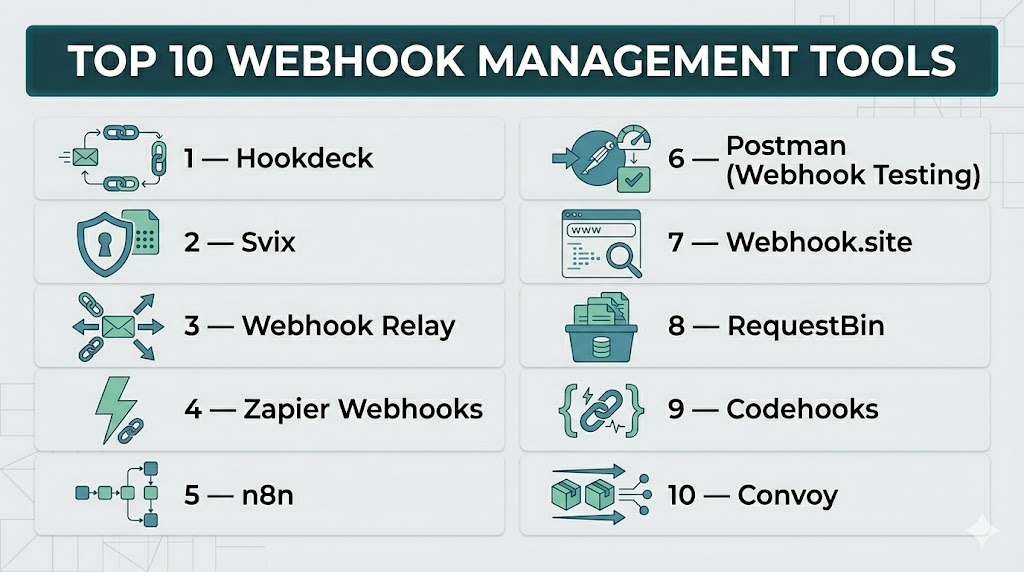
Top 10 Webhook Management Tools
#1 — Hookdeck
Short description: A modern webhook infrastructure platform designed for reliability, observability, and debugging.
Key Features
- Webhook queueing and retries
- Real-time monitoring
- Error tracing and debugging
- Event routing
- Filtering and transformation
Pros
- Strong reliability features
- Excellent debugging tools
Cons
- Requires setup understanding
- Pricing varies with usage
Platforms / Deployment
Cloud
Security & Compliance
Token-based authentication, secure delivery
Integrations & Ecosystem
Hookdeck integrates with APIs and backend systems for event processing.
- APIs
- Backend services
- Dev tools
Support & Community
Growing developer-focused community
#2 — Svix
Short description: A webhook-as-a-service platform focused on secure and scalable webhook delivery.
Key Features
- Managed webhook infrastructure
- Retry logic and queueing
- Webhook subscription management
- High scalability
- Security-first design
Pros
- Enterprise-ready
- Highly scalable
Cons
- Premium pricing
- SaaS dependency
Platforms / Deployment
Cloud / Self-hosted
Security & Compliance
Encryption, SOC 2, GDPR support
Integrations & Ecosystem
- APIs
- Backend systems
- SaaS platforms
Support & Community
Strong enterprise support
#3 — Webhook Relay
Short description: A tool for forwarding and managing webhooks across networks and environments.
Key Features
- Webhook forwarding
- Public endpoint creation
- Traffic routing
- Real-time analytics
- Tunneling support
Pros
- Easy setup
- Useful for development
Cons
- Limited advanced features
- Not full lifecycle management
Platforms / Deployment
Cloud / Self-hosted
Security & Compliance
Authentication and access controls
Integrations & Ecosystem
- APIs
- Dev environments
Support & Community
Moderate support resources
#4 — Zapier Webhooks
Short description: A no-code solution for triggering workflows using webhooks across thousands of apps.
Key Features
- Webhook triggers
- Workflow automation
- App integrations
- Event-based actions
- Visual builder
Pros
- Easy to use
- Huge integration ecosystem
Cons
- Limited control for developers
- Pricing based on usage
Platforms / Deployment
Cloud
Security & Compliance
Basic authentication
Integrations & Ecosystem
- 3000+ apps
- Automation tools
Support & Community
Large user base and support resources
#5 — n8n
Short description: An open-source workflow automation tool with strong webhook support.
Key Features
- Webhook triggers
- Visual workflow builder
- Self-hosted option
- API integrations
- Automation logic
Pros
- Open-source flexibility
- Highly customizable
Cons
- Requires setup
- UI learning curve
Platforms / Deployment
Cloud / Self-hosted
Security & Compliance
Not publicly stated
Integrations & Ecosystem
- APIs
- Automation workflows
Support & Community
Active open-source community
#6 — Postman (Webhook Testing)
Short description: A popular API platform used for testing and debugging webhook requests.
Key Features
- Webhook testing
- Request logging
- Debugging tools
- API monitoring
- Collaboration
Pros
- Easy debugging
- Widely used
Cons
- Not a full webhook platform
- Limited automation
Platforms / Deployment
Web / Desktop (Cloud)
Security & Compliance
RBAC, access control
Integrations & Ecosystem
- APIs
- Dev tools
Support & Community
Large developer community
#7 — Webhook.site
Short description: A simple tool for inspecting and debugging webhook requests in real time.
Key Features
- Instant webhook URLs
- Request inspection
- Logging
- Debugging
- Testing tools
Pros
- Extremely simple
- Free to use
Cons
- Limited production use
- Basic features
Platforms / Deployment
Web
Security & Compliance
HTTPS support
Integrations & Ecosystem
- APIs
- Testing tools
Support & Community
Basic documentation
#8 — RequestBin
Short description: A debugging tool that captures and inspects webhook requests.
Key Features
- Request capture
- Debugging interface
- Temporary endpoints
- Logging
- Error inspection
Pros
- Simple setup
- Good for testing
Cons
- Not production-ready
- Limited features
Platforms / Deployment
Web
Security & Compliance
Not publicly stated
Integrations & Ecosystem
- APIs
Support & Community
Basic support
#9 — Codehooks
Short description: A developer-focused platform for building webhook delivery systems quickly.
Key Features
- Queue-based delivery
- Retry mechanisms
- Event-driven architecture
- API-first design
- Custom logic
Pros
- Fast setup
- Highly customizable
Cons
- Requires development knowledge
- Smaller ecosystem
Platforms / Deployment
Cloud
Security & Compliance
HMAC signing, secure delivery
Integrations & Ecosystem
- APIs
- Backend systems
Support & Community
Developer-focused resources
#10 — Convoy
Short description: An open-source webhook gateway for managing webhook delivery at scale.
Key Features
- Webhook gateway
- Event delivery
- Retry handling
- Monitoring tools
- Scalability
Pros
- Open-source
- High performance
Cons
- Requires setup
- Smaller ecosystem
Platforms / Deployment
Self-hosted
Security & Compliance
Authentication, secure delivery
Integrations & Ecosystem
- APIs
- Event systems
Support & Community
Growing open-source community
Comparison Table (Top 10)
| Tool Name | Best For | Platform(s) Supported | Deployment | Standout Feature | Public Rating |
|---|---|---|---|---|---|
| Hookdeck | Reliability | Web | Cloud | Event routing | N/A |
| Svix | Enterprise scale | Web | Cloud/Self-hosted | Secure delivery | N/A |
| Webhook Relay | Dev environments | Web | Cloud/Self-hosted | Forwarding | N/A |
| Zapier Webhooks | Automation | Web | Cloud | App integrations | N/A |
| n8n | Open-source automation | Web | Cloud/Self-hosted | Workflow builder | N/A |
| Postman | Testing | Web/Desktop | Cloud | Debugging | N/A |
| Webhook.site | Debugging | Web | Cloud | Request inspection | N/A |
| RequestBin | Testing | Web | Cloud | Request capture | N/A |
| Codehooks | Developers | Web | Cloud | Queue system | N/A |
| Convoy | Open-source | Web | Self-hosted | Gateway | N/A |
Evaluation & Scoring of Webhook Management Tools
| Tool Name | Core (25%) | Ease (15%) | Integrations (15%) | Security (10%) | Performance (10%) | Support (10%) | Value (15%) | Weighted Total |
|---|---|---|---|---|---|---|---|---|
| Hookdeck | 9 | 7 | 8 | 8 | 9 | 8 | 7 | 8.2 |
| Svix | 9 | 7 | 8 | 9 | 9 | 8 | 6 | 8.3 |
| Webhook Relay | 7 | 8 | 7 | 7 | 8 | 7 | 8 | 7.5 |
| Zapier | 8 | 9 | 9 | 7 | 7 | 8 | 7 | 7.9 |
| n8n | 8 | 7 | 8 | 7 | 8 | 7 | 9 | 8.0 |
| Postman | 7 | 9 | 8 | 7 | 7 | 8 | 8 | 7.8 |
| Webhook.site | 6 | 10 | 6 | 6 | 6 | 6 | 9 | 7.0 |
| RequestBin | 6 | 9 | 6 | 6 | 6 | 6 | 9 | 6.9 |
| Codehooks | 8 | 7 | 8 | 8 | 8 | 7 | 8 | 7.9 |
| Convoy | 8 | 6 | 7 | 7 | 8 | 7 | 8 | 7.6 |
How to interpret scores:
- Full platforms score higher in reliability and scalability
- Automation tools excel in integrations and ease
- Testing tools score high in simplicity but lower in features
- Choose based on production vs development needs
Which Webhook Management Tool Is Right for You?
Solo / Freelancer
- Best: Webhook.site, RequestBin
- Focus on testing and debugging
SMB
- Best: Zapier, n8n
- Balance automation and cost
Mid-Market
- Best: Hookdeck, Webhook Relay
- Need reliability and monitoring
Enterprise
- Best: Svix, Hookdeck
- Require scalability and security
Budget vs Premium
- Budget: n8n, open-source tools
- Premium: Svix
Feature Depth vs Ease of Use
- Advanced: Hookdeck, Svix
- Easy: Zapier, Webhook.site
Integrations & Scalability
- Strong integrations: Zapier
- High scalability: Svix, Hookdeck
Security & Compliance Needs
- Enterprise: Svix
- Basic: Testing tools
Frequently Asked Questions (FAQs)
What is a webhook management tool?
It helps manage, monitor, and secure webhook-based integrations across systems.
Why are webhooks important?
They enable real-time communication between applications without polling.
Are webhook tools necessary?
For small systems, no—but for scaling integrations, they are essential.
What features matter most?
Reliability, security, and monitoring are critical.
Can I use webhooks without these tools?
Yes, but managing retries and failures becomes complex.
Are there free tools?
Yes, many testing tools and open-source platforms are available.
Are webhook tools secure?
Security depends on implementation, but many support authentication and encryption.
Can I automate workflows with webhooks?
Yes, they are widely used for automation triggers.
How scalable are webhook systems?
Modern tools support high-scale event processing.
What are alternatives?
Polling APIs or message queues, though less efficient for real-time use.
Conclusion
Webhook management tools are essential for building reliable, event-driven systems and automating integrations at scale. From simple debugging tools to enterprise-grade platforms, each solution serves a different stage of development and deployment. The right choice depends on your need for reliability, scalability, and integration depth. Focus on tools that provide strong monitoring and security features. Start with a few options and test them based on your workflow requirements.