Introduction
Cloud computing has transformed the way businesses operate. Huge computing resources can be launched with a single click. However, this ease of access has created a massive problem: uncontrollable cloud bills. Many organizations spend millions of dollars on cloud services without understanding where the money goes. This is why cloud financial management, known as FinOps, has become an essential practice for modern engineering teams.
To solve these budgeting challenges, a bridge must be built between engineering, finance, and business leadership. Engineers understand how to build systems, but they rarely see the financial bills. Finance teams see the bills, but they do not understand the underlying software architecture. A Certified FinOps Architect is trained to sit at the exact center of this intersection, optimizing cloud infrastructure for both maximum performance and minimal cost.
This comprehensive guide is written to help software engineers, cloud architects, and engineering managers understand how to build a career in cloud financial optimization. The entire learning path, skill requirements, and practical application strategies of the Certified FinOps Architect program will be broken down in detail below.
What is Certified FinOps Architect
The Certified FinOps Architect designation is an advanced professional credential given to individuals who master the intersection of cloud architecture and financial accountability. It is not just about cutting costs or turning off unused servers. Instead, it teaches professionals how to design highly scalable cloud systems that are financially efficient by default.
An architect holding this credential knows how to analyze cloud billing data, identify wasteful architectural patterns, and implement automated scaling policies. They ensure that every dollar spent on cloud resources directly drives business value. The certification validates your ability to talk to corporate finance executives in terms of return on investment while speaking to software developers in terms of microservices and latency.
Why It Matters Today
In the current tech landscape, cloud budgets are being scrutinized more than ever before. Companies can no longer afford to over-provision their cloud infrastructure just to be safe. Wastage in cloud environments is frequently driven by idle databases, oversized virtual machines, and unoptimized storage tiers.
A professional who understands how to architecturalize cloud systems with cost in mind is highly valuable. Organizations are shifting away from reactive cost-cutting measures. Instead, they are adopting proactive cloud financial architectural practices where cost efficiency is treated as a core non-functional requirement, just like security or reliability.
Why Certified FinOps Architect Certifications Are Important
Holding an official certification is crucial for professional validation in a competitive job market. It provides a standardized framework of knowledge that is recognized by global employers.
- Standardized Knowledge: It ensures you learn industry-verified best practices for cost visibility, allocation, and optimization rather than relying on guesswork.
- Bridge the Gap: It proves you can translate complex cloud infrastructure bills into actionable engineering tickets.
- Career Growth: It opens up specialized leadership roles within platform engineering and cloud architecture teams.
- Enterprise Credibility: It gives corporate stakeholders confidence that your architectural decisions will not lead to unexpected budget overruns.
Why Choose FinOpsSchool?
When selecting a training provider for cloud financial management, specialized focus matters. FinOpsSchool is dedicated entirely to the discipline of cloud financial operations and architectural optimization. The curriculum is crafted by real-world practitioners who manage multi-million dollar cloud budgets daily.
Instead of focusing purely on theoretical concepts, the programs are deeply rooted in practical enterprise scenarios. Comprehensive labs, real-world datasets, and step-by-step optimization exercises are provided to ensure students gain actual hands-on capabilities. By choosing this platform, learners are guaranteed an education that aligns perfectly with current global corporate hiring standards.
Certification Deep-Dive
What is this certification?
The Certified FinOps Architect program is an advanced technical credential that teaches professionals how to design, build, and optimize cloud architectures for maximum financial efficiency. It bridges the gap between cloud engineering design patterns and corporate financial governance.
Who should take this certification?
This program is designed for cloud engineers, DevOps practitioners, platform architects, site reliability engineers, and engineering managers who are responsible for cloud infrastructure budgets and system designs.
Certification Overview Table
| Track | Level | Who it’s for | Prerequisites | Skills Covered | Recommended Order |
| FinOps Practitioner | Foundational | Beginners, Finance Analysts, Fresh Engineers | Basic Cloud Awareness | Cost allocation, FinOps lifecycle, basic budgeting | First |
| FinOps Certified Engineer | Professional | DevOps Engineers, System Admins | 1 Year Cloud Experience | Resource tagging, automation scripts, right-sizing | Second |
| Certified FinOps Architect | Advanced / Expert | Cloud Architects, Principal Engineers | Deep Architectural Knowledge | Unit economics, multi-cloud cost design, governance | Third |
| FinOps Certified Leader | Leadership | Engineering Directors, CFOs, VPs | Management Experience | Cultural change, policy creation, KPI tracking | Fourth |
Skills You Will Gain
- Advanced Cost Modeling: The ability to calculate unit economics and accurately predict future cloud spend based on architectural designs.
- Automated Governance: Skills to deploy automated policy engines that stop budget spikes before they happen.
- Multi-Cloud Allocation: Mastery over tracking and allocating shared costs across complex multi-cloud ecosystems.
- Architectural Optimization: Expertise in container cost allocation, serverless financial design, and storage lifecycle management.
Real-World Projects You Should Be Able to Do After This Certification
- Design a Multi-Tenant Cost Allocation System: Build an automated tagging and allocation pipeline for a Kubernetes cluster shared by multiple business units.
- Formulate an Automated Right-Sizing Engine: Create serverless workflows that scan infrastructure for underutilized assets and automatically downsize them safely.
- Construct a Real-Time Cost Anomaly Detection Dashboard: Deploy monitoring tools that alert engineering teams within minutes when an architectural change causes a budget spike.
Preparation Plan
7–14 Days Plan
- Spend 2 hours daily reviewing the official FinOps core framework pillars.
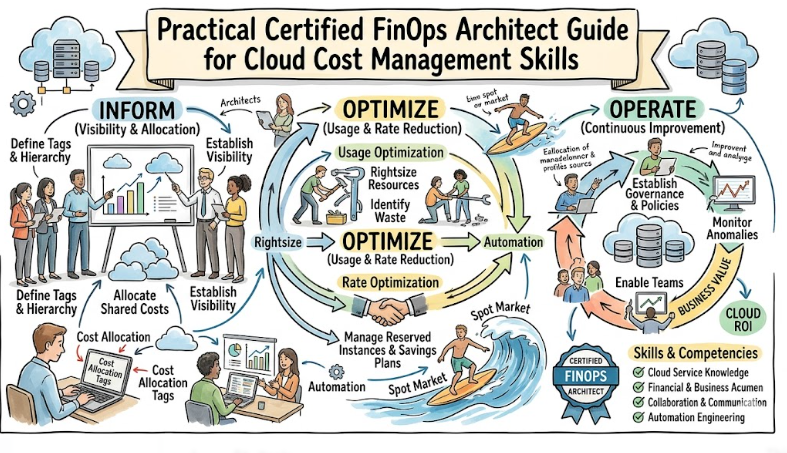
- Focus heavily on understanding the differences between cloud cost optimization phases: Inform, Optimize, and Operate.
- Complete all basic practice quizzes provided in the learning portal.
30 Days Plan
- Dedicate the first 15 days to studying cloud-specific billing structures (AWS, Azure, and GCP pricing models).
- Spend the remaining 15 days building sample dashboards and working through cost allocation scenarios.
- Review core case studies of large enterprise cloud migrations and their budgeting failures.
60 Days Plan
- Spend month one deep-diving into advanced architectural blueprints, container optimization, and unit economics calculations.
- Use month two to practice configuring automated governance policies and writing architectural cost optimization scripts.
- Take multiple full-length timed mock exams to build confidence before sitting for the final certification test.
Common Mistakes to Avoid
- Focusing Only on Cost-Cutting: FinOps is about making money, not just saving money. Do not sacrifice system performance or reliability just to lower a bill.
- Ignoring the Cultural Aspect: Changing how engineers think about money is a cultural shift. Avoid treating certification prep as a purely technical scripting exercise.
- Neglecting Finance Terminology: Ensure basic accounting concepts like amortization, capital expenditure, and operational expenditure are fully understood.
Best Next Certification After This
- Same Track: FinOps Certified Leader (to master organizational change and executive communication).
- Cross-Track: Advanced Cloud Solutions Architect credentials from major cloud providers (AWS, GCP, or Azure).
- Leadership / Management: Certified Cloud Enterprise Governance Expert or formal ITIL framework credentials.
Choose Your Learning Path
DevOps Learning Path
This path is tailored for engineers who manage continuous integration and deployment pipelines. The focus is placed on embedding cost visibility directly into the CI/CD pipeline. By learning FinOps, DevOps engineers ensure that code changes are evaluated for financial impact before being deployed to production environments.
DevSecOps Learning Path
Best suited for security and compliance professionals. This pathway combines security guardrails with financial guardrails. Learners are taught how to build cloud infrastructure policies that simultaneously check for security vulnerabilities and cost allocation errors.
Site Reliability Engineering (SRE) Learning Path
Designed for engineers focused on system uptime, scalability, and reliability. This path teaches SREs how to balance Service Level Objectives (SLOs) with financial budgets. It ensures that system redundancy and high-availability setups are built cost-effectively.
AIOps / MLOps Learning Path
Tailored for data scientists and machine learning engineers who train heavy AI models. This path focuses on controlling the massive compute and GPU costs associated with artificial intelligence training pipelines. It teaches automated scheduling and model optimization strategies.
DataOps Learning Path
Best for data engineers and database administrators who handle massive corporate data lakes. The learning focus is placed on storage lifecycle optimization, querying cost efficiency, and managing large-scale data warehouse spend.
FinOps Learning Path
The pure, specialized path for dedicated cloud financial analysts and operations leads. This path covers the full spectrum of organizational financial management, cultural enablement, rate optimization, and cloud vendor contract negotiation.
Role → Recommended Certifications Mapping
| Corporate Role | Core Certification | Secondary Certification | Leadership Focus |
| DevOps Engineer | Certified FinOps Architect | DevSecOps Certified Professional | Cloud Governance Expert |
| Site Reliability Engineer | Certified FinOps Architect | SRE Master Certification | Platform Director Program |
| Platform Engineer | Certified FinOps Architect | Advanced Infrastructure Engineer | Technical Product Manager |
| Cloud Engineer | FinOps Certified Engineer | Certified FinOps Architect | ITIL Practitioner |
| Security Engineer | DevSecOps Specialist | Certified FinOps Architect | Enterprise Risk Manager |
| Data Engineer | DataOps Specialist | Certified FinOps Architect | Big Data Director |
| FinOps Practitioner | FinOps Certified Engineer | Certified FinOps Architect | FinOps Certified Leader |
| Engineering Manager | Certified FinOps Architect | FinOps Certified Leader | Executive MBA / Tech Leadership |
Next Certifications to Take
One Same-Track Certification
The Advanced Automated Deployment Specialist certification serves as the ideal same-track progression. It deepens technical capabilities in managing complex multi-stage release pipelines and continuous integration tools.
One Cross-Track Certification
The Certified FinOps Architect program serves as a valuable cross-track addition. It equips engineering teams with the financial vocabulary and unit economics knowledge needed to optimize cloud infrastructure costs.
One Leadership-Focused Certification
The VP of Engineering Certification Program prepares senior professionals for executive roles. It teaches how to oversee multiple technology divisions and align them completely with corporate business goals.
Training & Certification Support Institutions
DevOpsSchool
Comprehensive training programs are provided by this institution to help engineers master automation tools. Hands-on training libraries and live online classes are delivered by industry experts to build deep deployment skills.
Cotocus
Specialized consulting and training support are offered here for modern cloud computing tracks. Complex technological architectures are broken down into easy, consumable lessons for corporate transformation projects.
ScmGalaxy
A long-standing knowledge portal and training community dedicated to source code management and delivery pipelines. Valuable educational articles, guides, and workshops are regularly produced to support working professionals.
BestDevOps
Focused training frameworks centered on continuous integration tools and modern platform development are provided. Practical instruction sets are designed to help corporate teams clear professional exams with high confidence.
devsecopsschool.com
This platform is completely focused on the intersection of cloud security and automated deployment. Comprehensive modules are structured to teach engineers how to write secure code and protect cloud infrastructure.
sreschool.com
Educational training tracks centered around system reliability, monitoring, and fault tolerance are delivered here. Engineers are trained to handle heavy production site traffic loads smoothly.
aiopsschool.com
Advanced training programs regarding the application of artificial intelligence to IT operations are provided. Machine learning automation setups are taught to help teams predict and fix system errors rapidly.
dataopsschool.com
This institution delivers specialized coursework for managing enterprise data pipelines. Data lifecycle management, quality automation, and storage infrastructure designs are covered extensively.
finopsschool.com
The primary educational institution dedicated entirely to cloud financial management and cost architectural design. Comprehensive preparatory tracks are provided to help professionals earn their Certified FinOps Architect credentials successfully.
FAQs Section
1. What is the difficulty level of standard cloud optimization certification exams?
Most foundational exams are moderately easy, while advanced architect exams are highly difficult and require deep practical experience with billing datasets.
2. How much time is required to prepare for a professional FinOps exam?
Between 30 to 60 days of consistent study is typically required for a working engineer to feel fully prepared.
3. Are there any mandatory prerequisites before attempting advanced cloud architecture tests?
No formal prerequisites are forced by most providers, but a solid year of working with cloud infrastructure is highly recommended.
4. What is the ideal certification sequence for a complete beginner?
Begin with a foundational practitioner course, progress to an engineering specialist level, and finish with an advanced architect credential.
5. What is the real-world career value of earning a cloud financial credential?
It makes you a highly sought-after professional because companies are actively looking to minimize their cloud expenses without degrading software quality.
6. Which job roles benefit the most from learning these budgeting frameworks?
Cloud architects, platform engineers, DevOps practitioners, and engineering managers find the greatest value in these courses.
7. How does cloud optimization knowledge impact long-term salary growth?
Professionals holding these specialized skills often command higher salaries because their daily work directly saves the company visible amounts of money.
8. Can a non-technical financial analyst successfully clear these exams?
Foundational tracks are easily passed by finance professionals, but advanced architect tracks require a deep understanding of software systems.
9. How often do these cloud financial certificates need to be renewed?
Most professional certifications require renewal every two or three years to ensure your knowledge matches current cloud software updates.
10. Do these training courses cover multiple public cloud vendors like AWS and Azure?
Yes, global frameworks are built to apply universally to any major cloud vendor platform used by businesses.
11. What type of exam format is utilized for the final testing process?
The tests generally consist of multiple-choice questions along with practical, scenario-based case studies.
12. Is classroom attendance required, or can studies be completed online?
The entire learning process can be done via flexible, self-paced online video lessons and digital testing facilities.
Certified FinOps Architect Focused FAQs
1. What is the specific focus of the Certified FinOps Architect program?
The primary focus is placed on designing cloud infrastructures that are fundamentally cost-efficient from the very first line of code.
2. How does this architect credential differ from a basic practitioner certificate?
Practitioners learn basic definitions and tracking concepts, whereas architects design complex automated systems and write cost optimization policies.
3. Is coding knowledge required to pass the Certified FinOps Architect evaluation?
Yes, a basic understanding of scripting languages and cloud infrastructure-as-code tools is highly beneficial for the advanced sections.
4. What role does unit economics play in the architect training path?
Unit economics is used by architects to link cloud infrastructure costs directly to specific business metrics, such as the delivery cost per active user.
5. How does the training help with container and Kubernetes optimization?
Detailed strategies are provided to show how shared container clusters can be accurately split and billed to individual development teams.
6. Can this credential help me secure a role as a cloud consultant?
Absolutely. It provides the exact verified credentials needed to audit large corporations and recommend major infrastructure budget overhauls.
7. Are automation practices taught inside the Certified FinOps Architect course?
Yes, heavy emphasis is placed on building automated workflows that detect budget anomalies and clean up unused cloud assets automatically.
8. Where can the official exam signup and curriculum guidelines be found?
The complete curriculum syllabus and registration steps are located at the : Certified FinOps Architect.
Testimonials
The architectural framework taught in this course was incredibly helpful. Our team successfully identified thousands of dollars in hidden cloud waste within two weeks of completion.
— Rajesh
Total career clarity was achieved after completing this program. I can now confidently sit with our finance directors and explain our cloud infrastructure spending using real business metrics.
— Amit
The real-world labs gave me the exact skills needed to build an automated tagging system for our enterprise Kubernetes clusters. My technical confidence has grown tremendously.
— Priya
As a security specialist, this training helped me blend financial guardrails with our existing compliance checks. It completely changed how we approach infrastructure governance.
— Vikram
Managing multi-million dollar cloud accounts became much easier after sending my principal leads through this course. Our cloud infrastructure is now highly optimized.
— Sanjay
Conclusion
Mastering cloud financial operations has transitioned from a niche advantage to an absolute business necessity. The Certified FinOps Architect certification provides engineers and managers with a powerful, standardized blueprint to control cloud infrastructure costs while maintaining system excellence. Long-term career benefits are immense, unlocking premium consulting roles and senior platform leadership opportunities across the global technology market. Strategic learning paths should be mapped out immediately, and certification preparation should be planned carefully to ensure a future-proof position in the evolving cloud industry.