Introduction
Imagine standing at a crossroads. On one side is your current life—familiar, comfortable, but perhaps lacking the growth or adventure you crave. On the other side is a dream: a new beginning in a country like Canada, Australia, or New Zealand. You’ve done the research, looked at the photos of pristine landscapes, and read about the high quality of life. But then comes the big question: “Am I actually eligible to move there?”
This is where the PR Points Calculator becomes your most valuable tool. It is the digital gatekeeper of the immigration world. For most developed nations, immigration isn’t just about a visa application; it’s a merit-based competition.
Whether you are a software engineer in Bangalore, a healthcare professional in Manila, or a finance expert in London, the “Points System” is the universal language used by immigration departments to rank your potential contribution to their economy. Understanding how to calculate these points—and more importantly, how to improve them—is the difference between a successful move and a rejected application.
What Is a PR Points Calculator?
At its core, a PR Points Calculator is an algorithmic tool used by immigration authorities to evaluate and rank candidates for Permanent Residency (PR).
The Concept of Points-Based Immigration
Most modern economies face labor shortages or aging populations. Instead of a “first-come, first-served” approach, countries like Canada and Australia use a meritocracy. They assign numerical values to specific human capital factors.
How PR Points Determine Visa Eligibility
Think of it like a university entrance exam. The government sets a “cut-off” score (often called a Draw or an Invitation Round). If your points—calculated based on your age, skills, and background—meet or exceed that cut-off, you receive an Invitation to Apply (ITA). Without a high enough score on the calculator, your application remains in a “pool,” and you cannot move forward.
How Points Systems Work (General Overview)
While every country has its own specific criteria, the fundamental DNA of these systems is remarkably similar. They prioritize youth, high-level education, and professional experience.
Key Factors of Scoring
The following table outlines the universal pillars that almost every PR Points Calculator uses:
| Factor | Description | Why it Matters |
| Age | Most points are usually awarded to those between 25 and 32. | Younger migrants contribute to the workforce for a longer period. |
| Education | PhDs and Master’s degrees outscore Bachelor’s or Diplomas. | Higher education correlates with higher economic adaptability. |
| Language Skills | Proficiency in English (IELTS/PTE) or the local language. | Essential for integration and professional success. |
| Work Experience | Years of “skilled” employment in a specific field. | Proves you have transferable skills needed in the local market. |
| Adaptability | Having family in the country or previous study there. | Reduces the “settling-in” burden on social services. |
How Factors are Scored
Points are cumulative. For example, a 28-year-old with a Master’s degree and 5 years of experience will naturally outscore a 45-year-old with a Bachelor’s degree. The calculator aggregates these numbers to give you a “Profile Strength.”
Country-Specific Sections
Canada PR Points Calculator
Canada uses the Express Entry system, which relies on the Comprehensive Ranking System (CRS). This is perhaps the most famous PR points calculator in the world.
The CRS Breakdown:
The CRS is out of a total of 1,200 points. It is divided into two parts:
- Core Points (Up to 600): Age, education, language, and work experience.
- Additional Points (Up to 600): Provincial nomination (a massive 600-point boost), a valid job offer, or Canadian study.
Example Point Distribution (Estimates):
- Age (Max 110): 20–29 years old gets the maximum. Points drop significantly after age 30.
- Education (Max 150): A Master’s degree earns 135; a PhD earns 150.
- Language (Max 136): Scoring a CLB 9 or higher in all four IELTS categories is the “Golden Ticket.”
Australia PR Points Calculator
Australia’s points test is used for Subclass 189 (Skilled Independent), 190 (Skilled Nominated), and 491 (Regional) visas. The minimum threshold is usually 65 points, but in reality, competitive scores are often 85+.
Key Factors for Australia:
- Professional Year: Completing a professional year in Australia adds 5 points.
- Regional Study: Studying in “Regional Australia” adds another 5 points.
- Partner Skills: If your spouse is also skilled and has high English scores, you can gain up to 10 extra points.
New Zealand PR Points Calculator
New Zealand recently updated its Skilled Migrant Category (SMC) to a simplified 6-point system.
Instead of a complex 180-point grid, you now need a total of 6 points from:
- Professional registration (3 to 6 points)
- Educational qualifications (3 to 6 points)
- Income (3 to 6 points)
- PLUS: One point for every year of skilled work in New Zealand (up to a max of 3 points).
Japan (Highly Skilled Professional – HSP)
Japan is often overlooked, but its Highly Skilled Professional (HSP) visa is a fast-track to PR. It uses a points system that prioritizes high salaries and academic achievements.
- Academic Background: Graduating from a top-ranked global university provides bonus points.
- Annual Salary: High earners (especially those making over 10M JPY) get significant boosts.
- Research: Patents or published papers in recognized journals add points.
Global Comparison Table
| Feature | Canada (CRS) | Australia | New Zealand | Japan (HSP) |
| Max Points | 1,200 | No Max (Min 65) | 6 Points | No Max (Min 70) |
| Focus | Holistic (Age/Edu/Lang) | Regional/State Need | Skilled NZ Job Offer | Salary/Research |
| Language Test | Mandatory (IELTS/CELPIP) | Mandatory (IELTS/PTE) | Mandatory (IELTS) | Optional (JLPT bonus) |
| PR Timeline | 6–9 Months | 12–18 Months | 6–12 Months | 1–3 Years (Fast-track) |
Benefits of Using a PR Points Calculator
Why should you use these tools before even talking to a consultant?
- Immediate Reality Check: It tells you instantly if you are a “strong” or “weak” candidate.
- Strategic Planning: If you see your score is 430 but the cut-off is 470, you know exactly what you need: better language scores or another year of work.
- Cost Savings: Don’t waste money on visa fees or lawyers if your points aren’t even close to the threshold.
- Program Selection: You might find your points are low for Canada but exceptionally high for Australia’s regional programs.
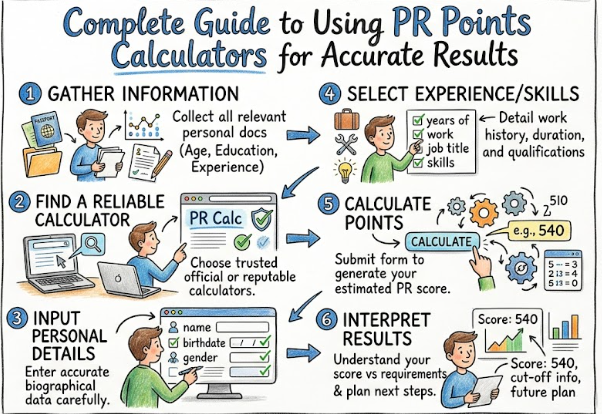
Step-by-Step Guide to Calculate Your Points
Follow this manual walkthrough to estimate your score before using an automated tool:
Step 1: Evaluate Your Education
Gather your degrees. If you studied outside the target country, you likely need an Educational Credential Assessment (ECA) to prove your degree is equivalent to their local standards.
Step 2: Language Testing
Do not guess. Take a mock IELTS or PTE test. A difference between a “7.5” and an “8.0” in Listening can be the difference between 3 points and 20 points in some systems.
Step 3: Count Your “Skilled” Years
Only “post-qualification” and “skilled” work counts. If you have 10 years of experience but only 3 years were in your specialized field after you graduated, the calculator will only give you points for those 3 years.
Realistic Example Profiles:
- The Single Pro: 27 years old, Master’s degree, 3 years experience, IELTS 8.0. Result: Extremely high CRS score for Canada.
- The Married Couple: Primary applicant is 35 (loses age points), but the spouse is a Doctor (adds partner points). Result: Stronger together for Australia’s Subclass 190.
How to Maximize Your PR Points
If your score is low, don’t panic. There are “Point Boosters” you can use:
- Language (The Easiest Boost): Retaking the IELTS to hit a higher band is the fastest way to add points without waiting years.
- Provincial/State Nomination: In Canada, a PNP (Provincial Nominee Program) adds 600 points, effectively guaranteeing an invitation.
- Second Language: In Canada, learning basic French can add up to 50 additional points.
- Higher Education: Sometimes a one-year Post-Graduate Diploma can bridge the gap.
Common Mistakes to Avoid
- Misjudging Age: Points for age often drop on your birthday. If you calculate at 29 but apply at 30, your score will be lower.
- Incorrect NOC/ANZSCO Codes: Choosing the wrong job category can lead to a rejection for “misrepresentation.”
- Spouse Points: Sometimes, applying without your spouse as a dependent (initially) gives the primary applicant a higher score.
- Validity of Documents: Language tests expire after 2 years. Using an expired score on a calculator gives you a false sense of security.
Practical Case Studies
Case Study 1: The “Language Leap”
Ananya, a 31-year-old Marketing Manager from Mumbai, had a CRS score of 435. The Canada draws were at 470. She used a PR points calculator and realized her IELTS “Writing” score was holding her back. She retook the test, improved from a 7.0 to a 7.5, and her score jumped to 468. She then applied for an Ontario Provincial Nomination and received the 600-point boost, securing her PR within 6 months.
Case Study 2: The Regional Strategy
Mark, a 40-year-old Civil Engineer, was too old to get high points for Australia’s 189 visa. By using a points calculator, he discovered that by moving to a “Regional Area” (Subclass 491), he could gain 15 extra points. This brought his total from 60 to 75, making him eligible for an invitation in South Australia.
FAQs (Frequently Asked Questions)
1. What is a PR points calculator?
It is an online tool that simulates the official government algorithms to estimate your eligibility score for permanent residency.
2. How accurate are these tools?
They are highly accurate for estimations, provided you input honest and verified data (like ECA-verified degrees and actual IELTS scores).
3. How many points are required for Canada PR in 2026?
While it varies, a competitive CRS score is generally between 470 and 510, though category-based draws (e.g., healthcare, STEM) may have lower cut-offs.
4. Can I improve my points after submission?
Yes! You can update your Express Entry or SkillSelect profile if you get a new job, a higher degree, or better test scores.
5. Does having a sibling in the country help?
In Canada, having a sibling who is a PR or citizen adds 15 points to your CRS.
6. Is there an age limit for PR?
There is no hard “limit,” but points for age usually drop to zero after 45 in Australia and Canada.
7. Do I need a job offer to use the calculator?
No. Most points-based systems (like Canada’s Express Entry) allow you to apply without a job offer, though having one provides extra points.
8. What is the difference between Canada and Australia’s systems?
Canada focuses more on “Human Capital” (age/education), while Australia is more “State-Driven” (focusing on specific occupations needed in certain regions).
9. How long does the points calculation take?
Using an online calculator takes less than 5 minutes if you have your details ready.
10. Can my spouse’s education help my score?
Yes, most systems allow the primary applicant to claim points for the spouse’s education and language proficiency.
11. What is a “Draw”?
A draw is when the government selects the top-ranking profiles from the pool based on their points.
12. Should I hire an agent to calculate my points?
You can do it yourself for free using online tools, but an agent can help ensure you aren’t “over-claiming” points you can’t prove.
Conclusion
A PR Points Calculator is more than just a bunch of fields to fill out—it is the blueprint for your future. Whether you are aiming for the snowy landscapes of Canada, the sun-drenched coasts of Australia, or the tech hubs of Japan, the points system is your path forward.
Remember, your score today isn’t permanent. If you aren’t eligible right now, use the calculator to identify your weaknesses. Is it your language score? Your education level? Use these insights to build a two-year plan. Immigration is a marathon, not a sprint, and the most successful migrants are those who treat their points calculation as a strategic project.