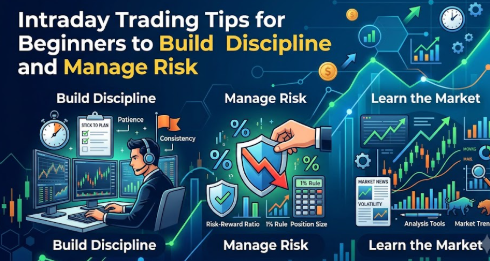
Introduction
Many beginners enter the stock market with excitement, but they often feel confused when prices move rapidly and a promising trade suddenly turns into a loss. Intraday trading involves opening and closing positions within the same trading session, which means traders have limited time to analyse information, control emotions, and make decisions. Without a written plan, beginners may follow social media tips, take oversized positions, hold losing trades, or trade repeatedly to recover earlier losses. SEBI has specifically studied the outcomes of individual intraday traders in the equity cash segment, highlighting the need for stronger risk awareness among retail participants. e explains practical intraday trading tips for beginners, including stock selection, position sizing, stop-loss planning, trading psychology, order types, record keeping, and risk management so that new traders can approach the market with greater discipline and realistic expectations.
Understanding Intraday Trading in Simple Words
Intraday trading means buying and selling a financial instrument during the same trading day. A trader does not normally keep the intraday position open overnight. The objective is to respond to short-term price movements rather than hold the stock for months or years.
For example, suppose a trader buys 20 shares of a company at ₹500 and sells them at ₹506 during the same session. The gross price difference is ₹6 per share, but the trader must still account for brokerage, taxes, exchange charges, slippage, and other applicable costs. If the price instead falls to ₹494, the trader faces a loss.
People search for intraday trading tips because short-term price movements appear to create frequent opportunities. However, frequent opportunities do not automatically produce consistent profits. A trader must make decisions about direction, entry, stop-loss, quantity, target, and exit while market conditions continue changing.
A common misunderstanding is that intraday trading is simply about finding a stock that will rise. In reality, even a correct market view can produce a poor result when the entry price is late, the position is too large, the stop-loss is unrealistic, or the order is not executed as expected.
The practical takeaway is simple: intraday trading should be treated as a structured risk-management activity, not as a quick-income method.
Why Intraday Trading Knowledge Is Important
Intraday trading knowledge is important because short-term trading decisions can directly affect savings, monthly cash flow, financial confidence, and emotional health. A beginner who uses salary money, emergency savings, borrowed funds, or money needed for household expenses may experience serious financial pressure after a few losses.
Good trading knowledge helps a person separate investing from trading. Investing generally focuses on business quality, valuation, and long-term growth. Intraday trading focuses more heavily on immediate price behaviour, liquidity, volume, volatility, execution, and strict risk limits.
It also helps traders understand that expected return should never be considered without risk. SEBI’s investor education material identifies market risk, liquidity risk, and volatility risk as important securities-market risks. It also advises market participants to understand their objectives and risk appetite before committing money. knowledge can also improve tax and record-keeping awareness. Traders should maintain contract notes, broker statements, profit-and-loss reports, expense records, and other documents required for accurate financial reporting. Tax treatment can depend on the instrument, trading activity, circumstances, and applicable law, so qualified professional advice may be necessary.
A Practical Scenario
A salaried employee has ₹80,000 in savings and decides to use ₹50,000 for intraday trading after seeing profitable screenshots online. Instead of risking the entire amount, a better approach would be to keep emergency savings separate, begin with observation or simulated practice, establish a small maximum loss per trade, and review results over a meaningful sample of trades before increasing exposure.
The Real Problems Beginners Face With Intraday Trading
The biggest problem in intraday trading is often not a lack of indicators. It is the absence of a repeatable decision-making process.
Beginners regularly face the following difficulties:
Too Much Conflicting Advice
One person recommends breakout trading, another recommends moving averages, and someone else claims that news trading is the best approach. Beginners combine several unrelated ideas without testing whether they work together.
A better approach is to learn one basic setup, define its rules clearly, and observe its behaviour across different market conditions.
Emotional Decision-Making
Fear can make a trader exit a valid position too early. Greed can make the trader ignore the target. Hope can make the trader hold a losing trade beyond the planned stop.
The better approach is to define the entry, stop, target, quantity, and invalidation point before placing the order.
Unrealistic Expectations
Social media often shows profitable trades without showing losing trades, costs, capital employed, or overall account performance. This creates the impression that daily profits are normal and easily repeatable.
The better approach is to measure process quality, risk control, and performance over many trades rather than judging success from one session.
Poor Position Sizing
A trader may place the same quantity in every stock without considering the distance between entry and stop-loss. This creates inconsistent risk.
The better method is to calculate position size using the amount the trader can afford to lose and the risk per share.
Following Unverified Tips
A message stating “sure-shot stock” or “guaranteed target” may encourage immediate action without research. SEBI cautions investors to be suspicious of guaranteed high-return claims and warns against unregistered advisers offering assured returns. er approach is to verify the source, understand the setup independently, and avoid any advice that promises certainty.
Not Knowing the Next Step
Many beginners enter a trade but have no plan for what to do when the price moves slightly against them, reaches the target, gaps sharply, or remains inactive.
A complete trade plan should include responses for multiple possible outcomes before money is placed at risk.
How Intraday Trading Works Step by Step
Step 1: Decide Whether Intraday Trading Suits You
Intraday trading requires attention, emotional control, time, and the ability to accept losses without disturbing essential finances. Before starting, examine whether your schedule allows you to monitor positions responsibly and whether you can follow rules under pressure. A common mistake is choosing intraday trading only because it appears faster than investing. A better approach is to compare intraday, swing trading, and long-term investing before selecting a style that suits your risk tolerance, time availability, and financial goals.
Step 2: Protect Essential Money Before Allocating Trading Capital
Trading capital should be separated from rent, loan payments, medical expenses, education costs, emergency funds, and household savings. Decide the maximum amount that can be exposed without affecting your financial stability. The common mistake is depositing a large part of available savings into a trading account. A better approach is to create a separate trading allocation and accept that the entire allocation is exposed to risk, even when individual trades use stop-loss orders.
Step 3: Prepare a Small Watchlist
Select a limited number of actively traded stocks instead of searching the entire market during live trading. Examine liquidity, usual trading volume, price behaviour, major news, corporate announcements, and broader market direction. A common mistake is selecting a stock only because it is moving rapidly. A better approach is to prepare the watchlist before the session and define what conditions would make each stock tradable or unsuitable.
Step 4: Define a Clear Trade Setup
A setup is a specific combination of conditions that must be present before a trade is considered. It may involve a breakout from a defined range, a pullback in a trend, support or resistance behaviour, volume confirmation, or another tested structure. The common mistake is entering because a candle “looks strong.” A better approach is to write objective rules explaining the trend, entry trigger, invalidation level, stop-loss, target, and conditions under which no trade should be taken.
Step 5: Calculate Position Size Before Entry
First decide the maximum rupee amount you are prepared to lose on the trade. Next, calculate the difference between the proposed entry and stop-loss. Divide the maximum permitted loss by the risk per share. For example, if the maximum risk is ₹300 and the entry-to-stop distance is ₹6, the calculated quantity is 50 shares before considering slippage and charges. The common mistake is selecting quantity based on available margin. The better approach is to select quantity based on controlled risk.
Step 6: Choose the Appropriate Order Type
Market, limit, stop-loss, and other order conditions behave differently. NSE explains that a market order seeks execution at the best obtainable price, while a limit order allows a price to be specified. A stop-loss order becomes active when the relevant trigger level is reached or crossed. mistake is using a market order in a rapidly moving or illiquid stock without considering slippage. The better approach is to understand how the selected order behaves before placing it.
Step 7: Manage the Trade Without Changing Rules Emotionally
Once the trade is active, monitor whether the original reason for entry remains valid. Do not widen the stop-loss merely to avoid accepting a loss. Do not increase quantity in a losing position unless that action is part of a carefully tested strategy with controlled total risk. A common mistake is moving the stop farther away whenever price approaches it. A better approach is to accept the predefined loss when the trade is invalidated.
Step 8: Close and Review the Trade
Record the entry, exit, stop, target, quantity, setup, result, costs, screenshot, emotional state, and rule compliance. NSE also provides mechanisms through which eligible investors can verify trades executed in their accounts and receive trade information or alerts through registered contact details. n mistake is reviewing only profitable trades. A better approach is to review every trade, including trades that were skipped, because good decisions do not always produce profits and poor decisions can occasionally produce profits.
Key Factors That Influence Intraday Trading
Risk and Potential Return
A trade with a large possible gain may also involve a wide stop or low probability of success. Beginners should compare expected reward with the amount at risk instead of looking only at the target.
The common mistake is choosing trades because the target looks attractive. The better approach is to define the acceptable loss first.
Market Volatility
Volatility describes how quickly and widely prices move. High volatility may create opportunities, but it can also increase slippage, sudden reversals, and stop-loss execution risk.
Beginners should reduce position size when price movement becomes unusually wide or unpredictable.
Liquidity
Liquidity reflects how easily shares can be bought or sold without causing or experiencing a major price difference. Low-liquidity stocks may have wide bid-and-ask spreads and poor execution.
Beginners should generally focus on instruments with adequate participation and avoid assuming that every displayed price is available for their full quantity.
Research Quality
Intraday research may include market direction, sector strength, price structure, volume, important levels, announcements, and scheduled events.
The mistake is collecting information without deciding how it affects the trade. Better research converts information into specific conditions for entry, avoidance, or exit.
Position Size
Position sizing determines how much capital is exposed to a single trading idea. A technically good setup can still damage the account if the position is too large.
Use a consistent risk formula rather than increasing quantity because of confidence or excitement.
Trading Costs
Brokerage, statutory charges, taxes, exchange charges, bid-and-ask spread, and slippage can reduce net performance. Frequent small trades may appear profitable before costs but become weak after all expenses are included.
Review net results using broker statements rather than relying only on the price difference visible on the chart.
Emotional Control
Intraday prices change quickly, creating pressure to act immediately. Fear of missing out, revenge trading, overconfidence, and panic can override the plan.
Predefined rules, limited trade frequency, and daily loss limits help reduce emotional decisions.
Review and Discipline
A trader cannot improve a process that is not recorded. Regular review reveals which setups, periods, stocks, and behaviours are creating avoidable losses.
Discipline means following the plan even when breaking the rules might occasionally produce a profit.
Detailed Breakdown of Intraday Trading
Stock Market Basics
The stock market connects buyers and sellers of listed securities. Prices change as orders interact and market participants respond to company information, economic conditions, sector developments, expectations, and broader sentiment.
Beginners should understand that a price chart reflects transactions that have already occurred. It does not guarantee what will happen next.
How Stock Orders Work
Orders are processed according to exchange rules. On NSE, orders are generally matched using price priority and then time priority. The highest eligible buy order and lowest eligible sell order receive priority according to the matching system. ters because a trader may identify the correct direction but receive a different execution price from the one expected, particularly when the market moves quickly.
Investing Versus Intraday Trading
Investors may hold a company based on business performance, financial strength, valuation, industry position, and long-term potential. Intraday traders usually focus on short-term price movement and close positions during the same session.
A company can be a strong long-term investment but a poor intraday trade when liquidity is low or price action is unclear. The reverse can also happen.
Long-Term Versus Short-Term Thinking
Long-term participants can often tolerate normal daily fluctuations when their investment thesis remains valid. Intraday traders cannot rely on a long-term story to justify a short-term losing position.
A common mistake is converting a failed intraday trade into an investment because the trader does not want to record a loss. The better approach is to decide the trade type before entry and follow the appropriate exit rule.
Fundamental Understanding
Although intraday decisions frequently rely on price and volume, fundamental events can create sudden movement. Earnings, management announcements, regulatory developments, mergers, large orders, or industry news may change expectations quickly.
Do not trade an unfamiliar announcement merely because the price is moving. Read the information and understand that the market may react differently from your interpretation.
Technical Understanding
Technical analysis examines price, volume, trend, support, resistance, patterns, and indicators. It can help organise decisions, but it cannot eliminate uncertainty.
Beginners often place several indicators on the chart and assume agreement between them guarantees success. A better approach is to use a small number of tools that answer distinct questions, such as trend, momentum, volatility, or entry timing.
Support and Resistance
Support is an area where buying interest may appear, while resistance is an area where selling pressure may emerge. These are zones rather than perfectly reliable prices.
A common mistake is entering exactly at a level without waiting for evidence of rejection, breakout, or continuation. The better approach is to define what price behaviour confirms the trade and what behaviour invalidates it.
Volume
Volume shows trading participation. Rising volume can help confirm interest in a price move, but volume alone does not reveal whether the move will continue.
Compare current volume with the stock’s normal behaviour and combine it with price structure.
Trend
An uptrend generally displays higher highs and higher lows, while a downtrend generally displays lower highs and lower lows. A sideways market may move within a range.
Beginners commonly use a trend-following strategy in a sideways market and then take repeated false signals. Recognise the market structure before selecting the strategy.
Breakouts
A breakout occurs when price moves beyond a defined level or range. A valid breakout may attract further participation, while a false breakout may quickly reverse.
Instead of entering every breakout, examine volume, broader market support, nearby obstacles, risk distance, and whether the price has already moved too far.
Pullbacks
A pullback is a temporary movement against the prevailing trend. Some traders wait for a pullback rather than entering after an extended move.
The risk is assuming every decline in an uptrend is a buying opportunity. Define the level that would indicate the trend structure has failed.
Risk-to-Reward Planning
Risk-to-reward compares the possible loss with the planned gain. A trade risking ₹1 to target ₹2 has a planned ratio of 1:2, but this ratio alone does not make the trade attractive.
The setup must also have a reasonable probability, realistic target, adequate liquidity, and disciplined execution.
Stop-Loss Planning
A stop-loss is a predefined exit point intended to limit damage when the trade idea becomes invalid. It should be based on market structure and then used to calculate quantity.
A stop-loss cannot guarantee execution at the exact trigger price during gaps, sharp movements, or low liquidity. Position size must therefore leave room for execution uncertainty.
Diversification and Concentration
Taking several positions in closely related stocks does not necessarily create diversification. If all stocks belong to the same sector, they may react similarly to one event.
Beginners should limit simultaneous exposure and consider whether multiple trades represent the same underlying market view.
Trading Psychology
Trading psychology includes the thoughts and emotions that influence decisions. Common pressures include fear of missing out, refusal to accept losses, overconfidence after profits, and the desire to recover money quickly.
The goal is not to eliminate emotion completely. It is to prevent emotion from changing position size, risk limits, and exit rules.
Patience and Discipline
Intraday trading involves periods when no suitable opportunity is available. A trader who believes that every session must produce income may force low-quality trades.
A no-trade decision can be a successful risk-management decision.
Why Random Tips Are Risky
A tip rarely explains the adviser’s entry, time horizon, quantity, stop-loss, capital size, risk tolerance, or exit. Even when the direction is correct, your execution may differ.
Never share account passwords, one-time passwords, PINs, or remote device access with anyone claiming they will trade for you.
Common Mistakes Beginners Make With Intraday Trading
Trading Without a Written Plan
This happens because entering a trade feels easier than planning one. Without written rules, the trader reacts differently each time.
Write the entry condition, stop, target, quantity, maximum loss, and exit condition before placing the order.
Risking Too Much on One Trade
Overconfidence or the desire for fast profits can lead to oversized positions. One sudden move may then erase the gains from several careful trades.
Set a fixed maximum risk per trade and reduce the quantity when the stop distance is wider.
Averaging a Losing Position
Beginners sometimes buy more after a decline to reduce the average entry price. This increases exposure while the original trade may already be failing.
Do not add merely because the price is lower. Any addition should be planned before entry and remain within the original total-risk limit.
Removing or Widening the Stop-Loss
A trader may move the stop to avoid accepting a small loss. The loss can then become much larger.
Place the stop where the setup is invalidated and size the position so that accepting the stop is financially manageable.
Chasing a Fast-Moving Stock
Fear of missing out encourages entry after a large price move. The trader may enter just before profit-taking begins.
Wait for a planned setup, pullback, consolidation, or fresh confirmation. Missing a trade is better than entering without controlled risk.
Overtrading
After a loss, traders may place several new trades to recover money. After a profit, they may continue because they feel unusually confident.
Set a maximum number of trades and a daily loss limit. Stop when either limit is reached.
Ignoring Costs
Several small gross profits can disappear after charges and slippage. Beginners may judge performance using only chart prices.
Record all costs and analyse net profit or loss.
Trading Illiquid Stocks
Low-priced or rapidly moving stocks may appear attractive but can have wide spreads and poor execution. Exiting the desired quantity may be difficult.
Check trading activity, spread, and available market depth before entry.
Using Emergency or Borrowed Money
Financial pressure makes it harder to follow a stop-loss because the trader feels compelled to recover the money.
Use only risk capital and keep emergency funds separate.
Blindly Following Social Media
Online posts may be delayed, edited, selective, sponsored, or published without accountability. Profitable screenshots do not prove long-term results.
Use social media for ideas only after independent verification and never treat popularity as evidence.
Ignoring Trade Verification and Account Security
Failure to review contract notes and alerts can allow errors or unauthorised activity to remain unnoticed.
Keep registered contact information current, verify transactions, and report discrepancies promptly.
Ignoring Tax and Compliance Responsibilities
Frequent trading creates records that may be relevant for taxation, accounting, and financial reporting.
Maintain organised statements and consult a qualified tax professional for guidance relevant to your circumstances.
“Don’t Do This” Checklist
- Do not trade with rent, EMI, medical, or emergency money.
- Do not follow guaranteed-return or sure-shot claims.
- Do not place a trade without a predefined exit.
- Do not select quantity only from available margin.
- Do not keep widening the stop-loss.
- Do not average losses impulsively.
- Do not chase a stock after an extended move.
- Do not trade to recover an earlier loss immediately.
- Do not share passwords, PINs, OTPs, or remote access.
- Do not ignore brokerage, taxes, charges, and slippage.
- Do not convert every failed intraday trade into an investment.
- Do not continue trading after reaching the daily loss limit.
Practical Real-Life Examples of Intraday Trading
Example 1: The Salaried Beginner
Situation: Rohan wants to trade before beginning his office work and uses money reserved for monthly expenses.
Challenge: Because he needs the money, he becomes anxious whenever a trade moves against him.
Better action: He keeps essential money separate, reduces capital exposure, and trades only when his schedule allows proper monitoring.
Learning: Financial pressure weakens decision-making, even when the trading setup appears reasonable.
Example 2: The Random Stock-Tip Follower
Situation: Meera receives a message claiming that a stock will reach a guaranteed target.
Mistake: She buys immediately without checking the price structure, source, liquidity, or stop-loss.
Better action: She avoids the trade, verifies the source, and considers only setups that fit her written rules.
Learning: A popular or confident message is not a substitute for independent analysis.
Example 3: The Oversized Position
Situation: Arjun has ₹1,00,000 of trading capital and takes a very large position because he strongly believes the stock will rise.
Challenge: A small adverse movement creates a large account loss.
Better action: He defines a maximum rupee risk and calculates quantity from the distance between entry and stop.
Learning: Confidence should never determine quantity; controlled risk should determine it.
Example 4: The Revenge Trader
Situation: Kavita loses on her first two trades and immediately takes several new positions.
Mistake: Her objective changes from following the setup to recovering the loss before the session ends.
Better action: She stops after reaching her daily loss limit and reviews the trades later.
Learning: A daily loss limit protects both capital and decision quality.
Example 5: The Disciplined Trade Reviewer
Situation: Sameer records every entry, exit, screenshot, reason, and emotion.
Challenge: His early results are inconsistent, but the journal reveals that most losses occur when he enters late.
Better action: He adds a rule that prevents entries after the price has moved beyond a defined distance from the setup.
Learning: A trading journal converts repeated mistakes into measurable improvements.
Table 1: Intraday Trading Versus Long-Term Investing
| Factor | Intraday Trading | Long-Term Investing |
|---|---|---|
| Holding period | Position is generally closed within the session | Position may be held for years |
| Main focus | Short-term price, volume, liquidity, and execution | Business quality, valuation, growth, and financial strength |
| Decision speed | Fast decisions may be required | More time is normally available for research |
| Monitoring | Often requires active monitoring | Usually requires periodic review |
| Cost impact | Frequent transactions can make costs significant | Lower transaction frequency may reduce cost impact |
| Emotional pressure | Can be high because prices move quickly | Daily movement may be less important to the long-term thesis |
| Primary discipline | Entry, stop-loss, position sizing, and execution | Asset allocation, diversification, valuation, and patience |
| Main risk | Rapid loss from volatility, leverage, or poor execution | Business, valuation, market-cycle, and long-term capital risk |
Table 2: Beginner Mistakes and Better Approaches
| Beginner Mistake | Why It Is Risky | Better Approach |
|---|---|---|
| Trading without a stop | A small loss can grow significantly | Define invalidation and stop before entry |
| Using maximum available margin | Exposure may exceed personal risk capacity | Calculate quantity from maximum permitted loss |
| Chasing rapid movement | Entry may occur near exhaustion | Wait for a defined setup or skip the trade |
| Following unverified tips | Source and risk plan may be unknown | Verify independently and use written rules |
| Averaging down emotionally | Exposure increases as the trade weakens | Exit when the original setup is invalid |
| Trading repeatedly after loss | Decisions become recovery-driven | Stop at the daily loss limit |
| Ignoring transaction costs | Gross profit may not become net profit | Review contract notes and net results |
| Holding intraday positions accidentally | Overnight risk may be different from the plan | Review open positions before the session ends |
Tools, Methods, and Frameworks Readers Can Use
Stock Watchlist
A watchlist is a small collection of stocks selected for observation. It helps beginners avoid searching randomly during live trading.
Include liquidity, relevant levels, expected events, trend direction, and conditions that would cancel the trade idea. A watchlist helps prevent impulsive entries in unfamiliar stocks.
Pre-Trade Checklist
A pre-trade checklist confirms whether the setup meets all requirements. It may include market direction, stock trend, volume, entry trigger, stop, target, quantity, news risk, and available reward.
Its purpose is to prevent emotional exceptions such as “this trade looks too good to miss.”
Position-Size Calculator
A position-size calculator converts the maximum permitted rupee loss and stop distance into a suggested quantity.
The basic educational formula is:
Position size = Maximum permitted trade loss ÷ Risk per share
The final quantity may need to be reduced for slippage, costs, gaps, liquidity, and broker requirements.
Trading Journal
A trading journal records both numbers and behaviour. Important fields include date, stock, setup, entry, exit, stop, target, quantity, costs, result, screenshot, emotion, and rule compliance.
It helps identify whether losses come from the strategy, execution, overtrading, poor timing, or emotional decisions.
Daily Loss Limit
A daily loss limit is the maximum amount a trader is willing to lose during one session. Once reached, no new trades should be placed.
This framework reduces the risk of revenge trading and prevents one emotionally difficult session from causing disproportionate damage.
Maximum Trade Limit
A maximum number of trades creates a pause between opportunities and reduces unnecessary activity.
Beginners may start with a very low limit so that each decision receives proper attention.
Risk-to-Reward Framework
This framework compares planned loss with planned gain. It helps reject trades where the target is too close relative to the stop.
However, do not use the ratio alone. The target must be realistic and the setup must have evidence behind it.
Screenshot Review Method
Take a chart screenshot before entry and after exit. Mark the setup, levels, and reasons.
This allows the trader to compare the original plan with the actual decision without relying on memory.
Weekly Performance Review
A weekly review should examine net results, rule compliance, average loss, average gain, repeated mistakes, trade frequency, and the quality of skipped trades.
The objective is not merely to ask, “Did I make money?” It is to ask, “Did I follow a process capable of controlling risk?”
Expert Intraday Trading Tips for Beginners
1. Learn Market Mechanics Before Using Real Money
Understanding order types, execution, bid-and-ask prices, liquidity, and stop-loss behaviour is essential. Beginners can first observe live markets or use a simulated environment. This helps prevent avoidable operational mistakes.
2. Start With One Simple Setup
Using several setups makes it difficult to identify what is working. Choose one clearly defined pattern and study it across many sessions. Record both valid and invalid examples.
3. Risk a Small, Consistent Amount
Small risk helps beginners stay emotionally stable and collect experience without exposing large capital. Define risk in rupees rather than using an arbitrary quantity.
4. Calculate Quantity Before Placing the Order
Position sizing should happen before entry, not after the price moves. Use the stop distance and maximum permitted loss. Reduce the quantity when volatility increases.
5. Place the Stop at a Logical Invalidation Point
A stop should represent where the trading idea becomes invalid. Do not select a random stop merely because it creates a preferred quantity. Adjust the quantity to the correct stop, not the stop to the desired quantity.
6. Avoid Trading Every Price Movement
Most price movement does not need to be traded. Wait for conditions that match your plan. A skipped low-quality trade protects capital and attention.
7. Trade Liquid Stocks
Adequate liquidity usually supports better entry and exit execution. Examine spread and market participation rather than choosing only by price or percentage movement.
8. Check Events Before Trading
Corporate announcements, results, policy decisions, and other scheduled developments may increase uncertainty. Decide in advance whether your strategy is designed for such conditions.
9. Set a Daily Loss Limit
Stop trading after the predefined daily limit is reached. This rule prevents a normal losing session from becoming a major financial and psychological setback.
10. Avoid Immediate Recovery Trades
A trade taken mainly to recover money is rarely based on objective analysis. Take a break after a loss and apply the complete checklist again.
11. Review Net Performance
Include all charges and expenses when assessing performance. Gross chart profits can create a misleading impression when transaction costs are ignored.
12. Keep Emergency Money Separate
Emergency funds should be available for genuine financial needs. Trading losses should not create difficulty in paying bills, servicing debt, or managing medical requirements.
13. Protect Your Trading Account
Use strong security controls and review alerts, statements, and contract notes. Never allow another person to operate your account through shared credentials or remote access.
14. Measure Discipline as Well as Profit
A losing trade taken according to a valid plan may still be a good process decision. A profitable trade that violated every rule may reinforce dangerous behaviour.
15. Increase Exposure Only After Evidence
Do not increase capital because of a few successful trades. Review a meaningful sample across different market conditions and confirm that risk controls were consistently followed.
Case Studies: How Better Understanding Changes Decisions
Case Study 1: The Overconfident New Trader
Profile: Nikhil is a 27-year-old salaried employee with a growing interest in the stock market.
Situation: He earns a profit in his first three intraday trades and assumes that he has discovered an easy income source.
Problem: He increases his position size sharply and stops calculating risk.
Wrong approach: Nikhil uses most of the margin available in his account and enters a volatile stock without a predefined stop-loss.
Better approach: After experiencing a significant loss, he separates his essential savings, reduces his trade size, creates a maximum risk limit, and records each decision in a journal.
Result or learning: His objective changes from making daily income to following a controlled process. He trades less frequently and accepts that some sessions will offer no suitable opportunity.
Key takeaway: Early profits do not prove skill. Risk limits must remain consistent during both winning and losing periods.
Case Study 2: The Social Media Tip Follower
Profile: Priya is a beginner who follows several market channels and online groups.
Situation: She receives multiple stock recommendations each morning and feels pressure to enter before the price rises.
Problem: She does not know the source’s entry price, capital, holding period, or exit strategy.
Wrong approach: Priya buys whichever stock is mentioned most frequently and exits in panic when the price moves against her.
Better approach: She stops acting on anonymous tips, creates a five-stock watchlist, and takes a trade only when it matches her own setup and risk conditions.
Result or learning: The number of trades falls, but each decision becomes easier to explain and review. She also avoids claims offering guaranteed profits.
Key takeaway: Independent verification and a written plan are more valuable than the popularity of a recommendation.
Case Study 3: The Trader Who Focused Only on Accuracy
Profile: Amit has been trading for several months and believes that a high win rate is the main sign of success.
Situation: He records many small gains but occasionally suffers a very large loss.
Problem: He closes profitable trades quickly while allowing losing trades to remain open.
Wrong approach: Amit tries to avoid being wrong, so he moves stops and waits for losing positions to recover.
Better approach: He records average gain, average loss, maximum loss, rule compliance, and risk-to-reward—not merely the percentage of winning trades.
Result or learning: He understands that one uncontrolled loss can cancel several successful trades. He begins accepting small planned losses and stops widening the exit.
Key takeaway: Loss size and risk consistency can matter more than the percentage of trades that finish profitably.
Risk Awareness: What Readers Must Check First
Market Risk
Market risk is the possibility that broad market developments will move prices against the position. Even a strong stock may fall when the entire market experiences selling pressure.
Reduce this risk by checking the broader market, limiting exposure, and avoiding assumptions of certainty.
Volatility Risk
Volatility risk arises when prices move rapidly or unpredictably. Stops may trigger quickly, and actual execution can differ from the expected price.
Reduce quantity during high volatility and avoid placing trades whose normal movement exceeds your risk capacity.
Liquidity Risk
Liquidity risk means that a position may not be bought or sold promptly at the expected price. SEBI identifies liquidity risk as an important securities-market consideration. struments with adequate participation and avoid large positions relative to visible market activity.
Slippage Risk
Slippage is the difference between the expected execution price and the actual price. It can increase during fast movement, gaps, or weak liquidity.
Include a slippage allowance in position sizing and avoid assuming that every stop will execute at the trigger price.
Leverage Risk
Leverage allows exposure greater than the trader’s own available capital, but it also magnifies losses. A small price movement can create a large percentage change in account equity.
Beginners should not interpret available margin as an acceptable risk limit.
Emotional Risk
Fear, greed, frustration, boredom, and overconfidence can cause rule-breaking. Emotional risk often increases after several wins or consecutive losses.
Use breaks, loss limits, written rules, and reduced trade frequency.
Technology Risk
Internet failure, device problems, broker outages, delayed data, or accidental orders can interfere with execution.
Know the broker’s support process, keep account details secure, verify orders carefully, and avoid leaving positions unmanaged.
Misinformation and Fraud Risk
Unregistered advisers, fake profiles, manipulated screenshots, and guaranteed-profit claims can influence traders.
Verify credentials where applicable and avoid transferring money or account access to anyone offering assured results.
Data Privacy Risk
Trading accounts contain sensitive financial and personal information. Sharing passwords, OTPs, PINs, screen access, or identity documents with unverified persons creates serious risk.
Use official applications, strong passwords, and secure devices.
Tax and Compliance Risk
Incorrect records or misunderstanding applicable tax treatment may create compliance problems.
Maintain statements and consult a qualified tax professional because treatment can depend on individual facts and current law.
Checklist Before Taking an Intraday Trade
- I understand why I am entering the trade.
- The trade matches a written setup.
- I have checked the broader market direction.
- I have checked the stock’s trend, liquidity, and volume.
- I have reviewed relevant announcements or event risk.
- My entry price is clearly defined.
- My stop-loss is based on an invalidation level.
- My target is realistic under current conditions.
- My position size is calculated from maximum permitted loss.
- Possible slippage and costs have been considered.
- The trade does not use emergency or borrowed money.
- I am not entering from fear of missing out.
- I am not attempting to recover an earlier loss.
- The trade remains within my daily loss limit.
- I know what will make me exit early.
- I understand how the selected order type works.
- My device, internet connection, and broker account are secure.
- I will record and review the trade after closing it.
Use this checklist before every order until the process becomes consistent. Do not ignore a failed condition simply because the stock appears to be moving quickly. The purpose of a checklist is to protect the trader precisely when emotional pressure encourages shortcuts.
Strategic Insights for Better Decision-Making
Position Sizing Is the First Defence
Beginners often search for a more accurate indicator when the real problem is oversized exposure. A strategy with normal losing trades becomes dangerous when position size is uncontrolled.
Define a maximum loss for each trade and calculate quantity accordingly.
Daily Risk Is More Important Than a Daily Profit Target
A fixed profit target can encourage forced trading when no quality setup exists. A daily risk limit gives the trader permission to stop.
Focus on protecting capital rather than extracting income from every session.
Multiple Trades May Represent One Risk
Buying several banking stocks at the same time may appear diversified, but all positions can react to the same sector event.
Evaluate total exposure by sector, market direction, and underlying idea.
Market Conditions Affect Strategy Performance
A breakout strategy may perform differently in a strong trend than in a narrow range. A pullback strategy may fail when the market reverses completely.
Classify the market condition before applying the setup.
Avoid Herd Mentality
A stock discussed widely online may already have moved significantly. Entering because “everyone is buying” removes independent decision-making.
Use observable price behaviour and predefined risk rather than crowd enthusiasm.
Trading Frequency Does Not Equal Productivity
More trades create more costs, more decisions, and more opportunities for error. A trader can improve by waiting rather than acting.
Track the percentage of trades that fully met the checklist.
Review Process and Outcome Separately
A well-planned trade can lose because uncertainty cannot be removed. A careless trade can profit because of favourable movement.
Evaluate whether the process was correct before judging yourself only by the financial result.
Scale Gradually
Increasing quantity changes emotional pressure and execution behaviour. A setup followed calmly with a small position may be difficult to follow with a much larger position.
Increase exposure in small stages only after consistent rule compliance.
Key Terms Explained for Beginners
- Intraday Trading: Buying and selling a security during the same trading session rather than holding it overnight.
- Entry Price: The price at which a trader intends to open a position.
- Exit Price: The price at which a position is closed, either for profit, loss, or risk control.
- Stop-Loss: A predefined order or exit level intended to limit damage when the trade moves against the plan.
- Target: The planned price level at which the trader may book a profit.
- Position Size: The number of shares or units included in a trade.
- Risk per Trade: The maximum amount a trader plans to lose if the stop is reached.
- Liquidity: The ability to buy or sell an instrument promptly without a major effect on its price.
- Volatility: The speed and size of price movement. Higher volatility can create both opportunity and greater risk.
- Market Order: An order intended to execute at the best available price, which may differ from the price visible when the order is submitted.
- Limit Order: An order that specifies the maximum buying price or minimum selling price acceptable to the trader.
- Slippage: The difference between the expected transaction price and the actual execution price.
- Support: A price area where buying interest may appear, although it is not guaranteed to hold.
- Resistance: A price area where selling pressure may emerge, although price can still move beyond it.
- Risk-to-Reward Ratio: A comparison between the planned loss and planned gain of a trade.
Who Should Read This Blog
Beginners
New market participants can use this guide to understand the complete trading process before risking significant capital.
Students
Students interested in financial markets can learn why risk management, research, and discipline matter more than profit screenshots.
Salaried Employees
Salaried people can understand why household money, loan payments, and emergency funds must remain separate from trading capital.
Small Business Owners
Business owners can learn why operating cash, tax funds, and employee-payment money should not be exposed to short-term market risk.
New Investors
Investors can understand the difference between holding a business for the long term and trading short-term price movement.
Active Traders
Developing traders can use the checklists, journal framework, and case studies to review their existing process.
Loan Seekers
People managing loans can recognise why borrowed money and EMI funds should not be used for speculative trading.
Crypto Learners
Crypto participants may find the principles of volatility control, position sizing, account security, and misinformation awareness useful.
Casino Content Creators
Responsible-content writers can understand why financial-risk topics must avoid guaranteed-income language and misleading profit claims.
Finance Bloggers
Finance writers can use the structure to create educational, transparent, and reader-first trading content.
People Improving Financial Awareness
Anyone seeking better money habits can learn how planning, record keeping, and emotional control support financial decisions.
People Trying to Avoid Financial Mistakes
Readers who have experienced impulsive decisions can use the risk checklist before committing money again.
Frequently Asked Questions
1. What is intraday trading?
Intraday trading means opening and closing a position within the same trading session. Traders attempt to respond to short-term price movement and generally avoid carrying the position overnight. It involves market, execution, liquidity, and emotional risks.
2. What are the most important intraday trading tips for beginners?
The most important intraday trading tips for beginners are to protect essential savings, begin with small exposure, define a stop-loss, calculate position size, trade liquid instruments, avoid random tips, and maintain a trading journal.
3. Can beginners earn a fixed daily income from intraday trading?
No fixed daily income can be guaranteed from intraday trading. Market conditions and trade outcomes are uncertain. Treating trading as a compulsory daily-income source can encourage overtrading and excessive risk.
4. How much money should a beginner use for intraday trading?
There is no universal amount suitable for every person. The capital should not include emergency funds, borrowed money, rent, EMI, medical funds, or essential household savings. Beginners should prioritise learning and small controlled risk.
5. Is a stop-loss guaranteed to prevent a larger loss?
A stop-loss is a valuable risk-control tool, but it cannot guarantee execution at the exact trigger price. Fast markets, gaps, technical issues, and low liquidity can cause slippage. Position sizing should account for this uncertainty.
6. How should beginners select stocks for intraday trading?
Beginners should examine liquidity, trading volume, price structure, volatility, spread, important news, and broader market direction. They should prepare a small watchlist instead of selecting stocks randomly during the session.
7. What is the biggest intraday trading mistake?
One of the biggest mistakes is taking an oversized position without defining the maximum acceptable loss. Other serious mistakes include widening stops, revenge trading, averaging losses, and following guaranteed-return claims.
8. Are technical indicators enough for profitable trading?
No indicator can guarantee profitable results. Indicators organise historical price or volume information, but they should be combined with market structure, liquidity, risk management, execution planning, and disciplined review.
9. How can intraday trading tips for beginners improve risk management?
Intraday trading tips for beginners provide a structured way to define risk, calculate quantity, place stops, limit daily losses, and review mistakes. They cannot remove risk, but they can reduce avoidable and uncontrolled decisions.
10. How often should a trader review performance?
Trades should be recorded after every session and reviewed more deeply each week or month. Review net results, average loss, average gain, rule compliance, setup quality, emotional behaviour, and total transaction costs.
11. Should beginners follow stock tips from social media?
Beginners should not act blindly on social media tips. The source may be unverified, delayed, selective, or unaware of the reader’s financial situation. Every trade should be independently evaluated using a written risk plan.
12. What should a beginner do after reading this guide?
Begin by learning market mechanics, creating a watchlist, defining one simple setup, preparing a checklist, and practising position sizing. Use small or simulated exposure until you can follow the process consistently without emotional rule changes.
Conclusion
Intraday trading can appear simple because buying and selling happen within one session, but the real process requires preparation, risk control, patience, technical understanding, accurate execution, and emotional discipline. The most useful intraday trading tips for beginners are not promises of daily profits or perfect market predictions; they are practical rules that help protect capital when uncertainty is high. Beginners should start by separating essential savings from trading funds, understanding order types, selecting liquid stocks, preparing a limited watchlist, and defining one clear setup. Every proposed trade should include an entry, invalidation point, stop-loss, realistic target, calculated position size, and maximum permitted loss before the order is placed. Traders should also consider slippage, transaction costs, event risk, liquidity, technology failures, and the possibility that the market may move differently from their expectations. A trading journal should record not only profit and loss but also whether the trade followed the plan, because a disciplined losing trade can provide better learning than an accidental profitable trade. Avoid using borrowed money, averaging losses emotionally, chasing fast price movements, widening stops, or following unverified social media recommendations. Set a daily loss limit and stop when it is reached rather than attempting to recover money immediately. Over time, review a meaningful sample of trades to identify which setups, market conditions, and behaviours produce the strongest decision quality. Intraday trading is not suitable for everyone, and choosing long-term investing, swing trading, or avoiding active trading may be the better decision for some individuals. Financial awareness means recognising both opportunity and limitation. Learn gradually, verify information independently, protect personal data, maintain accurate records, and consult qualified financial or tax professionals when individual guidance is required. The responsible next step is not to search for a guaranteed trade but to create a written, risk-aware process that you can follow consistently, even when the market becomes fast, uncertain, or emotionally challenging.