Introduction
CMMI Level 5 is one of the most respected performance maturity achievements for organizations that want to demonstrate strong process discipline, measurable improvement, predictable delivery, and continuous innovation. Many companies talk about quality, productivity, customer satisfaction, delivery control, risk management, and operational excellence, but CMMI provides a structured model to assess and improve these areas in a measurable way. CMMI, which stands for Capability Maturity Model Integration, helps organizations understand how mature their processes are and how effectively those processes support business performance. CMMI Level 5 represents the highest maturity level, where the organization is not only stable and measured but also continuously improving, innovating, and adapting to change.
What Is CMMI?
CMMI stands for Capability Maturity Model Integration. It is a process and performance improvement model used by organizations to improve capability, quality, productivity, delivery, risk control, customer satisfaction, and business results.
In simple words, CMMI helps an organization answer important questions such as:
- Are our processes clearly defined?
- Are projects planned and controlled?
- Are teams following consistent practices?
- Are results predictable?
- Are defects being reduced?
- Are risks managed properly?
- Are performance goals measured?
- Are improvements based on data?
- Are we continuously improving?
- Are our processes aligned with business objectives?
CMMI is not only a software model anymore. It is used across industries and service areas, including software development, IT services, engineering, product development, supplier management, cybersecurity, safety, data management, people management, and digital operations.
What Is CMMI Level 5?
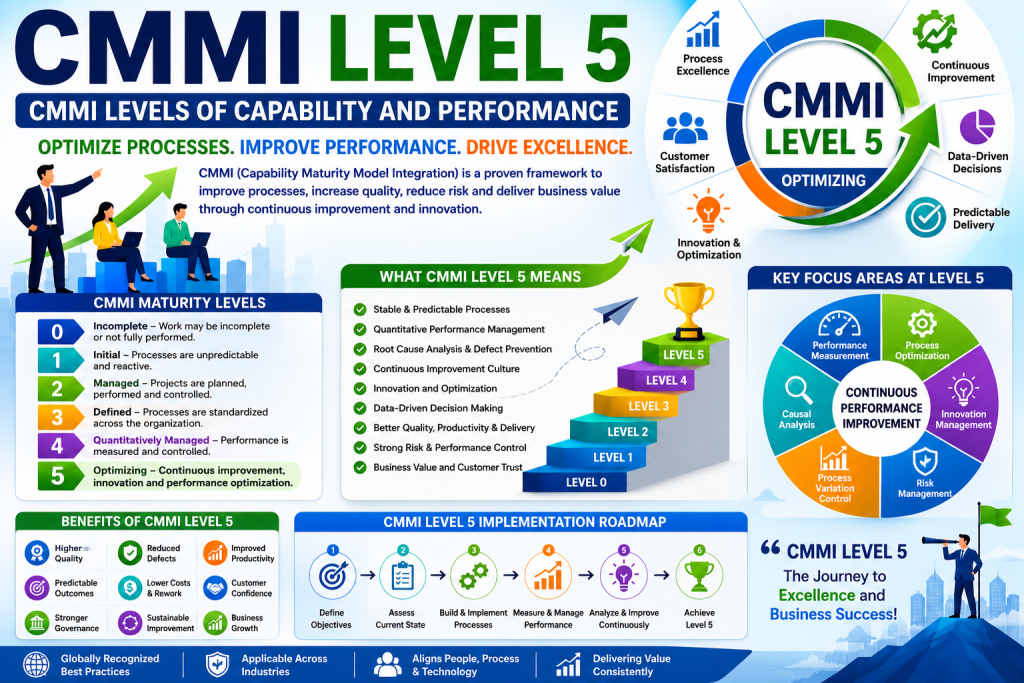
CMMI Level 5 is the highest maturity level in the CMMI maturity model. It is commonly known as the Optimizing level.
At CMMI Level 5, an organization has stable, measured, controlled, and continuously improving processes. It uses data, statistical analysis, performance trends, root cause analysis, innovation, and improvement actions to optimize business performance.
A CMMI Level 5 organization does not only ask, “Are we following the process?”
It asks deeper questions such as:
- How well is the process performing?
- What trends are visible in the data?
- Which areas can be optimized?
- Which improvements will create business value?
- How can defects be prevented earlier?
- How can delivery become more predictable?
- How can innovation improve productivity?
- How can the organization respond faster to change?
- How can performance goals be exceeded?
CMMI Level 5 is about becoming a learning, improving, and adaptive organization.
Why CMMI Level 5 Matters
CMMI Level 5 matters because it shows that an organization has reached a high level of process maturity and performance discipline. It demonstrates that the organization is not dependent on random efforts, individual heroics, or informal practices. Instead, it has established systems that support predictable performance and continuous improvement.
CMMI Level 5 can help organizations:
- Improve delivery predictability
- Reduce process variation
- Reduce defects and rework
- Improve customer satisfaction
- Strengthen process governance
- Improve productivity
- Support business growth
- Improve risk management
- Build client confidence
- Support tender and contract eligibility
- Improve innovation culture
- Strengthen data-based decision-making
- Create a long-term performance improvement system
For service providers, technology companies, engineering firms, government contractors, and large delivery organizations, CMMI Level 5 can become a strong business credibility factor.
CMMI Level 5 Is Not Just a Certificate
Many organizations mistakenly treat CMMI Level 5 as only a certificate or badge. This is a weak approach. CMMI Level 5 is not just about passing an appraisal. It is about building a mature performance culture.
A true Level 5 organization should be able to show:
- Real process implementation
- Consistent performance data
- Quantitative goals
- Stable process results
- Root cause analysis
- Preventive actions
- Process innovation
- Performance improvement
- Lessons learned
- Business outcome alignment
If an organization focuses only on getting a rating, it may miss the real value of CMMI. The real value is improved business performance.
CMMI Levels of Capability and Performance
CMMI uses levels to show how mature and capable an organization’s processes are. These levels help organizations understand where they currently stand and what they should improve next.
There are two important ways to understand CMMI levels:
- Maturity Levels
These represent organization-wide process maturity. - Capability Levels
These represent process capability in selected practice areas.
Both are useful, but they serve different purposes.
CMMI Maturity Levels Explained
CMMI maturity levels show the overall maturity of an organization’s processes. They provide a staged path for improvement.
Maturity Level 0: Incomplete
At this level, work may be incomplete, inconsistent, or not fully performed. Processes may be missing or poorly implemented.
Common signs include:
- No clear process ownership
- Unclear responsibilities
- Work depends on individuals
- Poor tracking
- Inconsistent results
- Limited evidence
This level indicates that the process is not yet capable of delivering reliable outcomes.
Maturity Level 1: Initial
At Level 1, work gets completed, but it is often unpredictable and reactive. Success may depend on individual effort rather than stable processes.
Common signs include:
- Unplanned work
- Frequent delays
- Budget overruns
- Poor risk control
- Informal practices
- Limited measurement
- High dependency on key people
Many organizations begin their improvement journey from this level.
Maturity Level 2: Managed
At Level 2, projects are planned, performed, measured, and controlled at the project level. Basic project management discipline is established.
Common characteristics include:
- Project planning
- Requirement tracking
- Work monitoring
- Basic measurement
- Risk tracking
- Configuration control
- Supplier management
- Quality checks
- Project-level governance
Level 2 helps organizations move from chaos to controlled project execution.
Maturity Level 3: Defined
At Level 3, processes are defined at the organizational level and used across projects, programs, and portfolios. The organization becomes proactive rather than reactive.
Common characteristics include:
- Standard organizational processes
- Tailoring guidelines
- Defined roles and responsibilities
- Training programs
- Process assets
- Knowledge sharing
- Organization-wide improvement
- Consistent service or product delivery
Level 3 helps organizations achieve consistency across teams.
Maturity Level 4: Quantitatively Managed
At Level 4, the organization becomes data-driven. Processes are measured and controlled using quantitative performance objectives.
Common characteristics include:
- Quantitative goals
- Statistical process control
- Performance baselines
- Predictive models
- Process capability analysis
- Data-driven decisions
- Variation control
- Predictable results
Level 4 is where organizations begin to manage performance scientifically.
Maturity Level 5: Optimizing
At Level 5, the organization focuses on continuous improvement, innovation, agility, and optimization. Processes are stable enough to support experimentation, learning, and rapid adaptation.
Common characteristics include:
- Continuous improvement culture
- Root cause analysis
- Defect prevention
- Innovation management
- Process optimization
- Data-based improvement
- Organizational learning
- Proactive risk reduction
- Business performance alignment
- Adaptability to change
Level 5 is the highest maturity level and represents an organization that is stable, flexible, learning-oriented, and improvement-driven.
CMMI Capability Levels Explained
Capability levels are used to measure how well a specific practice area is implemented. Instead of rating the whole organization, capability levels focus on selected areas.
For example, an organization may want to improve:
- Supplier management
- Risk management
- Process quality
- Service delivery
- Configuration management
- Requirements management
- Measurement and analysis
- Governance
- Workforce capability
Capability levels help organizations improve targeted areas based on business needs.
Capability Level 0: Incomplete
The practice area is not fully implemented or does not achieve its purpose.
Capability Level 1: Initial
The practice area is performed, but it may not be systematic or consistent.
Capability Level 2: Managed
The practice area is planned, monitored, and controlled.
Capability Level 3: Defined
The practice area is standardized, integrated, and improved across the organization.
Capability levels are useful when an organization wants targeted improvement without pursuing an organization-wide maturity rating immediately.
CMMI Maturity Level vs Capability Level
| Point | Maturity Level | Capability Level |
|---|---|---|
| Focus | Whole organization or organizational unit | Specific practice area |
| Purpose | Staged organizational maturity improvement | Targeted capability improvement |
| Rating Style | Single maturity level rating | Capability profile across selected areas |
| Best For | Organizations seeking broad maturity recognition | Organizations improving selected business capabilities |
| Example | Organization appraised at Maturity Level 5 | Risk Management at Capability Level 3 |
Both approaches can support business improvement. The right choice depends on the organization’s goals.
What Makes CMMI Level 5 Different?
CMMI Level 5 is different because it goes beyond defined and measured processes. It focuses on optimization, prevention, innovation, and business value.
At Level 3, an organization has defined processes.
At Level 4, the organization controls processes quantitatively.
At Level 5, the organization improves and innovates continuously based on performance data.
CMMI Level 5 organizations are expected to:
- Use performance data for improvement
- Identify root causes of defects and variations
- Prevent problems before they occur
- Improve process capability
- Encourage innovation
- Align improvement with business objectives
- Respond quickly to market and customer changes
- Use lessons learned across the organization
- Improve quality, cost, delivery, and productivity outcomes
Level 5 is not about doing more paperwork. It is about improving smarter.
Key Features of a CMMI Level 5 Organization
1. Stable Processes
Processes are consistent, controlled, and predictable. Teams do not work randomly. They follow defined and measured practices.
2. Quantitative Performance Management
Performance is measured using meaningful metrics. Management decisions are based on data, not assumptions.
3. Continuous Improvement
Improvement is not occasional. It is part of daily operations and management review.
4. Defect Prevention
The organization focuses on preventing defects instead of only fixing them after they occur.
5. Innovation Culture
New methods, tools, technologies, and process improvements are encouraged and evaluated.
6. Root Cause Analysis
Problems are investigated deeply to identify real causes, not only surface symptoms.
7. Business Alignment
Process improvements are linked with business objectives such as delivery speed, quality, cost, productivity, customer satisfaction, and risk reduction.
8. Organizational Learning
Lessons learned from one project are shared across the organization.
9. Agility With Stability
A Level 5 organization can adapt to change because its processes are stable and measurable.
10. Performance Optimization
The organization continuously improves its capability to deliver better outcomes.
Benefits of CMMI Level 5
1. Better Process Predictability
CMMI Level 5 helps organizations predict outcomes more accurately because performance is measured and controlled.
2. Reduced Defects
Root cause analysis, preventive action, and process control help reduce defects and rework.
3. Improved Delivery Performance
With stable processes and data-driven planning, organizations can improve schedule performance and delivery reliability.
4. Better Customer Satisfaction
Customers trust organizations that can deliver consistently and improve continuously.
5. Stronger Business Credibility
CMMI Level 5 can help organizations stand out in competitive markets, tenders, and enterprise vendor evaluations.
6. Higher Productivity
Process optimization reduces waste, duplication, delays, and rework.
7. Improved Risk Management
Mature organizations identify risks early, monitor them, and take preventive action.
8. Better Decision-Making
Management decisions become more reliable because they are supported by data and performance trends.
9. Stronger Innovation
Level 5 encourages innovation that improves process and business performance.
10. Long-Term Performance Culture
The organization develops a culture of discipline, learning, improvement, and accountability.
Who Should Aim for CMMI Level 5?
CMMI Level 5 is suitable for organizations that already have strong process discipline and want to improve performance maturity at the highest level.
It is especially useful for:
- IT service companies
- Software development companies
- Engineering service providers
- Product development organizations
- Government contractors
- Defense suppliers
- Aerospace companies
- Large technology service providers
- Business process outsourcing companies
- Managed service providers
- Quality-focused enterprises
- Organizations handling complex projects
- Companies competing in regulated or high-trust markets
Small organizations can also use CMMI practices, but Level 5 usually requires strong management commitment, process discipline, data maturity, and long-term improvement focus.
CMMI Level 5 and Business Performance
CMMI Level 5 is strongly connected with business performance. The goal is not only process maturity but measurable improvement.
Business performance may include:
- Lower defect rate
- Better schedule accuracy
- Reduced cost variance
- Higher productivity
- Faster cycle time
- Better service availability
- Improved customer satisfaction
- Reduced rework
- Better risk control
- Stronger employee capability
- Improved delivery predictability
A good CMMI implementation should always connect process improvement with business outcomes.
CMMI Level 5 and Agile
Some people think CMMI and Agile cannot work together. This is not correct. CMMI does not force one fixed development method. It can work with Agile, DevOps, SAFe, Lean, and other modern delivery approaches when implemented correctly.
CMMI can support Agile teams by improving:
- Process discipline
- Measurement
- Defect prevention
- Risk management
- Customer feedback handling
- Retrospective actions
- Release predictability
- Quality engineering
- Organizational learning
- Performance improvement
The key is not to make Agile heavy with unnecessary documentation. The key is to make Agile measurable, disciplined, and continuously improving.
CMMI Level 5 and DevOps
DevOps focuses on collaboration, automation, continuous delivery, feedback, reliability, and faster value delivery. CMMI Level 5 can support DevOps by adding performance discipline and improvement structure.
CMMI can help DevOps organizations improve:
- Deployment quality
- Change failure rate
- Incident trends
- Automation effectiveness
- Release predictability
- Root cause analysis
- Continuous improvement
- Service reliability
- Measurement maturity
- Cross-team process governance
A mature DevOps organization can use CMMI principles to improve outcomes without slowing down delivery.
CMMI Level 5 and Quality Management
CMMI Level 5 supports quality management by helping organizations move from inspection-based quality to prevention-based quality.
Traditional quality may focus on checking work after completion.
CMMI Level 5 focuses on improving the process so defects are prevented earlier.
This includes:
- Quality planning
- Process measurement
- Peer reviews
- Defect analysis
- Root cause analysis
- Preventive actions
- Statistical control
- Process improvement
- Lessons learned
- Quality performance trends
The result is a stronger quality culture.
CMMI Level 5 Appraisal Process
A CMMI Level 5 rating is achieved through a formal appraisal conducted according to CMMI appraisal requirements. The appraisal checks whether the organization’s processes align with the CMMI model and whether implementation evidence supports the target maturity level.
Step 1: Define Business Objectives
Before starting, the organization should define why it wants CMMI Level 5.
Objectives may include:
- Improve delivery predictability
- Reduce defects
- Win enterprise contracts
- Improve productivity
- Strengthen governance
- Improve customer confidence
- Reduce rework
- Build performance culture
The goal should not be only “get Level 5.” The goal should be business improvement.
Step 2: Select Scope
The organization defines the appraisal scope.
Scope may include:
- Business unit
- Delivery center
- Development organization
- Service organization
- Projects
- Programs
- Locations
- Practice areas
- Organizational unit
A clear scope helps avoid confusion during appraisal.
Step 3: Conduct Gap Analysis
Gap analysis compares current practices with CMMI expectations.
It helps identify:
- Missing processes
- Weak evidence
- Poor measurement
- Inconsistent implementation
- Weak improvement systems
- Gaps in quantitative management
- Weak root cause analysis
- Poor organizational learning
- Incomplete performance baselines
Gap analysis is one of the most important preparation steps.
Step 4: Build Process Assets
The organization creates or improves process assets such as:
- Policies
- Process descriptions
- Guidelines
- Templates
- Checklists
- Metrics definitions
- Risk registers
- Quality plans
- Measurement plans
- Review methods
- Improvement procedures
- Lessons learned repositories
Process assets should reflect real work, not only documentation.
Step 5: Implement Across Projects
CMMI appraisal requires evidence of real implementation. Processes must be used in actual projects or service operations.
Implementation evidence may include:
- Project plans
- Work tracking records
- Review records
- Risk logs
- Metrics reports
- Defect logs
- Change records
- Customer feedback
- Retrospective records
- Corrective actions
- Improvement actions
Step 6: Establish Quantitative Management
For Level 4 and Level 5, quantitative management becomes critical.
This includes:
- Defining performance objectives
- Establishing baselines
- Identifying process performance models
- Measuring variation
- Analyzing trends
- Predicting outcomes
- Managing process capability
- Using statistical methods where suitable
Without quantitative management, Level 5 maturity is not realistic.
Step 7: Strengthen Causal Analysis and Improvement
Level 5 requires strong improvement practices.
This includes:
- Identifying root causes
- Analyzing defects and variations
- Selecting improvement actions
- Testing improvements
- Deploying successful improvements
- Measuring results
- Sharing lessons learned
- Preventing recurrence
The organization must show that improvement is systematic and evidence-based.
Step 8: Conduct Internal Reviews
Before formal appraisal, the organization should conduct internal reviews or readiness checks.
These reviews help verify:
- Process implementation
- Evidence quality
- Project readiness
- Interview readiness
- Metrics availability
- Improvement evidence
- Management involvement
- Consistency across teams
Step 9: Work With a Certified Lead Appraiser
A formal CMMI appraisal should be led by an authorized and certified Lead Appraiser through the official CMMI ecosystem.
The Lead Appraiser helps plan and conduct the appraisal according to appraisal requirements.
Step 10: Complete Formal Appraisal
During appraisal, the appraisal team reviews evidence, interviews participants, evaluates implementation, and determines whether the organization satisfies the requirements for the target maturity level.
The result may include a maturity level rating if the organization successfully meets the criteria.
CMMI Level 5 Implementation Roadmap
| Phase | Key Action | Expected Output |
|---|---|---|
| Phase 1 | Define business objectives | Clear improvement purpose |
| Phase 2 | Understand CMMI model | Management and team awareness |
| Phase 3 | Define appraisal scope | Organizational unit boundary |
| Phase 4 | Conduct gap analysis | Improvement action list |
| Phase 5 | Build process assets | Standardized process system |
| Phase 6 | Implement processes | Real project evidence |
| Phase 7 | Establish measurement system | Metrics and performance baselines |
| Phase 8 | Apply quantitative management | Predictable process performance |
| Phase 9 | Conduct causal analysis | Root cause and prevention system |
| Phase 10 | Deploy improvements | Improved business outcomes |
| Phase 11 | Conduct readiness review | Appraisal preparedness |
| Phase 12 | Complete formal appraisal | Maturity level rating |
| Phase 13 | Continue improvement | Sustained performance maturity |
Documents and Evidence Commonly Needed for CMMI Level 5
CMMI is not only document-based, but evidence is important. The organization must show that practices are implemented and producing results.
Common evidence may include:
- Process policy
- Process architecture
- Organizational process assets
- Project plans
- Service plans
- Measurement plans
- Metrics definitions
- Performance baselines
- Statistical analysis reports
- Process performance models
- Defect analysis records
- Causal analysis records
- Root cause analysis reports
- Improvement proposals
- Innovation records
- Corrective action records
- Risk management records
- Quality assurance records
- Peer review records
- Configuration management records
- Customer feedback records
- Training records
- Internal audit records
- Management review records
- Lessons learned records
- Process deployment records
- Tailoring records
- Supplier management evidence
- Delivery performance reports
The quality of evidence matters more than document volume. Evidence should prove real implementation and performance improvement.
Key Metrics for CMMI Level 5
CMMI Level 5 organizations rely heavily on meaningful metrics.
Important metrics may include:
- Defect density
- Defect leakage
- Rework percentage
- Schedule variance
- Cost variance
- Productivity
- Effort variance
- Cycle time
- Lead time
- Requirement volatility
- Review effectiveness
- Test effectiveness
- Customer satisfaction
- Service level achievement
- Change failure rate
- Incident recurrence rate
- Delivery predictability
- Process compliance
- Improvement benefit
- Risk exposure reduction
Metrics should be connected to business objectives. Collecting metrics without using them for decisions does not create maturity.
What Is Quantitative Management in CMMI?
Quantitative management means using data and statistical thinking to understand and control process performance.
It helps organizations answer:
- Is the process stable?
- What variation exists?
- What is normal performance?
- What is abnormal performance?
- Can we predict future results?
- Which process changes improve outcomes?
- Are performance objectives achievable?
For example, if a company tracks defect density across projects, it can identify normal ranges, detect abnormal projects early, and take preventive actions before delivery is affected.
Quantitative management is a foundation for CMMI Level 5 optimization.
What Is Causal Analysis?
Causal analysis means identifying the root cause of problems or variations.
Instead of asking only “Who made the mistake?” a mature organization asks:
- Why did the defect occur?
- Was the requirement unclear?
- Was the review ineffective?
- Was training missing?
- Was the tool inadequate?
- Was the process unclear?
- Was there a communication gap?
- Was the estimation wrong?
- Was the supplier input defective?
Causal analysis helps organizations prevent repeated problems.
What Is Defect Prevention?
Defect prevention means reducing the chance of defects before they happen.
Examples include:
- Better requirement reviews
- Improved coding standards
- Automated testing
- Peer reviews
- Training programs
- Reusable checklists
- Root cause analysis
- Process improvements
- Design validation
- Better supplier controls
- Lessons learned deployment
A Level 5 organization focuses more on prevention than correction.
What Is Process Innovation in CMMI Level 5?
Process innovation means improving processes through new methods, tools, automation, technology, or working practices.
Examples include:
- Test automation
- AI-assisted code review
- Automated deployment pipelines
- Predictive analytics
- Digital dashboards
- Knowledge management systems
- Agile process optimization
- DevOps automation
- Quality engineering improvements
- Reusable component libraries
Innovation should be evaluated based on measurable benefit, not only novelty.
Common Mistakes During CMMI Level 5 Implementation
1. Chasing the Level Instead of Business Results
The biggest mistake is focusing only on the rating. CMMI should improve real business outcomes.
2. Creating Too Much Documentation
CMMI does not mean unnecessary paperwork. Documents should support real work and improvement.
3. Weak Measurement System
Level 5 requires strong metrics. Poor data quality weakens quantitative management.
4. No Real Root Cause Analysis
Superficial cause analysis does not prevent recurrence. Organizations must identify true causes.
5. Poor Process Adoption
Processes must be followed by teams, not only written by the quality department.
6. Lack of Management Commitment
CMMI Level 5 needs leadership support, resources, and active review.
7. Ignoring Project-Level Reality
Processes should match how teams actually work. Unrealistic processes lead to noncompliance.
8. Treating Agile and CMMI as Opposites
CMMI can work with Agile if implemented practically.
9. Poor Evidence Management
Appraisal evidence should be organized, complete, and connected to practices.
10. No Continuous Improvement After Appraisal
A Level 5 organization must continue improving after the appraisal. The rating is not the end.
CMMI Level 5 Audit and Appraisal Readiness Checklist
Use this checklist before preparing for a formal appraisal:
- Are business objectives clearly defined?
- Is the appraisal scope clear?
- Are standard processes documented?
- Are processes implemented across selected projects?
- Are tailoring guidelines available?
- Are project plans maintained?
- Are risks tracked and managed?
- Are quality activities performed?
- Are metrics defined and used?
- Are performance baselines established?
- Are quantitative goals documented?
- Are process performance models used where applicable?
- Are defects analyzed?
- Is root cause analysis performed?
- Are preventive actions tracked?
- Are improvement actions measured?
- Are lessons learned shared?
- Are management reviews conducted?
- Is customer feedback analyzed?
- Are teams trained?
- Is evidence organized?
- Are interviews prepared?
- Are improvements linked to business outcomes?
Best Practices for Achieving CMMI Level 5
Start With Business Goals
Define what the organization wants to improve before selecting CMMI practices.
Build Strong Level 2 and Level 3 Foundations
Level 5 cannot succeed without stable project management and defined organizational processes.
Invest in Metrics Quality
Bad data leads to bad decisions. Ensure metrics are accurate, consistent, and useful.
Use Quantitative Methods Practically
Do not use statistics only for show. Use quantitative analysis to manage real performance.
Focus on Root Cause and Prevention
Repeated defects should lead to systemic improvement.
Keep Processes Lean
CMMI should improve performance, not create bureaucracy.
Integrate With Agile and DevOps
Use CMMI to strengthen modern delivery methods instead of replacing them.
Train Managers and Teams
Everyone should understand why processes and metrics matter.
Review Improvement Benefits
Measure whether improvements actually reduce defects, cost, delays, or customer issues.
Sustain After Appraisal
Continue improving after receiving the rating.
Practical Examples of CMMI Level 5 in Action
Example 1: Software Development Company
A software company tracks defect leakage, review effectiveness, sprint predictability, and customer-reported defects. It uses root cause analysis to improve requirements review and test automation. Over time, defects reduce and delivery becomes more predictable.
Example 2: IT Service Provider
An IT service provider tracks incident recurrence, SLA achievement, change failure rate, and resolution time. It identifies recurring incident causes and improves knowledge management, automation, and change review practices.
Example 3: Engineering Services Firm
An engineering company analyzes schedule variance and rework across design projects. It identifies weak input validation as a root cause and improves design review checklists and customer clarification processes.
Example 4: Government Contractor
A contractor working on complex programs uses quantitative performance baselines to predict schedule and cost outcomes. Management uses dashboards to intervene early when projects move outside expected limits.
Example 5: Agile Product Organization
An Agile organization uses CMMI principles to improve sprint predictability, defect prevention, backlog quality, release readiness, and customer feedback loops without making Agile processes heavy.
Cost Factors for CMMI Level 5
The cost of CMMI Level 5 implementation and appraisal depends on many factors:
- Organization size
- Number of locations
- Number of projects in scope
- Current process maturity
- Existing measurement system
- Quality of documentation
- Internal team capability
- Consultant involvement
- Training needs
- Tooling requirements
- Appraisal scope
- Lead Appraiser fees
- Gap analysis effort
- Improvement implementation effort
- Evidence preparation effort
Organizations with strong existing processes and metrics may require less effort than organizations starting from informal practices.
How Long Does It Take to Achieve CMMI Level 5?
The timeline depends on the organization’s current maturity. An organization already operating at Level 3 or Level 4 may move faster than an organization starting from Level 1.
Important factors include:
- Existing process maturity
- Leadership commitment
- Data availability
- Team adoption
- Measurement discipline
- Process improvement culture
- Scope size
- Number of projects
- Internal capability
- Readiness for appraisal
The goal should not be only fast achievement. The goal should be sustainable performance improvement.
CMMI Level 5 for Small and Medium Businesses
Small and medium businesses can use CMMI principles, but they should avoid overcomplication. They can apply CMMI in a lean and practical way.
SMBs should focus on:
- Clear project planning
- Basic process discipline
- Useful metrics
- Customer feedback
- Risk control
- Defect prevention
- Lessons learned
- Continuous improvement
- Simple dashboards
- Practical documentation
Even if a small business does not immediately pursue Level 5 appraisal, CMMI practices can improve performance maturity.
CMMI Level 5 and Customer Trust
Customers often look for suppliers who can deliver reliably. A CMMI Level 5 rating can help show that the organization follows mature practices and focuses on measurable improvement.
It can support:
- Vendor qualification
- Enterprise sales
- Government contracts
- Outsourcing deals
- Quality assurance reviews
- Partner confidence
- Long-term customer relationships
- Competitive differentiation
However, customers also look for real results. A Level 5 rating should be supported by strong delivery performance and customer satisfaction.
CMMI Level 5 vs ISO Certification
CMMI and ISO standards are different but can complement each other.
| Point | CMMI Level 5 | ISO Certification |
|---|---|---|
| Main Focus | Process maturity and performance improvement | Management system conformity |
| Rating Style | Maturity or capability level appraisal | Certification against standard requirements |
| Best Known For | Process capability and performance maturity | Standardized management system compliance |
| Outcome | Maturity level or capability level result | Certificate issued by certification body |
| Improvement Focus | Strong performance improvement focus | Depends on the specific ISO standard |
For example, an organization may use ISO 9001 for quality management and CMMI for process maturity and performance improvement.
Frequently Asked Questions
1. What is CMMI Level 5?
CMMI Level 5 is the highest maturity level in CMMI. It is known as the Optimizing level and focuses on continuous improvement, innovation, quantitative management, and business performance optimization.
2. What does CMMI stand for?
CMMI stands for Capability Maturity Model Integration. It is a model used to improve organizational capability and performance.
3. Is CMMI Level 5 a certificate?
CMMI Level 5 is usually achieved through a formal appraisal that results in a maturity level rating. Many people call it certification, but the more accurate term is appraisal rating.
4. What is the difference between maturity level and capability level?
A maturity level measures organization-wide process maturity, while a capability level measures performance in selected practice areas.
5. What are the CMMI maturity levels?
The maturity levels include Incomplete, Initial, Managed, Defined, Quantitatively Managed, and Optimizing.
6. Who should pursue CMMI Level 5?
Organizations with strong process maturity, data discipline, and improvement culture may pursue CMMI Level 5, especially IT, software, engineering, service, defense, and government contractor organizations.
7. Can Agile organizations achieve CMMI Level 5?
Yes. CMMI can work with Agile when implemented practically and focused on performance improvement rather than bureaucracy.
8. What is required for CMMI Level 5?
Organizations need stable processes, quantitative management, root cause analysis, continuous improvement, innovation, strong evidence, and business-aligned performance improvement.
9. How long does CMMI Level 5 take?
The timeline depends on current maturity, scope, documentation, data quality, leadership support, and implementation discipline.
10. What is the main benefit of CMMI Level 5?
The main benefit is a mature performance improvement system that helps improve quality, predictability, productivity, customer satisfaction, and business results.
Conclusion
CMMI Level 5 represents the highest level of process maturity and performance optimization. It shows that an organization has stable, measured, controlled, and continuously improving processes. However, the real value of CMMI Level 5 is not the rating alone. Its real value comes from better business performance, improved predictability, reduced defects, stronger customer satisfaction, better risk management, and a culture of continuous improvement. Organizations that approach CMMI Level 5 as a performance improvement journey can build long-term capability, agility, innovation, and competitive strength. The best CMMI Level 5 organizations do not chase the level; they use the model to improve how work is planned, performed, measured, controlled, and optimized.