Introduction
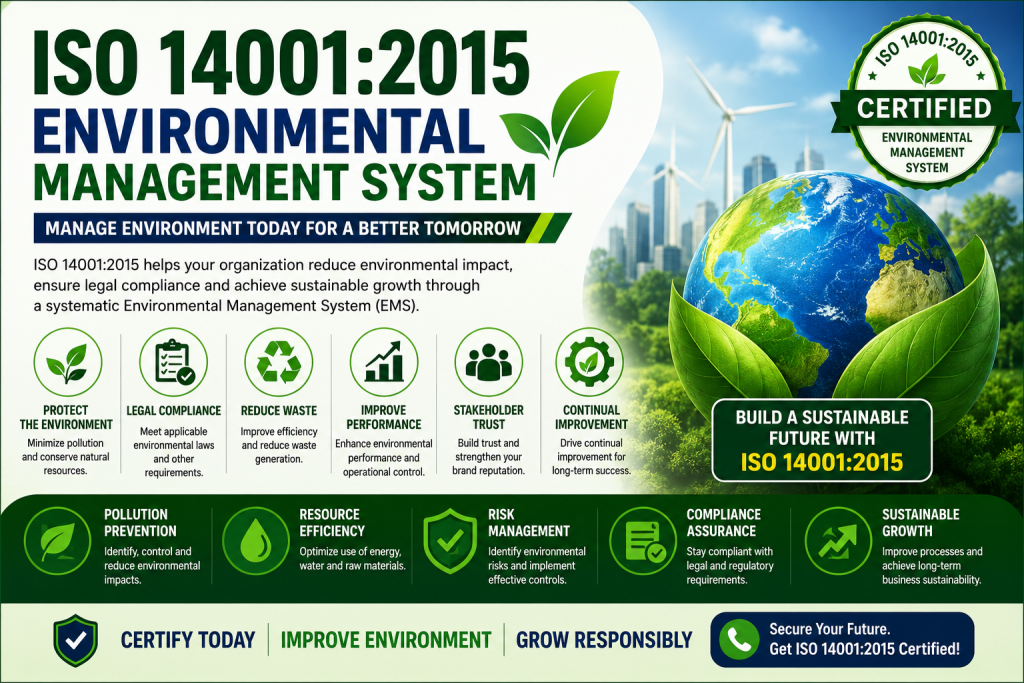
ISO 14001:2015 is an international standard for Environmental Management System, also known as EMS. It helps organizations manage their environmental responsibilities in a structured, practical, and professional way. Any business that wants to control pollution, reduce waste, improve resource usage, follow environmental compliance, and show commitment toward environmental protection can use ISO 14001:2015.
In today’s business world, customers, suppliers, government departments, investors, and stakeholders are becoming more serious about environmental responsibility. Companies are expected to manage energy use, waste, water, emissions, raw materials, and legal compliance properly. ISO 14001:2015 helps organizations create a system for this purpose.
ISO 14001:2015 is not only for large industries. It can be used by small businesses, factories, service companies, construction companies, hospitals, educational institutions, logistics companies, manufacturing units, IT companies, and many other organizations.
This blog explains ISO 14001:2015 in a simple and practical way. It covers meaning, importance, requirements, documents, certification process, benefits, common mistakes, and FAQs.
What Is ISO 14001:2015?
ISO 14001:2015 is an international standard that defines the requirements for an Environmental Management System. It gives organizations a framework to identify environmental impacts, control risks, meet compliance obligations, set environmental objectives, and improve environmental performance.
In simple words, ISO 14001:2015 helps an organization manage how its activities affect the environment.
It focuses on:
- Pollution prevention
- Waste management
- Legal compliance
- Resource efficiency
- Environmental risk control
- Continual improvement
- Environmental performance monitoring
- Management responsibility
- Emergency preparedness
- Sustainable business practices
ISO 14001:2015 does not give fixed environmental targets to every organization. Instead, it helps each organization create its own environmental management system based on its activities, risks, legal requirements, and business goals.
What Is an Environmental Management System?
An Environmental Management System is a structured system that helps an organization manage environmental responsibilities. It includes policies, procedures, records, objectives, controls, monitoring, audits, and improvement actions.
An EMS helps the organization answer important questions such as:
- What environmental impacts are created by our business?
- What legal requirements apply to us?
- How do we control pollution?
- How do we manage waste?
- How do we reduce energy and water usage?
- How do we prepare for environmental emergencies?
- How do we measure environmental performance?
- How do we improve year by year?
A good EMS is not just paperwork. It should be practically implemented in daily business operations.
Why ISO 14001:2015 Certification Is Important
ISO 14001:2015 Certification is important because it shows that an organization has a structured environmental management system. It helps the business demonstrate environmental responsibility and improve operational control.
Key Importance of ISO 14001:2015
- Helps manage environmental risks
- Supports legal and regulatory compliance
- Reduces waste and pollution
- Improves resource efficiency
- Builds customer and stakeholder trust
- Supports tender and vendor registration
- Improves company image
- Helps reduce environmental incidents
- Encourages continual improvement
- Supports sustainable business growth
Many companies also need ISO 14001:2015 Certification to participate in tenders, work with large clients, meet supplier requirements, or improve compliance confidence.
Who Needs ISO 14001:2015 Certification?
ISO 14001:2015 can be used by any organization, regardless of size, industry, or location. It is suitable for businesses that want to manage environmental impact and improve environmental performance.
Suitable For
- Manufacturing companies
- Construction companies
- Engineering companies
- Chemical industries
- Textile units
- Food processing units
- Packaging companies
- Logistics companies
- Warehouses
- Hospitals and healthcare organizations
- Educational institutions
- Hotels and hospitality businesses
- IT companies
- Service providers
- Government contractors
- Export businesses
- Startups and MSMEs
- Large industrial units
Any organization that uses resources, produces waste, consumes energy, or has environmental responsibilities can benefit from ISO 14001:2015.
Main Objectives of ISO 14001:2015
ISO 14001:2015 helps organizations achieve clear environmental objectives.
Main Objectives Include
- Protecting the environment
- Preventing pollution
- Meeting compliance obligations
- Improving environmental performance
- Reducing waste and resource consumption
- Managing environmental risks
- Creating environmental awareness among employees
- Improving emergency preparedness
- Building a culture of responsibility
- Supporting continual improvement
The standard helps organizations move from reactive environmental management to planned and systematic environmental control.
ISO 14001:2015 Certification Is Not a Product Certificate
Many business owners think ISO 14001:2015 certifies a product. This is not correct.
ISO 14001:2015 is a management system certification. It certifies that the organization has implemented an Environmental Management System as per ISO 14001:2015 requirements.
It does not mean that every product of the company is environmentally certified. It means the company has a system to manage environmental aspects and improve environmental performance.
Key Requirements of ISO 14001:2015
ISO 14001:2015 is based on a structured management system approach. The main practical requirements are explained below.
1. Context of the Organization
The organization must understand internal and external issues that can affect its Environmental Management System.
This includes understanding:
- Business activities
- Environmental conditions
- Legal requirements
- Customer expectations
- Community expectations
- Supplier requirements
- Environmental risks
- Operational challenges
The organization should also define the scope of the EMS. The scope explains which locations, departments, activities, products, and services are covered under ISO 14001:2015.
2. Leadership and Environmental Policy
Top management must show leadership and commitment toward the EMS. ISO 14001:2015 is not only the responsibility of the environmental officer or consultant. Management involvement is very important.
The organization must create an environmental policy.
Environmental Policy Should Include
- Commitment to environmental protection
- Commitment to pollution prevention
- Commitment to legal compliance
- Commitment to continual improvement
- Framework for setting objectives
- Suitability for the organization’s activities
The policy should be communicated to employees and made available to relevant interested parties.
3. Planning
Planning is one of the most important parts of ISO 14001:2015. The organization must identify environmental aspects, environmental impacts, compliance obligations, risks, opportunities, and objectives.
Environmental Aspects
Environmental aspects are activities, products, or services that can interact with the environment.
Examples include:
- Electricity consumption
- Water consumption
- Fuel use
- Waste generation
- Air emissions
- Noise generation
- Chemical storage
- Packaging waste
- Wastewater discharge
- Raw material usage
Environmental Impacts
Environmental impacts are the effects caused by environmental aspects.
Examples include:
- Air pollution
- Water pollution
- Soil contamination
- Resource depletion
- Climate impact
- Waste burden
- Noise pollution
- Biodiversity impact
The organization should identify significant environmental aspects and plan controls for them.
4. Compliance Obligations
The organization must identify legal and other environmental requirements applicable to its business.
Compliance obligations may include:
- Pollution control requirements
- Waste management rules
- Water discharge requirements
- Air emission requirements
- Hazardous waste handling rules
- Local environmental permissions
- Customer environmental requirements
- Industry-specific rules
- Consent or authorization requirements
The organization should maintain a legal register and periodically check whether it is complying with applicable requirements.
5. Environmental Objectives
The organization should set measurable environmental objectives. These objectives should support the environmental policy and significant environmental aspects.
Examples of Environmental Objectives
- Reduce electricity consumption
- Reduce water wastage
- Reduce paper usage
- Improve waste segregation
- Reduce hazardous waste
- Increase recycling
- Reduce fuel consumption
- Improve environmental training
- Reduce environmental complaints
- Improve compliance score
Each objective should have a plan, responsibility, timeline, resources, and method of monitoring.
6. Support
ISO 14001:2015 requires proper support for EMS implementation. This includes people, training, communication, awareness, and documented information.
Support Requirements Include
- Competent employees
- Environmental awareness
- Training records
- Internal communication
- External communication
- Document control
- Record control
- Required resources
Employees should understand the environmental policy, their responsibilities, significant environmental aspects, and consequences of not following procedures.
7. Operation
Operational control means controlling activities that can affect the environment. The organization should create procedures and controls for important environmental aspects.
Examples of Operational Controls
- Waste segregation procedure
- Hazardous waste handling procedure
- Chemical storage procedure
- Water usage control
- Energy saving practices
- Emergency response plan
- Spill control procedure
- Machine maintenance
- Supplier environmental control
- Waste disposal vendor control
The organization should also consider environmental requirements in procurement, outsourcing, contractor work, and product life cycle where applicable.
8. Emergency Preparedness and Response
The organization must prepare for possible environmental emergencies.
Examples of Environmental Emergencies
- Chemical spill
- Fire
- Gas leakage
- Oil leakage
- Wastewater overflow
- Hazardous waste accident
- Fuel leakage
- Storage tank leakage
- Environmental complaint
- Natural disaster affecting operations
The organization should prepare emergency response plans, conduct mock drills, train employees, and keep emergency equipment available.
9. Performance Evaluation
The organization must monitor, measure, analyze, and evaluate environmental performance.
Monitoring Can Include
- Energy consumption
- Water consumption
- Waste generation
- Emission levels
- Effluent quality
- Environmental incidents
- Legal compliance status
- Environmental objectives progress
- Training completion
- Internal audit results
Monitoring records help management understand whether the EMS is working effectively.
10. Internal Audit
Internal audit is required to check whether the EMS is properly implemented and maintained.
Internal audit helps identify:
- Nonconformities
- Missing records
- Weak controls
- Legal compliance gaps
- Training gaps
- Process improvement areas
- Documentation issues
- Operational failures
Internal audits should be planned, conducted by competent auditors, and followed by corrective actions.
11. Management Review
Top management must review the EMS periodically. Management review helps check performance, risks, objectives, audit results, compliance status, resource needs, and improvement opportunities.
Management Review May Cover
- Environmental policy suitability
- Objective progress
- Audit results
- Compliance status
- Environmental incidents
- Stakeholder feedback
- Resource requirements
- Risks and opportunities
- Corrective actions
- Improvement plans
Management review proves that top management is involved in the EMS.
12. Improvement
ISO 14001:2015 focuses on continual improvement. The organization must improve its EMS and environmental performance over time.
Improvement may happen through:
- Corrective actions
- Better waste management
- Energy-saving projects
- Water-saving projects
- Pollution reduction
- Better training
- Improved supplier control
- Better emergency planning
- Better legal compliance tracking
- Stronger operational control
Continual improvement is one of the main principles of ISO 14001:2015.
Documents Required for ISO 14001:2015 Certification
Documentation depends on the size, nature, and risk level of the organization. However, some documents are commonly needed.
Common Documents Required
- Environmental policy
- EMS scope
- Environmental objectives
- Environmental aspect-impact register
- Legal compliance register
- Risk and opportunity register
- Operational control procedures
- Emergency preparedness procedure
- Waste management records
- Training records
- Communication records
- Monitoring and measurement records
- Internal audit plan
- Internal audit report
- Management review minutes
- Corrective action records
- List of interested parties
- Compliance evaluation records
- Document control procedure
- Emergency drill records
The documentation should be simple, practical, and relevant to actual business operations.
Records Required for ISO 14001:2015
Records prove that the EMS is actually implemented.
Important Records Include
- Energy consumption records
- Water consumption records
- Waste disposal records
- Hazardous waste records
- Training attendance records
- Legal compliance records
- Environmental monitoring reports
- Internal audit records
- Management review records
- Incident records
- Corrective action records
- Mock drill records
- Calibration records, if applicable
- Supplier evaluation records, if applicable
Good records help during certification audit and also support real environmental improvement.
Step-by-Step ISO 14001:2015 Certification Process
The ISO 14001:2015 Certification process should be planned properly. Below is a simple step-by-step process.
Step 1: Understand Business Activities
First, understand the organization’s activities, products, services, departments, locations, and environmental impact areas.
Step 2: Define EMS Scope
Decide which locations, departments, operations, and services will be covered under ISO 14001:2015.
Step 3: Conduct Gap Analysis
Compare existing practices with ISO 14001:2015 requirements. Identify what is already available and what needs improvement.
Step 4: Identify Environmental Aspects and Impacts
List all activities that affect the environment. Identify significant environmental aspects and plan controls.
Step 5: Identify Legal Requirements
Prepare a legal register based on applicable environmental laws, permissions, customer requirements, and industry requirements.
Step 6: Prepare Environmental Policy
Create an environmental policy that reflects the organization’s commitment to environmental protection, compliance, and improvement.
Step 7: Set Environmental Objectives
Set measurable environmental objectives such as reducing waste, saving energy, reducing water use, or improving compliance.
Step 8: Prepare Required Documents
Prepare practical EMS documents, procedures, registers, formats, and records.
Step 9: Provide Employee Training
Train employees about environmental policy, responsibilities, waste handling, emergency response, and operational controls.
Step 10: Implement EMS Controls
Start using the procedures and controls in daily operations. Maintain records as evidence.
Step 11: Conduct Internal Audit
Conduct an internal audit to check whether EMS requirements are properly implemented.
Step 12: Conduct Management Review
Top management should review EMS performance, audit results, compliance status, and improvement plans.
Step 13: Select Certification Body
Choose a recognized certification body for the external certification audit.
Step 14: Stage 1 Audit
The certification body reviews documentation, scope, readiness, and basic implementation.
Step 15: Stage 2 Audit
The auditor checks actual implementation, records, operational controls, legal compliance, and employee awareness.
Step 16: Close Nonconformities
If any nonconformity is found, corrective action should be taken and evidence should be submitted.
Step 17: Receive ISO 14001:2015 Certificate
After successful audit and closure of nonconformities, the certification body issues the ISO 14001:2015 certificate.
ISO 14001:2015 Certification Audit
The certification audit is usually conducted in two stages.
Stage 1 Audit
Stage 1 audit checks documentation readiness. The auditor reviews whether the organization has prepared the basic EMS documents and is ready for Stage 2 audit.
Stage 2 Audit
Stage 2 audit checks actual implementation. The auditor verifies records, interviews employees, checks operational controls, reviews legal compliance, and evaluates EMS effectiveness.
If the organization meets requirements, certification is recommended.
ISO 14001:2015 Certificate Validity
ISO management system certificates are commonly issued for a certification cycle of three years, subject to surveillance audits.
During this cycle, the certification body may conduct surveillance audits to check whether the EMS is maintained properly.
If the organization fails to maintain the system, the certificate may be suspended or withdrawn by the certification body.
Surveillance Audit
Surveillance audit is a periodic audit conducted after certification. It checks whether the organization continues to follow ISO 14001:2015 requirements.
During surveillance audit, the auditor may check:
- EMS records
- Objective progress
- Legal compliance
- Internal audit
- Management review
- Corrective actions
- Environmental monitoring
- Operational controls
- Employee awareness
Surveillance audits help ensure the EMS remains active and effective.
Recertification Audit
Before the certificate cycle ends, the organization must go through a recertification audit if it wants to continue certification.
The recertification audit checks the full EMS again and confirms whether the organization is still suitable for certification.
Benefits of ISO 14001:2015 Certification
ISO 14001:2015 Certification gives many benefits to organizations.
1. Better Environmental Performance
It helps the organization reduce waste, pollution, and resource wastage.
2. Legal Compliance Support
It helps identify and monitor applicable environmental legal requirements.
3. Improved Business Reputation
Certification improves the organization’s image among customers, suppliers, investors, and stakeholders.
4. Tender and Vendor Benefits
Many tenders and corporate buyers prefer or require ISO 14001 certification.
5. Cost Saving
Better resource control can reduce energy, water, material, and waste disposal costs.
6. Employee Awareness
Employees become more aware of environmental responsibilities and safe operating practices.
7. Risk Reduction
The system helps identify environmental risks and prepare controls before problems occur.
8. Better Emergency Preparedness
Organizations become better prepared for spills, leaks, fire, and other environmental emergencies.
9. Continual Improvement
The EMS creates a cycle of planning, implementation, checking, and improvement.
10. Sustainable Growth
ISO 14001:2015 supports responsible growth by balancing business needs with environmental responsibility.
ISO 14001:2015 Certification Cost
The cost of ISO 14001:2015 Certification depends on several factors. There is no fixed single cost for every organization.
Cost Depends On
- Size of organization
- Number of employees
- Number of locations
- Nature of business
- Environmental risk level
- Scope of certification
- Documentation requirements
- Consultant charges
- Certification body charges
- Audit duration
- Existing compliance status
Small businesses may have lower costs, while large factories or multi-location companies may have higher costs.
Common Mistakes to Avoid
Many organizations face audit problems because they treat ISO 14001:2015 as only a document requirement. The system must be implemented practically.
Avoid These Mistakes
- Preparing documents but not implementing them
- Not identifying environmental aspects properly
- Ignoring legal requirements
- Not maintaining records
- No employee training
- Weak internal audit
- No management review
- Poor waste management evidence
- No emergency drill records
- Not tracking environmental objectives
- Copy-paste procedures not matching actual work
- Ignoring supplier and contractor controls
- Not closing corrective actions
A practical EMS is more valuable than a large file of unused documents.
ISO 14001:2015 Certification Service Includes
Professional ISO 14001:2015 Certification assistance may include:
- Basic consultation
- Gap analysis
- EMS scope preparation
- Environmental policy drafting
- Aspect-impact register preparation
- Legal register guidance
- Objective planning
- Procedure preparation
- Format and record support
- Employee awareness training
- Internal audit support
- Management review support
- Certification audit coordination
- Nonconformity closure support
- Certificate issuance coordination
Professional support helps organizations implement ISO 14001:2015 in a structured and audit-ready way.
Important Points Before Applying
Before applying for ISO 14001:2015 Certification, keep these points in mind:
- ISO 14001:2015 is an Environmental Management System standard.
- It is not a product certification.
- It can be applied to any type of organization.
- Environmental policy is required.
- Environmental aspects and impacts must be identified.
- Legal compliance requirements must be checked.
- Employee awareness is important.
- Internal audit and management review are required.
- Certification requires external audit by a certification body.
- Records must prove actual implementation.
- Continual improvement is required.
Difference Between ISO 14001 and ISO 9001
Many businesses confuse ISO 14001 with ISO 9001. Both are management system standards, but their focus is different.
| Point | ISO 14001 | ISO 9001 |
|---|---|---|
| Main Focus | Environmental management | Quality management |
| Purpose | Reduce environmental impact | Improve product/service quality |
| Key Area | Pollution, waste, compliance, resources | Customer satisfaction and process control |
| Suitable For | Any organization with environmental responsibility | Any organization wanting quality improvement |
| Certification Type | Management system certification | Management system certification |
Many organizations implement ISO 9001 and ISO 14001 together for better business and compliance management.
Difference Between ISO 14001 and ISO 45001
ISO 14001 and ISO 45001 are also different.
| Point | ISO 14001 | ISO 45001 |
|---|---|---|
| Main Focus | Environment | Occupational health and safety |
| Protects | Environment and natural resources | Workers and workplace safety |
| Key Risks | Pollution, waste, emissions, resource use | Injury, illness, accidents, hazards |
| Main System | Environmental Management System | Occupational Health and Safety Management System |
Both standards can be integrated because they follow a management system approach.
Who Should Apply for ISO 14001:2015 Certification?
ISO 14001:2015 Certification is suitable for organizations that want to improve environmental responsibility and meet customer or regulatory expectations.
Best Suitable For
- Factories
- Exporters
- Manufacturers
- Construction companies
- Engineering companies
- Packaging companies
- Chemical industries
- Textile units
- Food industries
- Hospitals
- Hotels
- Warehouses
- Logistics companies
- Service organizations
- Government suppliers
- MSMEs
- Startups
If your business wants to show environmental responsibility and improve operational control, ISO 14001:2015 can be useful.
FAQs
1. What is ISO 14001:2015?
ISO 14001:2015 is an international standard for Environmental Management System. It helps organizations manage environmental responsibilities and improve environmental performance.
2. What is EMS?
EMS means Environmental Management System. It is a structured system for managing environmental aspects, impacts, risks, compliance, objectives, and improvement.
3. Who can apply for ISO 14001:2015 Certification?
Any organization can apply, including manufacturers, service providers, hospitals, hotels, construction companies, exporters, MSMEs, and startups.
4. Is ISO 14001:2015 mandatory?
ISO 14001:2015 is not mandatory for every business by default. However, it may be required by customers, tenders, contracts, or industry expectations.
5. Is ISO 14001:2015 a product certificate?
No. It is a management system certificate, not a product certificate.
6. What are environmental aspects?
Environmental aspects are activities or processes that interact with the environment, such as energy use, water use, waste generation, emissions, and chemical storage.
7. What documents are required for ISO 14001:2015?
Common documents include environmental policy, EMS scope, aspect-impact register, legal register, objectives, procedures, internal audit records, and management review records.
8. How long is ISO 14001:2015 certificate valid?
ISO management system certificates are commonly valid for a three-year certification cycle, subject to surveillance audits.
9. What is a surveillance audit?
A surveillance audit is a periodic audit conducted after certification to check whether the EMS is still implemented and maintained.
10. What is the benefit of ISO 14001:2015?
It helps improve environmental performance, reduce waste, support compliance, improve reputation, and increase trust among customers and stakeholders.
11. Can small businesses apply for ISO 14001:2015?
Yes. Small businesses can apply if they want to manage environmental responsibilities and improve business credibility.
12. What is the difference between ISO 14001 and ISO 9001?
ISO 14001 focuses on environmental management, while ISO 9001 focuses on quality management.
Conclusion
ISO 14001:2015 is a valuable Environmental Management System standard for organizations that want to manage environmental responsibilities in a proper and structured way. It helps businesses identify environmental aspects, control impacts, follow compliance obligations, reduce waste, improve resource efficiency, and build a culture of continual improvement.
The certification is useful for manufacturers, service providers, exporters, construction companies, hospitals, hotels, logistics companies, MSMEs, startups, and many other organizations. It improves business credibility and helps meet customer, tender, and stakeholder expectations.
A successful ISO 14001:2015 implementation requires more than documents. The organization must create a clear environmental policy, identify risks, train employees, maintain records, conduct internal audits, review performance, and take corrective actions.
With proper planning and implementation, ISO 14001:2015 Certification can help an organization protect the environment, improve operations, reduce risks, and build a responsible business image.