Introduction
Secrets Scanning Tools help organizations detect exposed credentials such as API keys, database passwords, private keys, tokens, certificates, cloud access keys, webhook URLs, and service account credentials inside source code, Git history, CI/CD pipelines, containers, configuration files, collaboration tools, and developer workflows. These tools reduce the risk of attackers abusing leaked credentials to access cloud accounts, production systems, databases, internal APIs, and third-party services.
Secrets scanning is important because modern software teams use more APIs, cloud services, DevOps tools, AI coding assistants, and automation pipelines than ever before. A single exposed key can create serious security, compliance, and financial risk. Strong secrets scanning tools now support historical repository scanning, real-time push protection, custom detectors, verified secret validation, remediation workflows, and DevSecOps integration. GitHub’s secret scanning, for example, scans repository history and can detect exposed credentials across branches and related GitHub content, while GitLab describes secret detection as a way to help prevent leaks and respond when secrets are exposed.
Real-world use cases include:
- Detecting hardcoded API keys in repositories
- Blocking secrets before code is pushed
- Scanning Git history for legacy credential leaks
- Monitoring CI/CD pipelines and pull requests
- Reducing cloud credential exposure risk
Evaluation Criteria for Buyers
Organizations evaluating Secrets Scanning Tools should consider:
- Detection accuracy and false-positive control
- Supported secret types
- Historical Git scanning
- Real-time push protection
- CI/CD and pre-commit integration
- Custom rule support
- Verified secret validation
- Remediation workflows
- Developer experience
- Enterprise reporting and governance
Best for: DevSecOps teams, application security teams, cloud security teams, platform engineers, software developers, enterprises, SaaS companies, fintech organizations, healthcare companies, and any organization using Git-based development workflows.
Not ideal for: Teams with no source-code repositories, no API-based systems, or no DevOps workflows. However, even small teams should use at least lightweight scanning if they store configuration files, scripts, or infrastructure code.
Key Trends in Secrets Scanning Tools
- Push protection is becoming essential because organizations want to stop secrets before they enter shared repositories.
- Verified secret detection is improving because security teams need to prioritize valid credentials over test strings and false positives.
- AI-assisted development is increasing secrets exposure risk as code assistants, generated files, and pasted configuration snippets can accidentally include credentials.
- Historical Git scanning remains critical because old commits may contain credentials that still work.
- Custom detectors are becoming more important for internal tokens, private service formats, and organization-specific credentials.
- Secrets scanning is moving beyond Git into CI/CD logs, containers, package artifacts, ticketing systems, Slack-like tools, and cloud storage.
- Risk-based prioritization is gaining importance because not every exposed credential carries the same business risk.
- Developer-friendly remediation workflows are improving with automatic owner assignment, rotation guidance, and pull request comments.
- Policy integration is expanding across DevSecOps, supply chain security, and cloud security posture workflows.
- False-positive reduction remains a major buyer concern because research continues to show that noisy findings can make remediation harder for developers and security teams.
How We Selected These Tools
The following Secrets Scanning Tools were selected based on practical DevSecOps relevance, adoption, ecosystem maturity, detection capabilities, and fit across enterprise, SMB, and developer-first environments.
- Strong ability to detect common and sensitive secrets
- Support for Git repositories and historical scanning
- CI/CD, pre-commit, and pull request integration
- Enterprise reporting and workflow support
- Developer usability and remediation guidance
- Custom detector and policy flexibility
- Cloud and DevOps ecosystem integrations
- Balance between open-source and commercial options
- Support for real-time or shift-left scanning
- Long-term relevance for application security and software supply chain protection
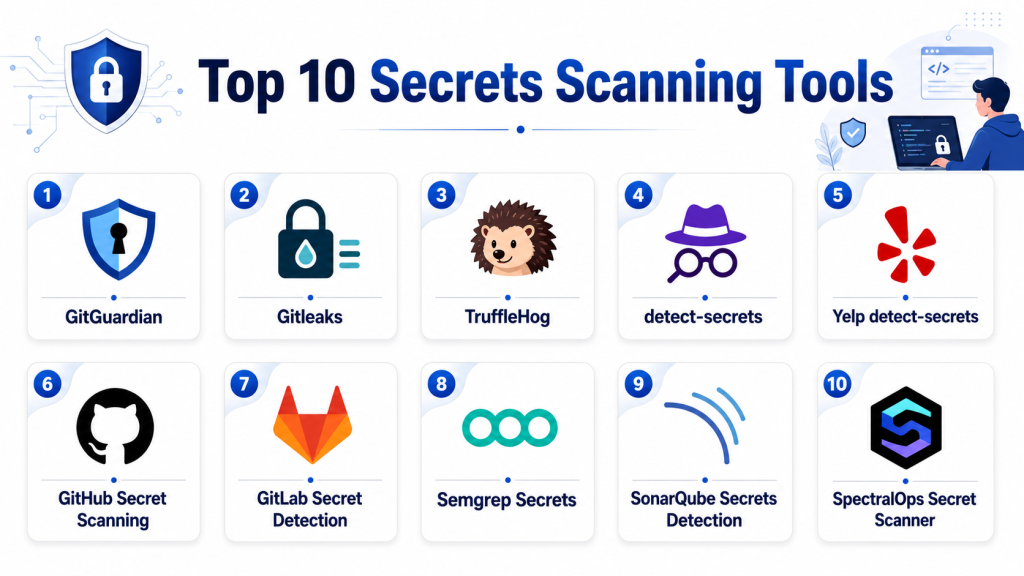
Top 10 Secrets Scanning Tools
1- GitGuardian
Short description: GitGuardian is a secrets detection and remediation platform focused on finding exposed credentials across public repositories, private repositories, DevOps workflows, and software supply chains. It is designed for application security teams, DevSecOps teams, and enterprises that need broad secrets visibility and remediation workflows.
Key Features
- Public and private repository secrets monitoring
- Historical and real-time secrets scanning
- More than hundreds of specific detectors
- Custom detector support
- GitHub, GitLab, Bitbucket, and Azure DevOps integrations
- Remediation and incident workflows
- Developer-focused alerting and collaboration
Pros
- Strong enterprise secrets detection coverage
- Good remediation and incident management workflows
- Useful for both public exposure monitoring and internal repository scanning
Cons
- Enterprise-grade capabilities may require premium plans
- Large organizations need clear triage ownership
- Detection tuning is important to reduce alert fatigue
Platforms / Deployment
- Cloud / On-premises / Hybrid
Security & Compliance
Supports governance workflows, audit visibility, access controls, and secrets remediation processes. Specific compliance certifications vary by deployment and contract.
Integrations & Ecosystem
GitGuardian integrates with development, source control, and security workflows. Its documentation describes a secrets detection engine with broad detector coverage and validation logic, while its platform pages describe repository history scanning and real-time monitoring.
- GitHub
- GitLab
- Bitbucket
- Azure DevOps
- CI/CD systems
- SIEM and security workflows
Support & Community
Strong enterprise support ecosystem with detailed documentation, developer resources, and security-team workflows.
2- Gitleaks
Short description: Gitleaks is a popular open-source secrets scanner used by developers and DevSecOps teams to detect hardcoded credentials in Git repositories, files, and CI/CD workflows. It is commonly used as a lightweight scanner in pipelines and pre-commit processes.
Key Features
- Open-source secrets detection
- Git repository scanning
- CI/CD pipeline integration
- Custom rules and configuration
- Pre-commit workflow support
- Fast local scanning
- JSON and report outputs
Pros
- Lightweight and developer-friendly
- Strong open-source adoption
- Good fit for CI/CD and local scanning
Cons
- Enterprise governance features require external tooling
- Remediation workflows are limited compared to commercial tools
- Accuracy depends on rule configuration and maintenance
Platforms / Deployment
- Linux / macOS / Windows / Self-hosted
Security & Compliance
Supports local scanning and CI/CD validation. Compliance workflows depend on how organizations integrate it into pipelines and reporting systems.
Integrations & Ecosystem
Gitleaks fits well into developer and DevSecOps workflows.
- Git repositories
- GitHub Actions
- GitLab CI
- Jenkins
- Pre-commit hooks
- Custom DevSecOps pipelines
Support & Community
Strong open-source community with active developer usage and community-driven rule improvements.
3- TruffleHog
Short description: TruffleHog is a secrets scanning tool focused on finding sensitive credentials across Git history, repositories, cloud platforms, and other developer environments. It is often used by security teams that want deep scanning and secret verification capabilities.
Key Features
- Git history scanning
- Verified secrets detection
- Cloud and repository scanning
- CI/CD integration
- Multiple detector types
- JSON output support
- Open-source and commercial options
Pros
- Strong historical scanning capability
- Useful for verified secret validation
- Good fit for security audits and deep repository checks
Cons
- Can require tuning for large environments
- Results may need triage discipline
- Enterprise workflows depend on edition and implementation
Platforms / Deployment
- Linux / macOS / Windows / Cloud / Self-hosted
Security & Compliance
Supports local and pipeline-based secret scanning. Governance and compliance workflows depend on deployment model.
Integrations & Ecosystem
TruffleHog integrates with developer and security workflows.
- GitHub
- GitLab
- CI/CD pipelines
- Cloud environments
- Local repositories
- Security reporting workflows
Support & Community
Strong security community adoption with documentation and active usage in DevSecOps workflows.
4- GitHub Secret Scanning
Short description: GitHub Secret Scanning is GitHub’s native secret detection capability for repositories hosted on GitHub. It helps detect exposed credentials in repository content, Git history, pull requests, issues, discussions, and related GitHub surfaces depending on repository and organization configuration.
Key Features
- Native GitHub repository scanning
- Git history scanning
- Secret alerts
- Push protection
- Partner pattern detection
- Custom patterns
- Organization-level visibility
Pros
- Native experience for GitHub users
- Strong developer workflow integration
- Useful push protection and repository-level alerting
Cons
- Best suited for GitHub-hosted code
- Advanced functionality depends on plan and configuration
- May need complementary tools for non-GitHub environments
Platforms / Deployment
- Cloud
Security & Compliance
Supports GitHub-native access controls, security alerts, repository governance, and audit workflows. GitHub documentation states that secret scanning uses pattern matching and validation, with detection scope depending on repository type and enabled features.
Integrations & Ecosystem
GitHub Secret Scanning fits naturally into GitHub development workflows.
- GitHub repositories
- GitHub Advanced Security
- Pull requests
- Security alerts
- Code scanning workflows
- Partner alerting ecosystem
Support & Community
Strong documentation and large developer ecosystem through GitHub’s security tooling.
5- GitLab Secret Detection
Short description: GitLab Secret Detection is GitLab’s native secret scanning capability for GitLab projects and CI/CD workflows. It helps teams detect sensitive tokens, private keys, passwords, and credentials before or after they are committed.
Key Features
- Pipeline secret detection
- Secret push protection
- Client-side secret detection
- Custom ruleset support
- GitLab-native security dashboards
- Merge request workflow support
- Vulnerability tracking
Pros
- Native GitLab workflow integration
- Good CI/CD and merge request compatibility
- Useful for teams already standardized on GitLab
Cons
- Best suited for GitLab environments
- Advanced governance depends on GitLab tier
- Custom tuning may be needed for internal secret formats
Platforms / Deployment
- Cloud / Self-managed / Dedicated
Security & Compliance
GitLab documentation describes secret detection as a way to help prevent secrets from being leaked and help teams respond when a secret is leaked. It supports multiple detection methods including pipeline detection, client-side detection, and push protection.
Integrations & Ecosystem
GitLab Secret Detection integrates into the GitLab DevSecOps lifecycle.
- GitLab CI/CD
- Merge requests
- GitLab security dashboards
- GitLab runners
- Vulnerability management workflows
- Custom rulesets
Support & Community
Strong GitLab ecosystem support with documentation, self-managed deployment options, and enterprise support.
6- Checkmarx Secrets Detection
Short description: Checkmarx Secrets Detection helps organizations detect hardcoded credentials across repositories, software pipelines, containers, and application security workflows. It is suitable for enterprises that want secrets scanning as part of a broader application security platform.
Key Features
- Hardcoded secrets detection
- Repository and pipeline scanning
- Container and SCM coverage
- Application security platform integration
- Remediation workflow support
- Policy-driven governance
- Enterprise reporting
Pros
- Strong enterprise AppSec ecosystem
- Good fit for organizations already using Checkmarx
- Supports broader software supply chain security workflows
Cons
- May be more platform-heavy than lightweight scanners
- Enterprise pricing and onboarding can require planning
- Best value comes when used with broader Checkmarx workflows
Platforms / Deployment
- Cloud / Hybrid
Security & Compliance
Supports governance workflows, application security reporting, and remediation processes. Checkmarx describes its secrets detection as helping prevent exposed credentials across repositories, SCMs, containers, and pipelines.
Integrations & Ecosystem
Checkmarx integrates with enterprise AppSec and DevSecOps ecosystems.
- GitHub
- GitLab
- Bitbucket
- Azure DevOps
- CI/CD systems
- Application security platforms
Support & Community
Strong enterprise AppSec support ecosystem with implementation guidance and customer support tiers.
7- Snyk
Short description: Snyk provides developer-first security tools that include code, open-source dependency, container, IaC, and security workflow capabilities. For secrets-related workflows, Snyk is useful when organizations want broader developer security governance with secret exposure visibility as part of their secure development lifecycle.
Key Features
- Developer-first security workflows
- Source control integrations
- CI/CD security checks
- Code and dependency scanning
- Infrastructure as Code scanning
- Policy workflows
- Remediation guidance
Pros
- Strong developer experience
- Good DevSecOps workflow integration
- Broad application security coverage beyond secrets
Cons
- Secrets scanning depth may depend on product configuration
- Not always the deepest standalone secret detection option
- Best used as part of broader developer security strategy
Platforms / Deployment
- Cloud / CLI / CI/CD
Security & Compliance
Supports governance workflows, access controls, policy management, and developer security reporting. Specific secrets-related controls depend on selected modules and configuration.
Integrations & Ecosystem
Snyk integrates broadly across modern development workflows.
- GitHub
- GitLab
- Bitbucket
- Azure DevOps
- CI/CD tools
- IDE and developer workflows
Support & Community
Large developer security ecosystem with strong documentation and enterprise support options.
8- SonarQube
Short description: SonarQube helps development teams improve code quality and security by scanning source code for bugs, vulnerabilities, code smells, and security issues. Secrets detection can be part of broader code security and quality governance workflows, especially for teams already using SonarQube in CI/CD pipelines.
Key Features
- Static code analysis
- Code quality rules
- Security issue detection
- CI/CD integration
- Pull request analysis
- Quality gates
- Developer remediation guidance
Pros
- Strong developer workflow integration
- Useful quality gate enforcement
- Good fit for organizations already using SonarQube
Cons
- Not a dedicated secrets-only platform
- Secret coverage may require rule configuration
- Enterprise governance depends on edition and setup
Platforms / Deployment
- Cloud / Self-hosted / Hybrid
Security & Compliance
Supports secure code governance, quality gates, audit visibility, and policy-based release controls. Specific compliance workflows depend on deployment and edition.
Integrations & Ecosystem
SonarQube integrates into common engineering workflows.
- GitHub
- GitLab
- Bitbucket
- Azure DevOps
- Jenkins
- CI/CD pipelines
Support & Community
Large developer community with strong enterprise and self-hosted support options.
9- Cycode
Short description: Cycode provides application security posture management and software supply chain security with visibility across source code, CI/CD, repositories, developer tools, and secrets exposure risks. It is suited for organizations seeking centralized AppSec governance across development ecosystems.
Key Features
- Software supply chain security
- Secrets exposure visibility
- Source control integrations
- CI/CD security governance
- Developer risk analytics
- Policy enforcement workflows
- Remediation tracking
Pros
- Strong software supply chain visibility
- Useful centralized AppSec governance
- Good enterprise workflow alignment
Cons
- Enterprise deployment planning required
- May be more platform-heavy than single-purpose scanners
- Advanced tuning needed for complex environments
Platforms / Deployment
- Cloud
Security & Compliance
Supports governance workflows, access controls, audit visibility, and developer security reporting.
Integrations & Ecosystem
Cycode integrates across developer and AppSec ecosystems.
- Source control systems
- CI/CD platforms
- Artifact registries
- Security tools
- Ticketing workflows
- Cloud development environments
Support & Community
Enterprise-focused support ecosystem with application security onboarding resources.
10- detect-secrets
Short description: detect-secrets is an open-source tool originally designed to help prevent secrets from being committed into repositories. It is a good fit for teams that want lightweight pre-commit scanning and baseline-based secrets management.
Key Features
- Open-source secrets scanning
- Pre-commit hook support
- Baseline file workflow
- Plugin-based detection
- Local repository scanning
- Custom detector support
- Developer-friendly usage
Pros
- Lightweight and cost-effective
- Good for pre-commit workflows
- Useful baseline model for existing repositories
Cons
- Limited enterprise governance features
- Requires internal process ownership
- Remediation tracking must be built separately
Platforms / Deployment
- Linux / macOS / Windows / Self-hosted
Security & Compliance
Supports local scanning and preventive developer workflows. Compliance reporting depends on how teams integrate it into CI/CD and governance systems.
Integrations & Ecosystem
detect-secrets fits into lightweight developer workflows.
- Pre-commit hooks
- Git repositories
- CI/CD pipelines
- Local developer environments
- Custom scripts
- Internal security workflows
Support & Community
Open-source community support with developer-driven maintenance and customization options.
Comparison Table
| Tool Name | Best For | Platform Supported | Deployment | Standout Feature | Public Rating |
|---|---|---|---|---|---|
| GitGuardian | Enterprise secrets detection | Cloud / Hybrid | Cloud / On-premises / Hybrid | Public and private secrets monitoring | N/A |
| Gitleaks | Lightweight open-source scanning | Linux / macOS / Windows | Self-hosted | Fast Git and CI scanning | N/A |
| TruffleHog | Deep repository and verified secret scanning | Linux / macOS / Windows / Cloud | Hybrid | Verified secret detection | N/A |
| GitHub Secret Scanning | GitHub-native protection | GitHub Cloud | Cloud | Native push protection | N/A |
| GitLab Secret Detection | GitLab-native DevSecOps | GitLab Cloud / Self-managed | Cloud / Self-managed | Pipeline and push protection | N/A |
| Checkmarx Secrets Detection | Enterprise AppSec workflows | Cloud / Hybrid | Cloud / Hybrid | Secrets detection in AppSec platform | N/A |
| Snyk | Developer security programs | Cloud / CLI / CI/CD | Cloud | Developer-first security workflows | N/A |
| SonarQube | Code quality and security governance | Cloud / Self-hosted | Hybrid | Quality gates and code scanning | N/A |
| Cycode | Software supply chain governance | Cloud | Cloud | Developer ecosystem risk visibility | N/A |
| detect-secrets | Pre-commit secret prevention | Linux / macOS / Windows | Self-hosted | Baseline-based local scanning | N/A |
Evaluation & Scoring of Secrets Scanning Tools
| Tool Name | Core 25% | Ease 15% | Integrations 15% | Security 10% | Performance 10% | Support 10% | Value 15% | Weighted Total |
|---|---|---|---|---|---|---|---|---|
| GitGuardian | 10 | 8 | 9 | 9 | 9 | 9 | 7 | 8.8 |
| Gitleaks | 8 | 9 | 8 | 8 | 9 | 7 | 10 | 8.5 |
| TruffleHog | 9 | 8 | 8 | 8 | 8 | 7 | 9 | 8.2 |
| GitHub Secret Scanning | 9 | 9 | 10 | 9 | 9 | 9 | 8 | 9.0 |
| GitLab Secret Detection | 8 | 8 | 9 | 8 | 8 | 8 | 8 | 8.2 |
| Checkmarx Secrets Detection | 9 | 7 | 9 | 9 | 8 | 8 | 7 | 8.1 |
| Snyk | 8 | 9 | 9 | 8 | 8 | 8 | 8 | 8.3 |
| SonarQube | 7 | 8 | 8 | 8 | 8 | 8 | 8 | 7.8 |
| Cycode | 8 | 7 | 9 | 9 | 8 | 8 | 7 | 8.0 |
| detect-secrets | 7 | 8 | 7 | 7 | 8 | 6 | 10 | 7.7 |
These scores are comparative evaluations intended to help organizations understand differences across secrets scanning ecosystems. A high score does not mean a universal winner. GitHub Secret Scanning is excellent for GitHub-native teams, GitGuardian is strong for broad enterprise monitoring, Gitleaks and detect-secrets are strong for open-source shift-left workflows, and Checkmarx or Cycode may fit teams that want broader AppSec governance. Buyers should also test false positives and false negatives using their own repositories because secret detection accuracy varies by file type, secret format, and ruleset quality.
Which Secrets Scanning Tool Is Right for You?
Solo / Freelancer
Solo developers and small open-source maintainers should consider Gitleaks, detect-secrets, or GitHub Secret Scanning. These tools are practical for local scanning, pre-commit hooks, and repository-level protection without heavy enterprise setup.
SMB
Small and medium-sized businesses should evaluate GitGuardian, GitHub Secret Scanning, GitLab Secret Detection, or Snyk depending on their source control platform. The goal should be to stop secrets before they reach shared branches and to create a simple rotation workflow when a leak happens.
Mid-Market
Mid-market organizations should prioritize GitGuardian, TruffleHog, Checkmarx, Snyk, or Cycode. These teams usually need more than detection: they need alert ownership, remediation tracking, integration with ticketing tools, and consistent reporting across multiple repositories.
Enterprise
Large enterprises should evaluate GitGuardian, GitHub Secret Scanning, GitLab Secret Detection, Checkmarx, Cycode, and SonarQube depending on their development ecosystem. Enterprise buyers should focus on historical scanning, real-time push protection, custom detectors, auditability, and policy enforcement across multiple business units.
Budget vs Premium
Open-source tools such as Gitleaks, TruffleHog, and detect-secrets reduce cost and give developers strong scanning flexibility. Premium platforms usually add better enterprise reporting, access controls, remediation workflows, risk dashboards, and centralized governance.
Feature Depth vs Ease of Use
Native tools like GitHub Secret Scanning and GitLab Secret Detection are easier for teams already using those platforms. Dedicated platforms like GitGuardian and Checkmarx provide deeper governance, while CLI tools offer flexibility but require more internal process design.
Integrations & Scalability
Organizations should choose tools that integrate with source control, CI/CD, ticketing, SIEM, identity systems, and secret managers. At scale, secrets scanning should connect to rotation workflows, ownership mapping, and security dashboards.
Security & Compliance Needs
Regulated organizations should prioritize audit trails, RBAC, policy enforcement, remediation evidence, custom detectors, and reporting. The strongest programs also connect secrets scanning to incident response, cloud IAM review, and key rotation processes.
Frequently Asked Questions FAQs
1- What are Secrets Scanning Tools?
Secrets Scanning Tools detect exposed credentials such as API keys, passwords, tokens, private keys, and cloud access keys inside repositories, pipelines, and development workflows.
2- Why are secrets scanning tools important?
They help prevent attackers from using leaked credentials to access cloud services, databases, APIs, repositories, and internal systems.
3- What types of secrets can these tools detect?
Common examples include API tokens, SSH keys, database passwords, OAuth credentials, webhook URLs, cloud access keys, certificates, and private keys.
4- Can secrets scanning tools scan Git history?
Yes. Many tools can scan historical commits because secrets may remain in Git history even after being removed from the latest version of a file.
5- What is push protection?
Push protection blocks or warns developers when they attempt to push a detected secret into a repository, helping prevent leaks before they become shared.
6- Are open-source secrets scanners available?
Yes. Gitleaks, TruffleHog, detect-secrets, Checkov-related workflows, and other open-source tools are commonly used in developer and DevSecOps environments.
7- Do secrets scanning tools produce false positives?
Yes. False positives are common in secrets detection, especially with generic patterns and entropy-based detection. Teams should tune rules and use validation when possible.
8- What should organizations do after finding a leaked secret?
They should revoke or rotate the credential, assess where it was used, remove it from code history where appropriate, update owners, and improve prevention controls.
9- Can secrets scanning integrate with CI/CD pipelines?
Yes. Most modern secrets scanning tools integrate with CI/CD systems, pre-commit hooks, pull requests, and security dashboards.
10- Which secrets scanning tool is best for enterprise use?
GitGuardian, GitHub Secret Scanning, GitLab Secret Detection, Checkmarx, Cycode, and Snyk are commonly evaluated for enterprise secrets governance depending on the development ecosystem.
Conclusion
Secrets Scanning Tools are now essential for modern DevSecOps because exposed credentials can create immediate risk across cloud systems, APIs, databases, CI/CD pipelines, and third-party platforms. The best tool depends on where your code lives, how your developers work, and how mature your security workflows are. GitHub Secret Scanning and GitLab Secret Detection are strong choices for teams standardized on those platforms, while GitGuardian provides broader enterprise visibility across public and private exposure. Gitleaks, TruffleHog, and detect-secrets are excellent for lightweight open-source scanning, local workflows, and CI/CD enforcement, while Checkmarx, Snyk, SonarQube, and Cycode fit teams that want secrets scanning inside broader AppSec or software supply chain programs. Buyers should not select only by detector count; they should test accuracy, review false positives, validate remediation workflows, and confirm integrations with source control, CI/CD, ticketing, SIEM, and secret managers. A practical next step is to shortlist two or three tools, scan representative repositories, measure signal quality, verify push protection workflows, and build a clear process for secret rotation and incident response.
One thing missing is how teams manage secret rotation after detection. Fixing leaks quickly is very important in real projects.