In the fast-paced world of software engineering, projects often derail not from a lack of coding talent, but due to structural failures—poor communication, shifting requirements, untraceable changes, or vague definitions of responsibility. To combat this, the international community established a standardized, universal architecture for software engineering: ISO/IEC/IEEE 12207.
The ISO/IEC/IEEE 12207:2017 edition defines a comprehensive framework for Software Life Cycle Processes. It spans the entire lifespan of a software system—from the initial business concept, through development and deployment, all the way to its ultimate retirement.
This deep-dive guide breaks down the standard into clear, actionable components to help your team implement it effectively.
1. What is ISO/IEC/IEEE 12207:2017?
ISO/IEC/IEEE 12207:2017 establishes a common framework with well-defined terminology for describing and managing software lifecycles.
Key Characteristics
- Universal Language: It provides a shared vocabulary for software acquirers, suppliers, developers, operators, and maintainers globally.
- Process-Focused, Not Methodology-Bound: The standard specifies what activities must occur, not how to execute them. It applies equally whether your organization utilizes Agile (Scrum, Kanban), DevOps, or traditional Waterfall models.
- Systems Alignment: The 2017 edition was completely harmonized with ISO/IEC/IEEE 15288 (Systems Life Cycle Processes). This structural alignment recognizes that software is almost always a component of a larger physical or digital system.
2. The Process Reference Model (The Core Architecture)
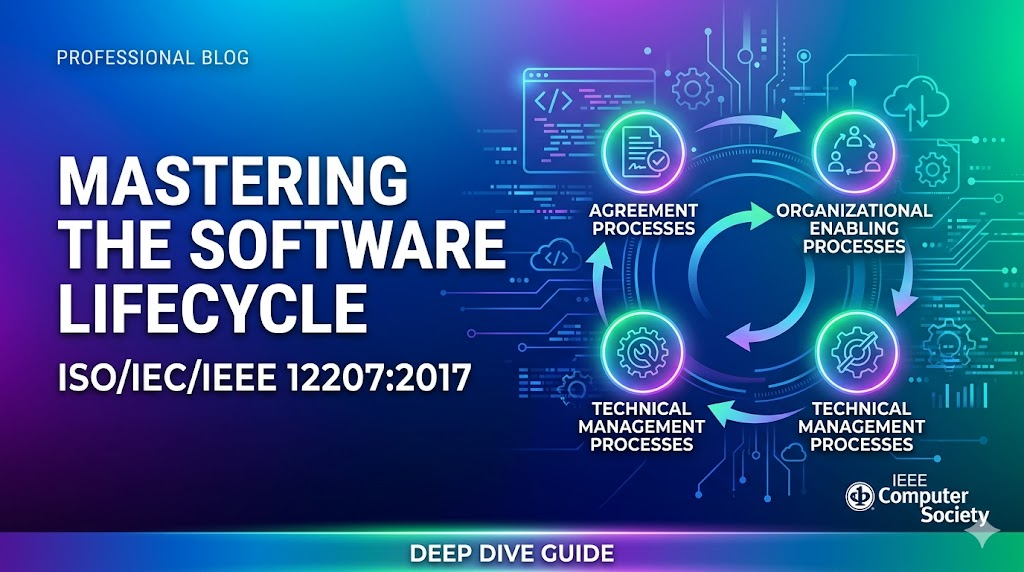
The standard organizes software lifecycles into four distinct process groups, which collectively contain 30 individual processes designed to bring systematic management to software quality.
┌───────────────────────────────────────────────────────────────────┐
│                 ISO/IEC/IEEE 12207:2017 Processes                 │
├─────────────────┬──────────────────┬──────────────┬───────────────┤
│    Agreement    │  Organizational  │  Technical   │   Technical   │
│    Processes    │ Project-Enabling │  Management  │   Processes   │
└─────────────────┴──────────────────┴──────────────┴───────────────┘
Let’s break down each of these four foundational groups:
1. Agreement Processes
These processes establish the business relationships and formalize operational boundaries between the organization acquiring the software and the organization supplying it.
- Acquisition Process: The systematic activities required by an organization to obtain a software system, product, or service.
- Supply Process: The framework required to deliver a software product or service that meets agreed-upon customer requirements.
2. Organizational Project-Enabling Processes
These processes ensure the overarching organization possesses the capability, infrastructure, resources, and continuous improvement mechanisms to manage software projects successfully.
- Life Cycle Model Management: Defining, maintaining, and adapting the lifecycle models suitable for the business.
- Infrastructure Management: Providing the hardware, software tools, environments, and facilities needed for engineering.
- Human Resource Management: Ensuring personnel are properly trained, competent, and skilled to meet engineering demands.
- Quality Management & Knowledge Management.
3. Technical Management Processes
These processes focus on managing the resources, risks, and technical efforts of a specific project to ensure it hits its quality, timeline, and cost targets.
- Project Planning & Project Assessment and Control: Creating execution roadmaps and systematically monitoring project execution deviations.
- Decision Management: Evaluating alternatives objectively (e.g., “Build vs. Buy” scenarios).
- Risk Management: Continually identifying, analyzing, and mitigating technical and project risks.
- Configuration Management: Controlling changes to software baselines, code repositories, and maintaining software integrity.
- Information Management & Quality Assurance.
4. Technical Processes
This is where the direct engineering takes place. These processes transform a vague user need into a working, deployed, and ultimately decommissioned software system.
- Business or Mission Analysis: Defining the problem space and fundamental business goals.
- System/Software Requirements Definition: Translating stakeholder needs into precise, trackable software requirements.
- Architecture & Design Definition: Designing the software structure, modules, interfaces, and database schemas.
- Implementation: The actual coding, compiling, and unit testing of software components.
- Integration & Verification: Assembling code modules together and verifying that “the software was built right” (testing against specifications).
- Validation: Ensuring “the right software was built” (testing against user expectations and operational requirements).
- Operation & Maintenance: Supporting users and managing corrective, adaptive, and preventive modifications in production.
- Disposal: Safely deprecating, sunsetting, or decommissioning software at the end of its life.
3. The 3 Pillars of a Process
For every single process listed above, ISO/IEC/IEEE 12207:2017 defines three critical elements that must be structurally documented:
- Purpose: A high-level statement explaining why the process exists.
- Outcomes: The measurable, observable results achieved by executing the process correctly.
- Activities and Tasks: The actual actions team members take to convert project inputs into standardized outcomes.
4. Step-by-Step Implementation Guide
Adopting ISO/IEC/IEEE 12207:2017 does not mean introducing massive, rigid bureaucracy. Follow this implementation roadmap to tailor it to your organization’s unique structure:
Step 1: Conduct Tailoring
The standard explicitly encourages tailoring. You do not need to apply all 30 processes to a simple application. Assess your project’s scale, risk tolerance, and regulatory environment, and formally document which processes are included or excluded.
Step 2: Map to Your Methodology
Map the standard’s technical processes to your actual day-to-day workflow.
- Example: If you use Scrum, the Requirements Definition process maps directly to managing and grooming your Product Backlog, while Implementation maps to your weekly Sprints.
Step 3: Automate Compliance
Leverage modern DevOps tools to fulfill the standard automatically. Use CI/CD pipelines to enforce the Verification process, utilize automated testing tools for Validation, and leverage Git repository histories to fulfill Configuration Management and ensure end-to-end traceability.
Why Should Teams Care?
Implementing ISO/IEC/IEEE 12207 delivers immediate strategic value:
- Reduced Rework: Better traceability and requirements control mean fewer misunderstandings during core coding phases.
- Regulatory Readiness: It serves as a necessary baseline for software developed in highly critical sectors like defense, aerospace, medical devices, and automotive.
- Process Improvement: It provides a common benchmark for capability assessment and organizational learning.
Ultimately, the standard shifts software engineering away from chaotic, “hero-based” developer efforts into a reliable, repeatable, and scalable business science.