Introduction
Food export is a major opportunity for manufacturers, processors, distributors, private-label brands, and international traders. However, exporting food products is not only about production, packaging, shipping, and finding buyers. Many foreign governments, importers, distributors, and customs authorities may ask for official documents that show the product’s regulatory or marketing status in the United States. This is where FDA Food Export Certificates become important. These certificates help support export transactions for FDA-regulated food products by providing written certification in a format accepted by importing authorities or foreign buyers. For food exporters, understanding FDA export certificates can reduce shipment delays, improve buyer confidence, and support smoother international trade.
What Are FDA Food Export Certificates?
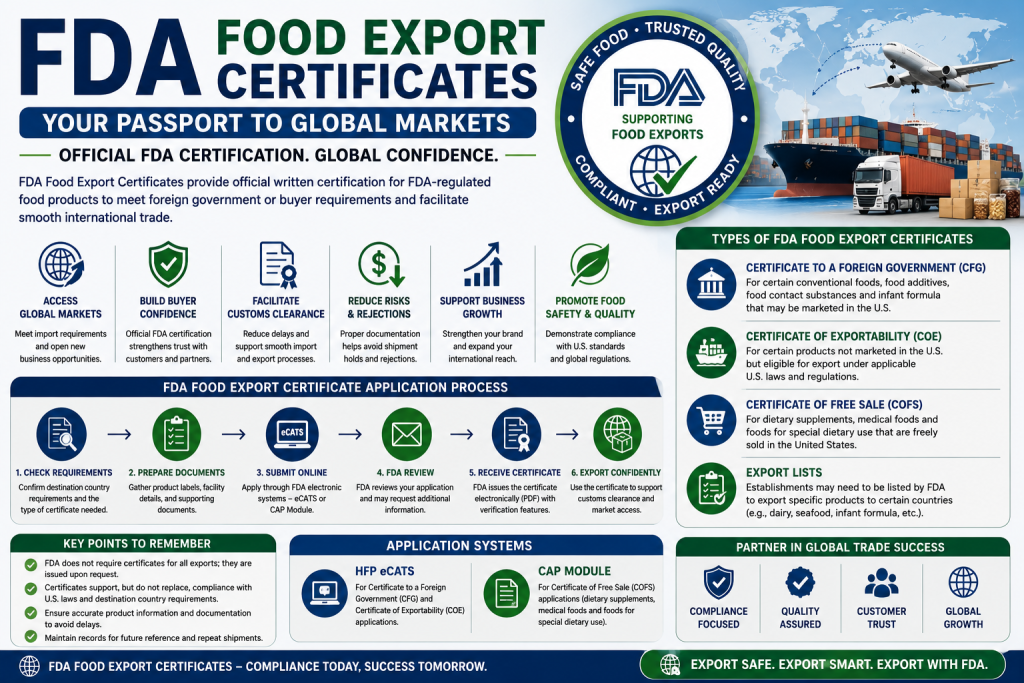
FDA Food Export Certificates are official export-related documents issued by the U.S. Food and Drug Administration for certain FDA-regulated food products. These documents are often requested by foreign governments, customs departments, importers, distributors, or buyers before allowing products to enter a country.
In simple words, an FDA food export certificate helps communicate important information about a product’s U.S. regulatory or marketing status.
FDA Food Export Certificates may be used for:
- Conventional foods
- Food additives
- Food contact substances
- Infant formula
- Dietary supplements
- Medical foods
- Foods for special dietary use
- Certain collagen and gelatin products
- Other eligible FDA-regulated food categories
It is important to understand that FDA export certificates are not a replacement for full export compliance. Exporters must still follow U.S. laws, destination-country requirements, labeling rules, product safety requirements, and buyer documentation needs.
Why FDA Food Export Certificates Are Important
FDA Food Export Certificates are important because many international buyers and foreign authorities want assurance before accepting food products from the United States. These certificates can help confirm that the product falls within a recognized export certification pathway.
Key Reasons FDA Food Export Certificates Matter
- They support food export documentation.
- They help meet importing-country requirements.
- They improve buyer and distributor confidence.
- They reduce confusion during customs clearance.
- They support product credibility in foreign markets.
- They help exporters respond to foreign government requests.
- They provide official written certification from FDA where applicable.
- They support international food trade compliance.
- They help prevent avoidable shipment delays.
- They improve documentation control for export businesses.
For many exporters, the certificate becomes an important part of the export file along with invoice, packing list, product label, ingredient details, manufacturing information, laboratory reports, and country-specific documents.
FDA Does Not Require Export Certificates for Every Food Export
One important point exporters must understand is that FDA does not require written certification for every food export. Many exporters request certificates because the importing country, foreign customer, distributor, or customs authority asks for them.
This means the exporter should first confirm:
- Which country the product is going to
- What the foreign authority requires
- What the buyer specifically requested
- Which FDA certificate type applies
- Whether an export list is required
- Whether product category restrictions apply
- Whether the certificate wording is acceptable to the destination market
A certificate should not be requested blindly. The correct document depends on the product type and importing-country requirement.
Who Needs FDA Food Export Certificates?
FDA Food Export Certificates may be needed by businesses exporting FDA-regulated food products from the United States.
They may be useful for:
- Food manufacturers
- Food processors
- Dietary supplement companies
- Infant formula manufacturers
- Food additive suppliers
- Food contact substance businesses
- Private-label food brands
- Exporters and traders
- U.S. distributors selling internationally
- Companies responding to foreign buyer requirements
- Businesses exporting to countries requiring FDA documentation
- Companies applying for export lists
- Businesses dealing with customs or import clearance requirements
Even if a business does not manufacture the product itself, it may still need certificate-related documentation if it is the exporter, brand owner, or responsible commercial party.
Main Types of FDA Food Export Certificates
FDA issues different types of export certificates depending on the product category and regulatory status. The main food-related certificate types include:
- Certificate to a Foreign Government
- Certificate of Exportability
- Certificate of Free Sale
- Health certificates for certain collagen and gelatin exports
- Export lists for specific products and destinations
Each type has a different purpose and applies to different situations.
Certificate to a Foreign Government
A Certificate to a Foreign Government, often called CFG, is available for certain FDA-regulated food products that meet applicable U.S. requirements for marketing in the United States.
It may apply to:
- Conventional foods
- Food additives
- Food contact substances
- Infant formula
A CFG generally states that the product may be marketed in and legally exported from the United States, depending on the applicable requirements.
When Is a CFG Useful?
A Certificate to a Foreign Government may be useful when:
- A foreign government asks for an FDA certificate
- An importer needs proof of U.S. marketing status
- A distributor requires official export documentation
- A shipment is going to a country with strict food import controls
- A buyer wants FDA-issued documentation before purchase
Important Point
A CFG should be requested only when the product category and regulatory status match the certificate type. Submitting the wrong certificate request may delay processing.
Certificate of Exportability
A Certificate of Exportability, often called COE, is available for certain food products that may not be legally marketed in the United States but meet export requirements under applicable U.S. law.
It may apply to:
- Conventional foods
- Food additives
- Food contact substances
- Infant formula
This certificate is useful in special cases where the product is intended only for export and meets the legal conditions for export even though it cannot be marketed domestically in the United States.
When Is a COE Useful?
A Certificate of Exportability may be useful when:
- The product is produced for export only
- The product is not sold in U.S. domestic commerce
- The product meets foreign buyer specifications
- The export meets applicable legal export conditions
- The destination country allows the product
This certificate requires careful review because the product’s U.S. marketing status and export eligibility must be properly understood.
Certificate of Free Sale
A Certificate of Free Sale, often called COFS, is available only for specific categories of FDA-regulated products.
For food-related products, it is generally available for:
- Dietary supplements
- Medical foods
- Foods for special dietary use
A Certificate of Free Sale is commonly requested by foreign governments or buyers to show that a product is sold or eligible for sale in the United States.
When Is a COFS Useful?
A Certificate of Free Sale may be useful when:
- A foreign buyer requests proof that the product is freely sold
- A country requires free sale documentation for registration
- A distributor needs the document for import approval
- A dietary supplement or special dietary product is being exported
- A medical food product needs supporting export documentation
Important Point
The Certificate of Free Sale is not available for all food products. Exporters should not assume that every food product qualifies for this certificate.
Food Export Lists
Some importing countries do not only ask for a certificate. They may require establishments to be included on an FDA-supported export list.
Export lists are publicly available lists of establishments eligible to export specific products to specific destinations.
Export lists may apply to categories such as:
- Dairy products
- Seafood
- Shellfish
- Egg and egg products
- Infant formula
- Collagen and gelatin
- Honey and other apiculture products
Why Export Lists Matter
Some foreign food safety authorities require establishment listing before products can enter their market. If a product is shipped before the establishment is properly listed, the shipment may face detention, rejection, or delay.
Exporters should check destination-country requirements before shipping.
Difference Between FDA Food Export Certificates and Export Lists
FDA Food Export Certificates and export lists are related, but they are not the same.
| Point | Food Export Certificate | Food Export List |
|---|---|---|
| Purpose | Provides written certification for a product or products | Lists establishments eligible to export specific products |
| Requested By | Exporter through FDA system | Establishment through export listing process |
| Used For | Buyer, importer, or foreign government documentation | Market access for specific products and destinations |
| Format | Certificate document, often electronic | Public or official establishment list |
| Product Scope | Depends on certificate type | Depends on product and country requirements |
| Risk If Missing | Certificate request may delay transaction | Shipment may be detained or rejected if listing is required |
Exporters should confirm whether they need a certificate, export list placement, or both.
FDA Food Export Certificate Application Systems
FDA uses electronic systems for food export certificate applications.
HFP eCATS
HFP eCATS stands for Human Foods Program Export Certification Application and Tracking System. It is used to request certain FDA-issued export certificates for food products.
It may be used for:
- Certificate to a Foreign Government
- Certificate of Exportability
These certificates apply to conventional foods, food additives, food contact substances, and infant formula.
CAP Module
The Certificate Application Process module is used for Certificate of Free Sale requests.
It may be used for:
- Dietary supplements
- Medical foods
- Foods for special dietary use
Exporters should choose the correct application system based on the product and certificate type.
Step-by-Step Process to Apply for FDA Food Export Certificates
Step 1: Identify the Product Category
The first step is to identify what type of food product you are exporting.
Examples include:
- Conventional food
- Dietary supplement
- Medical food
- Food for special dietary use
- Infant formula
- Food additive
- Food contact substance
- Collagen or gelatin product
The certificate type depends heavily on product category.
Step 2: Confirm Destination-Country Requirements
Before applying, confirm what the importing country or buyer requires.
Check:
- Does the country require an FDA certificate?
- Which certificate name is requested?
- Is an export list required?
- Is a health certificate needed?
- Does the buyer need product-specific wording?
- Are labels, ingredients, or facility details required?
- Is legalization, authentication, or apostille needed after issuance?
Destination-country requirements may differ, so exporters should verify before submitting an application.
Step 3: Select the Correct Certificate Type
Choose the certificate based on product category and regulatory status.
General guidance:
- Conventional foods may need Certificate to a Foreign Government.
- Food additives may need Certificate to a Foreign Government.
- Food contact substances may need Certificate to a Foreign Government.
- Infant formula may need Certificate to a Foreign Government.
- Export-only eligible products may need Certificate of Exportability.
- Dietary supplements may need Certificate of Free Sale.
- Medical foods may need Certificate of Free Sale.
- Foods for special dietary use may need Certificate of Free Sale.
Choosing the wrong certificate type is one of the most common causes of delay.
Step 4: Prepare Product and Company Information
Before starting the application, gather accurate information.
Common information may include:
- Company name
- Company address
- Contact person
- Product name
- Product category
- Product label
- Manufacturer details
- Manufacturing facility address
- Product description
- Ingredient information
- Destination country
- Supporting documentation
- Facility inspection information if applicable
- Product authorization information where needed
The application should clearly connect the product, manufacturer, and exporter.
Step 5: Prepare Product Labels and Supporting Documents
FDA may need product labels and supporting documents to process the application.
Documents should generally be clear, accurate, and in English or supported by English translation where needed.
Useful supporting documents may include:
- Product labels
- Ingredient statements
- Specification sheets
- Manufacturer letter
- Facility inspection report
- Product formulation details
- Food additive authorization support
- Food contact substance documentation
- Product category explanation
- Country-specific request letter
- Buyer requirement letter
If the product label does not clearly show the manufacturer, exporters may need extra documentation showing the link between product and manufacturer.
Step 6: Submit the Application Electronically
The exporter submits the application through the appropriate FDA electronic system.
Use:
- HFP eCATS for Certificate to a Foreign Government and Certificate of Exportability
- CAP module for Certificate of Free Sale
The application should be complete and accurate to reduce clarification requests.
Step 7: Respond to FDA Questions
If FDA needs clarification, the applicant may be asked to provide additional information.
Common clarification areas include:
- Product identity
- Manufacturer link
- Product category
- Facility inspection history
- Label details
- Ingredient information
- Regulatory status
- Destination-country requirement
- Supporting documentation
Fast and accurate responses can help avoid processing delays.
Step 8: Receive the Certificate
Many FDA-issued food export certificates are issued electronically as PDF documents. The certificate may include verification features such as QR code or online verification options.
Exporters should review the certificate carefully after issuance.
Check:
- Product name
- Company name
- Manufacturer details
- Destination country
- Certificate type
- Certificate date
- Number of certificates
- Spelling and formatting
- Certificate authenticity features
If any information is incorrect, the exporter should address it before sending the document to the buyer or foreign authority.
Step 9: Share With Buyer or Importing Authority
After receiving the certificate, the exporter can share it with the buyer, distributor, customs broker, foreign authority, or registration consultant.
Some countries may also require further document authentication. Exporters should confirm destination-country document requirements before shipment.
Step 10: Maintain Records
Exporters should maintain a complete export documentation file.
This may include:
- FDA certificate
- Application copy
- Product label
- Supporting documents
- Buyer request
- Destination-country requirement
- Shipment invoice
- Packing list
- Bill of lading or airway bill
- Product testing reports
- Facility records
- Communication with FDA
- Communication with importer
Good recordkeeping helps with future exports and repeat applications.
FDA Food Export Certificate Process Summary
| Step | Action | Expected Output |
|---|---|---|
| 1 | Identify product category | Correct product classification |
| 2 | Check destination-country requirement | Clear certificate need |
| 3 | Select certificate type | CFG, COE, COFS, or other route |
| 4 | Gather company and product data | Complete application information |
| 5 | Prepare labels and documents | Supporting evidence |
| 6 | Submit application electronically | FDA application filed |
| 7 | Respond to FDA questions | Clarification completed |
| 8 | Receive certificate | Export certificate issued |
| 9 | Share with buyer or authority | Import documentation support |
| 10 | Maintain records | Audit-ready export file |
Documents Commonly Needed for FDA Food Export Certificates
The exact documents depend on product type and certificate request. Common documents may include:
- Product label
- Product name and description
- Product category details
- Manufacturer name and address
- Exporter name and address
- Contact person details
- Destination country
- Ingredient statement
- Specification sheet
- Facility inspection information
- Manufacturing facility details
- Product authorization reference where applicable
- Manufacturer letter where needed
- English translation of documents where needed
- Buyer request or foreign government requirement
- Supporting regulatory documents
- Previous certificate reference where applicable
Submitting complete documents can reduce delays and improve application quality.
Tips for a Complete Application
A complete application is easier for FDA to review. Exporters should follow these practical tips:
- Make sure product names match labels and documents.
- Use the correct certificate type.
- Provide English labels or English translations.
- Clearly identify the manufacturer.
- Upload supporting documents when the label does not show manufacturer details.
- Provide specification sheets for food additives or food contact substances where needed.
- Ensure facility and product information is accurate.
- Avoid vague product descriptions.
- Confirm the destination country before applying.
- Check spelling and formatting before submission.
- Keep records of all submitted documents.
A small mismatch in product name, manufacturer address, or product category can delay the application.
Certificate Fees
FDA fees may vary depending on the certificate type.
In general:
- Certificate to a Foreign Government may carry a fee.
- Certificate of Exportability may carry a fee.
- Certificate of Free Sale for eligible products may not carry a fee.
- Some specific health certificates may not carry a fee.
- Fees may depend on the number of certificates requested for the same products in the same request.
Exporters should always verify current FDA fee details before applying because fees and processes can change.
Online Verification of FDA Food Export Certificates
Many FDA-issued food export certificates are issued electronically. Recipients can verify authenticity through FDA’s online verification system.
Some certificates may include a QR code. A buyer or foreign authority can scan the QR code to view a copy of the certificate as issued by FDA.
This helps reduce fraud risk and improves confidence in digital certificates.
Exporters should send the certificate exactly as issued and avoid editing or modifying the PDF.
FDA Food Export Certificates vs FDA Registration
FDA Food Export Certificates and FDA food facility registration are not the same.
FDA Food Facility Registration
Food facility registration applies to facilities that manufacture, process, pack, or hold food for consumption in the United States, subject to applicable requirements.
FDA Food Export Certificate
An FDA food export certificate is a document issued for export purposes when requested and applicable.
A facility may be registered with FDA, but that does not automatically mean every product qualifies for every export certificate. Similarly, having an export certificate does not replace all food safety, labeling, and destination-country requirements.
FDA Food Export Certificates vs Health Certificates
A food export certificate is not always the same as a health certificate.
Some countries or product categories may require health certificates, veterinary certificates, sanitary certificates, phytosanitary certificates, or specific product certificates from different U.S. agencies or authorities.
For example:
- Some animal-origin products may involve other agencies.
- Some plant products may involve agricultural authorities.
- Some dairy, seafood, shellfish, collagen, gelatin, or egg products may have special destination-country requirements.
- Some products may require export list placement before shipment.
Exporters should confirm which U.S. authority is responsible for the product and destination.
FDA Food Export Certificates and Importing Country Rules
FDA export certificates support documentation, but they do not guarantee entry into every foreign country.
The importing country may still require:
- Product registration
- Label approval
- Import permit
- Free sale certificate
- Health certificate
- Halal certificate
- Certificate of analysis
- Ingredient approval
- Laboratory testing
- Shelf-life data
- Nutrition information
- Facility listing
- Legalization or apostille
- Customs documentation
- Country-specific wording
Exporters should work closely with importers before shipment.
Common Mistakes in FDA Food Export Certificate Applications
1. Requesting the Wrong Certificate Type
A conventional food and a dietary supplement may require different certificate routes. Choosing the wrong one can delay the process.
2. Assuming FDA Requires Certificates for All Exports
FDA does not require written certification for every export. Certificates are usually requested because a foreign buyer or authority requires them.
3. Submitting Incomplete Labels
Product labels should be clear, complete, and in English or supported by translation.
4. No Clear Manufacturer Link
If the label does not show the manufacturer, additional proof may be needed.
5. Ignoring Destination-Country Requirements
Some countries require export list placement, not just a certificate.
6. Using Incorrect Product Category
Misclassifying a dietary supplement, conventional food, medical food, infant formula, food additive, or food contact substance can create application problems.
7. Not Reviewing Certificate Details
Errors in product name, address, or destination country can create import issues.
8. Waiting Until Shipment Date
Certificate processing should be planned before shipment, not at the last minute.
9. Modifying Issued Certificates
Certificates should not be edited after issuance. Any change should follow the proper process.
10. Poor Recordkeeping
Exporters should keep all applications, certificates, labels, and supporting documents for future reference.
FDA Food Export Certificate Checklist
Use this checklist before applying:
- Is the product regulated by FDA?
- Is the product being exported from the United States?
- Has the destination-country requirement been confirmed?
- Is a certificate required by the buyer or government?
- Is export list placement required?
- Is the correct certificate type selected?
- Is the product category correct?
- Are product labels ready?
- Are labels in English or translated?
- Is manufacturer information clear?
- Are facility details accurate?
- Are supporting documents available?
- Are ingredient or specification sheets needed?
- Is inspection information available where applicable?
- Is the application complete?
- Are certificate fees understood?
- Is there enough time before shipment?
- Is the certificate reviewed after issuance?
- Are records saved properly?
Benefits of FDA Food Export Certificates
1. Better Export Readiness
Certificates help exporters prepare stronger documentation for international markets.
2. Buyer Confidence
Foreign buyers may feel more confident when official FDA-issued documentation is available.
3. Smoother Import Clearance
When a destination country requests FDA certification, the correct certificate can support customs or regulatory review.
4. Improved Market Access
Certificates and export lists may support access to markets with specific food import requirements.
5. Stronger Documentation Control
The process encourages businesses to maintain accurate product, label, manufacturer, and compliance records.
6. Reduced Shipment Risk
Correct documentation can reduce avoidable delays, rejections, or repeated buyer questions.
7. Support for International Expansion
Export certificates can help food businesses enter new countries and build distributor relationships.
Practical Examples
Example 1: Conventional Food Exporter
A U.S. food manufacturer exports packaged snacks to a country where the importer requests an FDA certificate. The company checks the product category and applies for a Certificate to a Foreign Government with product labels and manufacturer details.
Example 2: Dietary Supplement Brand
A dietary supplement company wants to export capsules to a new market. The foreign distributor requests a Certificate of Free Sale. The company applies through the correct FDA certificate route for dietary supplements.
Example 3: Infant Formula Export
An infant formula exporter checks whether the destination country requires both a certificate and additional product registration. The company prepares labels, product details, and supporting documentation before applying.
Example 4: Food Contact Substance Supplier
A business exports food packaging material intended for contact with food. The buyer asks for FDA export certification. The company prepares specification sheets and authorization-related support documents.
Example 5: Seafood Export Establishment
A seafood processor checks whether the destination country requires export list placement. The company applies for listing before shipping to avoid detention or rejection.
Best Practices for Food Exporters
Confirm Requirements Before Shipment
Do not wait until the shipment is ready. Ask the importer which certificate or listing is required.
Understand Your Product Category
Product classification affects the certificate type and documentation route.
Keep Labels Updated
Product labels should match the application and supporting documents.
Maintain Manufacturer Evidence
Keep clear records connecting the product with the manufacturing facility.
Prepare English Documents
FDA applications are easier to process when labels and supporting documents are in English or accompanied by English translations.
Track Certificate Validity and Reuse
Do not assume an old certificate is acceptable for every shipment or destination.
Monitor Importing Country Changes
Country requirements can change. Exporters should review requirements regularly.
Keep a Complete Export File
A complete file helps with future shipments, buyer audits, and repeat certificate applications.
Use Official Systems
Apply through the correct FDA electronic system and avoid unofficial shortcuts.
Build Compliance Into Export Planning
Certificates should be part of the export planning process, not an emergency step after goods are packed.
Cost Factors for FDA Food Export Certificates
The cost may depend on:
- Certificate type
- Number of certificates requested
- Number of products included
- Whether repeat certificates are requested
- Product category
- Need for supporting documentation
- Third-party consultant involvement
- Translation requirements
- Authentication or legalization needs
- Destination-country document requirements
Exporters should review current FDA fees and additional external costs before planning the shipment budget.
How Long Does It Take to Get an FDA Food Export Certificate?
The timeline depends on the completeness of the application, certificate type, supporting documents, FDA review needs, and whether clarification is requested.
Delays may happen when:
- Product labels are incomplete
- Manufacturer information is unclear
- Product category is wrong
- Supporting documents are missing
- English translation is not provided
- Destination-country requirement is unclear
- Facility information is incomplete
- FDA needs additional clarification
The best way to reduce delay is to submit a complete and accurate application the first time.
Frequently Asked Questions
1. What is an FDA Food Export Certificate?
An FDA Food Export Certificate is an export-related document issued by FDA for certain FDA-regulated food products when requested and applicable.
2. Does FDA require export certificates for all food exports?
No. FDA does not require written certification for every food export. Certificates are often requested by foreign governments, importers, or buyers.
3. What is a Certificate to a Foreign Government?
A Certificate to a Foreign Government is available for certain food products that meet applicable U.S. requirements for marketing and export.
4. What is a Certificate of Exportability?
A Certificate of Exportability is used for certain products that may not be marketed in the United States but meet legal export conditions.
5. What is a Certificate of Free Sale?
A Certificate of Free Sale is available for certain products such as dietary supplements, medical foods, and foods for special dietary use.
6. How do exporters apply for FDA food export certificates?
Most applications are submitted electronically through FDA systems such as HFP eCATS or the CAP module, depending on certificate type.
7. Are FDA food export certificates free?
Some certificate types may have fees, while certain certificates such as eligible Certificates of Free Sale may have no FDA fee. Exporters should check current FDA fee details before applying.
8. Can a certificate guarantee entry into a foreign country?
No. A certificate supports documentation, but the importing country may still require registration, import permits, labels, testing, listing, or other approvals.
9. What documents are needed for application?
Common documents include product labels, manufacturer details, product descriptions, ingredient information, specification sheets, inspection information, and supporting regulatory documents.
10. Can FDA export certificates be verified online?
Many FDA-issued food export certificates can be verified online, and some certificates include QR codes for authenticity verification.
Conclusion
FDA Food Export Certificates play an important role in international food trade by supporting documentation for FDA-regulated food products exported from the United States. These certificates can help exporters meet foreign buyer or government requirements, improve confidence, and reduce avoidable shipment delays. However, exporters must understand that FDA does not require written certification for every export, and the correct certificate depends on the product category, regulatory status, and destination-country requirement. A successful export documentation process starts with proper product classification, clear labels, accurate manufacturer information, complete supporting documents, and use of the correct FDA application system. For food exporters, FDA Food Export Certificates should be treated as part of a broader export compliance strategy that includes U.S. law, importing-country rules, buyer expectations, and strong recordkeeping.