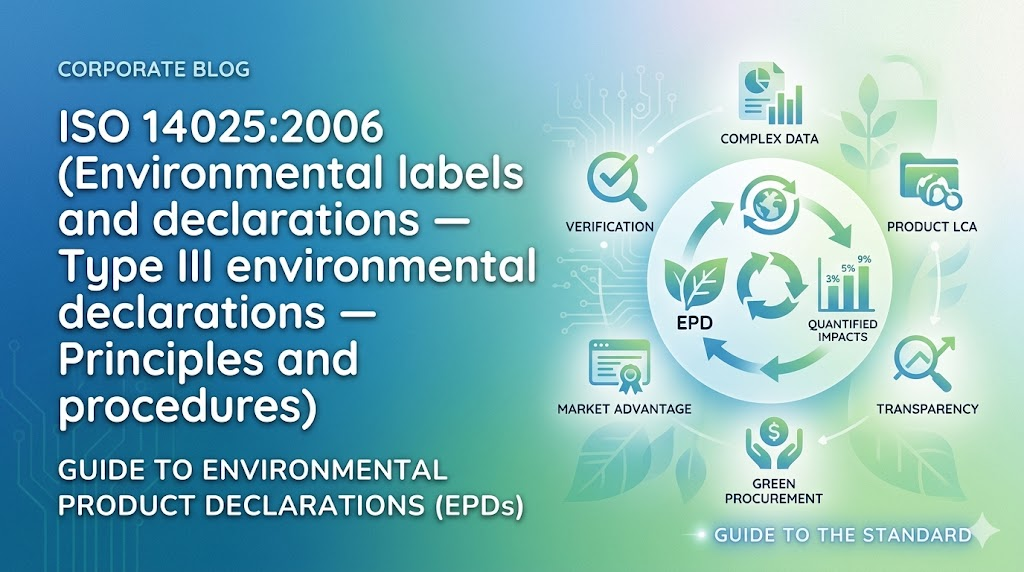
In an era where “eco-friendly,” “sustainable,” and “green” are tossed around on almost every product label, greenwashing has become a major challenge for businesses and consumers alike. How do you distinguish genuine environmental stewardship from clever marketing?
Enter ISO 14025:2006.
This international standard is the backbone of Type III Environmental Declarations, commonly known as Environmental Product Declarations (EPDs). Unlike vague green claims, ISO 14025 provides a rigorous, scientifically backed framework for quantifying a product’s environmental impact based on its entire life cycle.
Whether you are a sustainability officer, a manufacturer looking to enter green markets, or a curious professional, this comprehensive guide will break down everything you need to know about ISO 14025:2006.
1. What is ISO 14025:2006?
ISO 14025:2006, established by the International Organization for Standardization (ISO), defines the principles and procedures for developing Type III environmental declarations and programs.
The primary purpose of this standard is to encourage the demand for, and supply of, products that cause less stress on the environment. It achieves this by providing quantified, verified, and comparable environmental life cycle data.
The ISO Environmental Labeling Family
To truly understand ISO 14025, it helps to see where it sits among its sibling standards. ISO classifies environmental labels into three distinct types:
| Label Type | Standard | Description | Core Characteristics |
| Type I | ISO 14024 | Environmental Labeling Programs | Third-party certified, “pass/fail” eco-labels (e.g., EU Ecolabel, Blue Angel). |
| Type II | ISO 14021 | Self-Declared Environmental Claims | Informally made by manufacturers without mandatory independent verification (e.g., “Recyclable”). |
| Type III | ISO 14025 | Environmental Product Declarations (EPDs) | Quantified Life Cycle Assessment (LCA) data, independently verified, objective, and highly detailed. |
2. Core Principles of ISO 14025
ISO 14025 is not just a checklist; it is governed by a set of strict principles designed to ensure data integrity and transparency.
- Life Cycle Perspective: Declarations must be based on a Life Cycle Assessment (LCA) conducted in accordance with ISO 14040 and ISO 14044. This means assessing the product from “cradle to grave”—from raw material extraction through manufacturing, distribution, use, and final disposal.
- Comparability: One of the ultimate goals of an EPD is to allow buyers to compare the environmental footprints of two different products fulfilling the same function. ISO 14025 sets strict rules to ensure these comparisons are fair and standardized.
- Open and Transparent Consultations: The process of developing Type III declarations must involve an open consultation with stakeholders (industry peers, consumers, NGOs, and government bodies).
- Verifiability: To prevent false claims, all data, methods, and the final declaration must be independently verified by an internal or external expert before publication.
3. The Pillars of ISO 14025: PCRs and EPDs
Creating a Type III declaration requires a specific architecture. You cannot simply run a study and call it an EPD. ISO 14025 relies heavily on two foundational elements: Product Category Rules (PCR) and Program Operators.
A. Program Operators
A Program Operator is the body that conducts the Type III environmental declaration program. This can be a company, an industrial association, a government agency, or an independent scientific body. They are responsible for maintaining the rules, preparing the registry, and ensuring that declarations follow ISO 14025.
B. Product Category Rules (PCR)
Imagine trying to compare the environmental impact of a laptop to a carton of milk. It’s impossible because their lifespans, materials, and energy usages are completely different.
A PCR is a document that defines the specific rules, requirements, and guidelines for conducting an LCA for a specific product category (e.g., “Concrete,” “Screws and Bolts,” or “Paint”).
According to ISO 14025, a PCR defines:
- The functional unit (e.g., 1 cubic meter of concrete with a specific compressive strength).
- The system boundaries (what stages of the life cycle are included or excluded).
- The allocation rules (how to split environmental burdens if a factory makes multiple products).
- The data quality requirements.
4. Step-by-Step: How an EPD is Created Under ISO 14025
The journey to obtaining a verified Type III Environmental Product Declaration involves a highly structured four-step process.
[Find or Create PCR] ➔ [Conduct LCA Study] ➔ [Draft the EPD] ➔ [Independent Verification & Publication]
Step 1: Find or Create a PCR
Before anything else, the manufacturer must check if a Program Operator has an existing PCR for their product category. If a relevant PCR does not exist, one must be developed, peer-reviewed, and published by the Program Operator in consultation with stakeholders.
Step 2: Conduct the Life Cycle Assessment (LCA)
With the PCR in hand, the manufacturer (usually collaborating with an LCA consultant) collects primary data from their supply chain and manufacturing facilities. They model the product’s lifecycle using specialized software to calculate impacts such as:
- Global Warming Potential (Carbon Footprint)
- Ozone Depletion Potential
- Acidification Potential (Acid Rain)
- Eutrophication Potential (Algal blooms in water bodies)
- Resource Depletion
Step 3: Draft the EPD Document
The LCA report is highly technical and can be hundreds of pages long. The EPD translates this complex data into a concise, easily readable document (usually 10–20 pages). It contains:
- Description of the product and its intended use.
- Material composition.
- Diagrams of the production process.
- The quantified LCA results across various environmental impact categories.
Step 4: Independent Verification & Publication
An independent, accredited third-party verifier reviews the LCA report, the underlying data, and the draft EPD to ensure strict compliance with ISO 14040/44, ISO 14025, and the specific PCR. Once approved, the EPD is officially registered and published in the Program Operator’s public database.
5. Why is ISO 14025 Crucial for Modern Businesses?
While pursuing ISO 14025 compliance requires an investment of time and resources, the strategic advantages are profound.
B2B Procurement Advantage: Modern procurement departments—especially in the construction, automotive, and electronics sectors—increasingly mandate EPDs. In green building rating systems like LEED and BREEAM, products with ISO 14025-compliant EPDs directly contribute points toward project certification.
- Mitigating Greenwashing Risks: Because Type III declarations are completely transparent and verified by a third party, they eliminate the regulatory and public relations risks associated with deceptive environmental claims.
- Eco-Design and Internal Optimization: The process of gathering LCA data for an EPD shines a spotlight on a company’s supply chain. It highlights energy hot-spots, waste inefficiencies, and carbon-heavy materials, giving engineers the precise data needed to optimize product design.
- Global Market Access: ISO standards are recognized internationally. An EPD verified under an ISO 14025 program operator in Europe is heavily respected and easily adapted for markets in North America or Asia, easing international trade.
Final Thoughts: The Future of Transparent Sustainability
ISO 14025:2006 serves as the gold standard for environmental transparency. It shifts the conversation from subjective opinions (“Our product is sustainable!”) to hard, verified science (“Our product emits $X$ kg of $\text{CO}_2$ equivalent per functional unit”).
As global regulations tighten around corporate sustainability disclosures and carbon accounting, ISO 14025 is no longer just a luxury for hyper-green niche companies. It is rapidly becoming a baseline requirement for doing business in a decarbonizing global economy.